Album Description:
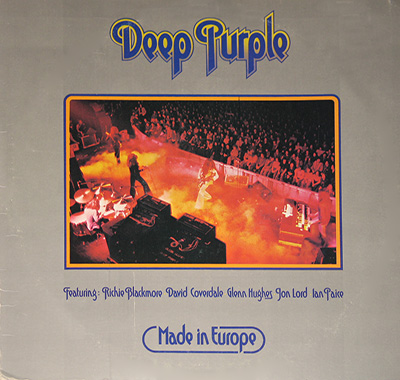
Deep Purple, the iconic pioneers of hard rock and heavy metal, etched their name in rock history with their powerful live album, "Made in Europe". Originally released in the United States as a 12" vinyl LP in 1976, this record captures the sheer energy and musical prowess of the band during their electrifying performances in Austria, Germany, and France in April 1975.
The USA release of "Made in Europe" features a captivating cover design, with the album housed in a classic 12" sleeve. The artwork sets the stage for the live recordings contained within, enticing listeners to embark on an exhilarating sonic journey.
Recorded live with the esteemed "Rolling Stones" Mobile Truck, the album showcases Deep Purple at the pinnacle of their musical prowess. The band's lineup at the time boasted the extraordinary talents of Ian Gillan on vocals, Ritchie Blackmore on guitar, Jon Lord on keyboards, Roger Glover on bass, and Ian Paice on drums. This formidable lineup delivered a transcendent performance that night.
The engineering of "Made in Europe" was skillfully handled by Mick Mckenna, Tapani, and the renowned Martin Birch. Birch, known for his work with bands like Black Sabbath and Rainbow, brought his expertise to the mixing process, ensuring that the album captured the essence of Deep Purple's live sound. The result is a dynamic and immersive mix that transports listeners to the front row of the concert hall.
The album's mixing duties were shared by Ian Paice, the band's exceptional drummer, alongside Martin Birch. Their collaboration resulted in a meticulously crafted mix that allows each instrument to shine, highlighting the virtuosity of every band member. The careful balance and attention to detail create an immersive listening experience that truly captures the essence of Deep Purple's live performances.
Released in 1976, the USA edition of "Made in Europe" showcases the band's live performances from the previous year. The album encapsulates the sheer power and intensity of Deep Purple's shows during this period, providing a glimpse into their stage presence and the unbreakable bond they shared with their audience.
Although the album was released in the USA, its impact extended far beyond national borders. Deep Purple's music resonated with fans worldwide, transcending geographical boundaries and cultural barriers. "Made in Europe" stands as a testament to their universal appeal, showcasing their ability to captivate audiences across continents.
With its release in the United States, "Made in Europe" added yet another significant milestone to Deep Purple's illustrious discography. The album exemplifies the band's commitment to delivering unforgettable live performances, highlighting their improvisational skills and the raw energy that made them a force to be reckoned with on stage.
"Made in Europe" stands as a testament to Deep Purple's enduring legacy and their indelible impact on the world of rock music. The live recordings on this album immortalize a band at the height of their powers, allowing fans to relive the magic of Deep Purple's live shows and introducing new listeners to their unrivaled musicianship.
Whether you're a dedicated Deep Purple enthusiast or a casual listener seeking to explore their live sound, "Made in Europe" offers an exhilarating musical journey. From Ritchie Blackmore's scorching guitar solos to Ian Gillan's commanding vocals, this album encapsulates the essence of Deep Purple's live performances, solidifying their status as true icons of rock.
Record Label: Warner Records 1976, PR 2995, Made in USA
Vinyl Collector's Information/Trivia:
Most of the pressing of this album come out of Europe, this is the actual rare to get USA pressing
UK September 1976 Purple Records TPSA-7517 (1a062-98181) [1LP]
US September 1976 Warner Bros [1LP]
Japan September 1976 Warner Bros P-10262W [1LP]
France October 1976 Purple Records C062-98181 [1LP]
Germany October 1976 Purple Records 1c064-98181 [1LP]
UK 1976 Purple Records TPSA-7517 (0c062-98181) [1LP; with faces on label]
South Africa 1976 Purple Records TPSAJ(D) 7517 [1LP]
Italy 1976 Purple Records 3c064-98181 [1LP]
Sweden 1976 Purple Records 7c062-98181 [1LP]
AMERICA : Warner Brothers PR 2995 : 1976 SS
JAPAN : Warner Brothers P 10262 : November 25. 1976
|
Transcript of the liner notes:
Deep Purple, whether with Rod Evans and Nick Simper, Ian Gillan and Roger Glover or David Coverdale and Glenn Hughes, were always a guarantee of first-class heavy rock.
Over the years, the band went from strength to strength — from a group of relative unknowns who recorded a single called Hush, to the album In Rock with its Child In Time silver-throated screamings, to a group of superstars pumping out the Smoke On The Water anthem. While the constant factor of the band, the three-man nucleus of Richie Blackmore-Jon Lord-Ian Paice, remained together and the original essence of the band was maintained, class music was assured. More than most, these three managed to create a new standard, a new dimension in an area of music which had, up until Deep Purple’s formation, been both raw and formative.
This album, also featuring Coverdale and Hughes, compiled from recordings of three European concerts in early 1975, represents Richie Blackmore’s very last musical contributions to the band — the tracks recorded at the Paris Olympia stemming from his final concert. His departure broke up the all-powerful guitar-keyboards-drums triumvirate and, to many fans, things were never the same again. This album could well represent an epitaph, a final testimony to the greatness that the name Deep Purple implied.
With the various members of the band now pursuing solo projects, it is unlikely that the same line-up will ever appear on stage again. Savour these tracks at maximum volume — here, at last, is a real chance to come taste the band.
Geoff Barton and Pete Makowski
|
Record Label:
Warner Bros PR 2995
|
Album Production:
Deep Purple recorded live on 4th April 1975 in Graz, Austria, on 5th April 1975 in Saarbrücken, Germany, and on 7th April 1975 in Paris with the "Rolling Stones" Mobile Truck.
Engineered by Mick Mckenna, Tapani and Martin Birch.
Martin Birch – Producer, Sound Engineer
I first noticed Martin Birch on those early Iron Maiden sleeves—the ones with the typography that felt like a threat. At twelve, I didn’t care about "production value"; I just liked that the guitars didn't sound like mud. He was the man behind the sound mixer, the one who made the snare snap like a dry branch in a cold forest. He was "The Headmaster," and we were all just students of his high-voltage curriculum.
Read more...
Birch didn’t just record noise; he organized aggression. By 1972, he was already wrangling the messy brilliance of Deep Purple’s Machine Head, turning Ian Gillan’s banshee wails into something that didn't just clip the tape but lived inside it. In 1980, he pulled off the ultimate renovation, giving Black Sabbath a much-needed shower and a new spine. Heaven and Hell shouldn't have worked, but Martin polished that Birmingham sludge into something operatic and gleaming. It was a pivot that felt like fate, mostly because he refused to let the mid-range get lazy.
Then came the long, obsessive stretch with Iron Maiden from 1981 to 1992. It was a twelve-year marriage to the fader. From the moment Killers (EMC 3357, for those who care) hit the shelves, the sound was physical. He knew how to let Steve Harris’s bass clatter like a machine gun without drowning out the melody—a sonic miracle that still feels fresh. You can almost smell the ozone and the dust on the Marshall stacks when the needle drops on The Number of the Beast. He stayed until Fear of the Dark, then simply walked away. No victory lap, no bloated memoir. He preferred the hum of the desk to the noise of the crowd, leaving us with nothing but the records and a slight sense of abandonment. But then, when you’ve already captured lightning on tape for twenty years, why bother hanging around for the rain?
Mixed by Ian Paice and Martin Birch.
Album Cover Design: Phil Duffy/Cream
All Photos by: Fin Costello
Fin Costello – Art Direction, Photography
Fin Costello is the guy behind the lens who made loud bands look even louder—caught mid-stride, mid-sweat, mid-myth. I always pay extra attention when his photos are printed on album covers and inner sleeves.
Read more...
Fin Costello hit my radar the way the best photographers do: not with a signature, but with a feeling. You’re staring at a sleeve and suddenly you can hear the room. Hot lights. Hair stuck to foreheads. That thin layer of sweat that says the set is only halfway done.
He comes out of late-1960s London photojournalism—learn the craft fast, get close, don’t ask the moment to repeat itself. And when the rock caravan starts dragging its cables across Europe, he’s already in the right place. Deep Purple (1972–1975) looks like volume you could measure with a broken window. Rainbow (1975–1977) looks sharper, richer, a little more dangerous in the fantasy costume. Then Ozzy Osbourne (1980–1983) arrives like a headline that won’t calm down.
The thing I like is that Costello doesn’t “capture legends.” He catches people working. There’s a difference. Legends pose. Working musicians forget you’re there—until the flash reminds them, and even then he’s already moved on.
|



.jpg)