Rolling Stones – Their Satanic Majesties Request 12" Vinyl LP Album

- The day the Stones ditched the blues and chased the cosmos

Album Front Cover Photo of Rolling Stones – Their Satanic Majesties Request Visit: https://vinyl-records.nl/

The Rolling Stones' 1967 psychedelic rock masterpiece, "Their Satanic Majesties Request" (catalog number: Decca TXS 103), marked a departure from their usual sound. Encased in a captivating gatefold cover, the album's title cleverly references British passports. This avant-garde venture showcases the band's experimental spirit within the dynamic cultural landscape of the time, making it a timeless and innovative contribution to the musical tapestry of the late 1960s.

Table of Contents

"Their Satanic Majesties Request" (1967) Album Description:

The Rolling Stones made Their Satanic Majesties Request as a loud, risky left turn in 1967: a psychedelic rock album that treats the studio like a playground, a weapon, and a smoke machine all at once. Chanting choruses, Mellotron fog, oddball instruments, and long-form detours replace the band’s usual blues bite, while self-production puts every bizarre choice firmly on their shoulders. This is the Stones trying to sound like the future, even when the future is messy.

Britain in 1967: when pop went technicolor and politics stayed gray

Britain in 1967 is “Swinging London” on the posters and a pressure cooker underneath: youth culture exploding, class rules bending, and the press watching every famous haircut like it’s a national emergency. Psychedelia isn’t just a sound here, it’s a cultural argument about freedom, taste, and who gets to be weird in public. Rock bands are suddenly expected to be artists, philosophers, and headline generators, sometimes all before dinner.

The genre climate matters because the market is primed for left turns: the same year sees big-budget studio imagination become a competitive sport. The Beatles have already dragged pop into a new “album as a world” mindset, Pink Floyd are pushing London psychedelia into the underground, and Jimi Hendrix is rewriting what a guitar can do in real time. In that context, a straight blues-rock Stones album would have looked like yesterday’s newspaper.

The sound: psychedelic rock with a studio-first attitude

The record’s core move is atmosphere over swagger: layered vocals, strange textures, and a constant sense that the walls of the song can move if the band wants them to. Tracks like Sing This All Together lean into chant and communal vibe, while 2000 Light Years from Home goes full space-trip with thick Mellotron haze. Even when a song is catchy, the production keeps nudging it toward the surreal.

The long suite Sing This All Together (See What Happens) is the clearest statement of intent: it stretches, wanders, changes scenes, and hides a coda titled “Cosmic Christmas.” That’s not a normal rock-band flex; that’s a studio collage flex. The album is built less like a set of singles and more like a sequence of rooms you walk through.

Who did what: the people behind the noise

The production credit is blunt: “Produced and Arranged by The Rolling Stones.” That means the band owns the experiment, the pacing, the detours, and the decision to lean into a psychedelic identity instead of playing it safe. The album feels like five people arguing inside a control room and then pressing “record” anyway, which is exactly the energy 1967 rewarded.

Glyn Johns gets the engineer line, and that’s not decoration on a record this dense. Capturing chants, odd instruments, and layered takes without turning the result into mush is the unglamorous hard part, and the mixes still need punch to keep the songs from evaporating. The sleeve credits point directly to Olympic Studios and Bell Sound, which reads like a transatlantic workflow: different rooms, different gear, one shared mission to bottle the chaos.

Nicky Hopkins is thanked for piano, and that thank-you carries weight because his kind of playing adds structure without bulldozing the vibe. Brian Jones’ instrument list is basically a psychedelic toolkit: Mellotron, organ, recorder, electric dulcimer, concert harp, plus backing vocals and percussion. The color palette of the album is not accidental; it’s built by choices like that.

The band situation: big fame, shifting roles, and a lot of pressure

The Rolling Stones are already a major British institution by 1967, but the internal balance is changing and the record shows it in how roles blur. Mick Jagger and Keith Richards dominate the songs and singing credits, while Bill Wyman gets a rare author-and-lead-vocal moment on In Another Land. That track even ends with a recording of Wyman snoring, which turns a band LP into a tiny slice of private absurdity.

Guest voices appear in the album’s orbit too: John Lennon and Paul McCartney are noted on backing vocals for Sing This All Together. That kind of cameo says something specific about the year: rivalry exists, sure, but the scene is small enough that the biggest names can drift into each other’s sessions. The album’s sound is not just “the Stones,” it’s the London psychedelic ecosystem leaning in.

Controversy and confusion: the title, the mood, and the timing

The title is a headline by itself: Their Satanic Majesties Request is a cheeky riff on the wording used on British passports, and that joke lands right on a cultural fault line. In a Britain still allergic to public scandal, dropping “Satanic” on the sleeve is guaranteed to make someone clutch pearls, call it decadent, and then buy it anyway to “investigate.” The album arrives during the peak of psychedelic imagery, when provocation and art are basically roommates.

Confusion was part of the release story too: fans expecting lean blues-rock get chants, orchestral color, and strange detours, while critics argue over whether the band is chasing trends or chasing genuine curiosity. The sleeve itself, with Michael Cooper credited for design and photography and additional illustration credited to Tony Meeuwissen, signals that presentation is part of the statement. This isn’t “just songs,” it’s an attempt to build a whole world and dare the listener to live in it for forty minutes.

Quick map: what shows up on the sleeve credits
  • Producer & Arrangers: The Rolling Stones
  • Engineer: Glyn Johns
  • Studios named: Olympic Studios and Bell Sound Studios
  • Design & photography: Michael Cooper
  • Back cover illustration: Tony Meeuwissen
  • Special thanks: Headley Grange and Hasselblad Studio
  • Publishing: Gideon (BMI)

A psychedelic album lives or dies on whether the weird parts feel intentional. Here, the weird parts feel like the point.
References

Album Key Details: Genre, Label, Format & Release Info

Music Genre:

English Psych Acid Prog Rock

A late-1960s blend of English psychedelia, acid rock experimentation, and early progressive ambition, marked by studio trickery, orchestral colors, and a deliberate break from straight blues-based rock.

Label & Catalognr:

Decca – Cat#: TXS 103

Album Packaging

Gatefold/FOC (Fold Open Cover) album cover design with artwork and photos printed on the inside cover pages.

Media Format:

Record Format: 12" LP Vinyl Stereo Gramophone Record
Total Weight: 280g

Release Details:

Release Date: 1967

Release Country: Made in Germany

Production & Recording Information:

Producers:
  • The Rolling Stones – Producer & Arrangers

    Self-producing here means no safety rails: the band steers every swirl, clash, and cosmic left turn on this album.

    The Rolling Stones, the producer credit on this album is the sound of a band calling every shot: pushing arrangements into full psychedelic theatre, deciding where the haze thickens, where the rhythm snaps back into focus, and how far the studio can be treated like an instrument. “Produced and Arranged by The Rolling Stones” is not a polite formality here; it is the mission statement behind the record’s collage of chants, strange textures, and deliberate detours away from straight rock & roll.

Sound & Recording Engineers:
  • Glyn Johns – Recording Engineer

    The steady hand behind the glass, keeping the album’s technicolor chaos recorded with shape, punch, and actual oxygen.

    Glyn Johns, the engineering credit matters on a record like this because the songs keep shape-shifting: chants dissolve into sound effects, instruments trade costumes mid-track, and the mix has to stay musical without sanding off the weird. That “Engineer” line pins Johns directly to the capture and control-room decisions that let the album feel expansive instead of messy.

    Engineered at Olympic Studios and Bell Sound.
Recording Location:

Olympic Studios and Bell Sound Studios

  • Olympic Studios – Recording Studio

    One of the key rooms where the album’s sounds were captured and shaped, with the engineering credit explicitly pointing here.

    Olympic Studios, the London end of this album’s studio footprint, is named right in the engineering credit, which tells the story: performances and overdubs that needed clarity, depth, and that big-room presence were handled in a place built for serious recording. The record’s layered feel depends on spaces like this that can hold a band, a pile of odd instruments, and a mountain of ideas without collapsing into mud.

  • Bell Sound Studios – Recording Studio

    The New York counterpart in the engineer credit, adding another set of rooms and tools to the album’s already wide sonic canvas.

    Bell Sound Studios, the other location explicitly named in the engineering credit, signals that parts of the album’s recording work were handled in New York as well. That matters because this record leans hard on studio craft: the same tracks can feel intimate one moment and hallucinatory the next, and a facility like Bell Sound is part of how those textures make it onto tape with definition instead of fuzz.

Album Cover Design & Artwork:
  • Michael Cooper – Album design and photography

    The visual architect of the album’s “you sure about this?” packaging mood: part art project, part controlled explosion.

    Michael Cooper, credited with design and photography here, is a major reason this album arrives like a psychedelic artifact instead of a normal LP. The cover concept, the band imagery, and the overall look-and-feel are built to match the record’s studio delirium: bold, crowded, and intentionally strange, like the sleeve is already playing music before the needle even drops.

  • Tony Meeuwissen – Back cover illustration

    The back cover gets its own visual punctuation mark: illustration that helps the package feel curated, not accidental.

    Tony Meeuwissen, credited for the back cover illustration, adds a separate visual voice that complements Cooper’s photography. That split between photo-reality and illustration fits the album perfectly: half rock band, half kaleidoscope, with the sleeve acting like an extra track that keeps the weirdness going even after Side Two ends.

  • The Rolling Stones, Michael Cooper, and Archie – Cover photo construction

    That “built” credit is the giveaway: the cover wasn’t just shot, it was assembled like a set for a psychedelic stage play.

    The Rolling Stones, Michael Cooper, and Archie, the cover credit here spells out the hands-on method: the imagery was constructed, not merely photographed. That practical build-work is part of why the sleeve feels tactile and deliberate, like an object made with scissors, glue, lights, and attitude rather than a quick studio snapshot.

    Pictorial Productions, Mount Vernon, New York.
Additional Production Credits & Notes:

Songs and singing by Mick Jagger and Keith Richards. (“In Another Land” written and sung by Bill Wyman.)

Thanks to Nicky Hopkins for piano contributions.

Strings on “She’s a Rainbow” arranged by F. P. Jones.

Additional brass arrangements and contributions by various musicians.

Special thanks to Headley Grange and Hasselblad Studio.

Published by Gideon (BMI).

Credits Spotlight:
  • F. P. Jones – Strings on “She’s a Rainbow”

    The string color that turns one of the album’s sweetest moments into full-on widescreen pop psychedelia.

    F. P. Jones, credited here for the strings on “She’s a Rainbow,” supplies the orchestral lift that makes the song bloom. That arrangement is the difference between a good tune and a proper psychedelic daydream: the strings don’t just decorate, they widen the emotional frame and make the chorus feel like it’s glowing.

  • Headley Grange – Special thanks

    A named “thank you” usually means something real happened there: help, access, space, support, or all of the above.

    Headley Grange is a Victorian-era country house in Hampshire, England, famous as a rented rural retreat where rock bands recorded and wrote in the 1970s. Its big rooms and isolation suited mobile studios, giving records a roomy, natural sound. Think of it as a creative hideout, not a label office, home to Led Zeppelin sessions.

  • Hasselblad Studio – Special thanks

    A nod toward the photographic side of the project, where image-making mattered almost as much as the music.

    Hasselblad Studio, thanked right alongside Headley Grange, points to the album’s heavy emphasis on visuals and presentation. The sleeve is not an afterthought here; it’s part of the album’s identity, and credits like this read like a wink toward the photographic craft that helped the whole package land.

  • Gideon (BMI) – Publishing

    The unglamorous but essential part: making sure the songs are formally handled and properly published.

    Gideon (BMI), credited as the publisher, is the administrative spine behind the songs: rights, registration, and the paperwork that turns recordings into properly managed works. Not the stuff that makes the hair on your neck stand up, but absolutely the stuff that keeps a catalog alive and accounted for.

Band Members / Musicians:

Band Line-up:
  • Mick Jagger – Vocals, Backing Vocals, Percussion

    The ringmaster of the psychedelic circus, keeping the songs human while everything around him melts.

    Mick Jagger, the voice that makes this album feel like a band record instead of a science-fair experiment, rides the weirdness without letting it swallow the songs. Lead vocals, backing vocals, and percussion credits here translate to presence: chants, sneers, sing-along hooks, and those little rhythmic nudges that keep even the most kaleidoscopic passages from drifting into abstract fog.

  • Keith Richards – Electric Guitar, Acoustic Guitar, Electric Bass, Backing Vocals

    Half pirate, half architect, supplying the riff-bones and even grabbing the bass when the trip demanded it.

    Keith Richards, the album’s grit dealer, threads electric and acoustic guitar through arrangements that keep trying to levitate. The extra electric bass credit matters because this record is full of shifting roles and studio gymnastics; the low-end is part of the architecture, and Richards helps hold the structure together while still sounding like he’s smirking at the whole idea of “structure.”

  • Brian Jones – Organ, Mellotron, Recorder, Electric Dulcimer, Concert Harp, Backing Vocals, Percussion

    The colorist of the band, spraying exotic instruments across the tracks like sonic paint splatters.

    Brian Jones, the resident alchemist, turns this album into a cabinet of curiosities by stacking organ, Mellotron, recorder, electric dulcimer, and even concert harp into the Stones’ usual frame. Those credits are the album’s atmosphere in plain text: the Mellotron haze on tracks like “Citadel” and “2000 Light Years from Home,” the odd timbres that make “Gomper” and “On with the Show” feel like they wandered in from a different dimension, and the extra backing vocals and percussion that thicken the psychedelic crowd-noise.

  • Bill Wyman – Bass, Vocals, Backing Vocals, Percussion

    Quietly anchoring the madness, then stepping out front for “In Another Land” and leaving the snore heard round the world.

    Bill Wyman, the low-frequency glue, keeps the album from floating away completely, even when the arrangements start hallucinating. Bass and percussion sit underneath the swirl, while the vocal credit becomes a real plot twist: “In Another Land” is his song and his vocal, complete with that infamous snoring coda that turns a band LP into a weirdly intimate little film scene.

  • Charlie Watts – Drums, Percussion

    Jazz-bred restraint keeping the whole thing from floating completely off into space.

    Charlie Watts, the calm center of the storm, makes the album’s strangest corners feel grounded just by placing the beat like a grown-up. Drums and percussion here are less about showing off and more about control: steady time through shifting textures, crisp punctuation under the chants, and a quiet authority that stops the record from turning into pure studio smoke.

Additional Musicians & Guests:
  • Nicky Hopkins – Piano

    The kind of pianist who makes a band sound richer without ever stealing the spotlight (which is basically a superpower).

    Nicky Hopkins, I first clocked you as that ghost in the grooves: the classy, lightning-fingered English piano that suddenly makes a rock track feel like it grew up, got a suit, and learned some manners. You cut your teeth in the London scene in the early-to-mid 1960s (including a serious run with The Kinks from roughly 1964 into the late 1960s), then became essential to The Rolling Stones across their late-60s and 70s peak (notably the studio years from 1967 through the early 1980s, plus the big touring stretch around 1971–1973). You also did time with the Jeff Beck Group in 1968, jumped across the Atlantic for Quicksilver Messenger Service around 1970–1971, and later rode the long, strange road with the Jerry Garcia Band in the mid-to-late 1970s (around 1975–1978). Add in the high-grade cameo work with The Who, The Beatles, and a ridiculous list of others, and the pattern is obvious: when a record needed elegance, bite, and momentum all at once, your name quietly appeared in the credits like a wink to the people paying attention.

  • Anita Pallenberg – Vocals

    A notorious face of the era drifting into the sessions, adding a little extra haze to the vocal collage and as much as a walking weather system that rolled into their universe and rearranged the furniture.

    First stop: Brian Jones (1965–1967). She meets the band in 1965, clicks with Jones, and suddenly the Stones’ orbit has this sharp, glamorous, art-scene gravity pulling at it. The relationship ends in 1967 after a Morocco trip where, by her own account, Jones became violent and Richards intervened and got her out of there. That’s the pivot point: the romance goes from “beautiful mess” to “get out now.”

    Then comes the long main event: Keith Richards (1967–1980). She moves in with him, and for over a decade they’re basically the outlaw royal couple of the Stones’ golden-era chaos. Not just arm candy—she’s there for the day-to-day reality of a band that’s permanently half-recording, half-escaping, with three kids in the middle of it: Marlon (born 1969), Angela (born 1972), and Tara (born 1976, died as an infant). It’s the kind of domestic detail that makes the whole mythology feel less like a poster and more like a life with sharp edges.

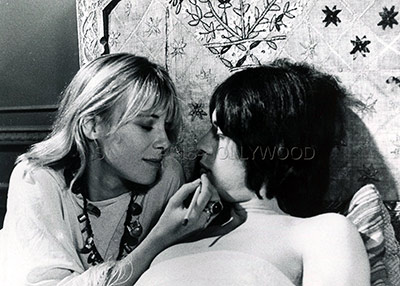
    Now the juiciest “maybe” in the Stones soap opera: Mick Jagger. During the film Performance (shot in 1968, released in 1970), Pallenberg is in that same creative furnace with Jagger, and rumors have circulated for decades that something happened. Richards himself claimed in his autobiography that it did; other accounts treat it as rumor, which is journalist-speak for “everybody whispers, nobody notarizes.” Either way, it’s part of the era’s weird chemistry: the lines between art, sex, ego, and competition were basically drawn in disappearing ink.

    Anita Pallenberg painting Mick Jagger's lips while in bed

    Anita Pallenberg painting Mick Jagger's lips while in bed.

    So yeah: she’s linked romantically to Jones and Richards for sure, and she’s linked to Jagger in that classic Stones way—half documented, half legend, fully messy. If the band is the soundtrack, Pallenberg is the scene: the style, the danger, the glare of the flashbulb, and the uncomfortable truth that the “glamour years” were also the “survival years.”

  • John Lennon – Vocals

    A cameo that screams 1967: the rival camp leaning in for backing vocals on “Sing This All Together.”

    John Lennon, the most recognizable voice in another galaxy, is credited here for vocals, and the track note pins it to backing vocals on “Sing This All Together.” The effect is exactly what it should be: not a takeover, not a duet, just that unmistakable presence folded into the chorus like an inside joke shared by the entire London scene.

  • Paul McCartney – Vocals

    Another superstar voice tucked into the blend on “Sing This All Together,” because 1967 had no chill.

    Paul McCartney, credited for vocals, turns up as part of the backing vocal crew on “Sing This All Together,” and the contribution is all about feel rather than spotlight. That’s the fun of it: a global-level pop craftsman slipping into the background to help a Stones chant land with extra weight and a slightly wider grin.

  • Steve Marriott – Backing Vocals, Acoustic Guitar

    A rough-edged talent from the same London oxygen supply, adding backing vocals and acoustic guitar to the album’s crowd-scene feel.

    Steve Marriott, a powerhouse singer and guitarist in his own right, is credited here for backing vocals and acoustic guitar, which fits the album’s “friends in the room” method. The contribution reads like reinforcement: extra voices to thicken choruses and acoustic texture to support the more song-based moments while the rest of the record is busy bending reality.

  • Ronnie Lane – Backing Vocals

    A warm, earthy voice added to the backing-vocal pile, helping the album feel like a communal happening.

    Ronnie Lane, credited for backing vocals, contributes exactly what this record loves: atmosphere created by people, not gadgets. A backing-vocal credit might look small on paper, but on an album built around chants, layered voices, and a sense of “everybody’s here,” that extra human grain is part of the texture that makes the psychedelia feel lived-in instead of sterile.

Complete Track-listing:

Tracklisting Side A:
  1. Sing This All Together (3:46) Guest
    Features guest vocals by John Lennon and Paul McCartney.
  2. Citadel (2:50)
    Brian Jones on Mellotron; Nicky Hopkins on piano and harpsichord.
  3. In Another Land (3:15)
    Written and sung by Bill Wyman; concludes with a recording of Wyman snoring.
  4. 2000 Man (3:07)
    Features Brian Jones on organ.
  5. Sing This All Together (See What Happens) (8:33)
    Extended psychedelic suite containing a hidden coda titled “Cosmic Christmas.”
Video: Sing This All Together (See What Happens) (Remastered 2017 / Stereo) Where is that Joint
Tracklisting Side B:
  1. She’s a Rainbow (4:35)
    Strings arranged by John Paul Jones.
  2. The Lantern (4:23)
    Nicky Hopkins on piano and Mellotron.
  3. Gomper (5:08)
    Brian Jones on electric dulcimer and recorder.
  4. 2000 Light Years from Home (4:45)
    Brian Jones on Mellotron; Bill Wyman on synthesizer.
  5. On with the Show (3:39)
    Brian Jones on Mellotron and concert harp.
Video: Rolling Stones - She's A Rainbow

Disclaimer: Track durations shown are approximate and may vary slightly between different country editions or reissues. Variations can result from alternate masterings, pressing plant differences, or regional production adjustments.

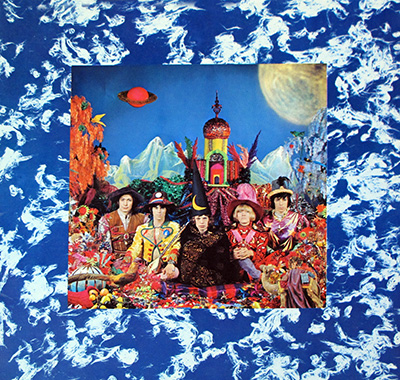
Album Front Cover Photo
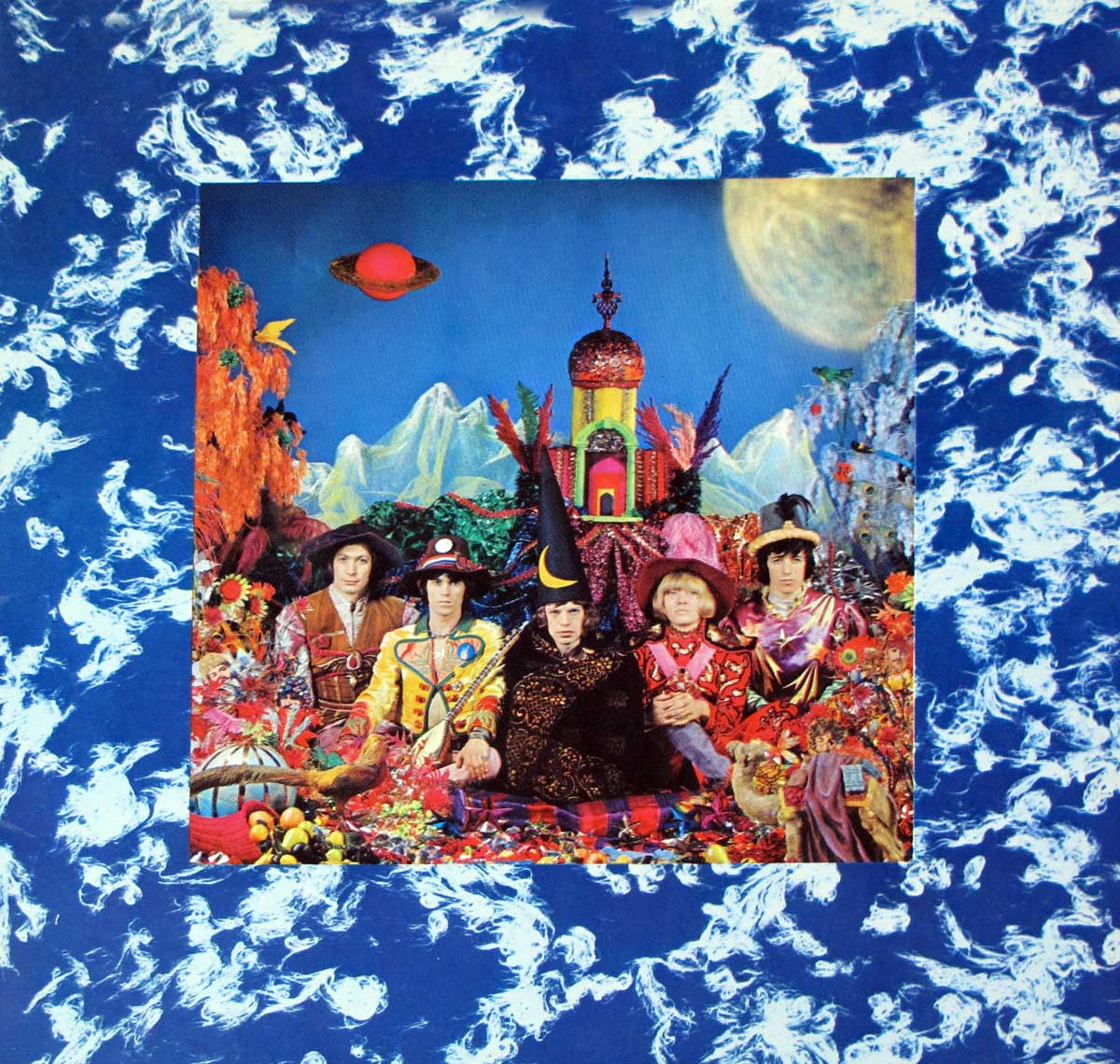
Front cover of The Rolling Stones’ 1967 album Their Satanic Majesties Request, showing the band seated in elaborate psychedelic costumes within a constructed fantasy landscape of mountains, planets, moons, flowers, and miniature figures, framed by a blue flame-like border; a complex, collage-style sleeve design emphasizing excess, color saturation, and late-1960s psychedelic aesthetics important to collectors.

This is the infamous front cover of The Rolling Stones – Their Satanic Majesties Request, a fully staged psychedelic tableau rather than a straightforward band portrait. The five Stones sit shoulder to shoulder, dressed in ornate, theatrical costumes that borrow from fantasy, Eastern motifs, and late-60s counterculture fashion. Each outfit is overloaded with texture: velvet, embroidery, metallic trims, feathers, and exaggerated headwear that instantly marks this as a studio-built scene, not a live moment.

The band is placed low in the frame, seated on a carpeted platform surrounded by miniature props—tiny figures, artificial flowers, fruit, and decorative objects scattered like relics from a psychedelic bazaar. Behind them rises a deliberately fake landscape: painted mountains, an oversized moon, floating planets, and a central domed structure that looks half-temple, half-fairground attraction. Nothing here is naturalistic; every element is visibly constructed, layered, and meant to overwhelm.

Color is doing heavy labor. Deep blues dominate the sky, punched through with reds, yellows, and electric greens. The border surrounding the central image is a separate visual statement: a thick frame of swirling blue-and-white flame or smoke patterns that isolates the scene like a hallucination inside a window. This border is crucial for collectors, as its saturation and sharpness are often the first casualties on worn copies.

From a sleeve-design perspective, this cover is pure 1967 excess. There is no band logo screaming for attention, no clean typography guiding the eye. Instead, the image dares the viewer to linger and decode it. On original vinyl pressings, especially early Decca issues, the texture, color density, and alignment of this composite image are key indicators of print quality and condition.

The overall effect is confrontational and deliberate: the Stones announcing, visually and unapologetically, that this record has abandoned blues grit for full-blown psychedelic theater. For collectors, this sleeve is not just packaging—it is an artifact of a moment when rock bands treated album covers as immersive environments, meant to be studied while the needle stayed in the groove.

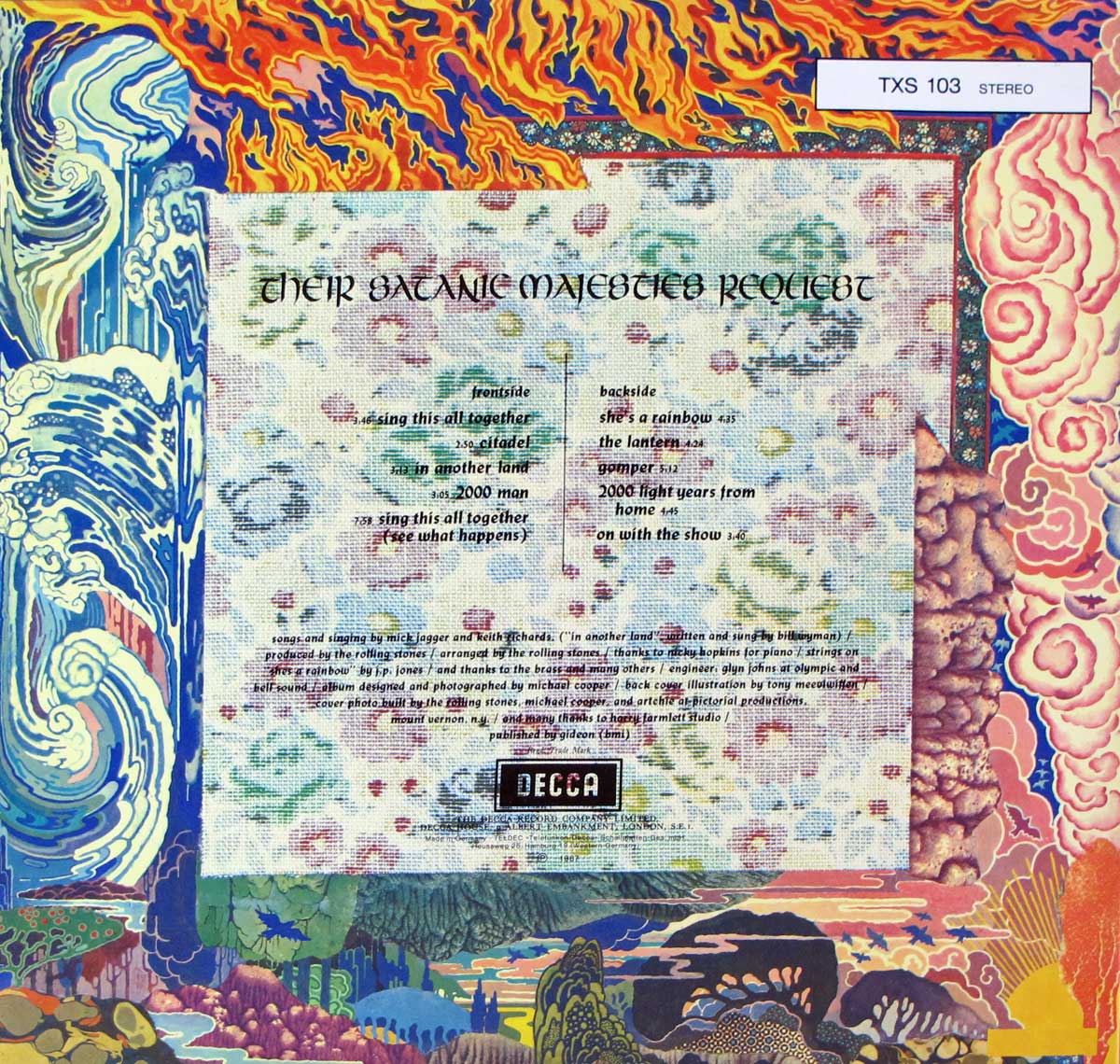
Album Back Cover Photo
Back cover of The Rolling Stones’ 1967 album Their Satanic Majesties Request, showing a central textured panel with handwritten-style track listings for frontside and backside, surrounded by a vivid psychedelic border of flames, clouds, waves, and abstract landscapes, with Decca logo and catalog number TXS 103 visible.

This image shows the back cover of The Rolling Stones – Their Satanic Majesties Request, and it doubles down on the album’s commitment to full psychedelic overload. The entire sleeve is framed by an intense, hand-drawn border bursting with flames, clouds, swirling water, rolling hills, and abstract landscapes. Every edge feels alive, as if the artwork itself is in motion, pressing inward toward the center.

At the heart of the design sits a large, fabric-textured rectangular panel, pale and speckled, resembling woven cloth or coarse canvas. This central block carries the practical information: the album title rendered in a stylized, medieval-leaning psychedelic font, followed by the track listings split into “frontside” and “backside.” The typography is deliberately uneven and organic, prioritizing mood over readability—a choice that perfectly matches the era, even if it makes archivists squint today.

The track list is compact and tightly arranged, with timings printed beside each song. Below it, a dense block of production credits runs across the lower portion of the panel. These credits are small, tightly spaced, and partially swallowed by the textured background, making legibility highly dependent on print sharpness. On clean copies, this area is a key indicator of sleeve condition and printing quality.

Anchoring the bottom center is the Decca logo, printed in black within a rectangular box, grounding the visual chaos with a solid corporate mark. In the upper right corner, the catalog number TXS 103 and Stereo designation appear in a white label box—an important detail for collectors verifying correct editions and pressings.

From a collector’s perspective, this back cover is as important as the front. The saturation of the outer artwork, the clarity of the central text panel, and the alignment of the Decca logo all matter. This sleeve isn’t just a container for music; it’s a dense information map wrapped inside a psychedelic mural, designed to be studied while the record spins and the room tilts slightly sideways.

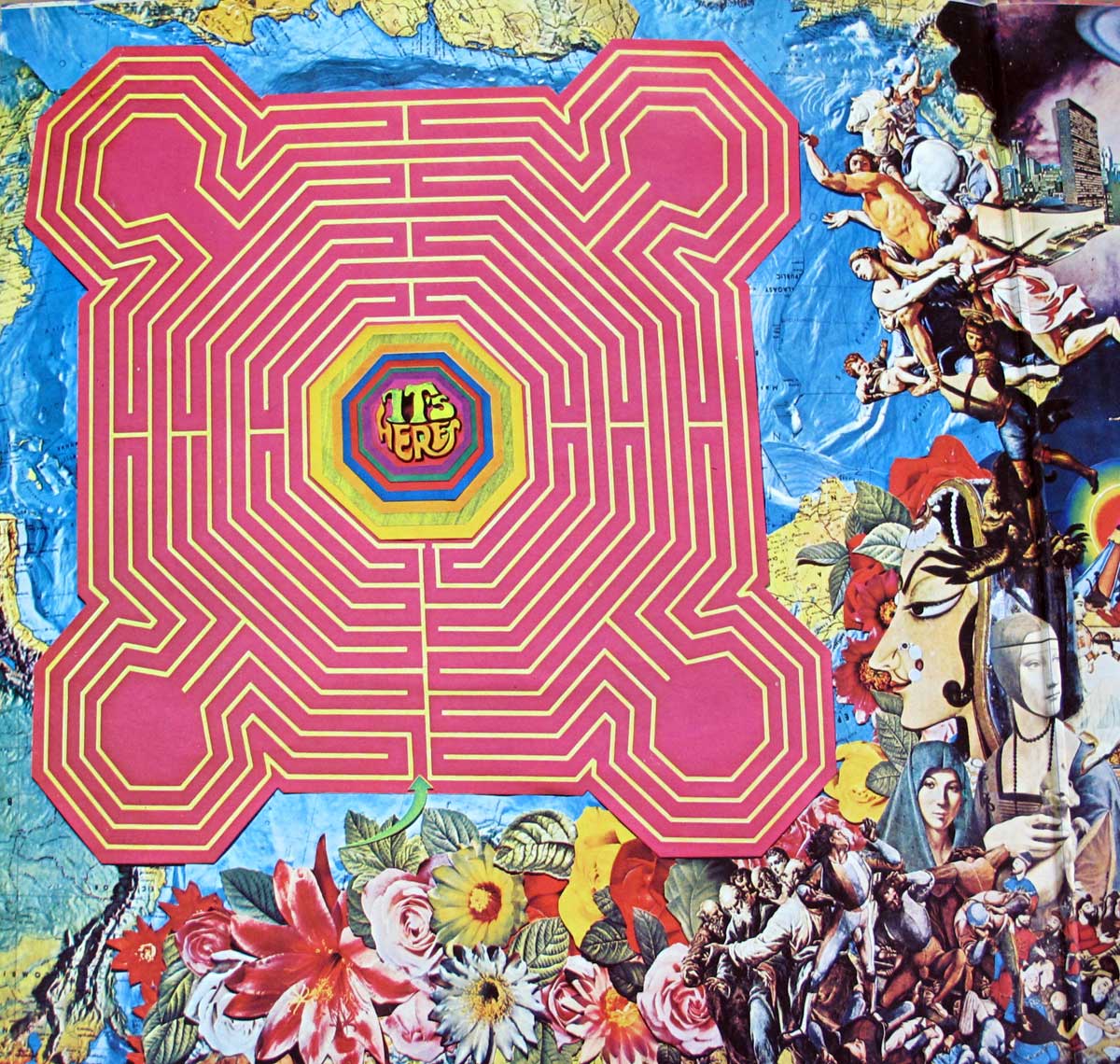
First Photo of Custom Inner Sleeve
Inner gatefold artwork of The Rolling Stones’ 1967 album Their Satanic Majesties Request, dominated by a large pink-and-yellow maze with the words 'IT’S HERE' at the center, surrounded by collage imagery of world maps, classical figures, flowers, and surreal scenes, emphasizing interactive psychedelic design and late-1960s excess.

This image shows one of the most notorious pieces of The Rolling Stones – Their Satanic Majesties Request package: the inner gatefold maze artwork. Front and center sits a massive geometric labyrinth printed in hot pink with sharp yellow pathways, symmetrical and mechanical, almost clinical in its precision. The maze fills most of the frame and instantly demands interaction, pulling the eye inward toward the middle.

At the center of the maze is a multicolored bullseye of concentric rings—green, blue, yellow, and red—surrounding the blunt message “IT’S HERE”. No song title, no band name, just a psychedelic taunt. The maze itself is not decorative filler; it is a playable object, meant to be traced by finger while the record spins, turning the sleeve into a physical extension of the listening experience.

Surrounding the maze is a dense collage that feels ripped from atlases, art books, and Renaissance paintings. Fragments of world maps form the blue-toned background, while clusters of oversized flowers explode along the bottom edge. On the right side, classical figures—angels, warriors, and painted faces—pile into the frame, cropped abruptly, as if history itself has been cut up and pasted into the scene.

From a collector’s perspective, this inner artwork is critical. Color saturation, clean line edges in the maze, and intact folding lines are everything. Any fading, cracking, or paper wear immediately dulls the impact, because this design relies on contrast and precision. On strong copies, the pink remains loud, the yellow stays sharp, and the collage retains its chaotic clarity.

This is peak late-1967 record packaging: interactive, indulgent, and slightly confrontational. The Stones weren’t just releasing music here—they were testing how far an album sleeve could go before it stopped being packaging and became an object you had to sit with, decode, and physically engage.

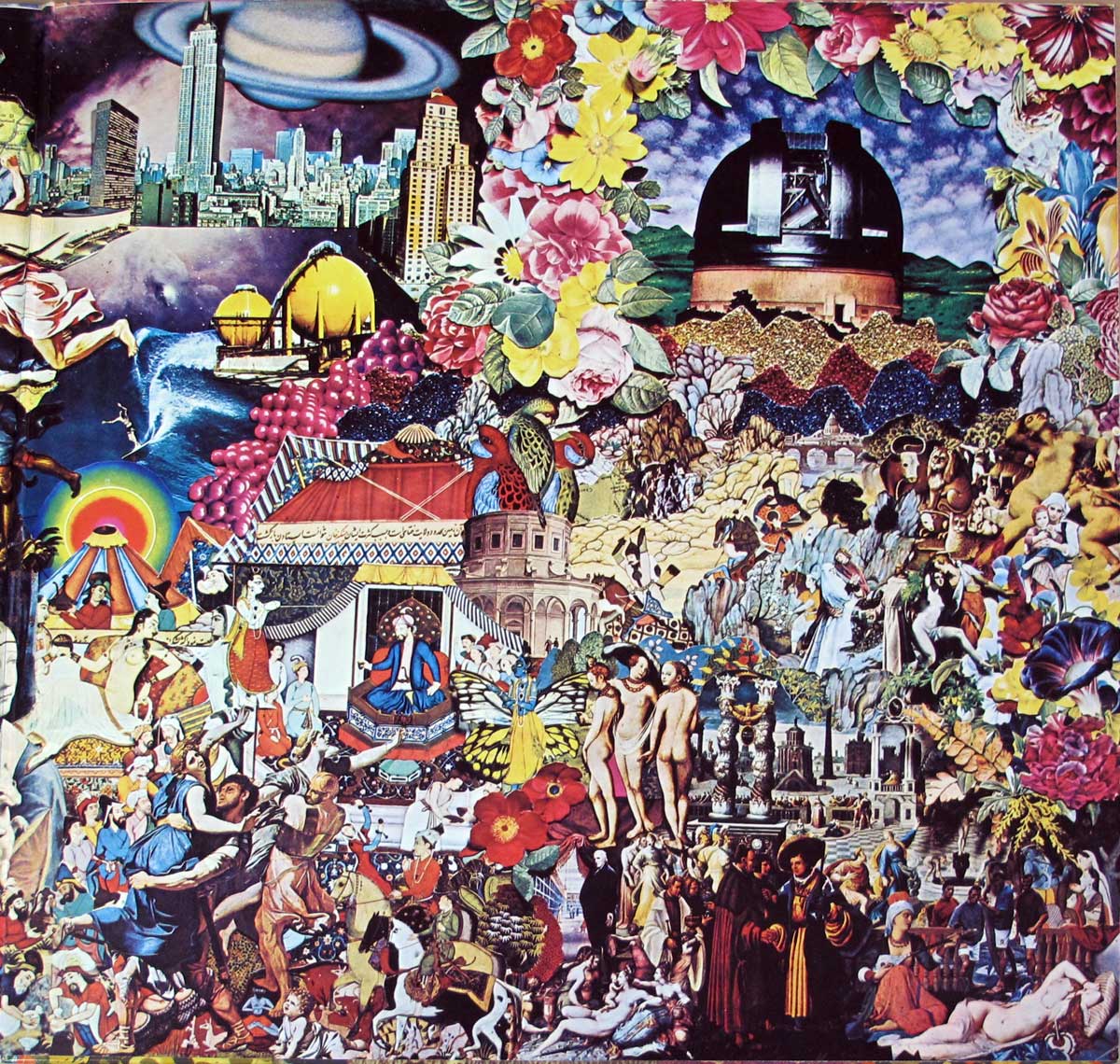
Second Photo of Custom Inner Sleeve
Second inner sleeve artwork from The Rolling Stones’ 1967 album Their Satanic Majesties Request, showing a dense psychedelic collage of classical paintings, naked figures, flowers, animals, city skylines, observatories, planets, and surreal architectural scenes layered tightly across the entire surface, emphasizing excess, visual overload, and late-1960s collage aesthetics valued by vinyl collectors.

This image is the second inner sleeve collage from The Rolling Stones – Their Satanic Majesties Request, and it’s pure visual overload by design. The entire surface is packed edge to edge with cut-up imagery pulled from classical art, illustrated books, travel photography, and surreal fantasy sources. No empty space, no breathing room—every square inch is doing work.

The eye immediately gets dragged across wildly different worlds. Classical figures in flowing robes clash with naked bodies posed like Renaissance studies. Mythological scenes bump shoulders with city skylines, domed observatories, and impossible landscapes. A ringed planet floats above modern skyscrapers, collapsing time and geography into one continuous hallucination. Flowers explode across the frame in unnatural scale, acting like visual glue between unrelated fragments.

Animals, angels, musicians, warriors, and lovers appear mid-action, cropped brutally at the edges. Some figures feel devotional, others erotic, others vaguely threatening. There’s no clear narrative, only accumulation. That’s the point. This sleeve isn’t asking to be “understood”—it’s daring the viewer to keep looking without forming a single, stable interpretation.
From a collector’s standpoint, this inner sleeve is a condition nightmare and a condition tell. Because it’s so dense, fading or color loss jumps out instantly. Strong copies retain deep blues, saturated reds, and crisp cut edges around figures. Soft copies look muddy fast. Creases and ring wear interrupt the collage in obvious ways, which makes clean examples increasingly scarce.

This artwork completes the album’s visual mission statement: total immersion. Music, sleeve, and inner art all operate on the same frequency—overstimulated, confrontational, and proudly excessive. This isn’t decoration. It’s part of the listening experience, meant to sit open on the floor while the record spins and the room tilts just enough to feel intentional.

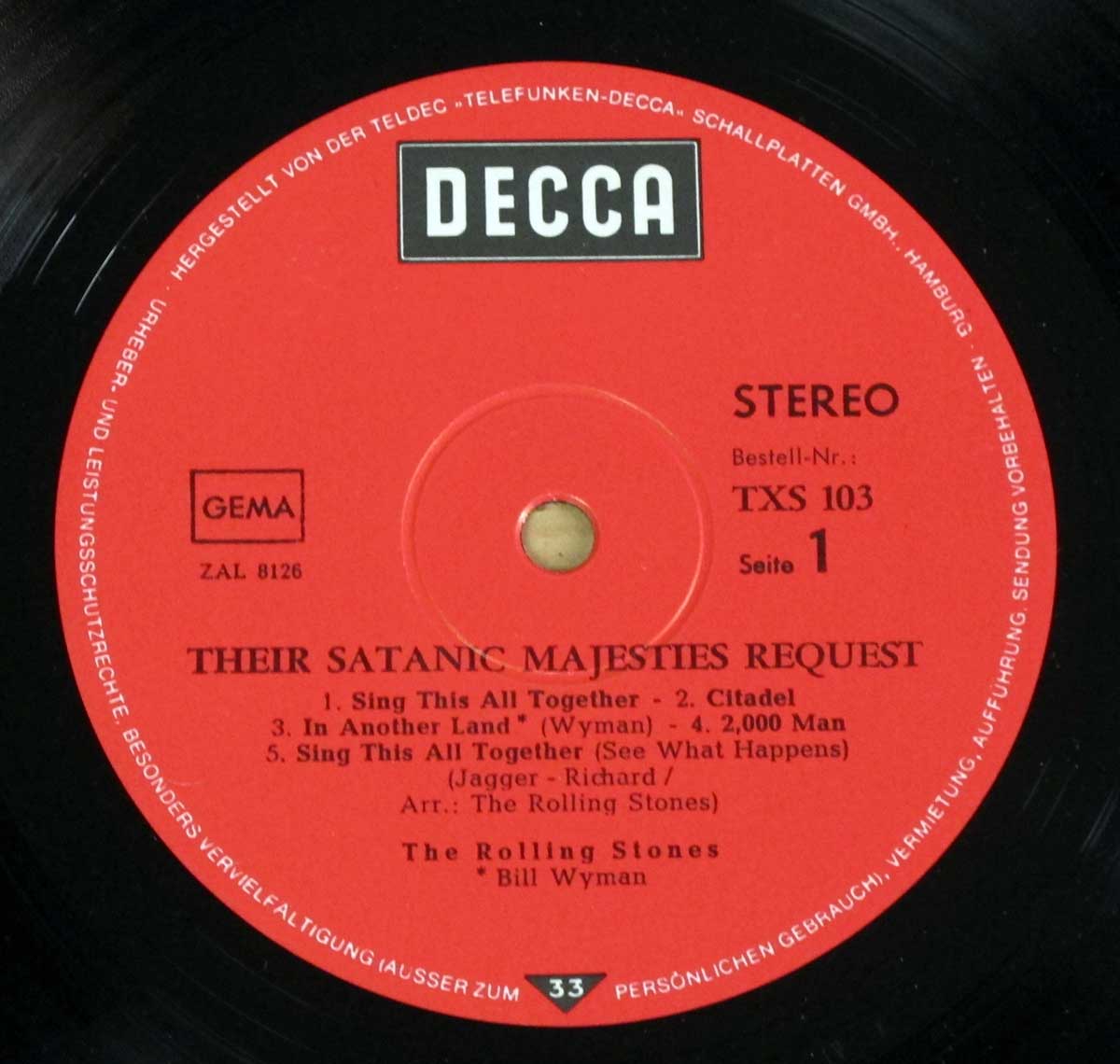
Close up of Side One record’s label
Close-up of the red DECCA stereo label on Side One of The Rolling Stones album Their Satanic Majesties Request, German pressing, showing catalogue number TXS 103, GEMA rights box, and full Side One track listing printed in black text around the center spindle hole

This is the Side One label of the German stereo pressing of The Rolling Stones – Their Satanic Majesties Request, instantly recognizable by its deep matte red DECCA background. The label is clean, uncluttered, and highly legible, with all text printed in black and white, designed to be read easily even under low turntable light.

Dominating the top is the classic DECCA logo: bold white block letters set inside a solid black rectangle. This logo is purely typographic—no illustration, no ornament—used as a stamp of authority. Its function is straightforward: brand identification and trust. By the late 1960s, this logo told buyers they were holding a professionally mastered, mass-market record from one of Europe’s major labels.

To the right sits the STEREO designation and catalogue number TXS 103, confirming this as the stereo issue rather than the mono variant. Below that, Seite 1 clearly marks Side One, following German labeling conventions. The presence of the boxed GEMA logo on the left indicates German performance and mechanical rights management.
The track listing is centered and compact, listing all Side One titles with composer credits where applicable, including Bill Wyman’s authorship of “In Another Land.” At the bottom edge, the 33 inside a triangle confirms the playback speed. Around the outer rim, German-language legal text identifies TELDEC–Telefunken–Decca Schallplatten GmbH, Hamburg, as the manufacturing and distribution company.
From a collector’s standpoint, this label tells the full story: country of manufacture, rights society, speed, format, and catalogue lineage. Clean red color, sharp black print, and an undamaged spindle hole are critical indicators of condition and careful handling on surviving copies.

DECCA, Germany Label

This DECCA label represents the German stereo pressing manufactured and distributed by TELDEC–Telefunken–Decca Schallplatten GmbH in Hamburg. It reflects DECCA’s late-1960s European house style: bold color fields, strict typography, and maximum informational clarity for both retailers and broadcasters. This particular label design was used by DECCA Germany between 1965 and 1970.

Colours
Solid red background with black and white text
Design & Layout
Centered text layout with strong horizontal hierarchy and wide outer rim text
Record company logo
White DECCA wordmark inside a black rectangle, used for brand identification
Band/Performer logo
No band logo present; band name printed as plain text
Unique features
German GEMA rights box, German-language rim text, stereo-only catalogue prefix
Side designation
“Seite 1” printed to the right of center
Rights society
GEMA (Germany)
Catalogue number
TXS 103
Rim text language
German
Track list layout
Centered block beneath album title, numbered sequentially
Rights info placement
Boxed GEMA logo on left side of label
Pressing info
TELDEC–Telefunken–Decca Schallplatten GmbH, Hamburg, in outer rim text
Background image
None; solid color field only

All images on this site are photographed directly from the original vinyl LP covers and record labels in my collection. Earlier blank sleeves were not archived due to past storage limits, and Side Two labels are often omitted when they contain no collector-relevant details. Photo quality varies because the images were taken over several decades with different cameras. You may use these images for personal or non-commercial purposes if you include a link to this site; commercial use requires my permission. Text on covers and labels has been transcribed using a free online OCR service.

The Rolling Stones Vinyl Discography: Album Covers, Descriptions & International Releases (1962-1989)

Over the decennia the line-up of "The Rolling Stones" has been changed several times read the mini-biographies of the best known stones

ROLLING STONES - Aftermath (Decca Records and London Records)
ROLLING STONES - Aftermath (Decca Records and London Records) album front cover vinyl record

The Rolling Stones' "Aftermath" (1966) stands as a pivotal moment in rock history, showcasing the band's songwriting prowess and sonic experimentation. The UK and US versions differ slightly, but both feature classics like "Paint It, Black" and "Under My Thumb."

Aftermath Netherlands Release on Decca Records Aftermath Netherlands Release on London Records )
ROLLING STONES - Around and Around Two different releases
ROLLING STONES - Beggars Banquet Two different releases
 album front cover vinyl record

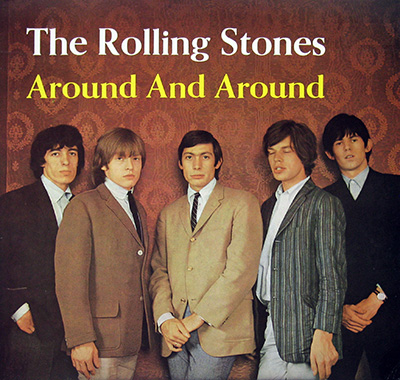
"Around and Around" isn't just another Rolling Stones album, it's a raw, bluesy ride showcasing their early energy. Released in 1964, this LP features covers and originals, capturing the essence of their live shows. Tracks like "It's All Over Now" and the title track prove why they became rock legends.

Around and Around German 1970 Release - Around and Around Holland 1970 Release
ROLLING STONES - Beggars Banquet Two different releases
 album front cover vinyl record

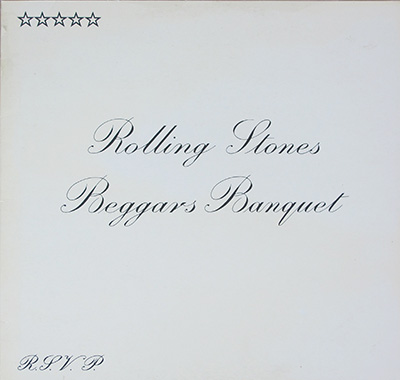
Ah, "Beggars Banquet" from 1968, now that's a landmark release! This album marked a return to the Stones' bluesy roots, but with a darker, more mature edge. You'll find classics like "Sympathy for the Devil" and "Street Fighting Man," showcasing their raw power and social commentary

British release of Beggars Banquet German Release of Beggars Banquet
ROLLING STONES - Between the Buttons (Three Album Cover Variations)
ROLLING STONES - Between the Buttons (Three Album Cover Variations) album front cover vinyl record

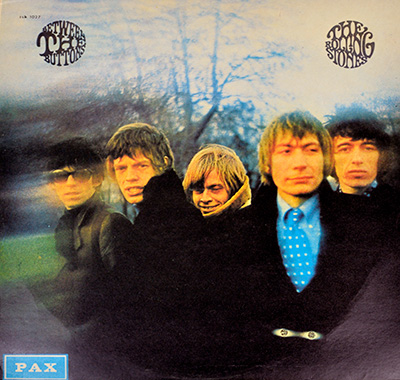
"Between the Buttons," released in 1967, is a fascinating album showcasing the Rolling Stones' creative evolution. It's known for having three distinct album cover variations, each a collector's item in its own right! The music itself blends psychedelia, pop, and their classic rock 'n' roll sound

Between Buttons German Release Between The Buttons Israel Release Between the Buttons West-German Release )
ROLLING STONES - Big Hits (High Tide and Green Grass) (Multiple European Versions)
ROLLING STONES - Big Hits (High Tide and Green Grass)  (Multiple European Versions) album front cover vinyl record

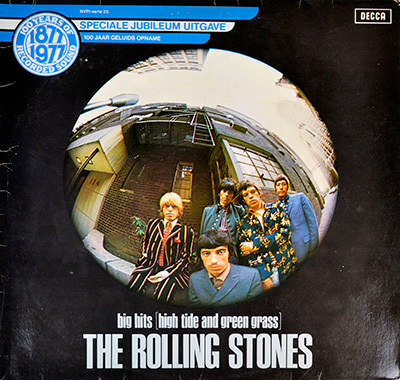
Now, "Big Hits (High Tide and Green Grass)" is a real treat for anyone new to the Rolling Stones or looking for a perfect overview of their early, energetic sound. Released in 1966, this compilation packs a punch with hits like "(I Can't Get No) Satisfaction," "Get Off of My Cloud," and "The Last Time."

Big Hits (High Tide And Green Grass) German Release - Big Hits (High Tide and Green Grass) Israel PAX Record Big Hits (High Tide and Green Grass) Special Edition Netherlands
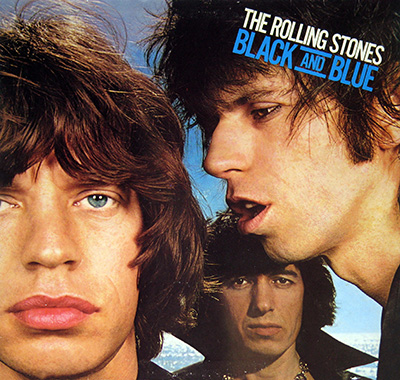
ROLLING STONES - Black and Blue (1976, Holland) album front cover vinyl record
ROLLING STONES - Black and Blue

“Black and Blue” is the Stones at their most unpredictable — part jam, part experiment, all attitude. The songs twist from funk to reggae to bruised ballads, with Jagger in full control and Richards slinging riffs like smoke rings. It’s a strange, swaggering record that captures the sound of a band refusing to fade quietly into the 1970s haze.

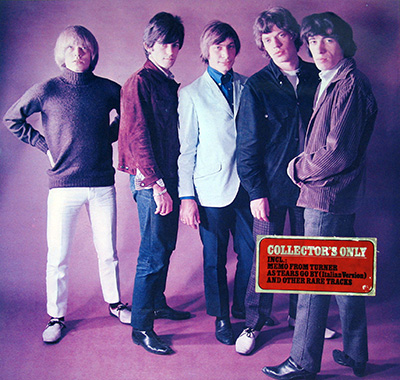
ROLLING STONES - Collector's Only
ROLLING STONES - Collector's Only album front cover vinyl record

DECCA 6.24321 , Year , Made in Germany

The ROLLING STONES - COLLECTOR'S ONLY 12" Vinyl LP Album is a rare find for any music enthusiast. One of the highlights is Mick Jagger showcasing his linguistic skills by singing a song entirely in Italian, adding a unique touch to this already exceptional collector's item.

Collector's Only 12" Vinyl LP
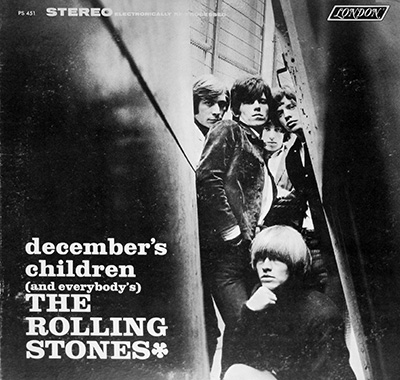
ROLLING STONES - December's Children (and everybody's)
 album front cover vinyl record

London PS 451   , , USA

"December's Children (And Everybody's)" is a pivotal Rolling Stones album, showcasing their evolution from blues covers to original songwriting. Released in 1965, it features hits like "Get Off of My Cloud" alongside R&B-infused tracks and Dylan-esque ballads, capturing the band's raw energy

December's Children (and everybody's) 12" Vinyl LP
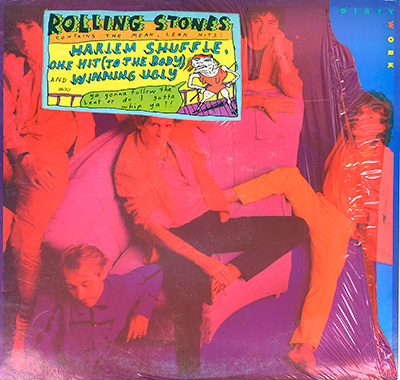
ROLLING STONES - Dirty Work
ROLLING STONES - Dirty Work (1986, Europe) album front cover vinyl record

 Rolling Stones Records – CBS 86321 , 1986 , Europe

"Dirty Work", a 1986 Rolling Stones release, reflects a tense period in the band's history with Jagger/Richards at odds. It's a raw, guitar-heavy album, less polished than their earlier work, but still packs a punch with hits like "Harlem Shuffle" and the defiant "One Hit (To the Body)"

Dirty Work (1986, Europe) 12" Vinyl LP
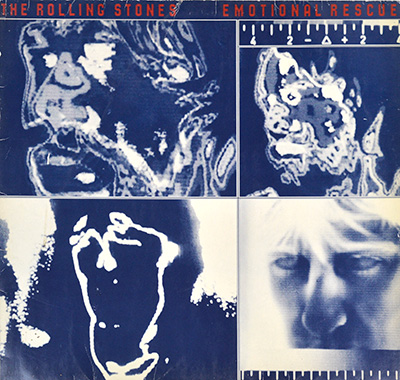
ROLLING STONES - Emotional Rescue (Dutch and German Releases)
ROLLING STONES - Emotional Rescue (Dutch and German Releases) album front cover vinyl record

The Dutch and German pressings of the Rolling Stones' "Emotional Rescue" offer a unique listening experience for vinyl enthusiasts. These 1980 releases boast exceptional audio quality, capturing the album's blend of disco, rock, and ballads with clarity and warmth.

Dutch Release of "Emotional Rescue" incl Poster German Release of "Emotional Rescue"
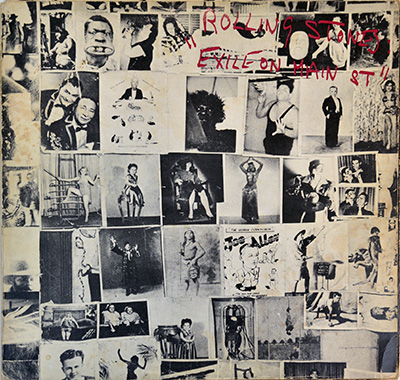
ROLLING STONES - Exile On Main Street
ROLLING STONES - Exile On Main Street (1972, Netherlands)
 album front cover vinyl record

   Rolling Stones Records – COC 69 100 , 1972 , Netherlands

"Exile on Main Street" is the Rolling Stones' gritty, sprawling masterpiece from 1972. This double LP captures the band at their rawest, blending blues, rock, and country influences into a loose, jam-heavy sound. It's a sonic journey through the highs and lows of rock 'n' roll excess, with classics

Exile On Main Street (1972, Netherlands) 12" Vinyl LP
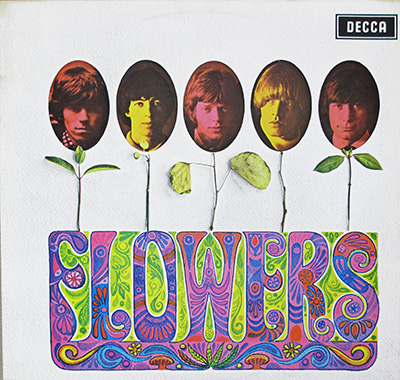
ROLLING STONES - Flowers (Two German Versions)
ROLLING STONES - Flowers (Two German Versions) album front cover vinyl record

The German pressings of the Rolling Stones' "Flowers" offer a unique glimpse into the band's mid-60s output. These 1967 releases compile tracks not included on US albums, featuring hits like "Ruby Tuesday" and "Let's Spend the Night Together."

Flowers - Decca Records Edition Flowers - Royal Sound Edition
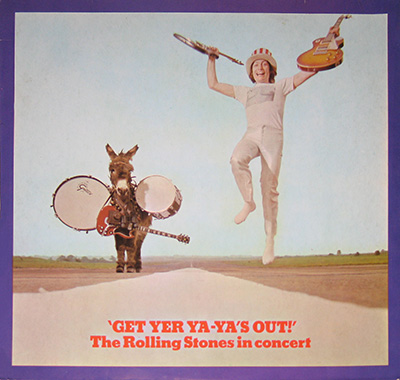
ROLLING STONES - Get Yer Ya-Ya's Out
ROLLING STONES - Get Yer Ya-Ya's Out (1970, France)
 album front cover vinyl record

Decca SKL 5065 (FFSS)   , 1970 , France

"Get Yer Ya-Ya's Out!" is a legendary live Rolling Stones album, capturing their raw energy and bluesy roots in 1969. Featuring electrifying performances of classics like "Jumpin' Jack Flash" and "Sympathy for the Devil," it's considered one of the greatest live rock albums ever.

Get Yer Ya-Ya's Out (1970, France) 12" Vinyl LP
ROLLING STONES - Goats Head Soup
ROLLING STONES - Goats Head Soup (1973, Germany) 
 album front cover vinyl record

COC 59101 , 1973 , Germany

"Goats Head Soup" is a classic Rolling Stones album from 1973, featuring the iconic ballad "Angie." It showcases the band's signature bluesy rock sound with a touch of experimentation, making it a must-have for any vinyl collector.

Goats Head Soup (1973, Germany) 12" Vinyl LP
ROLLING STONES - It's Only Rock and Roll
ROLLING STONES - It's Only Rock and Roll (1974, Germany)  album front cover vinyl record

 Rolling Stones Records COC 59 103 , 1974 , Germany

The Rolling Stones' 1974 album, "It's Only Rock 'n Roll," is a raw and energetic journey through a band in transition. The title track encapsulates their rebellious spirit, a statement of purpose in a changing music landscape. While some tracks stay true to their bluesy roots

It's Only Rock and Roll (1974, Germany) 12" Vinyl LP
ROLLING STONES - Let it Bleed
ROLLING STONES - Let it Bleed (1969, England)  album front cover vinyl record

Decca SKL 5025 FFSS / XZAL 9363 , 1969 , England

"Let It Bleed," released in 1969, is a blues-infused rock masterpiece by the Rolling Stones. This iconic album features raw energy and dark undertones, capturing the turbulent spirit of the late '60s. Tracks like "Gimme Shelter" and "You Can't Always Get What You Want" showcase the band's musical maturity

Let it Bleed (1969, England) 12" Vinyl LP
ROLLING STONES - Made In The Shade
ROLLING STONES - Made In The Shade (1975, Germany) album front cover vinyl record

  COC 59 104 , 1975 , Germany

"Made In The Shade," released in 1975, is a compilation album showcasing the Rolling Stones' iconic hits from the early 1970s. It features essential tracks like "Brown Sugar," "Tumbling Dice," and "Angie," providing a snapshot of the band's peak during that era.

Made In The Shade (1975, Germany) 12" Vinyl LP
ROLLING STONES - No 2 / Vol 2
Thumbnail of ROLLING STONES - No 2 / Vol 2 (1970, Holland)
 album front cover

LONDON 820 673  , 1970 , Netherlands

Released in 1965, "The Rolling Stones No. 2" captures the band's early raw energy and passion for blues and R&B. Filled with electrifying covers and Jagger/Richards originals, it showcases their musical exploration and establishes them as a driving force in the British Invasion.

No 2 / Vol 2 (1970, Holland) 12" LP
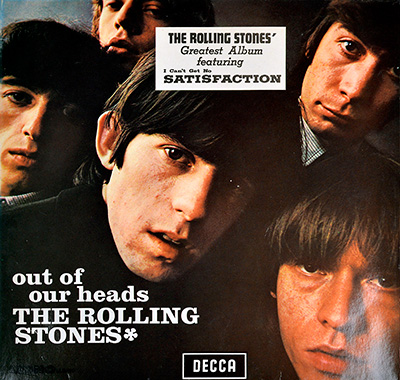
ROLLING STONES - Out Of Our Heads (Netherlands and USA Releases)
Thumbnail of ROLLING STONES - Out Of Our Heads (1965, Netherlands)   album front cover

 Decca – 6835 107 , 1965 , Netherlands

"Out Of Our Heads," released in 1965, showcases the Rolling Stones' evolution. The album's blend of blues covers and Jagger/Richards originals, including their iconic "(I Can't Get No) Satisfaction," perfectly captures their raw energy and rebellious spirit. It's a pivotal record that cemented their place

- Out Of Our Heads (1965, Netherlands) - Out Of Our Heads (1965, USA)
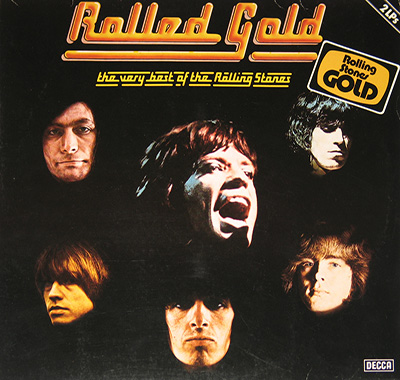
ROLLING STONES - Rolled Gold (German Releases)
Thumbnail of ROLLING STONES - Rolled Gold Decca Records (1975, Germany)
 album front cover

"Rolled Gold," released in 1975, is a classic Rolling Stones compilation featuring their biggest hits from the 1960s and early '70s. It's a perfect introduction for new fans or a nostalgic trip for longtime listeners, showcasing the band's evolution from bluesy rockers to stadium-filling icons.

Rolled Gold on Decca Records, Germany Rolled Gold on Nova Records Germany
ROLLING STONES - Self-Titled
Thumbnail of ROLLING STONES - Self-Titled (1982, DDR) album front cover

Record Label Information: , 1982 , East-Germany

This 12" vinyl LP serves as a compilation, showcasing the Stones' artistic progression within the given time frame. With a blend of timeless classics, it reflects the band's influential contributions to the music scene, leaving an indelible mark on the cultural landscape of that era.

ROLLING STONES - Self-Titled (1982, DDR/East Germany) 12" LP
ROLLING STONES - Self-Titled
Thumbnail of ROLLING STONES - Self-Titled (1984, Holland)  album front cover

London 820 047   , 1984 , Holland

"The Rolling Stones" is the debut album by The Rolling Stones, originallly released in the UK in April 1964. This is the 1984 re-issue and can be easily recognized by the barcode in the upper right corner of the album back cover and the (c) Copyright printed on the record's label,

ROLLING STONES - Self-Titled (1984, Holland) 12" LP
ROLLING STONES - Self-titled
ROLLING STONES - Self-titled (1973, Switzerland)  album front cover vinyl record

Decca S 17 005 (ML+)   , 1973 , Germany

Unveiling a musical rarity: The Rolling Stones' 1973 self-titled Swiss vinyl, a German-crafted masterpiece with +ML+ imprint, blending exclusivity and timeless rock allure.

ROLLING STONES - Self-titled (1973, Switzerland) 12" Vinyl LP
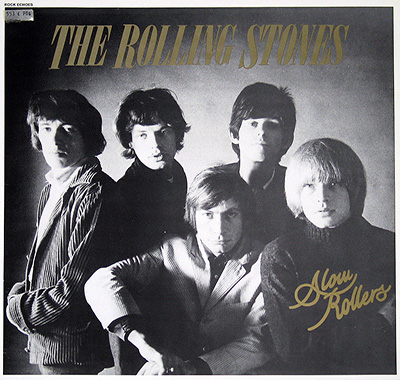
ROLLING STONES - Slow Rollers
ROLLING STONES - Slow Rollers (1981, Holland) album front cover vinyl record

Decca TAB 30 / KZAL ARL 17148 , 1981 , Holland

"Slow Rollers," a ballad compilation on 12" Vinyl LP by the Rolling Stones, showcases their emotive side. Notably, "Con Le Mie Lagrime Cosi (As Tears Go By)," sung in Italian by Mick Jagger, adds a unique touch

Slow Rollers (1981, Holland) 12" Vinyl LP
ROLLING STONES - Some Girls (International Versions)
ROLLING STONES - Some Girls (Multiple Versions) album front cover vinyl record

The Rolling Stones' 1978 album, "Some Girls," marked a turning point, introducing guitarist Ron Wood and showcasing a shift in their sound. While retaining their rock n' roll roots, they embraced elements of punk, disco, and new wave, resulting in a diverse and commercially successful album.

European Release of "Some Girls" with alternate cover Italian Release of "Some Girls" with alternate cover Netherlands Release of "Some Girls" with original cover Swedish Release of "Some Girls" with original cover
ROLLING STONES - Steel Wheels
ROLLING STONES - Steel Wheels (1989 Holland) album front cover vinyl record

CBS 465752 , 1989 , Holland

Released in 1989, "Steel Wheels" marks a triumphant return for the Rolling Stones. This album showcases a rejuvenated band delivering a blend of classic rock energy and polished production. With catchy hooks and powerful performances, "Steel Wheels" is a testament to the Stones' enduring appeal.

Steel Wheels (1989 Holland) 12" Vinyl LP
ROLLING STONES - Sticky Fingers (International Versions)
ROLLING STONES - Stick Fingers (Multiple International Versions) album front cover vinyl record

"Sticky Fingers," the iconic album by the Rolling Stones, achieved global renown not only for its timeless music but also for the distinctive front cover designed by the legendary artist Andy Warhol. A collector's delight, this album holds a unique allure for vinyl enthusiasts

Sticky Fingers with real ZIPP Zipper (1971, Germany) Sticky Fingers Real working zipper (1971, Germany) Sticky Fingers with Rounded PAN Zipper (1971, Netherlands) Sticky Fingers CBS NL (Netherlands) Sticky Fingers (United Kingdom)
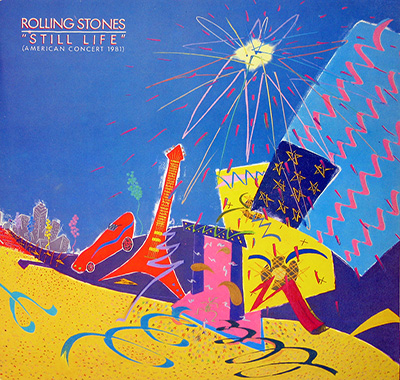
ROLLING STONES - Still Life American Concert 1981 (Multiple European Releases) 12" Vinyl LP
ROLLING STONES - Still Life American Concert 1981 (1982 EEC) album front cover vinyl record

Rolling Stones' zenith: A 1981 live album, encapsulated in a 12" Vinyl LP, is a sonic time capsule, showcasing the band's prowess and contributing profoundly to music history. A must-have for enthusiasts, reliving the magic of that era.

European Release of "Still Life American Concert 1981" German Release of "Still Life American Concert 1981"
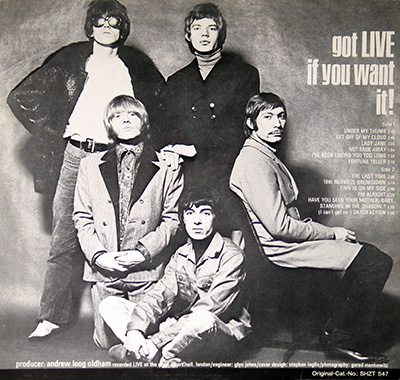
ROLLING STONES - Stone Age/Got Live if you want it
ROLLING STONES - Stone Age/Got Live if you want it  album front cover vinyl record

Decca SD 3024 / ZAL 10 432 , 1971 , Germany

"Stone Age/Got Live If You Want It!" is a unique Rolling Stones release, combining their 1971 studio album "Stone Age" with the live EP "Got Live If You Want It!" from 1966. "Stone Age" features a mix of bluesy rock and psychedelic experimentation, while the live EP captures the band's raw energy

Stone Age/Got Live if you want it 12" Vinyl 2LP
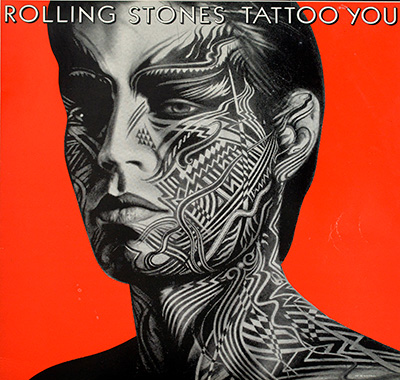
ROLLING STONES - Tattoo You (Multiple International Releases)
ROLLING STONES - Tattoo You album front cover vinyl record

In 1981, The Rolling Stones unveiled "Tattoo You," a 12" Vinyl LP Album that proved to be a remarkable compilation of previously unreleased gems from their 1970s recordings. With its release, the band skillfully curated a timeless collection, showcasing their musical prowess

The European Release of Tattoo You The French Release of Tattoo You The USA Release of Tattoo You
Updated Rolling Stones - Their Satanic Majesties Request album front cover vinyl LP album https://vinyl-records.nl

The day the Stones ditched the blues and chased the cosmos

Rolling Stones - Their Satanic Majesties Request

I love this album because it refuses to behave. The Stones ditch the tough blues posture and dive into psych-rock chaos—chants, weird breaks, and a thick, spaced-out haze that dares you to follow. Jagger commits like a showman, and Brian Jones is the secret sauce, dropping Mellotron and oddball sounds until the whole record feels like a proper head-trip.

ROLLING STONES - Their Satanic Majesties Request
ROLLING STONES - Their Satanic Majesties Request ( 1967 Germany )  album front cover vinyl record

Released in 1967, "Their Satanic Majesties Request" marks a bold departure for the Rolling Stones. This psychedelic-tinged album features unconventional instrumentation and studio effects, creating a dreamlike and experimental soundscape.

Holland release of "Their Satanic Majesties Request"
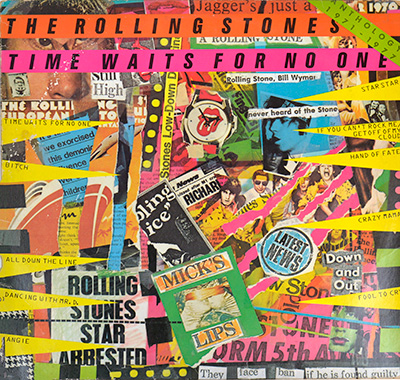
ROLLING STONES - Time Waits For No One (Multiple Versions)
ROLLING STONES - Time Waits For No One  (1979 Germany) 
 album front cover vinyl record

"Time Waits for No One" is a Rolling Stones compilation released in 1979, offering a taste of their music from 1971 to 1977. It features a mix of well-known hits like "Angie" and "It's Only Rock 'n' Roll," along with deeper cuts, providing a glimpse into the band's evolution during that period.

German Release of "Time Waits For No One" Dutch Release of "Time Waits For No One"
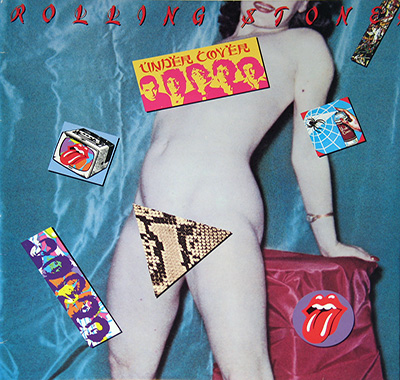
ROLLING STONES - Undercover (Multiple International Versions) 12" Vinyl LP
ROLLING STONES - Undercover (1983 France)  album front cover vinyl record

Released in 1983, "Undercover" showcases the Rolling Stones' edgier side. This album features a mix of hard-hitting rock, reggae influences, and experimental textures. Tracks like "Undercover of the Night" and "Too Much Blood" explore darker themes with a raw, contemporary sound.

French Release of Undercover USA Release of Undercover
ROLLING STONES - 7" Singles & 12" Maxi-Singles
THE ROLLING STONES Vinyl 7" Singles, 10" EP'S And 12"  Maxi-Singles  album front cover vinyl record

A Collection of 7" Singles and 12" Maxi Records by the Rolling Stones

ROLLING STONES - 7" Singles & 12" Maxi-Singles
ROLLING STONES - Live on Unofficial Vinyl Records
ROLLING STONES - Live on Unofficial Vinyl Albums album front cover vinyl record

This collection features three unofficial Rolling Stones recordings from the 60s and 70s. Each disc is identified by the initials "R.S." on the cover, but in different colors.

ROLLING STONES - Live on Unofficial Vinyl Records
ROLLING STONES - Assorted Picture Discs, LP's
ROLLING STONES - Assorted Picture Discs, LP's album front cover vinyl record

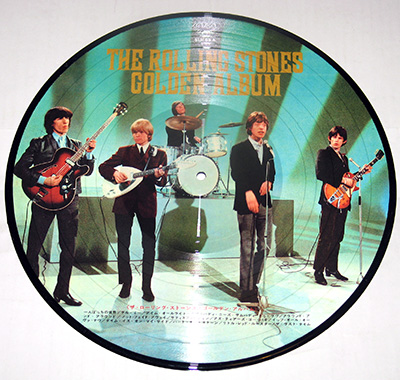
A hodgepodge of Rolling Stones vinyl records from different categories

ROLLING STONES - Assorted Picture Discs, LP's