- French Odeon Records
In 1966, The Beatles released "Revolver," a groundbreaking album that redefined popular music. Featuring innovative recording techniques and iconic tracks like "Eleanor Rigby" and "Tomorrow Never Knows," it left an indelible mark on music history. The French Odeon release, with its iconic "butcher cover," adds a unique collector's appeal. "Revolver" remains a timeless classic, influencing generations of musicians and standing as a testament to The Beatles' enduring impact on music.
This French 1978 Odeon press of “Revolver” hits like a flash grenade thrown into the polite living room of 60s pop. Even after all these decades, it still feels like the moment The Beatles decided to warp their own universe and drag the rest of us along for the ride. Every track feels like a creative jailbreak, the kind you still hear echoing through modern music whether people know it or not.
Mid-60s Britain was buzzing on post-war ambition, transistor radios, and a cultural youthquake that the old guard never saw coming. By the time these songs were conceived, London was a blender of fashion, protest, psychedelia, and raw creative energy. Against that background, Revolver didn’t just join the party — it blew a hole in the wall and rewired the lighting.
The Beatles were exhausted from years of touring, screaming audiences, and the industrial grind of pop fame. They wanted out of the hamster wheel, and the studio became their sanctuary. Free from the pressure to perform these songs live, the band — guided by the ever-sly George Martin — started chasing sounds instead of formulas. It was the first time they treated the studio not as a workplace, but as a laboratory where mistakes became breakthroughs.
Drop the needle and the room tilts. The album swings from razor-tight rhythm on “Taxman” to orchestral melancholy on “Eleanor Rigby”, then plunges straight into dream-logic psychedelia like “I’m Only Sleeping” and the mind-melter that ends the whole ride, “Tomorrow Never Knows”. The record feels like four artists pulling in different directions — yet somehow creating the cleanest, sharpest collision of their careers.
While 1966 was stacked with heavyweight releases — from The Beach Boys’ “Pet Sounds” to The Kinks’ “Face to Face” — Revolver is the one that feels like it cracked open the decade. Where others pushed the edges, The Beatles yanked the whole map off the wall and redrew it in pen. And compared to later psych landmarks of ’67, this album already sounds like the band was lapping the field.
While not wrapped in scandal, Revolver did split the old-school fans who expected clean-cut mop-tops singing about holding hands. Some listeners were confused by tape loops, backwards guitars, or the strange spiritual drone of “Tomorrow Never Knows.” Others just shrugged, turned the volume up, and realized the band wasn’t interested in being anyone’s jukebox anymore.
You can hear the tectonic plates shifting. Lennon drifting toward the surreal, McCartney leaning into melody and structure, Harrison emerging with a sharper voice, and Ringo laying down grooves that held the whole circus together. Revolver wasn’t four guys rowing the same boat — it was four currents pulling toward the future, somehow forming the same river.
Critics eventually hailed it as one of the greatest albums ever pressed, but the real proof is how many bands quietly stole from it. Every modern songwriter with a tape machine, every producer who layers sound like paint, every psych act chasing atmosphere — they all owe this record a drink. And this French Odeon press gives the whole history lesson a slightly different flavour: a collector’s artifact with its own continental swagger.
Every time I pull this copy from the shelf, it feels like opening a time capsule filled with spark plugs and stardust. The grooves still crackle with that fearless spark the band had just before the world got too loud to ignore. Spin after spin, this album reminds me that some records don’t age — they just keep mutating with you.
Beat, Psych
A hybrid of early British beat music charged with the trippier edges of late-60s psychedelic rock, giving the album its quirky, colour-bending character.
ODEON – Cat#: 2C 066-04.097
Standard sleeve.
Record Format: 12" LP Vinyl Gramophone Record
1978 – France
Disclaimer: Track durations shown are approximate and may vary slightly between different country editions or reissues. Variations can result from alternate masterings, pressing plant differences, or regional production adjustments.
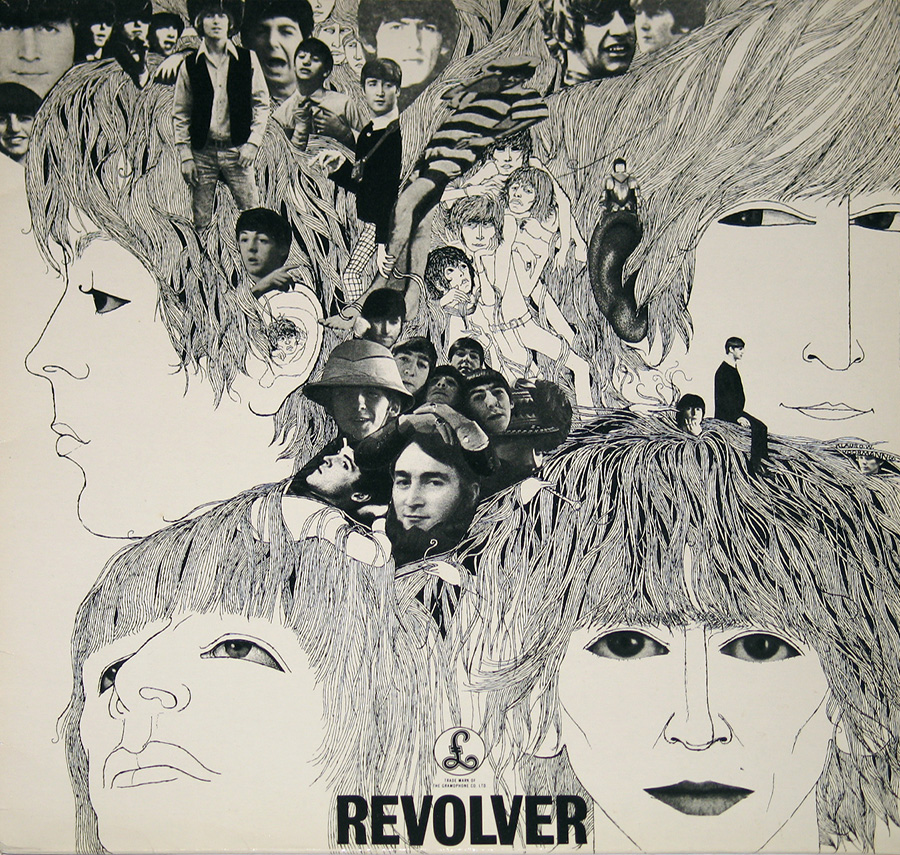
Front cover of the French Odeon pressing of Revolver, built around Klaus Voormann’s dense black-and-white collage. The layout mixes large hand-drawn portraits of all four Beatles with tightly packed clusters of small photographic cutouts. Each fragment is positioned to create a controlled visual chaos that still reads cleanly from a collector’s distance.
The left side shows McCartney’s profile in a thin ink outline, while Lennon, Harrison, and Ringo appear in multiple overlapping snapshots scattered across hair textures, shadows, and background shapes. The illustration uses fine linework that contrasts heavily with the sharp photographic inserts, giving the sleeve a hybrid look typical of mid-60s experimental design.
The lower area centers the familiar “Revolver” title in bold black letters, with the Odeon logo printed above it. Edges of the sleeve show minor curvature and aging common to surviving French copies. From a collector’s perspective, the image highlights the uniquely French print density, the slightly warmer white tone of the cardboard, and the crisp reproduction of Voormann’s line art.
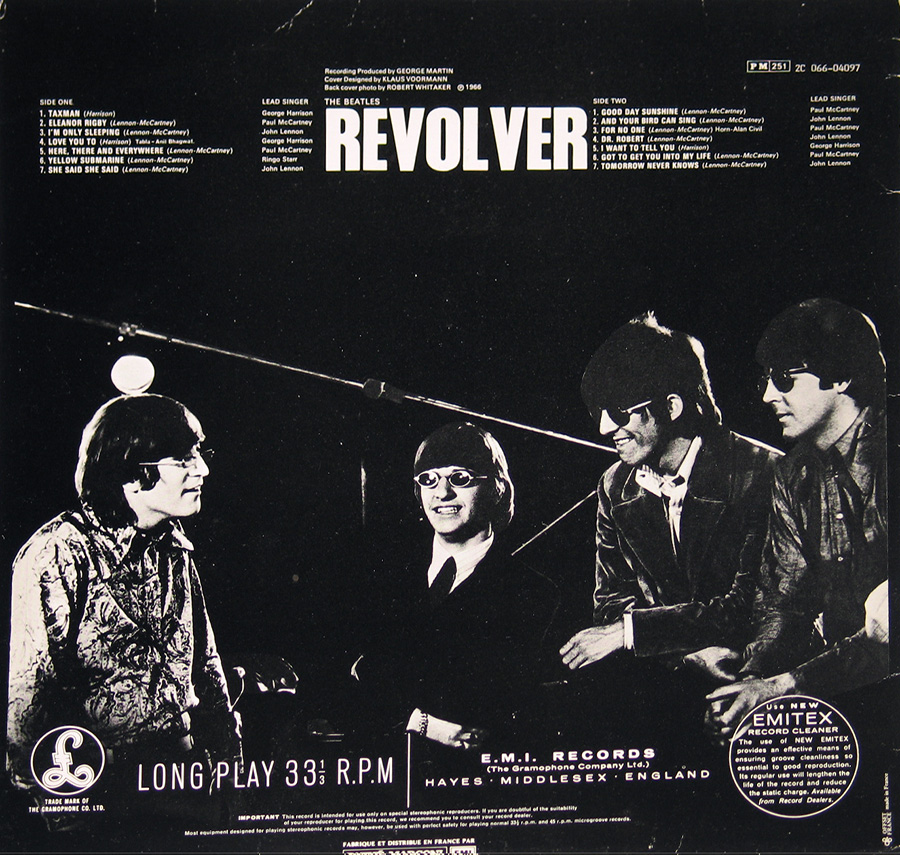
Back cover of the French Odeon pressing of Revolver, printed in stark black and white with the full tracklist arranged in two tight columns. Track titles appear in compact, condensed type with the songwriter credits set beside each entry, giving the whole layout a functional, production-room feel. The album title sits centered and bold near the top, framed by small-print production notes.
A monochrome photo stretches across the lower third, showing all four Beatles seated together under studio lighting. The image is a grainy late-60s print typical of EMI promotional photography, with the band wearing contrasting outfits: patterned shirts, sunglasses, and jackets. Their poses are relaxed but staged, the kind of photo that always ends up reused across territory-specific back covers.
The bottom section carries the collector-critical details: the large Odeon/Gramophone trademark logo, the LONG PLAY 33⅓ R.P.M. line, the EMI Records Hayes Middlesex England credit, and the Emitex record cleaner notice printed inside a rounded badge. The French manufacturing line appears at the very bottom edge, confirming this as a Pathé Marconi issue. All text is crisp, high-contrast white, giving the sleeve a strong archival look.
Transcription of all bottom text:
TRADE MARK OF THE GRAMOPHONE CO. LTD.
LONG PLAY 33⅓ R.P.M.
E.M.I. RECORDS (The Gramophone Company Ltd.) HAYES • MIDDLESEX • ENGLAND
IMPORTANT This record is intended for use only on special stereophonic reproducers. If you are doubtful of the suitability of your equipment, consult your dealer.
Most equipment designed for playing monophonic records will reproduce stereo records with a reasonable degree of success, but will not give the true stereophonic effect.
FABRIQUÉ ET DISTRIBUÉ EN FRANCE PAR PATHE MARCONI S.A. – 54.003 MICRO-GROOVE RECORDS
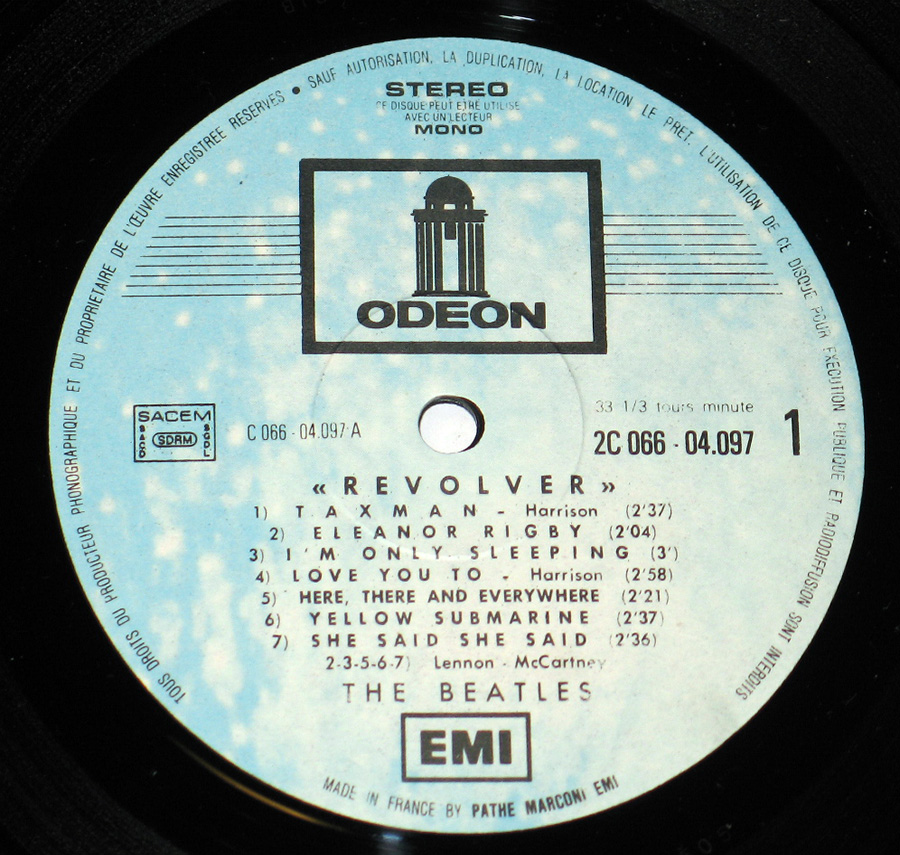
Side One label of the French Pathé Marconi EMI pressing of Revolver, printed on the distinctive light-blue “cloud” background Odeon used in the 1970s. The central ODEON logo depicts a stylised neoclassical rotunda with vertical pillars and a dome, framed by a heavy box that anchors the entire layout. This icon was used across multiple French EMI-affiliated releases as a quick visual identifier for Odeon-distributed titles.
Track titles are printed in compact black type in a centered block, with writing credits and durations placed on the right. The catalog number “2C 066-04.097” appears twice: once at the right edge under “33 1/3 tours minute” and again near the left in the matrix-style line “C 066-04.097 A.” Rights society SACEM/SDRM is shown inside a square box, confirming French mechanical rights handling for this edition.
Rim text appears entirely in French, running along the top arc and stating the usual restrictions on reproduction, duplication, rental, or loan of the disc. The EMI logo sits near the bottom in a heavy rectangular frame, and below it the pressing credit reads “MADE IN FRANCE BY PATHE MARCONI EMI.” Every detail on this label, from typography spacing to cloud texture, is typical for late-1970s Odeon repressings.
French Odeon label used on EMI/Pathé Marconi pressings during the later 1970s. This design is associated with the cloud-texture blue background and boxed neoclassical ODEON logo. This particular label design was used by Odeon between 1976 and 1981.
All images on this site are photographed directly from the original vinyl LP covers and record labels in my collection. Earlier blank sleeves were not archived due to past storage limits, and Side Two labels are often omitted when they contain no collector-relevant details. Photo quality varies because the images were taken over several decades with different cameras. You may use these images for personal or non-commercial purposes if you include a link to this site; commercial use requires my permission. Text on covers and labels has been transcribed using a free online OCR service.
1A 138-5307 ( 5C 184-05307 ) , , Mfd. in Holland
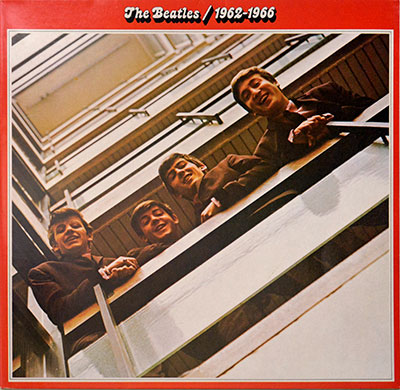
The album "1962–1966 (widely known as "The Red Album") " was compiled by Beatles manager Allen Klein, with his selections approved by the Beatles themselves. Even though the group had had success with cover versions of songs, most notably with "Twist and Shout"
Learn more
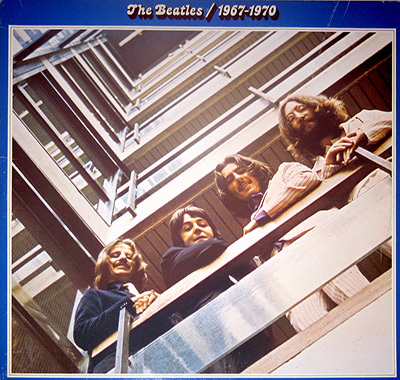
The album "1967–1970 (widely known as "The Blue Album")" was compiled by Beatles manager Allen Klein, with his selections approved by the Beatles themselves.
THE BEATLES - 1967-1970 (Canadian Release) THE BEATLES - 1967-1970 (German 1st Pressing) THE BEATLES - 1967-1970 (2nd German Pressing) THE BEATLES - 1967-1970 (Italian Release) THE BEATLES - 1967-1970 (Netherlands)
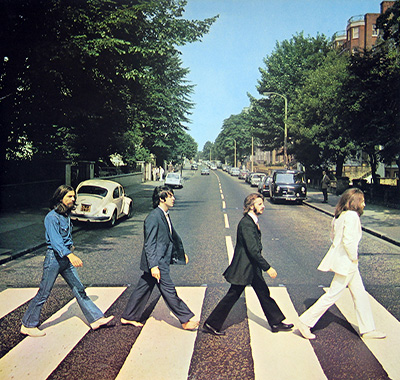
"Abbey Road" LP marked a cultural milestone. Photographer Iain Macmillan skillfully captured the Fab Four striding across the street. This album, with its innovative sound and artistic cover, contributed significantly to the music landscape of the late 1960s.
THE BEATLES - Abbey Road (Canadian Release) THE BEATLES - Abbey Road (Italian Release) THE BEATLES - Abbey Road (Netherlands Release) THE BEATLES - Abbey Road with Misaligned Apple UK THE BEATLES - Abbey Road UK 1st Pressing THE BEATLES - Abbey Road UK 1st Issue 2nd Pressing
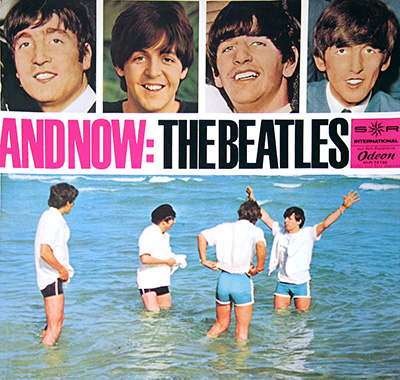
S*R International 73 735 , 1967 , Germany
"And Now: The Beatles," a 1966 compilation LP, showcases early hits by the iconic band. Released exclusively in Germany under Catalognr S*R International 73 735, this 1967 production is a collector's gem. Reflecting the Beatles' timeless influence, this album preserves a musical epoch.
Learn more
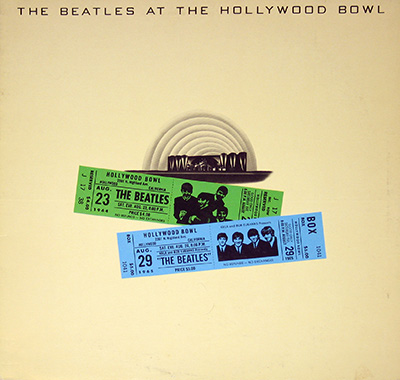
EMI Parlophone EMTV 4 , 1977 , England
The Beatles at the Hollywood Bowl is the live album released in May 1977 featuring songs by The Beatles compiled from two live performances at the Hollywood Bowl during August 1964 and August 1965.
Learn more
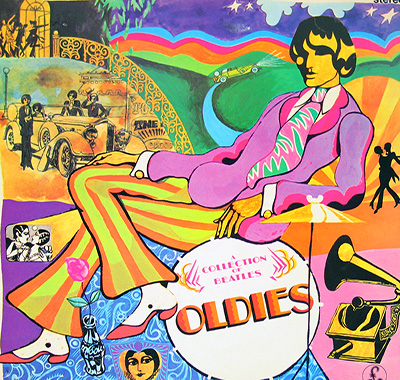
EMI Parlophone PCS 7016 , 1966 , Gt Britain
"A Collection of Beatles Oldies" (subtitled But Goldies!) is a compilation album featuring a selection of songs by THE BEATLES recorded between 1963 and 1966. The album was released in the UK and Australia but not in the U.S.
Learn more
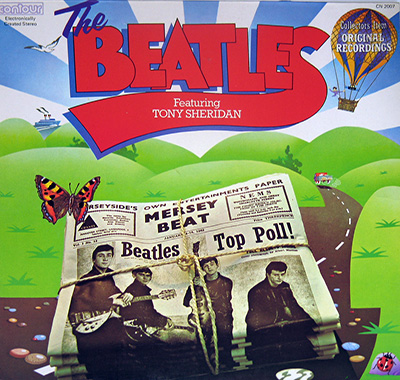
Contour CN 2007 , 1962 , England
"The Beatles Featuring Tony Sheridan" is a album recorded in Germany in 1961 by Tony Sheridan and the Beatles, who were then a relatively unknown band. The album features several cover songs, as well as a few original compositions by Tony Sheridan.
Learn more
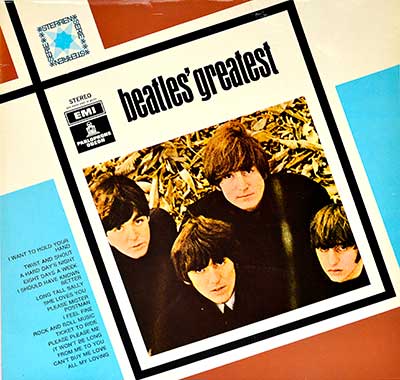
Odeon OMHS 3001 / YBEX 50069 , , Netherlands
The Beatles' Greatest Odeon album was released in Netherlands and Germany on 18 June 1965. This album has not been released in the UK nor in the USA:
Learn more
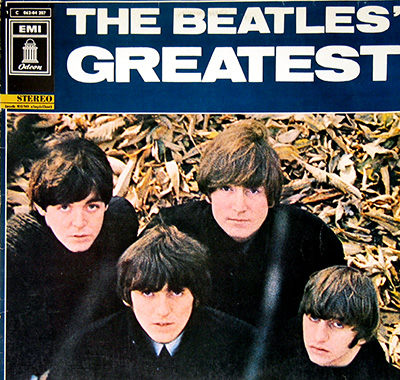
EMI Odeon 1C 062-04 207 , , Germany
"The Beatles' Greatest," a 12" vinyl LP by 4P Nicolaus GMBH, encapsulates the band's evolution during a transformative era. From the infectious Beatlemania anthems on Side One to the innovative sounds of Side Two, the compilation reflects their versatility and enduring impact.
Learn more
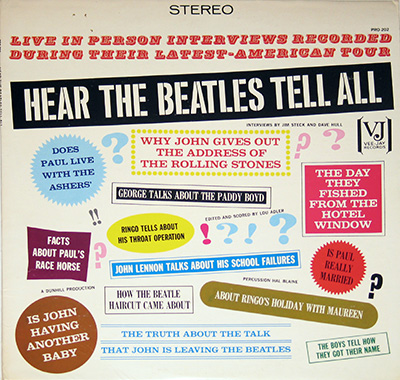
VJ Vee-Jay Records VJLP 202 PRO
This is unusual release to Hear The Beatles Tell All album, which consists of two lengthy interviews with Los Angeles radio disc jockeys (side one was titled "Dave Hull interviews John Lennon", while side two was titled "Jim Steck interviews
Learn more
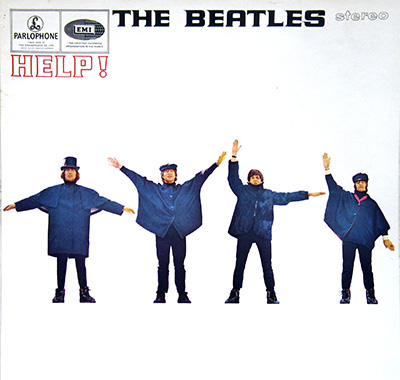
"Help!" stands as a pivotal moment in The Beatles' discography, capturing the energy of the mid-60s and the band's evolving musical landscape. From the upbeat tempo of the title track to the introspective tones of "Yesterday,"
THE BEATLES - Help! (Gt Britain) THE BEATLES - Help! (Italy)
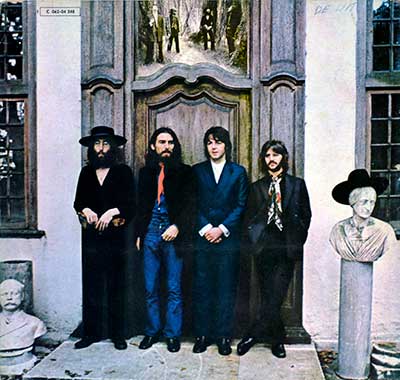
Apple Records – 5C 062-04 348, 1C 062-04 348 , 1970 , Netherlands
The 12" LP album vinyl of "Hey Jude" by The Beatles, crafted in Holland with the market code BIEM, stands as a timeless testament to the band's artistic brilliance. This musical masterpiece, encapsulating The Beatles' transcendent talent
Learn more
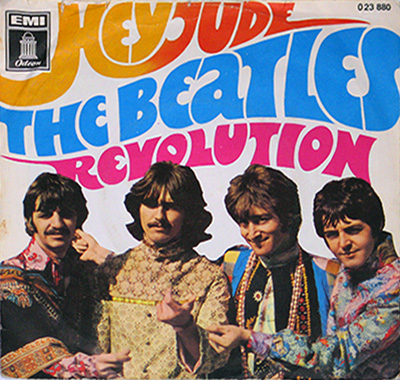
Odeon O 23 880 / 7 XCE 21186 , , Germany
"Hey Jude" is the song by the English band The Beatles, written by Paul McCartney and credited to Lennon–McCartney. The ballad evolved from "Hey Jules", a song generally accepted as being written to comfort John Lennon's son
Learn more
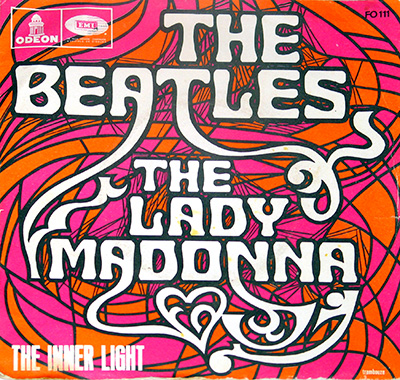
Odeon FO 111 , , France
"Lady Madonna" is the song by The Beatles, primarily written by Paul McCartney (credited to Lennon–McCartney). In March 1968, it was released as a single, backed with "The Inner Light."
Learn more
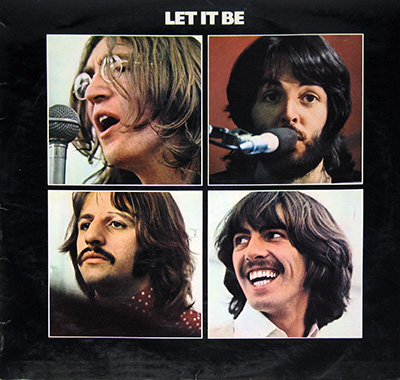
"Let It Be," released on 8th May 1970, encapsulates the spirit of an era marked by social change and the band's farewell. Initially recorded in January 1969, the album underwent re-production by Phil Spector.
THE BEATLES - Let It Be (Red Apple Logo, Italy) THE BEATLES - Let It Be (UK)
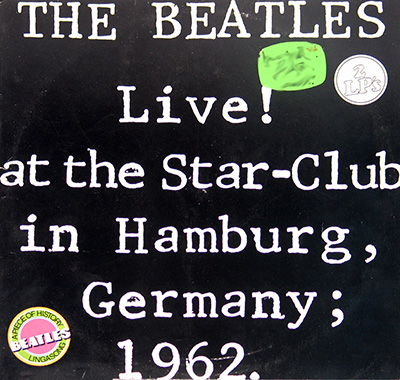
Ariola 28945 XBT, 1977 Lingasong Ltd , 1977 , Holland
Live! at the Star-Club in Hamburg, Germany; 1962 is a double album featuring live performances by The Beatles, recorded in late December 1962 at the Star-Club during their final Hamburg residency.
Learn more
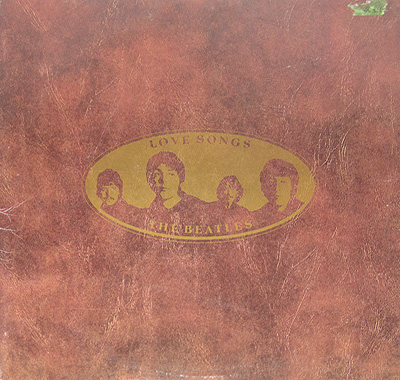
EMI Parlophone PCS 7211 , 1977 , Gt Britain
Love Songs is a compilation album that comprises love songs recorded by The Beatles between 1962 and 1970. It was released by Parlophone in the United Kingdom on 19 November 1977 (PCSP 721.)
Learn more
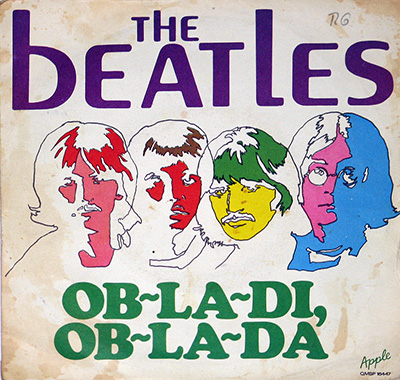
Apple QMSP 16447 , 1968 , Italy
"Ob-La-Di, Ob-La-Da" is the song credited to Lennon–McCartney, but written by Paul McCartney and released by The Beatles on their 1968 album .
Learn more
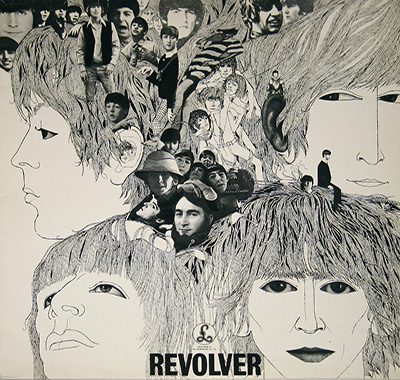
"Revolver," a groundbreaking album that redefined popular music. Featuring innovative recording techniques and iconic tracks like "Eleanor Rigby" and "Tomorrow Never Knows," it left an indelible mark on music history.
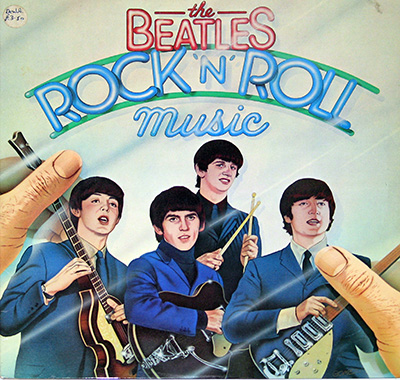
Rock 'n' Roll Music is the compilation album by The Beatles that consists of previously released Beatles tracks considered by many to be quintessential "rock and roll".
THE BEATLES - Rock 'n' Roll Music (Gt Britain) THE BEATLES - Rock 'n' Roll Music (Italy)
MFP (Music for Pleasure) 1A 022-58130 , , Netherlands
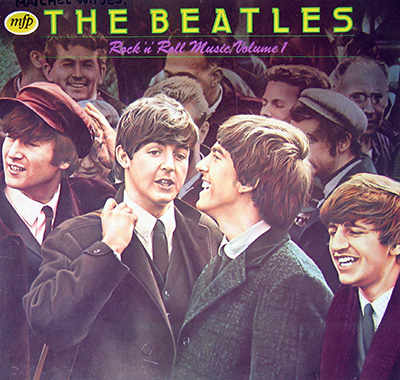
"Beatles - Rock 'n' Roll Music Volume 1" on 12" vinyl LP captures the essence of the Beatles' early rock 'n' roll hits. Produced by George Martin and released under the Music for Pleasure label .
Learn more
Parlophone 3C 062-04115 , , Italy
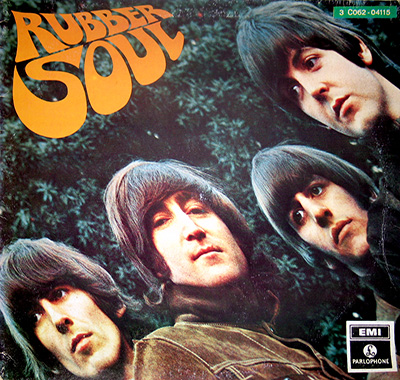
"Rubber Soul," a pivotal 1965 Beatles album, derives its name from John Lennon's playful mention of "plastic soul." The term evolved into "rubber soul," capturing the album's experimental shift.
Learn more
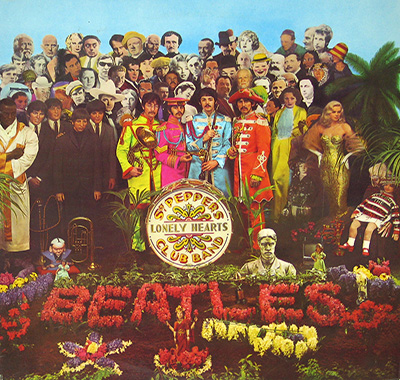
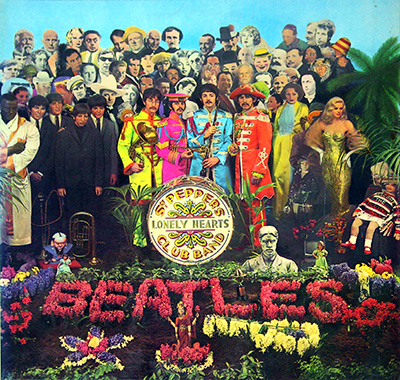
"Sgt. Pepper's Lonely Hearts Club Band" a sonic journey of experimentalism, encapsulates the zeitgeist of its time. The original custom cut-outs insert and innovative gatefold cover design by Michael Cooper
Sgt Pepper's Lonely Hearts Club Band (French Release) Sgt Pepper's Lonely Hearts Club Band (German Hörzu Release) Sgt Pepper's Lonely Hearts Club Band (Gt Britain Release) Sgt Pepper's Lonely Hearts Club Band (Italian Release)
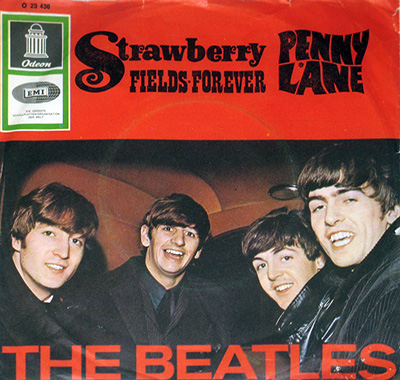
Odeon O 23 436 (23436) / 7 XCE 18 415 , 1967 , Germany
"Strawberry Fields Forever" is the song by The Beatles, written by John Lennon and attributed to the Lennon–McCartney songwriting partnership. It was inspired by Lennon's memories of playing in the garden of a Salvation Army house named "Strawberry Field" near his childhood home
Learn more
The first release of The Beatles' "White Album," officially titled "The Beatles," was on 22 November 1968. The album was originally released in a double LP format and featured 30 tracks.
White Album (German Release) White Album (UK Release)
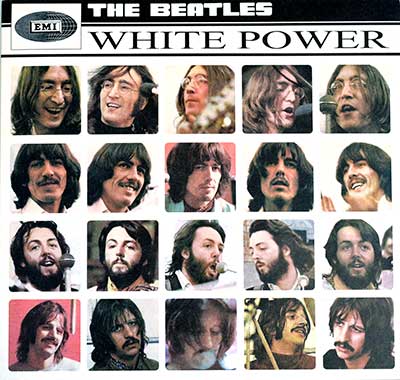
WP 5177-1 / WP 5177-2
"White Power - The Most Updated Unpolitically Correct Beatles Album", is an unofficial Beatles album. It has been released with differently coloured vinyls. On this page is the release on Black Vinyl.
Learn more
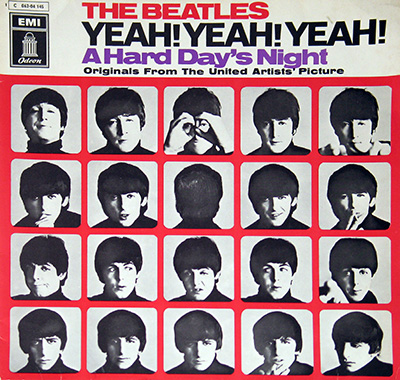
EMI Odeon 1C 062-04 145el , , Germany
Released in 1964, The Beatles' "A Hard Day's Night" 12" Vinyl LP Album encapsulates the essence of the British Beat/Pop era. Side one features tracks from the movie's soundtrack
Learn more