Abbey Road - Album Description:
I don’t need a lecture to know why "Abbey Road" matters. I just need that first dry, tight shove of “Come Together” and the room changes shape. 1969, late in the story, when the band could still sound locked-in even while the human situation was… not exactly sunshine and handshakes. UK release date is 26 September 1969, for the record. Not “some vague year in the late sixties”. Real date. Real moment.
About this Italian copy: the big tell is that S.I.A.E. stamp. That’s not decoration; it’s the Italian rights society mark. And if this copy carries the round S.I.A.E. stamp style that kicks in during the early 1970s, then calling it “produced in 1969” is probably wishful thinking. One common reference places that stamp type starting 1 February 1971 and running into the mid-1970s. So: Italian pressing, yes. Interesting, yes. “First Italian issue from 1969”, not necessarily.
The catalog number story is messy (because of course it is). The Italian "Abbey Road" is widely documented as PMCQ 31520 / 3C 062-04243 for the early Italian line-up, with release information often pegged to September 1969. My web-page mentions Apple 3C 082-04243, but the more commonly cited code is 3C 062-04243. If the record is in hand, the label text and deadwax/matrix markings are the grown-up way to settle it, not vibes.
Sound quality? Here’s my honest, annoying answer: it depends. Condition, cut, and luck. Italian pressings can be excellent, but “Italian vinyl was renowned for superior sound quality” is the kind of blanket claim that sounds confident and proves nothing. This album doesn’t need myth-balloons anyway; it already has “Something”, “Here Comes the Sun”, and that end-side medley that glues me to the chair even when I swear I’m only playing one track.
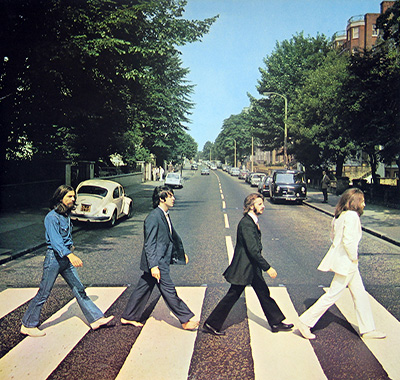
The cover stays the same punch to the retina: the band in single file, left to right, outside EMI Studios, photographed on 8 August 1969 by Iain Macmillan. No printed title on the front in the original UK concept—because they could get away with it. The crossing became a tourist trap later; on the sleeve it still looks like a normal street for a split second… and then the brain remembers what it is and it’s game over.
Collectors like this Italian edition because it’s a small twist on a huge object: different rights marks, different label details, sometimes subtle print differences, and a paper trail that makes me squint at numbers like I’m decoding a Cold War message. That S.I.A.E. stamp is the little bureaucratic tattoo that says: “Yes, this one lived a slightly different life.” That’s the whole point of collecting, really. The music is immortal; the objects are messy.
References / citations
Collector’s Note: Abbey Road & the “Paul Is Dead” Noise
"Abbey Road" didn’t just land with music fans and record collectors. It also attracted the conspiracy crowd like spilled beer attracts wasps. The “Paul Is Dead” business wasn’t a harmless footnote either—it briefly became a full-time obsession for strangers with too much imagination and very sharp hearing.
The “evidence” was always the same grab bag: Paul barefoot on the cover, the four of them lined up like a funeral procession (according to people who really wanted that to be true), lyrics picked apart as if Lennon was running a secret spy ring, and even the parked car’s license plate pressed into service as prophecy. It’s ridiculous. It’s also, in small doses, weirdly entertaining.
Timing did most of the damage. Late 1969, the band was already visibly cracking, the press was hungry, and rumors could sprint through radio stations and newspapers faster than common sense could catch its breath. Paul eventually shut it down in a Life magazine interview from his farm in Scotland—because being declared dead by strangers stops being funny very quickly.
The irony is that the cover photo was never trying to be clever. It’s just four people walking across a street. But once a rumor like that latches on, it doesn’t want facts. It wants crumbs. And it will happily chew through an entire album sleeve to get them.
References / citations
Music Genre:
Beat Pop Rock Music |
Collector's info:
Original 1969 Italian pressing of Abbey Road |
Album Production Information:
The Beatles album: "Abbey Road" was produced by:
George Martin.
Sir George Martin – Producer, arranger, studio architectThe quiet conductor behind the faders: tape loops, strings, and that famous Beatles sheen. Read more... Sir George Martin, the so-called 5th Beatle, was the producer who translated four Liverpool lads into studio language. I first clocked him at Parlophone in the 1950s; from 1962-1970 he shaped The Beatles' records with tape loops, strings, and ruthless edits that made pop feel like cinema. Alongside them he guided fellow Merseybeat names like Gerry & the Pacemakers and Billy J. Kramer & the Dakotas (1963-1965), plus Cilla Black (1963-1966). After leaving EMI he built AIR and, in the 1970s, produced Paul McCartney & Wings (1973), America (1974-1976), and Jeff Beck (1975). He rarely shouted, but the speakers did. That is why they called him the 5th Beatle, and nobody argued.
Assistent Sound/Recording Engineer(s): Alan Parsons
Alan Parsons – Sound engineer, producer, musicianAlan Parsons is my go-to “how does this record sound THAT good?” answer: the studio brain behind classic-era clarity, from Pink Floyd sessions to The Alan Parsons Project’s glossy sci-fi pop-rock. Read more... Alan Parsons is the guy I picture behind the glass when a record sounds ridiculously clean, wide, and expensive (in the best way). His first big “period” is the Abbey Road years, working as a tape operator and engineer across the late 1960s into the mid-1970s, right in the era when studios were basically science labs with guitars. In 1973 he engineered Pink Floyd’s "The Dark Side of the Moon", and that alone would’ve earned him a lifetime pass to the control room. Then he moved from “genius in the booth” to “name on the cover” as co-founder of The Alan Parsons Project, active from 1975 to 1990, where he blended pristine production with big melodies and concept-album vibes. From the 1990s onward he’s kept the music alive on stage with touring lineups commonly billed as The Alan Parsons Live Project, proving he’s not just a behind-the-scenes wizard but a musician who can carry the material in the real world too.
This album was recorded at:
Abbey Road Studios, London
Album cover photography: Iain MacMillan
Thanks to George Martin, Geoff Emerick, Philip McDonald
|
Record Label & Catalognr:
Apple 3C 082-04243 |
Media Format:
12" Vinyl LP Gramophone |
Year & Country:
1969 Made in Italy |
-1054.jpg)
-1055.jpg)
-1056.jpg)
-1057b.jpg)