Album Production Information:
Producers:
Metallica
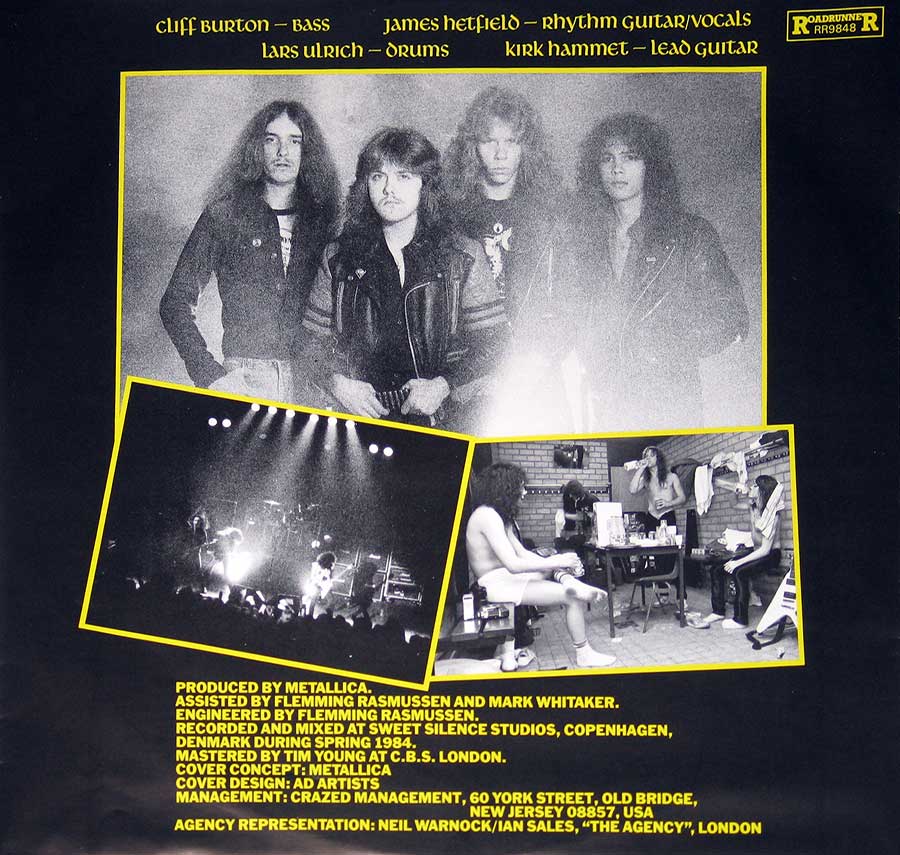
Recorded: June - September 1984 at Sweet Silence Studios in Copenhagen, Denmark
Sweet Silence Studios in Copenhagen, Denmark
is a Danish music recording music in Copenhagen, Denmark. It is owned by Freddy Hansson and Flemming Rasmussen (producer of Metallica albums).
Mark "Marc" Whitaker - Producer, Sound Engineer
Mark Whitaker was born in London in 1965 and found his way into the recording world just as the mid-1980s metal scene was starting to shake the walls of every decent studio in sight. Instead of chasing the spotlight, Whitaker gravitated toward the control room, where the real shaping of a record often happened. He came up during a period when bands wanted their music to hit harder, louder, and faster than the records that came before them, and engineers had to figure out how to capture that chaos without losing the punch.
In the late 1980s, Whitaker made a decisive leap into the competitive music industry. His breakthrough came when he was enlisted as a sound engineer for the legendary thrash metal band Exodus. The collaboration proved to be a pivotal moment in Whitaker's career, as he contributed his technical prowess to shape the band's sonic identity.
more...
Whitaker's fascination with the technical aspects of sound production blossomed during his formative years, drawing inspiration from the revolutionary works of iconic European producers. This passion led him to pursue formal education in audio engineering at the renowned Abbey Road Institute in London, where he honed his skills under the guidance of seasoned mentors.
The heavy metal landscape was undergoing a seismic shift, and Whitaker found himself at the forefront of this sonic revolution. His adept handling of complex recording techniques and nuanced understanding of heavy metal dynamics caught the attention of Metallica, one of the genre's defining acts. Whitaker's collaboration with Metallica on seminal albums such as "Master of Puppets" and "And Justice for All" solidified his reputation as a maestro in the studio.
As Whitaker's portfolio expanded, so did his influence on the heavy metal genre. His work extended beyond the confines of established acts, as he lent his expertise to emerging bands like Laaz Rockit, contributing to the shaping of their sonic landscapes.
Flemming Rasmussen - Producer, Sound Engineer
Flemming Rasmussen – Producer, Sound EngineerSweet Silence Studios founder/engineer whose fingerprints show up on metal records that sound way bigger than the room they were made in. Read more... Flemming Rasmussen is one of those behind-the-glass names I keep spotting like a quality stamp: a Danish producer and sound engineer, and the founder of Sweet Silence Studios in Copenhagen. His timeline reads like a metal history syllabus I actually want to study: Rainbow (1981), then Metallica (1984–1988: Ride the Lightning, Master of Puppets, ...And Justice for All), followed by Artillery (1990), Morbid Angel (1993), Blind Guardian (1995–1998), Ensiferum (2003–2004), and Evile (2007). He even won a Grammy for producing Metallica’s "One" (1989), which is kind of hilarious when you remember that song is basically anxiety with military boots on.
Bob Ludwig - Mastering Engineer
Bob Ludwig – Mastering EngineerMy quick tell for a record that’s about to sound expensive: “Mastered by Bob Ludwig” quietly lurking in the credits. Read more... Bob Ludwig, for me, is the final boss of “make it hit”: cutting lacquers at A&R in the late ’60s, shaping the 1970s at Sterling Sound, the 1976–1992 Masterdisk era, then building Gateway Mastering in Maine (founded 1992) before retiring in 2023. His mastering fingerprints run from classic rock to metal to modern pop—Led Zeppelin and Lou Reed through Metallica, Nirvana, Tool, and Daft Punk.
Tim Young - Mastering Engineer
Tim Young is a sound and mastering engineer who started his career in music in 1971. During the 1980s he has mastered two dozen of Heavy Metal albums.
Anthony D. Sommella - Photography
Fin Costello - Photography
Fin Costello – Art Direction, Photography
Fin Costello is the guy behind the lens who made loud bands look even louder—caught mid-stride, mid-sweat, mid-myth. I always pay extra attention when his photos are printed on album covers and inner sleeves.
Read more...
Fin Costello hit my radar the way the best photographers do: not with a signature, but with a feeling. You’re staring at a sleeve and suddenly you can hear the room. Hot lights. Hair stuck to foreheads. That thin layer of sweat that says the set is only halfway done.
He comes out of late-1960s London photojournalism—learn the craft fast, get close, don’t ask the moment to repeat itself. And when the rock caravan starts dragging its cables across Europe, he’s already in the right place. Deep Purple (1972–1975) looks like volume you could measure with a broken window. Rainbow (1975–1977) looks sharper, richer, a little more dangerous in the fantasy costume. Then Ozzy Osbourne (1980–1983) arrives like a headline that won’t calm down.
The thing I like is that Costello doesn’t “capture legends.” He catches people working. There’s a difference. Legends pose. Working musicians forget you’re there—until the flash reminds them, and even then he’s already moved on.
Harald Oimoen - Photography, Bass
Pete Cronin - Photography.
Pete Cronin has been a photographer for over 30 years and has photographed rock bands like: Demon Pact, Avenger, Metallica, Exciter, English Dogs, Plasmatics, Briar, Bow Wow, Thin Lizzy, Alice in Chains, Megadeth and others.
Rick Brackett - Photography
Robert Hoetink - Photography
Dave Mustaine - Songwriter
Dave Mustaine – Vocals, Guitars
Thrash metal’s original grudge match: one guy, one guitar, and enough spite to power Los Angeles for decades.
Read more...
Dave Mustaine is the razor-edged singer-guitarist who turned getting fired into a lifelong fuel source. To my ears, the story starts in Panic (late 1970s–1981), where those early riffs already sounded like trouble with a pick. From 1981–1983 he was Metallica’s original lead guitarist and co-writer, shaping key early songs before his April 11, 1983 dismissal. Back in Los Angeles he formed Megadeth in 1983 and has fronted it ever since, steering speed, spite, and precision through decades. Side quests like MD.45 (1996) just prove the volume never really drops.
|