"Peace Sells But Who Is Buying" Album Description:
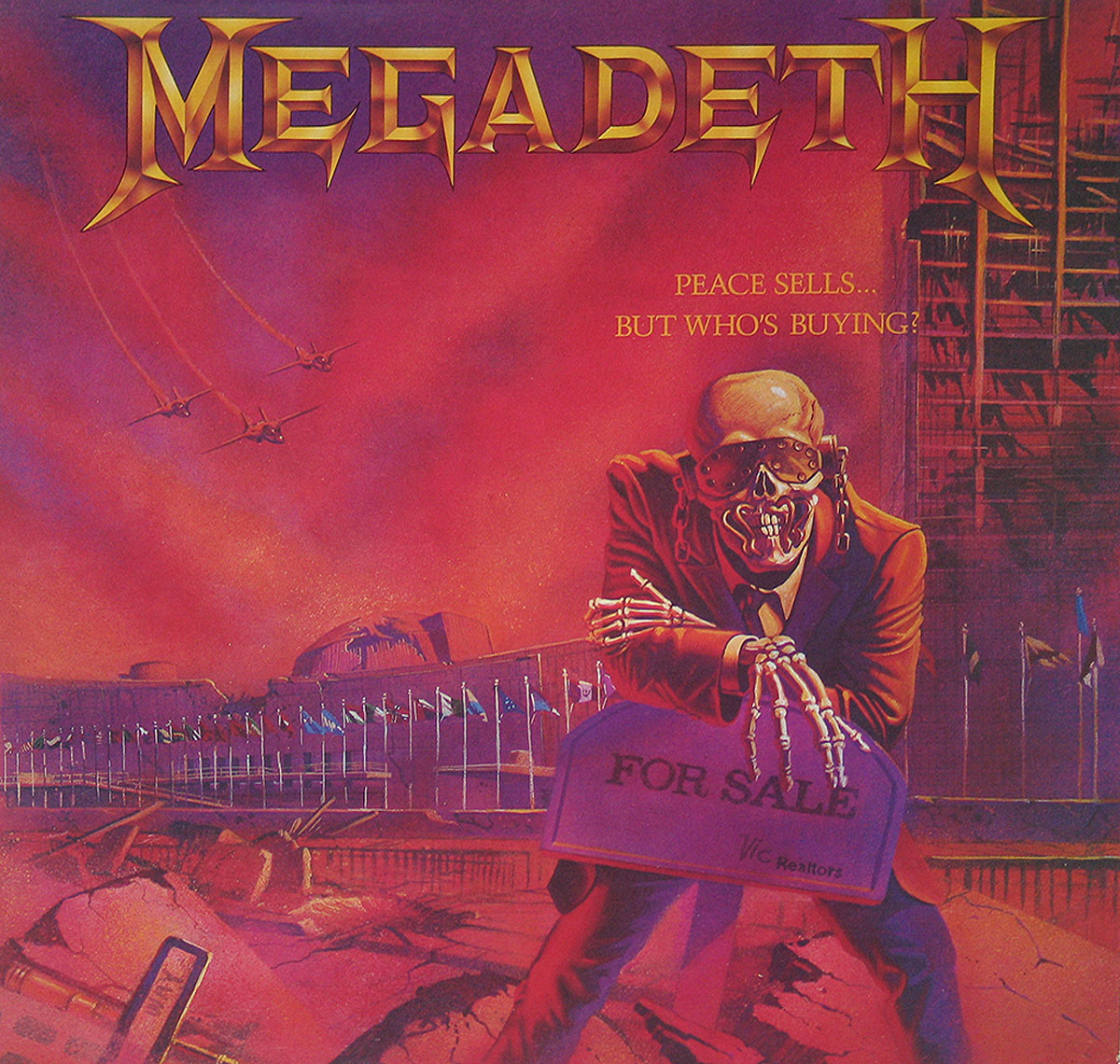
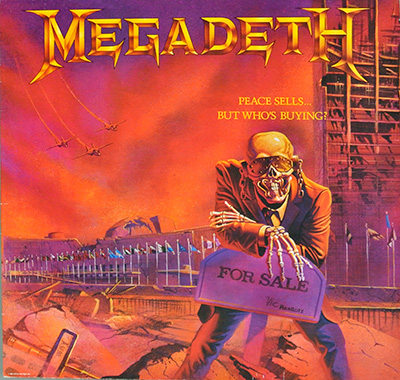
I remember seeing “Peace Sells... But Who’s Buying?” sitting in the bins like it was daring you to pull it out. 1986, Capitol logo, and that Ed Repka cover—Vic grinning like the world’s already on fire and you’re late to the party. Nobody needed a press release to tell them what it meant. You just looked at it and went, “Yeah… this is gonna be trouble.”
Drop the needle and it doesn’t “showcase musical prowess.” It swings and snaps. Mustaine and Randy Burns don’t polish the edges; they keep them sharp enough to cut. The guitars don’t pose, they lunge. The drums don’t just pound—they move, like the band’s trying to outrun its own anger without tripping over it.
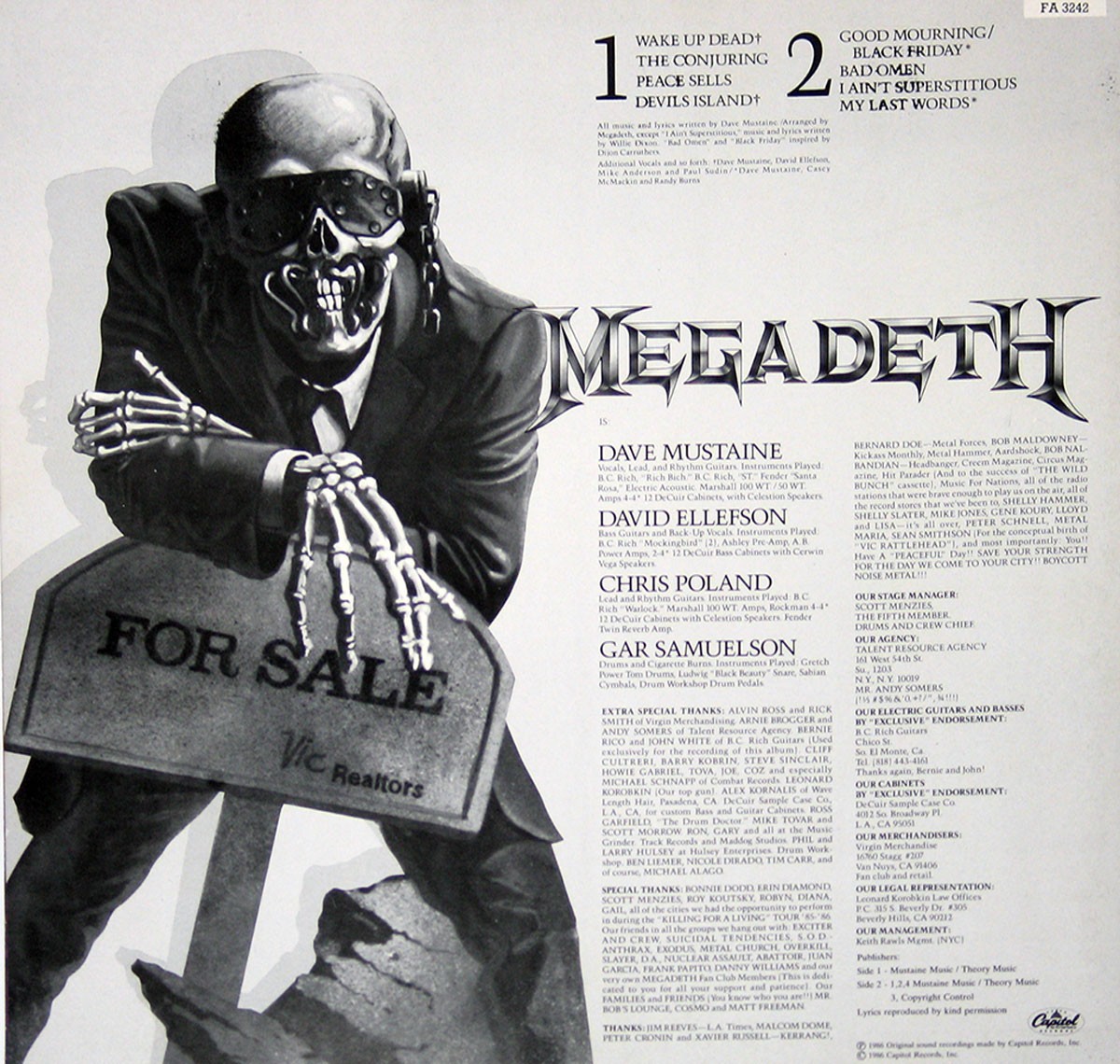
And the lyrics? They’re not “socially conscious,” they’re pointed—the kind you read off that printed inner sleeve with the record still spinning, half to keep up, half to check if he really said what you think he said. That extra sheet of paper turns the listening session into an argument you don’t fully win, which is kind of the point.
People love to call it “influential,” but the funnier truth is it didn’t ask permission. It just spread. It cracked the US Billboard 200 (peaking at No. 76) and kept hanging around long enough to go Platinum in the U.S.—not because it’s polite history, but because it still sounds like a raised eyebrow and a clenched fist at the same time.
Music Genre:
|
Death/Thrash Metal |
Album Production Information:
Produced by Dave Mustaine, Randy Burns
Randy Burns – Record Producer & Sound Engineer
He captured thrash when it still sounded dangerous, not "clean."
Read more...
Randy Burns is the producer/engineer I trust when metal has to hit hard without turning into mush. I clocked him in 1986 at Music Grinder, co-producing and engineering Megadeth's
"Peace Sells... but Who's Buying?"
with Mustaine: snare like a fist, bass tight, guitars sharp enough to shave with. He makes chaos readable, no fake gloss. His 80s run is a straight line of troublemaking: Suicidal Tendencies (engineer, 1983), Possessed
"Seven Churches"
(producer, 1985), Dark Angel
"Darkness Descends"
(producer/engineer, 1986), Death
"Scream Bloody Gore"
(producer, 1987), Nuclear Assault
"Survive"
(1988) and
"Handle with Care"
(1989), then Kreator "Coma of Souls" (1990).
Sound Engineer Casey McMackin and Randy Burns
Casey McMackin – Sound Engineer, Producer & Musician
The Music Grinder kid who made thrash readable without sanding off the danger.
Read more...
Casey McMackin is an acclaimed sound engineer, producer, and musician who learned the hard way at Hollywood's Music Grinder—starting as the gofer and listening his way into the chair. I hear his fingerprints on Megadeth (1986) where he engineered
"Peace Sells... but Who's Buying?"
and even tossed in backing vocals, then straight into Dark Angel (1986) on
"Darkness Descends"
. He stayed in the pit with Nuclear Assault (1987–1989), jumped to Exodus as assistant engineer (1990), and helped steer Motörhead's grit on "1916" (1991) and "March ör Die" (1992). Later, he still popped up—producing/mixing C.I.A. (1990) and engineering a Lemmy solo cut (2006).
Sound mixer: Paul Lani, Stan Katayama.
Artwork Edward Repka
Ed Repka – Graphic Artist & Album Cover Illustrator
He turned Cold War paranoia and death-metal gore into bright, rotten pop art.
Read more...
Ed Repka is the American graphic artist who gave thrash and early death metal its lurid, comic-book bite. I remember seeing his work hit the racks with Megadeth’s Vic Rattlehead—
"Peace Sells... but Who's Buying?"
(1986) and the colder, geopolitics-soaked
"Rust in Peace"
(1990). In between, he painted Death’s first three nightmares:
"Scream Bloody Gore"
(1987),
"Leprosy"
(1988), and
"Spiritual Healing"
(1990). He also lit up Nuclear Assault and Possessed in 1986, then kept the torch burning on shirts and posters for decades. He draws like Mad magazine with a switchblade: bright color, nasty detail, and a punchline that still hurts. Every corner is packed with little jokes and rot.
|
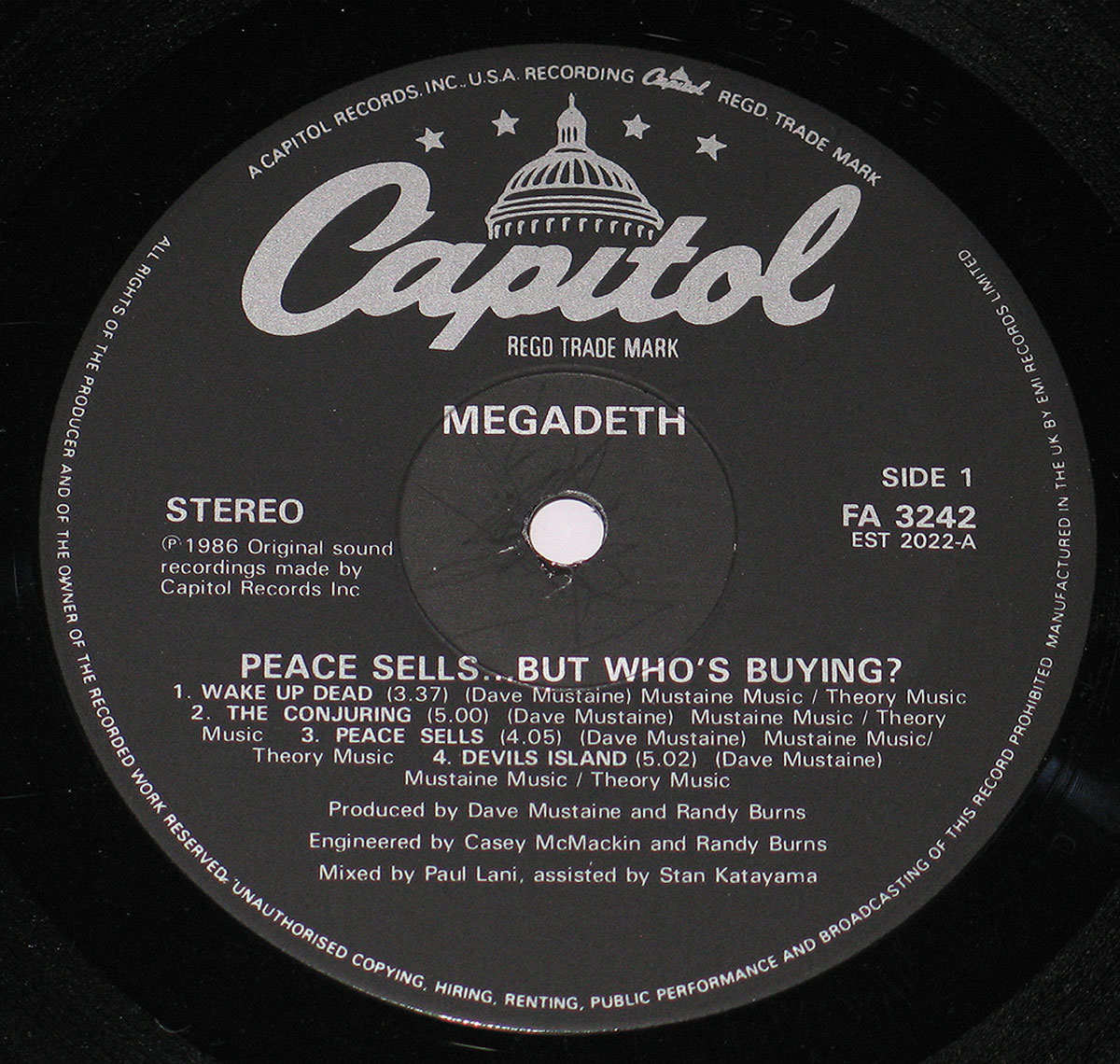
Record Label & Catalog-nr:
|
Black Label Capitol Records FA 3242 |
Media Format:
|
12" Vinyl Stereo Gramophone Record
Total Album (Cover+Record) weight: 210 gram |
Year & Country:
|
1986 Made in USA |
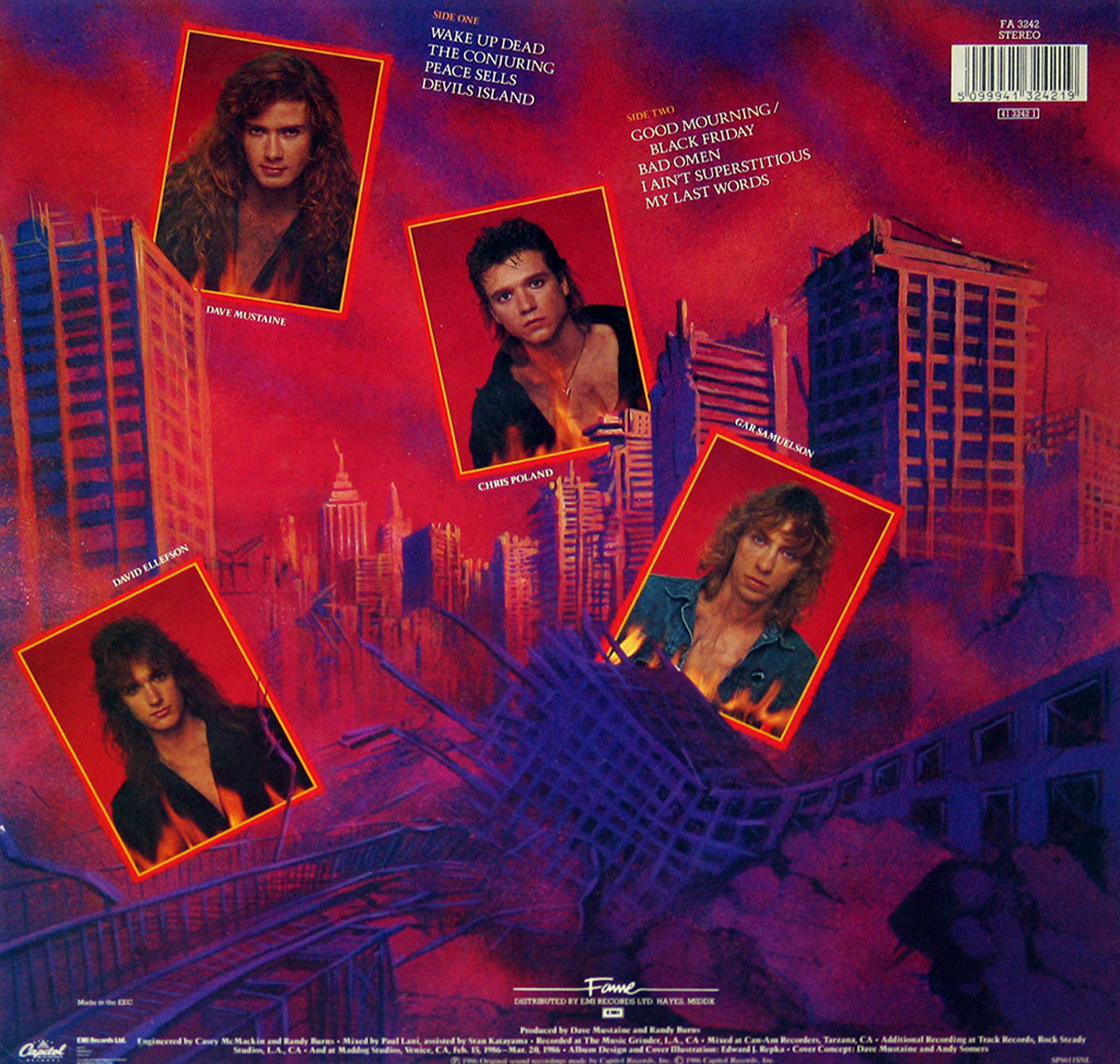
Band Members and Musicians on: MEGADETH - Peace Sells But Who Is Buying |
Band-members, Musicians and Performers
- Dave Mustaine - Vocals, Guitars
- Dave Mustaine – Vocals, Guitars
Thrash metal’s original grudge match: one guy, one guitar, and enough spite to power Los Angeles for decades.
Read more...
Dave Mustaine is the razor-edged singer-guitarist who turned getting fired into a lifelong fuel source. To my ears, the story starts in Panic (late 1970s–1981), where those early riffs already sounded like trouble with a pick. From 1981–1983 he was Metallica’s original lead guitarist and co-writer, shaping key early songs before his April 11, 1983 dismissal. Back in Los Angeles he formed Megadeth in 1983 and has fronted it ever since, steering speed, spite, and precision through decades. Side quests like MD.45 (1996) just prove the volume never really drops.
- David Ellefson - Bass
- Dave Ellefson – Bass guitarist
He’s the low-end rivet gun behind Megadeth’s sharpest turns.
Read more...
Dave Ellefson is the bass guitarist who gave Megadeth its steel spine while I watched thrash grow fangs. From 1983–2002, then again 2010–2021, he locked in with Mustaine like a rivet gun—tight, fast, no wobble—and he’s the only other guy who rode every album and tour from 1985 until the band imploded. I hear his pocket in the "Peace Sells" years and the clipped precision of the "Rust in Peace" lineup. Early on he played fingerstyle, later leaning on a pick for that crisp attack. After 2002 he formed F5 (2003–2013), did outside sessions, and in the 2020s jumped into The Lucid (2020–present) and launched Dieth (2022). It’s musical architecture with a street-fight grin.
- Chris Poland - Guitars
- Chris Poland – Guitarist
He snuck jazz-fusion phrasing into thrash, then escaped back into heavy fusion with a grin.
Read more...
Chris Poland is the guitarist who smuggled jazz-fusion grease into early thrash and made it sound like trouble with manners. Before Megadeth, he bounced through Welkin and The New Yorkers (late 1970s–early 1980s), sharpening that slippery legato. I first clocked him in Megadeth (1984–1987), cutting through "Killing Is My Business..." (1985) and "Peace Sells... but Who's Buying?" (1986) with off-angle phrasing and nasty little harmonies. After the split he went progressive with Damn the Machine (1991–1994), then detoured into Mumbo's Brain (1995–1996). He popped back in 2004 as a session ace on Megadeth's "The System Has Failed". Since 2002 he’s kept the fuse lit in OHM and OHMphrey, stretching riffs like elastic and letting the notes argue.
- Gar Samuelson
- Gar Samuelson – Drummer
He played thrash like a jazz guy who’d just discovered speed and bad decisions.
Read more...
Gar Samuelson (full-name: Gary Charles Samuelson) is the drummer who injected swing, ghost notes, and real feel into early Megadeth when most thrash kits sounded like someone falling down stairs on purpose. I first clocked him coming out of The New Yorkers with Chris Poland (late 1970s–early 1980s), then landing in Megadeth (1984–1987) and turning "Killing Is My Business..." (1985) into something sharper than speed: it breathed. On "Peace Sells... but Who's Buying?" (1986) he played fast without going stiff, accenting like a jazz cat in a leather jacket. After he left, he worked with The New Yorkers again and did sessions through the late 1980s. His legacy isn’t just the beats—it’s the idea that thrash could groove and still hit like a hammer.
|