SAXON - Wheels of Steel 12" Vinyl LP Album

- French Release

Buckle up, mate! "Wheels of Steel"* by SAXON isn't just another album—it's the roaring engine of the NWOBHM juggernaut. Dropped in 1980, this LP is a leather-clad, riff-fueled beast that left punk in the dust and revved heavy metal into overdrive. Crank it up, and let’s burn some rubber!

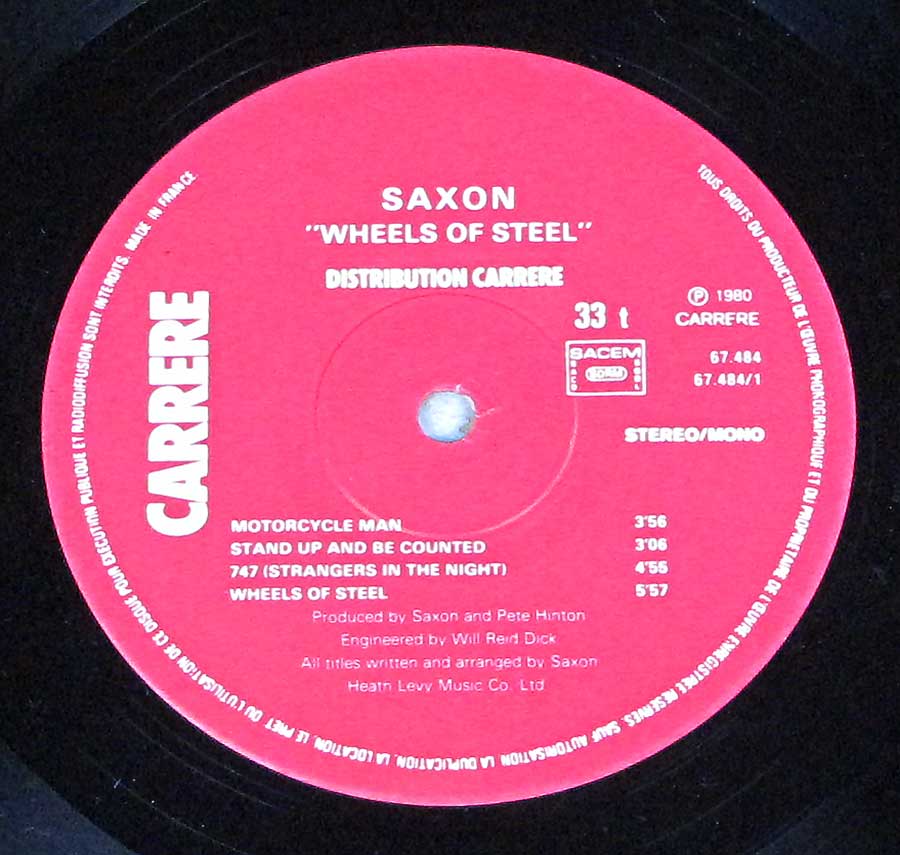
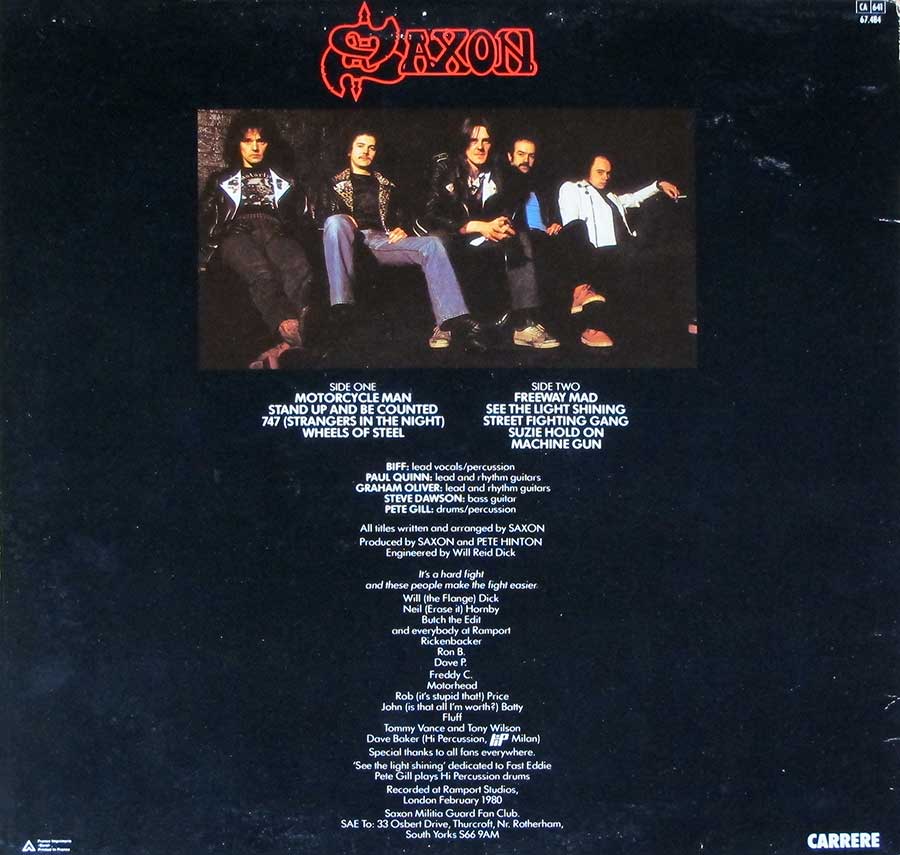
This web page has photos of album covers, inner sleeves, record labels together with production details, musicians and track-listing.

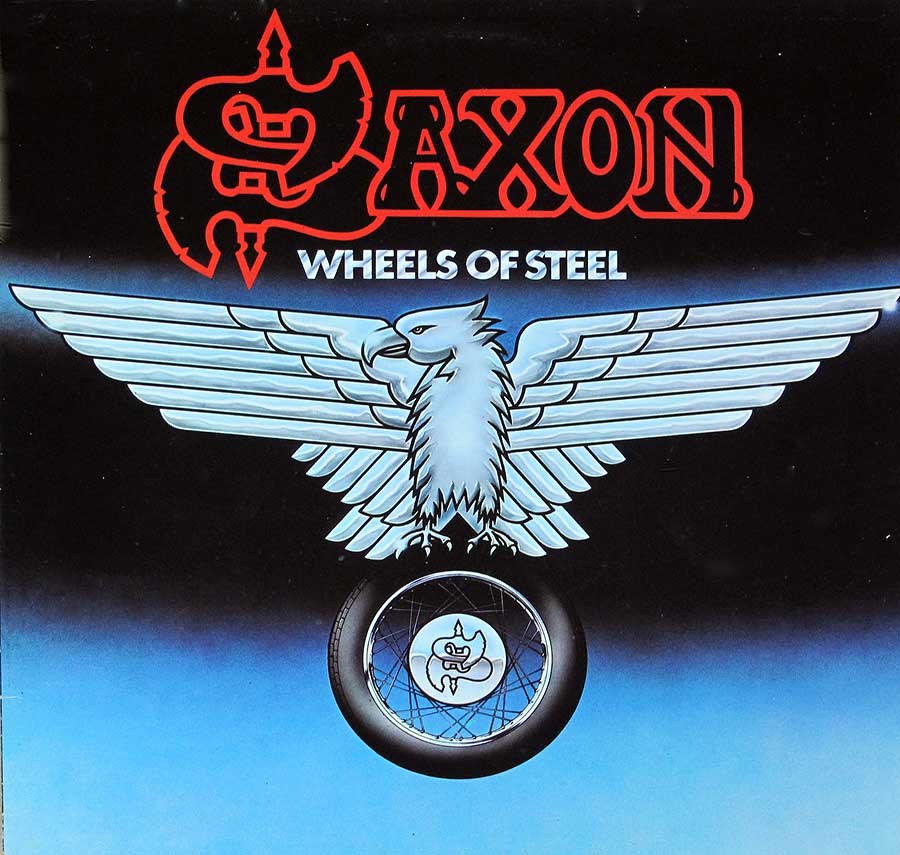
Front Cover Photo Of SAXON - Wheels Of Steel ( France )

SAXON's “Wheels of Steel”: A High-Octane Engine of the New Wave
Album Description:

SAXON’s Wheels of Steel isn't just a record; it's a revelation, a roaring embodiment of the New Wave of British Heavy Metal (NWOBHM). Released in 1980, this album didn't merely emerge; it tore out of the gate, screeching into a world hungover from the 1970s, still clinging to the embers of punk while tentatively peeking into the shadows of what would become the heavy metal explosion of the early ‘80s. This French release, pressed under the Carrere label (Catalogue Number: 67.484), captures that zeitgeist in a way that is raw, unrefined, and yet powerfully polished—a paradox that only heavy metal can pull off without the blink of an eye.

In the historical context, Wheels of Steel arrived at a moment when Britain was choking on the fumes of economic stagnation and social disillusionment. Margaret Thatcher had just come into power, and the punk era’s furious sneer was giving way to a more deliberate, anthemic aggression. SAXON, led by the leather-lunged Biff Byford, plugged directly into that energy, amplifying it with the iron-clad riffs and galloping rhythms that would come to define the NWOBHM movement.

Musically, Wheels of Steel is an album that sits at the crossroads of heavy metal’s lineage. It’s as if SAXON took a map of rock ‘n’ roll history, marked out the best routes from the bluesy swagger of Led Zeppelin, through the thunderous crunch of Black Sabbath, and into the quicksilver riffs of Deep Purple. But SAXON wasn’t interested in just retracing old paths; they wanted to carve their own road. The album’s title track is a rallying cry for the working-class hero, a blue-collar anthem wrapped in chains of steel and driven by a riff that feels like it could pull a freight train.

The genre exploration here is not just in the riffs or the lyrical content, but in the overall sound that SAXON cultivated. This album is pure heavy metal, but it’s a kind of metal that wears its influences on its sleeve while forging ahead with its own identity. Tracks like “Motorcycle Man” and “747 (Strangers in the Night)” are built on the foundation of rock ‘n’ roll, but they speed off into heavier, darker territories, with a pace and intensity that leaves punk rock in the dust and sets the stage for the thrash metal to come.

But it’s not all smooth cruising. The album’s production, helmed by Pete Hinton alongside the band themselves, is a point of contention. Recorded at Ramport Studios in London—a studio with a history as storied as the bands that passed through its doors— Wheels of Steel has a sound that is as sharp as a steel blade but sometimes as rough as a gravel road. Hinton’s production is minimalist; it doesn’t over-polish or embellish, leaving the raw energy of the band intact. This approach, while capturing the visceral power of SAXON’s live sound, also exposes some of the album’s rougher edges—most notably, a few moments where the mix feels a touch too muddy, the drums a bit too flat. But these are minor blemishes on what is otherwise a pristine beast of a record.

There’s also an undercurrent of controversy surrounding the album, not least because of its unapologetic embrace of the biker culture. “Motorcycle Man” isn’t just a song; it’s an ode, a full-throttle celebration of the rebellious freedom that the motorcycle symbolized. In a time when metal was beginning to be associated with the darker elements of society—bikers, outlaws, and fringe subcultures—SAXON didn’t shy away from that connection. They leaned into it, revved the engine, and blasted down the highway.

Ramport Studios, where the album was recorded, was a critical part of this process. Located in Battersea, London, and originally owned by The Who, Ramport had seen its share of rock legends, but in 1980 it was a place where SAXON could hone their sound without the prying eyes of major labels. This freedom allowed them to capture the raw energy and power that defines Wheels of Steel . The walls of Ramport absorbed every decibel of SAXON’s furious performance, and you can feel that in the grooves of this record.

In the grand tapestry of metal, Wheels of Steel stands as a banner unfurled at the dawn of a new era. It’s not just about the music, the riffs, or the image. It’s about capturing a moment in time when heavy metal was breaking out of the shadows, when the music was as much about the lifestyle as it was about the sound. SAXON was at the forefront of this movement, and Wheels of Steel is their manifesto—a declaration that heavy metal wasn’t just music; it was a way of life.

The French release of this album, through Carrere, brings with it a certain je ne sais quoi—a nod to the broader European appetite for this burgeoning sound. It’s as if the grooves of the vinyl hold not just the music, but the very spirit of rebellion, freedom, and unyielding power that SAXON embodied. Wheels of Steel is more than just an album; it’s a battle cry, a fist in the air, a roaring engine that never quits.

"747 (Strangers in the Night)": The Anthem that Elevated SAXON
Detailed Song Review:

In the electrifying landscape of *Wheels of Steel*, one track soars above the rest—“747 (Strangers in the Night)”. This song is the defining moment of SAXON’s 1980 release, a track that not only encapsulates the band’s sonic power but also cements their place in the pantheon of heavy metal giants.

“747 (Strangers in the Night)” is more than just a fan favorite; it’s a song that showcases SAXON's unique ability to weave narrative storytelling into the muscular framework of heavy metal. The track tells the gripping tale of an aircraft—a Boeing 747—forced to make an emergency landing due to a blackout in New York City. It’s a story that feels like it could have been ripped from the headlines, yet it’s delivered with the urgency and drama that only SAXON could muster.

Musically, “747 (Strangers in the Night)” is a masterclass in building tension. The song opens with a clean, almost ominous guitar line that sets the stage for what’s to come. As the drums and bass kick in, the atmosphere thickens, and Biff Byford’s vocals take center stage, narrating the tale with a mix of gravity and raw emotion. Byford’s voice, already an iconic instrument in its own right, is at its best here—strong, clear, and commanding. He draws the listener in, making you feel the weight of the moment, the uncertainty of the situation.

The chorus of “747” is nothing short of anthemic. It’s the kind of chorus that sticks in your head long after the record stops spinning, with the repeated refrain of “Strangers in the night” echoing like a rallying cry. This is a chorus built for live performance, for arenas filled with metalheads pumping their fists in unison. It’s the kind of moment that heavy metal thrives on—communal, powerful, and unforgettable.

Instrumentally, SAXON is firing on all cylinders in this track. Paul Quinn and Graham Oliver’s dual guitar attack is razor-sharp, blending melodic lines with heavy riffs that drive the song forward. Their playing is both disciplined and expressive, leaving just enough space in the arrangement to let the song breathe, but never allowing the energy to dip. Steve Dawson’s bass is the backbone, holding the track together with a steady, propulsive rhythm, while Pete Gill’s drumming is precise and forceful, adding to the song’s sense of momentum.

But what truly sets “747 (Strangers in the Night)” apart is its cinematic quality. The song is almost like a mini-movie, with each verse adding another layer to the story, building toward a climax that feels both inevitable and satisfying. The bridge, where Byford sings “Oh, we were strangers in the night / Both on separate flights,” brings a touch of melancholy to the song, highlighting the human element within the broader narrative of technological failure and disaster.

The production of the track is also worth noting. Pete Hinton, along with the band, crafted a sound that’s clean yet powerful, allowing each instrument to shine while maintaining the overall cohesion of the song. The mix is balanced, with Byford’s vocals sitting perfectly atop the instrumentation, and the guitars cutting through without overpowering the rhythm section. It’s a production that serves the song well, ensuring that the story and the music are given equal weight.

Lyrically, “747 (Strangers in the Night)” is a standout in SAXON’s catalog. The lyrics are vivid and evocative, painting a picture of the scenario with a clarity that’s rare in heavy metal. There’s a sense of urgency in the words, a feeling that something important is happening, and you’re right there in the middle of it. The song taps into universal themes—fear, isolation, the unpredictability of life—that resonate with listeners, even as it tells a very specific story.

“747 (Strangers in the Night)” became a staple of SAXON’s live shows and a fan favorite for a reason. It’s a song that combines all the best elements of heavy metal—powerful riffs, a memorable chorus, strong vocals, and a compelling story—into a package that feels both timeless and timely. Even decades after its release, the song retains its power, a testament to SAXON’s skill as songwriters and performers.

In the grander scheme of *Wheels of Steel*, “747 (Strangers in the Night)” is the track that elevates the album from great to legendary. It’s the song that you’ll remember long after the record has finished, the one that you’ll find yourself humming, singing, and shouting along to. For SAXON, it was a breakthrough moment—a song that showcased their ability to not just play heavy metal, but to transcend it, creating something that resonates with fans across generations.
Music Genre:

Hard Rock, Metal Music

Album Production:

Produced by Saxon and Pete Hinton

  • Pete Hinton – Record producer

    The Carrere A&R who signed Saxon and helped their early 80s metal hit like steel.

    Pete Hinton is the catalyst who helped turn UK metal into chartable thunder. Raised on 60s radio grit, he surfaced at Carrere UK (1978-1984) as A&R and producer, signing Saxon (formed 1976: Biff Byford, Graham Oliver, Paul Quinn, Steve Dawson, Pete Gill) in 1979 and steering the breakthrough punch of "Wheels of Steel" (1980) and "Strong Arm of the Law" (1980); he stayed in the "Denim and Leather" orbit as mixer/partial producer (1981). Early 80s he produced Demon (1982 "The Unexpected Guest" plus singles). Late 80s he jumped borders, producing Deathwish (1987) and Coroner's "No More Color" (1989). His biggest controversy was label politics: budgets shifted, producers got swapped, and he walked away in 1984 rather than play nice.

  • Engineer Will Reid-Dick

  • Will Reid-Dick – Producer, engineer

    The behind-the-glass trouble-shooter who went from Thin Lizzy to Motörhead and kept the tape rolling.

    Will Reid-Dick, I first noticed him as the guy behind the glass who could make chaos sound deliberate. Coming out of the 70s hard-rock studio grind, he shows up on records right where heavy metal starts turning professional: engineering Thin Lizzy's 1976 "Johnny the Fox" (Lynott, Gorham, Robertson, Downey), then helping capture Saxon's early NWOBHM punch on 1980's "Strong Arm of the Law" (Byford, Oliver, Quinn, Dawson, Gill). In 1982 he co-produced Motörhead's "Iron Fist" with "Fast" Eddie Clarke (Lemmy, Clarke, Phil Taylor) — a tense, rushed session that became as infamous as it was loud. By the late 80s he was producing Thunderhead (1989), proof his ears travelled well.

  • Record Label & Catalognr:

    Carrere 67.484 / Heath Levy Music
    Vinyl Record Format 12" Vinyl LP Record 

    Year & Country:

    1980 Made in France
    Band Members and Musicians on: Saxon - Wheels of Steel
      Band: Saxon
    • Biff Byford - Vocals
    • Biff Byford – Vocals

      Saxon's iron-lung frontman since 1976, still turning choruses into marching orders.

      Biff Byford, Saxon's storm-tested voice, is the bloke who can turn a chorus into a pub chant and a battle order in the same breath. I first clock him in the mid-1970s fronting Son of a Bitch, then he takes the wheel when Saxon forms in 1976 and never really lets go. The NWOBHM years are where he stamps the passport: "Wheels of Steel" and "Strong Arm of the Law" (1980) push them into headliner territory, and "Denim and Leather" (1981) seals the tribe. The mid-80s gloss got purists grumbling, but he kept touring and recording through the 1990s. Later he went solo with "School of Hard Knocks" (2020) and formed Heavy Water with his son. He never sang like he was asking permission.

    • Paul Quinn - Guitars
    • Paul Quinn – Guitar

      Founding Saxon guitarist (1975–present; not touring since 2023) with riffs that hit like a rivet gun.

      Paul Quinn is the quiet engine of Saxon, a Barnsley guitarist who helped turn late-70s pub grit into NWOBHM muscle. I first clock him in Son of a Bitch (1975-1978), then in Saxon from 1978 onward, locking riffs with Graham Oliver while Biff Byford barked the orders. The early run hit like a double punch: "Wheels of Steel" and "Strong Arm of the Law" (1980), then "Denim and Leather" (1981) when the scene became a tribe. He kept the machine running through the 80s and into the early 90s, even when labels wanted polish and the fans wanted blood. In 2023 he stepped back from touring; Brian Tatler took the live seat, while Quinn stayed on for studio work. Sensible, sure. Still stings.

    • Graham Oliver - Guitars
    • Graham Oliver – Guitar

      Saxon co-founder (1976–1995), twin-lead architect, later keeping the flame alive with Oliver/Dawson Saxon.

      Graham Oliver, Saxon’s original lead guitarist, is the bloke who made those early twin-lead harmonies feel like two motorbikes racing down the same hill. I remember him from the Son of a Bitch days (mid-1970s), then as a Saxon founder from 1976 to 1995 through the classic NWOBHM punch—“Wheels of Steel” and “Strong Arm of the Law” (1980), “Denim and Leather” (1981)—where his tone stayed bright, sharp, and just a bit reckless. After leaving, the band-name dispute turned into paperwork warfare. From the late 1990s into the 2000s he resurfaced with Oliver/Dawson Saxon, keeping the old songs alive with Steve Dawson. Not tidy. Not polite. Very Oliver.

    • Steve Dawson - Bass
    • Pete Gill - Drums
    • Pete Gill – Drums

      I always liked drummers who hit like they mean it, and Gill was built for the job.

      Pete Gill, Sheffield drummer with a backbeat like a rivet gun, is the original engine behind Saxon's early charge. I first clock him as one of The Glitter Band's twin drummers (1973), then grinding it out in Son of a Bitch (1977–1979) before the badge changed to Saxon (1979–1981). Those first four studio albums don't breathe without his boots-on-concrete timing—straight, hard, and built for denim-and-leather choruses. A hand injury ended his first Saxon run in 1981, but he didn't fade; he jumped into Motörhead from 1984–1987, recording the new tracks for "No Remorse", the live "The Birthday Party", and the album "Orgasmatron". He returned for one last blast in 1996 with Oliver and Dawson's Son of a Bitch, laying drums on "Victim You".

    Complete Track Listing of: Saxon - Wheels of Steel
      Side One:
    1. Motorcycle Man
    2. Stand Up and be Counted
    3. 747 (Strangers in the Night)
    4. Wheels of Steel
      Side Two:
    1. Freeway Mad
    2. See the Light Shining
    3. Street Fighting Man
    4. Suzie Hold On
    5. Machine Gun
    Front Cover Photo Of SAXON - Wheels Of Steel ( France )
    Front Cover Photo Of SAXON - Wheels Of Steel ( France )


    Note: The images on this page are photos of the actual album. Slight differences in color may exist due to the use of the camera's flash. Images can be zoomed in/out ( eg pinch with your fingers on a tablet or smartphone )

    Photo Of The Back Cover SAXON - Wheels Of Steel ( France )
    Photo of album back cover SAXON - Wheels Of Steel ( France )


    Close up of record's label SAXON - Wheels Of Steel ( France ) Side One:
    Close up of record's label SAXON - Wheels Of Steel ( France ) Side One


    Saxon: Revving Up the New Wave of British Heavy Metal - A Discography

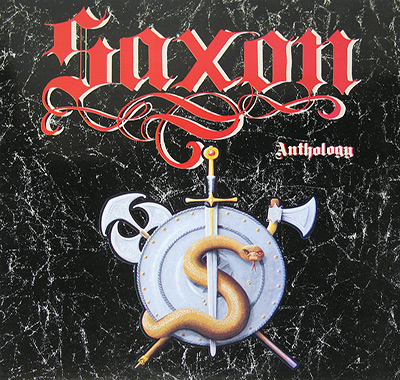
    SAXON - Anthology album front cover vinyl record
    SAXON - Anthology

    Saxon's 'Anthology,' a monumental compilation, emerged in the musical landscape of 1988. The British Heavy Metal icons unveiled this masterpiece as a 12" double LP, a testament to the New Wave of British Heavy Metal (NWOBHM) era. The anthology encapsulates the band's prowess, offering an auditory journey

    Anthology 12" Vinyl LP
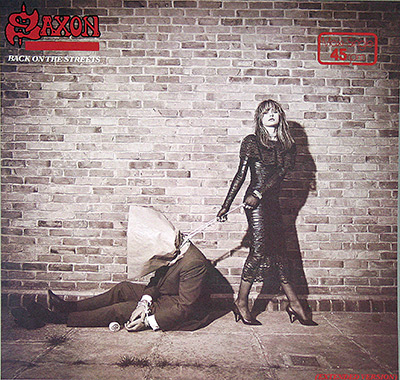
    SAXON - Back on the Streets album front cover vinyl record
    SAXON - Back on the Streets

    In the mid-1980s, British heavy metal band Saxon released an extended 12" vinyl maxi-single featuring two tracks, "Back on the Streets (Extended Version)" and "Live Fast Die Young". This release aimed to capitalize on the success of their album "Innocence Is No Excuse" and further solidify their position

    Back on the Streets 12" Vinyl Maxi
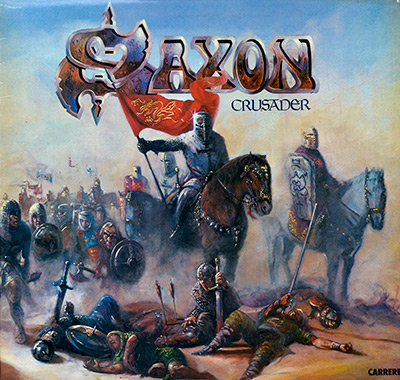
    SAXON - Crusader  album front cover vinyl record
    SAXON - Crusader

    Saxon's "Crusader," a hallmark of NWOBHM in 1984, exemplifies the genre's evolution. Produced by Kevin Beamish, known for his 1980s metal expertise, the 12" Gatefold vinyl offers a tactile journey. This album, a blend of anthems and experimentation, embodies the era's heavy metal spirit.

    Crusader 12" Vinyl LP
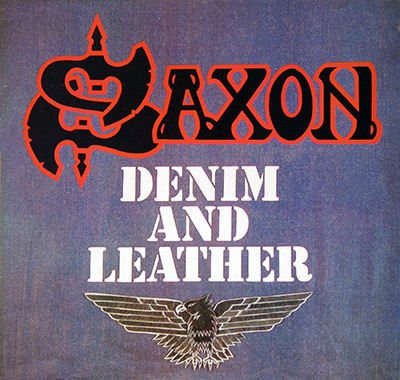
    SAXON - Denim and Leather  album front cover vinyl record
    SAXON - Denim and Leather

    In the early 1980s, amidst a burgeoning New Wave of British Heavy Metal scene, Saxon released their iconic album "Denim and Leather" on 12" vinyl LP. This album solidified their standing in the genre and became an anthem for the burgeoning heavy metal community.

    Denim and Leather 12" Vinyl LP
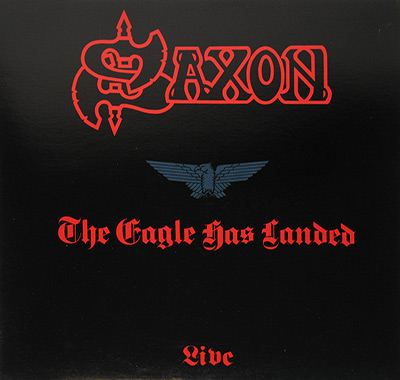
    SAXON - The Eagle Has Landed (Canadian and French Releases)  album front cover vinyl record
    SAXON - The Eagle Has Landed (Canadian and French Releases)

    Released as a 12" vinyl LP album, this live recording transports listeners back to a time when heavy metal was forging its identity, a genre marked by unbridled passion, piercing guitar solos, and anthemic vocals. The early 1980s were a defining period for metal, witnessing the rise of iconic bands

    - The Eagle has Landed Live (1982, Canada) - The Eagle Has Landed Live (1982, France)
    SAXON - Innocence Is No Excuse album front cover vinyl record
    SAXON - Innocence Is No Excuse

    Saxon's "Innocence Is No Excuse," a seminal British Heavy Metal masterpiece, emerged in 1985 as the band's seventh studio album. Marking their debut with EMI post a rift with Carrere Records, the LP showcases Saxon's resilience and evolution. Its tracks resonate with powerful guitar riffs and anthemic vocal

    Innocence Is No Excuse 12" Vinyl LP
    SAXON - Power and the Glory album front cover vinyl record
    SAXON - Power and the Glory

    The late 1970s and early 1980s marked a pivotal moment in the history of heavy metal, giving rise to the New Wave of British Heavy Metal. This movement, characterized by a raw and energetic sound, emerged as a reaction to the perceived stagnation in the rock and metal scenes of the time.

    Power and the Glory 12" Vinyl LP
    SAXON - Rock The Nations (British and German Releases) album front cover vinyl record
    SAXON - Rock The Nations (British and German Releases)

    Saxon's 1986 release, 'Rock The Nations,' epitomizes the NWOBHM era's spirit. Recorded at Wisseloord Studios, the album, featuring Elton John on select tracks, is a testament to Saxon's musical prowess. The production quality at Hilversum elevated their raw sound, contributing to their status as NWOBHM

    - Rock the Nations (1986, England) - Rock The Nations (1986, Germany)

    SAXON - S/T Self-Titled album front cover vinyl record
    SAXON - S/T Self-Titled

    Saxon burst onto the music scene at a time when rock music was undergoing a transformation. The late '70s witnessed the emergence of a new wave of British heavy metal, a movement characterized by the fusion of traditional heavy metal with punk and hard rock influences.

    SAXON - Self-Titled 12" Vinyl LP
    SAXON - Strong Arm Metal, Saxon's Greatest Hits album front cover vinyl record
    SAXON - Strong Arm Metal, Saxon's Greatest Hits

    SAXON's "Strong Arm Metal" is not just an album; it's a journey through the very essence of heavy metal. Released during a period when the genre was exploding with creativity and innovation, the album compiles some of the band's most iconic tracks, showcasing their ability to craft anthems

    Strong Arm Metal, Saxon's Greatest Hits 12" Vinyl LP
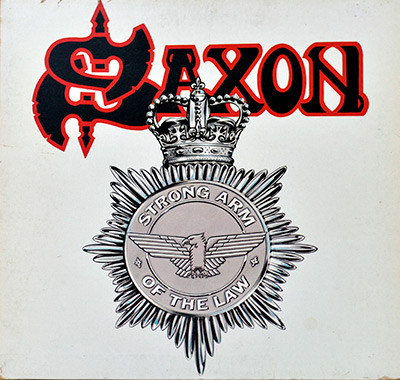
    SAXON - Strong Arm of the Law album front cover vinyl record
    SAXON - Strong Arm of the Law

    Saxon's 1980 album "Strong Arm of the Law," released on Carrere Records in France, encapsulates the dynamic early 1980s metal scene. A product of the New Wave of British Heavy Metal, the album's production on a 12" vinyl LP resonates with the era's analog warmth.

    Strong Arm of the Law 12" Vinyl LP
    SAXON - Wheels of Steel (Multiple International Versions)  album front cover vinyl record
    SAXON - Wheels of Steel (Multiple International Versions)

    The release of "Wheels of Steel" by the British Heavy Metal band SAXON in 1980 marked a significant moment in the history of the genre. This iconic album, recorded at Ramport Studios in London, UK, and produced by Pete Hinton and Saxon themselves, became a cornerstone in the metal landscape.

    - Wheels of Steel (1980, England) - Wheels of Steels ( 1980, Europe ) - Wheels of Steel (1980, France) - Wheels of Steel (1980, USA)