"Wish You Were Here" (1975) Album Description:
"Wish You Were Here" arrived in 1975 with Pink Floyd already sitting on top of the rock world, and you can hear how little comfort that brought them. This is not a victory lap after "The Dark Side of the Moon." It is a colder, thinner-skinned record, full of absence, professional disgust, and the queasy feeling that success has turned the whole operation into a machine with human beings trapped inside it. Even before you study the sleeve, the album gives off heat haze and emotional frost at the same time.
The trick, of course, is that people remember the title track and forget how severe the rest of the album really is. Beneath that famous acoustic ache sits one of the most brittle pieces of mid-1970s prog ever pressed in large numbers, and once you notice the bite in it, the cover, the studio atmosphere, and even the Syd Barrett shadow all start pulling in the same uneasy direction.
Britain in 1975: big stages, smaller patience
In Britain that year, progressive rock still had money, scale, and enough confidence to build cathedrals out of tape reels, synthesisers, and folded sleeve art. Yet the backlash had already started muttering in the corners. Pub rock was dragging guitars back into tighter rooms and simpler clothes, while the arena acts grew richer, slower, and more insulated. Floyd stood right in the middle of that contradiction: massive, technically assured, and deeply suspicious of the very industry feeding them.
Put it next to Yes, Emerson, Lake & Palmer, Genesis, Camel, or even the polished art-school cool of Roxy Music, and "Wish You Were Here" feels less interested in showing off than in stripping the gloss off the room. There is no fantasy-world escape here, no prog peacock display for its own sake. The album moves like a bruised machine: patient, exact, and quietly angry. Very English, really. Tea, resentment, and expensive studio time.
How the band got here
By 1975, the Pink Floyd line-up was long settled: Roger Waters, David Gilmour, Richard Wright, and Nick Mason. The rupture had happened years earlier when Syd Barrett, the original spark and unstable centre of the early band, fell away and Gilmour came in as both practical replacement and emotional witness. That old wound never healed cleanly, and this album does not romanticise it so much as circle it like men who still do not know what to do with the damage.
That is why "Shine On You Crazy Diamond" matters so much. It is not simply a tribute wrapped in incense. It is grief with structure, guilt with a pulse, and a way for Waters in particular to write about Barrett while also writing about absence in a broader sense: the missing friend, the missing self, the missing honesty inside a business built on handshakes and invoices.
Inside the grooves
The album is only five tracks long, but it never feels skimpy. "Shine On You Crazy Diamond" frames the record like a slow-opening and slow-closing gate, built from that patient four-note guitar figure, Wright's ghost-light keyboards, and a rhythm section that understands restraint better than most bands understand force. The sound is spacious without drifting off into wallpaper. Every entrance feels measured, every delay intentional, every swell slightly haunted.
"Welcome to the Machine" is where the temperature drops. The synth texture is hard-edged and airless, the acoustic guitar sounds almost trapped inside the arrangement, and the whole thing advances with the grim certainty of factory doors shutting behind you. "Have a Cigar" adds sneer and grease, with Roy Harper taking the lead vocal and giving the song exactly the right industry-lounge smirk. It does not rant. It curls its lip.
Then comes the title track, which fools people into thinking the record has softened. It has not. The song is beautiful, yes, but it is beautiful in the way a nearly empty room can be beautiful late at night when the light is low and you suddenly notice how quiet everything has become. On a decent pressing, that radio-tuned intro still feels like someone finding the song through static in the next room, and that small trick does more emotional work than half the overblown confessionals made by lesser bands.
Waters supplied the conceptual sting, Gilmour brought the melodic ache and that human guitar voice, Wright filled the spaces with melancholy and depth, and Mason did the least flashy job of all: he kept the whole thing from tipping into mush. That balance is the record's secret. Plenty of 1970s prog albums had ambition; fewer had discipline. Fewer still knew when not to hit the listener over the head with it.
The sleeve and the misunderstanding
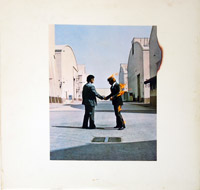
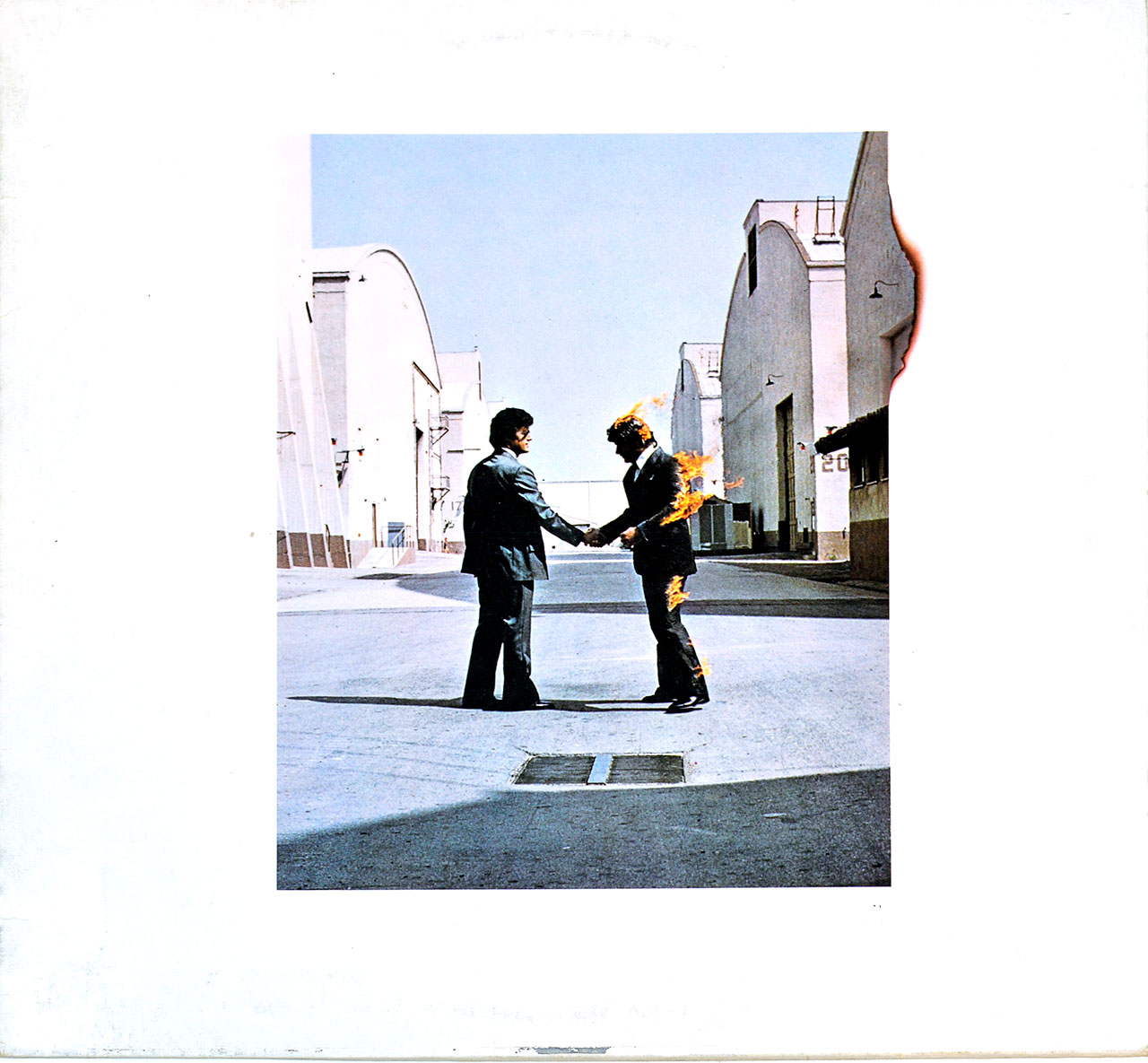
The Hipgnosis cover, with two businessmen shaking hands while one burns, has become so familiar that people forget how nasty the image really is. It is not some dreamy surrealist decoration. It is a joke with teeth: getting burned, selling out, greeting exploitation with a professional smile because that is what the trade demands. For once, the sleeve does not merely match the music; it translates it into a single visual insult.
There was no grand scandal around the release, no public moral panic, no church bells clanging over degeneracy. The real argument was subtler. Some critics at the time thought the album was too solemn, too controlled, too drained of immediacy after the shockwave of "Dark Side." That part gets forgotten now, because history has a bad habit of pretending every classic was greeted like the second coming instead of sometimes being met with a shrug and a raised eyebrow.
The common misconception is that "Wish You Were Here" is only about Syd Barrett. Barrett is central, absolutely, but the album is also about the band staring at itself in the mirror and not much liking what success has turned the reflection into. That is why the industry songs belong here. They are not side comments. They are the same wound in a different suit.
I have always liked records that keep a little distance, records that do not beg to be loved on first contact. This one sits there in your hands like an object that knows more than it plans to say. Fifty years on, it still feels less like a monument than a controlled leak of grief, bitterness, memory, and professional nausea. Not bad for a record some people reduce to the campfire singalong in the middle.
References
- Pink Floyd official "Wish You Were Here" album page
- Pink Floyd official 1975 timeline
- Pink Floyd official band history and biography
- The Guardian interview on Aubrey Powell and the burning-man cover photo
- The Vulcan Blues Experiment archive homepage for album-page context and high-resolution record coverage
 album front cover mediumsize.jpg)
 album front cover mediumsize.jpg)
 album front cover mediumsize.jpg)
 album front cover mediumsize.jpg)
 album front cover mediumsize.jpg)
 album front cover mediumsize.jpg)
 album front cover mediumsize.jpg)
 album front cover mediumsize.jpg)
 album front cover mediumsize.jpg)
 album front cover mediumsize.jpg)
 album front cover mediumsize.jpg)