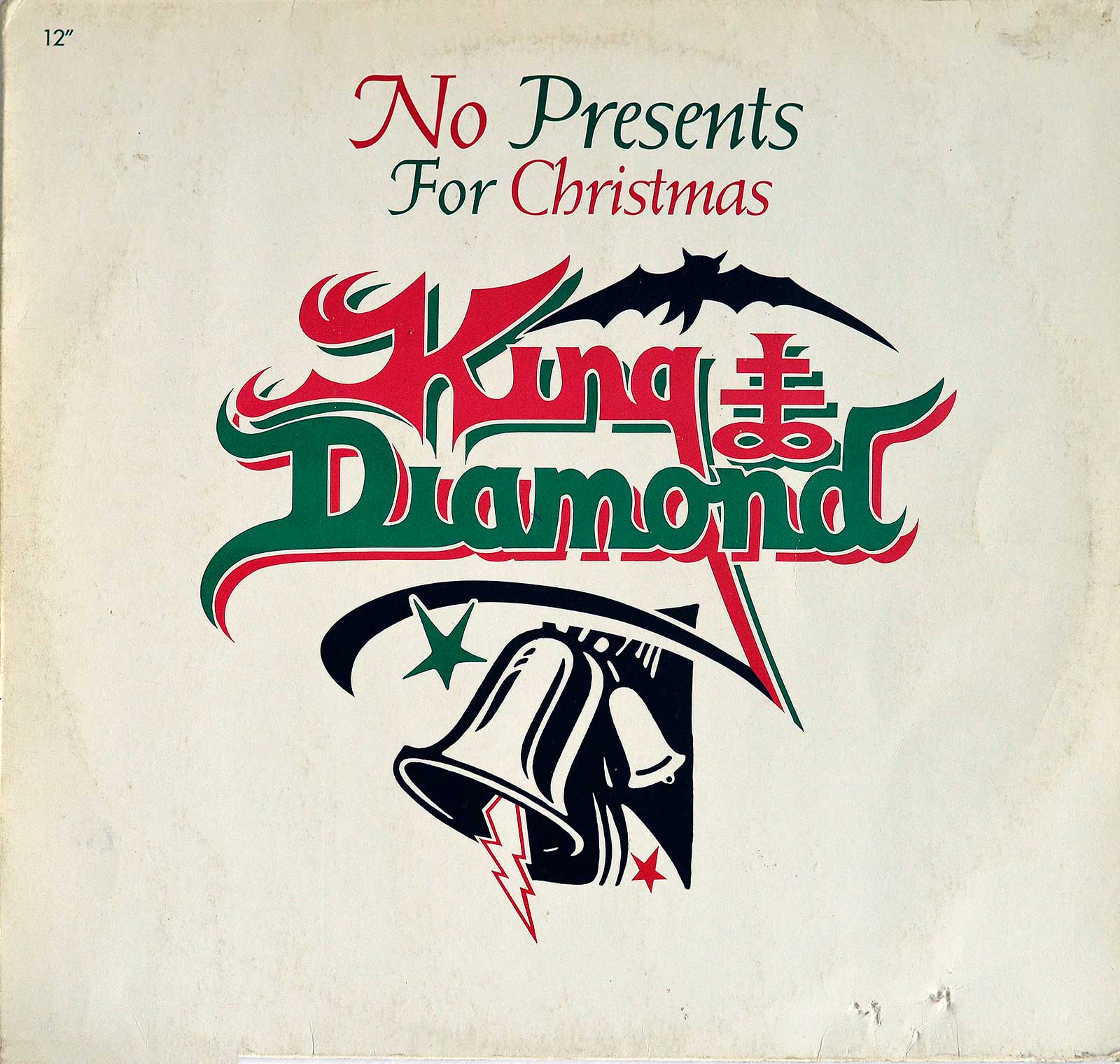
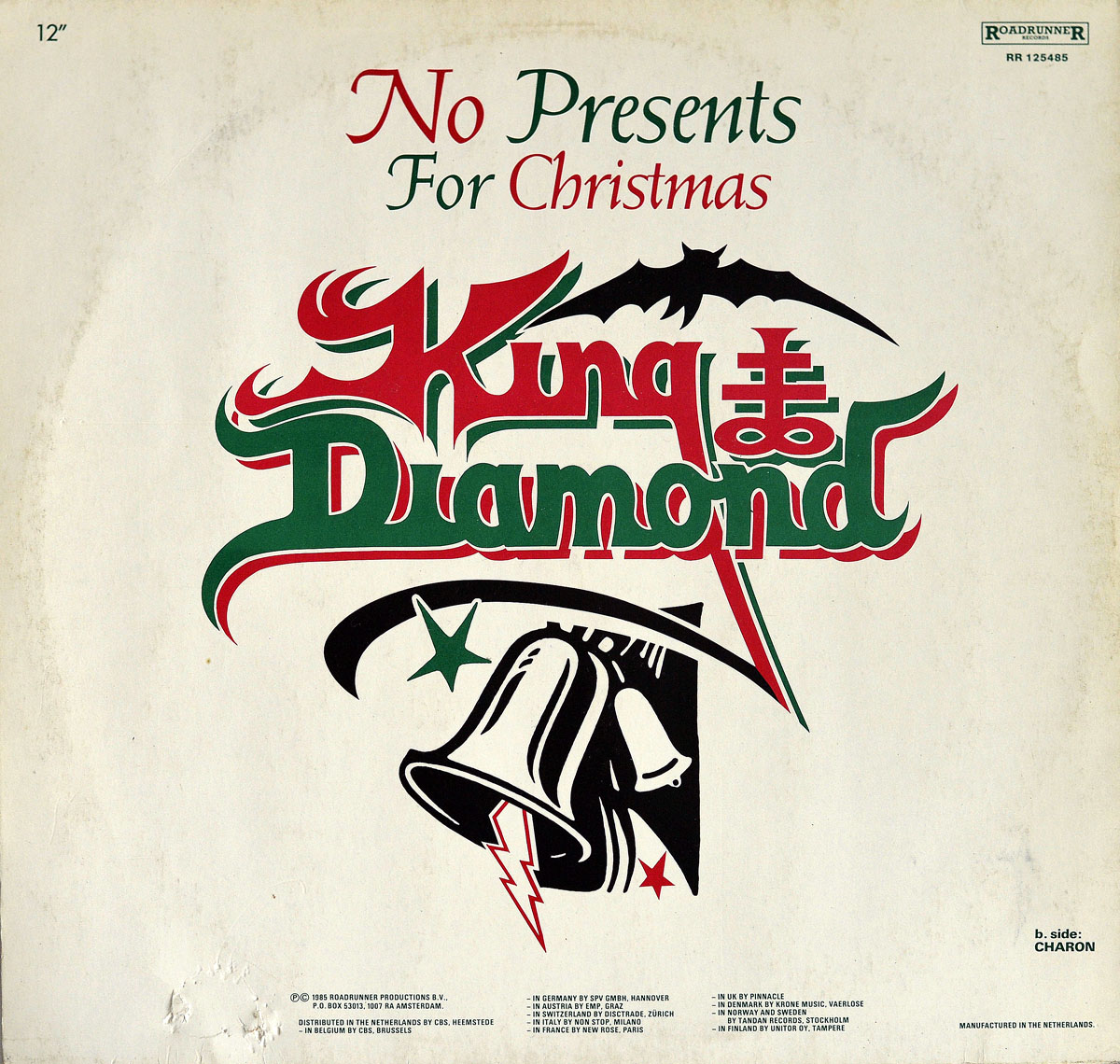
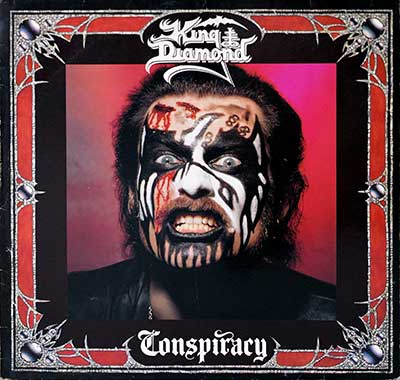
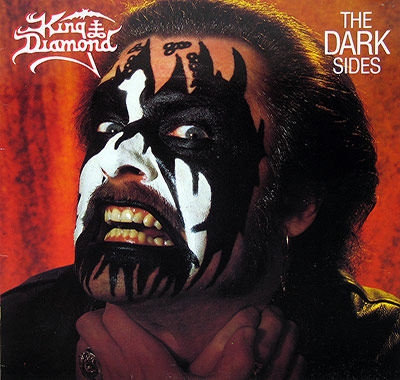
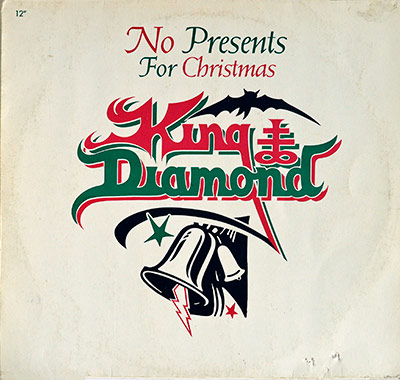
"No Presents For Christmas" Album Description:
In 1985, Christmas morning (25 December) didn’t come with tinsel for me—it came with a 12" slab of bad intentions: KING DIAMOND’s "No Presents for Christmas". First release from the new band, fresh after Mercyful Fate’s initial split, and it sounded like someone kicked the church door open just to see who’d flinch.
I remember the needle drop more than any “historical context.” Bells, that evil laugh, then the riff barges in—fast, sharp, smug. Not “festive.” More like a winter boot to the ribs. King doesn’t sing so much as he stalks the melody, falsetto raised like a blade, daring you to call it camp.
People love to explain it as a “concept.” Fine. The story is a nasty Santa who punishes instead of spoils, but the real hook is the mood: cold air, cheap lights, and a grin that doesn’t mean comfort. You can hear the band learning how to turn theatrics into weight, not just decoration.
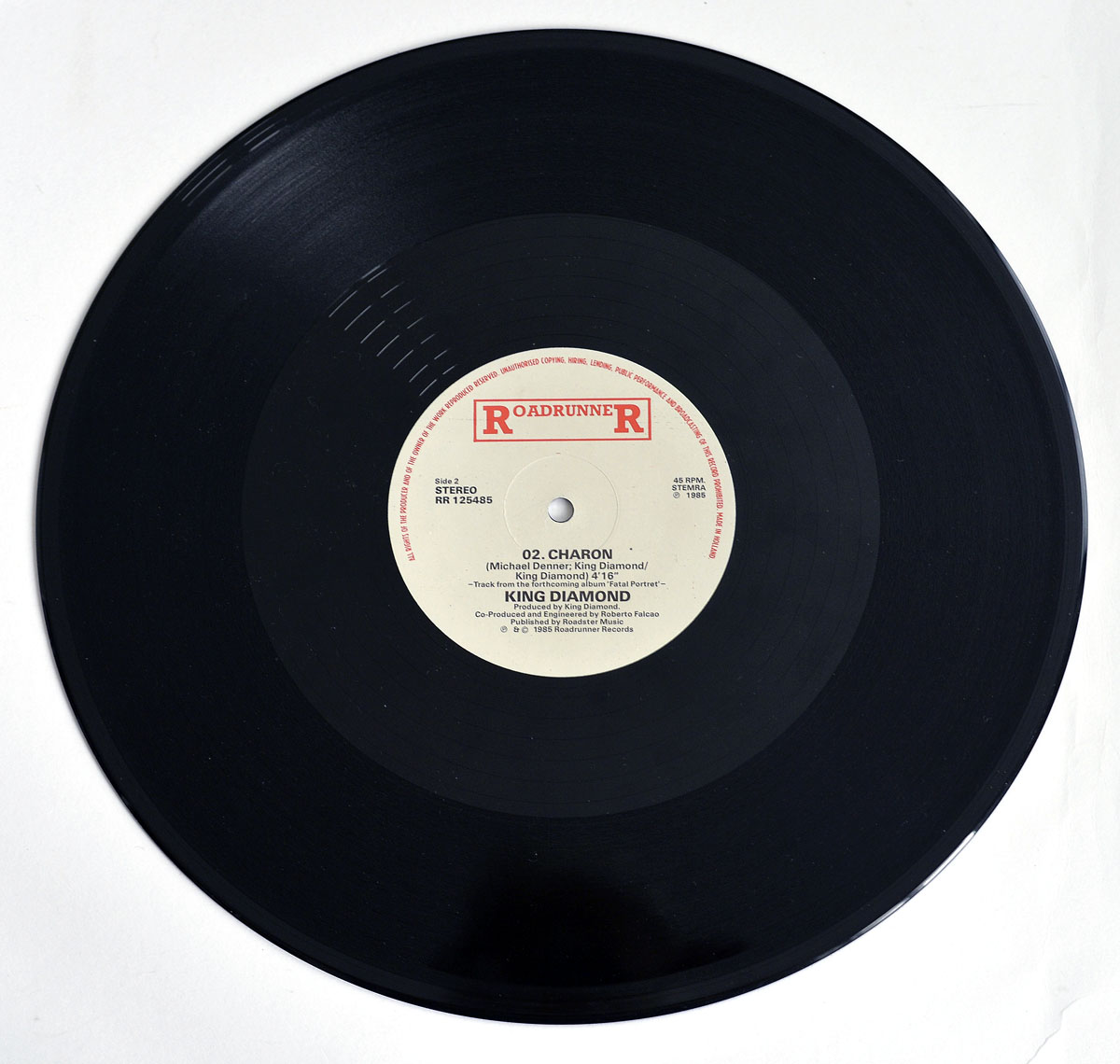
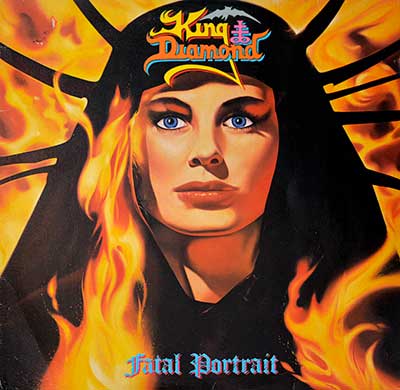
The 12" itself is simple and better for it: one main punch on Side A, and "Charon" on Side B—pulled from the same 1985 sessions that fed "Fatal Portrait" (released 14 March 1986). No padded “immersive experience,” no overstuffed extras. Just two tracks that say: this is the lane we’re driving in.
And yes, the song later turns up as a bonus track on some reissues of "Fatal Portrait", which is a polite way of admitting the single refused to stay a seasonal gimmick. It kept getting played in July. Because metal fans are predictable like that.
Legacy? Here’s mine: it’s still the rare holiday record that doesn’t beg to be loved. It smirks. It bites. And every December, it reminds me that the best “gifts” in metal were often the ones your parents hoped you’d lose behind the radiator.
References
Personnel/Band Members and Musicians on: KING DIAMOND - No Presents for Christmas - |
Band-members, Musicians and Performers
- King Diamond - Vocals
- King Diamond – Vocals, keyboards
The Danish high-priest of the falsetto, whose corpse-paint probably never quite washes off the collar.
Read more...
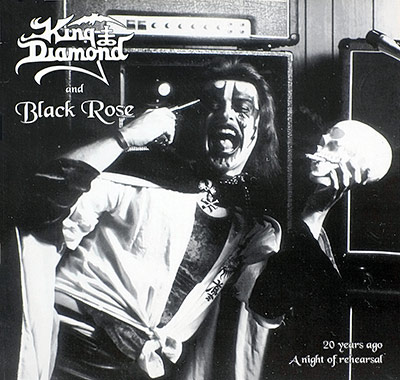
Before he was an icon, Kim Bendix Petersen was just another kid in Copenhagen lugging gear through the mid-70s gloom with Brainstorm and Black Rose. By the time Mercyful Fate coalesced in ’81, he’d stopped playing the part of a frontman and started inhabiting something far more unsettling. To hear that first EP is to hear a man daring the listener to laugh at his theatrics, only to realize the music is too sharp, too lethal, to be a joke. When the Fate inevitably fractured in '85—as bands built on such rigid alchemy usually do—the King simply took the candles and the bone-cross with him. His solo output didn't just 'feature' horror; it exhaled it, turning 12-inch vinyl into a physical medium for ghost stories. It’s music that smells of old velvet and cheap stage fog, anchored by a voice that shouldn't work but somehow, impossibly, does. You either buy into the ritual or you don’t, but you never forget the first time that scream hits the speakers.
King Diamond Wiki
- Andy LaRocque - Guitars
- Andy LaRocque – Swedish guitar virtuoso behind King Diamond's sound.
Joined King Diamond in 1985 and turned shred into story-telling, not sport. Read more... Andy LaRocque, Swedish guitar virtuoso who joined King Diamond in 1985 and never stopped sharpening the knives. Before the robes and candles, he cut his teeth in Gothenburg hard-rock acts Trafalgar and an early Swedish Erotica in the mid-1980s. I hear his stamp from "Fatal Portrait" (1986) through the 1987–1990 run—"Abigail", "Them", "Conspiracy", "The Eye"—where his leads glide then lunge. After the quiet years he’s back on the 1995–2007 albums ("The Spider’s Lullabye" to "Give Me Your Soul...Please"), keeping the melody cold and precise. He also turns up outside the crypt: guitarist on Death’s "Individual Thought Patterns" (1993) and a guest solo on At the Gates’ "Cold" (1995), then later puts producer ears to work at Sonic Train Studios.
- Michael Denner - Guitars
- Michael Denner – Guitarist (Mercyful Fate, King Diamond)
The master of the eerie harmony; the man who proved that heavy metal solos could be as graceful as they are grim.
Read more...
Michael Denner is the reason those early Mercyful Fate records didn’t just sound heavy—they sounded *expensive.* Emerging from the same snot-nosed Brats era as his partner-in-crime Hank Shermann, Denner brought a 70s-inflected soul to the band's occult attack. While others were chasing speed, Denner was chasing the kind of vibrato that lingers in the air like incense. His tenure from '81 to '85 didn't just 'feature' guitar work; it established a twin-guitar language that redefined the genre. When the Fate first fractured, he jumped straight into the fire with King Diamond, providing the neoclassical elegance that makes Abigail (1987) feel like a Victorian ghost story rather than a standard metal record. He’s floated in and out of the fold since—rejoining for the mid-90s resurrection and occasional guest appearances—but his thumbprint is permanent. To hear a Denner solo is to hear a player who values the space between the notes as much as the notes themselves. It’s a sophisticated, slightly melancholic touch that reminds you he grew up listening to the greats before the world turned into a distortion pedal.
- Timi "Grabber" Hansen - Bass
- Timi “Grabber” Hansen – Bassist (Mercyful Fate, King Diamond)
The man didn't just play the bass; he attacked it with a pick-heavy rattle that became the heartbeat of Danish occult metal.
Read more...
Timi Hansen earned the name 'Grabber' for a reason. While most metal bassists of the early '80s were content to be felt and not heard, Hansen used his fingers and a relentless pick attack to carve a space for himself between the twin-guitar assault of Shermann and Denner. He was the foundational weight of Mercyful Fate during that lightning-in-a-bottle run from ’81 to ’85, providing a muscular, clattering drive that kept the band’s high-concept theatrics grounded in the gutter. When the King moved on to solo territory, Hansen was the logical choice to anchor the 1985–1987 era, his lines on Abigail pulsing with a sinister, driving urgency that feels like a pursuit. He returned briefly for the '92 reunion—a final, thunderous victory lap—before the rigors of the road took their toll. There’s a specific, trebly grit to his tone that sounds like a Rickenbacker being pushed to its breaking point. It’s a sound that is sorely missed, a reminder that in the right hands, four strings are more than enough to summon a storm.
- Mikkey Dee - Drums
- Mikkey Dee – Drum legend behind Motörhead, Scorpions, King Diamond
The guy who can make speed feel heavy and heavy feel fast—without breaking a sweat. Read more... Mikkey Dee, Swedish drum legend, hits like a wrecking ball with metronome manners. I first clock him with King Diamond (1985–1989): tearing through "Fatal Portrait" (1986), "Abigail" (1987) and "Them" (1988), then coming back as a session hardcase for "Conspiracy" (1989). He jumps to Don Dokken for the solo blast "Up from the Ashes" (1990), and in 1992 Lemmy snaps him up—Motörhead’s engine room from 1992 to 2015, all muscle, swing, and those grin-inducing drum solos that can run five to fifteen minutes. Since 2016 he’s been driving Scorpions, proving you can be thunderous, clean, and a little dangerous without spilling a beat, night after night.
|