HELLOWEEN – Judas / Ride The Sky / Guardians 12" Vinyl EP Album

- the night early Helloween caught fire on tape and never looked back

Album Front Cover Photo of HELLOWEEN – Judas / Ride The Sky / Guardians Visit: https://vinyl-records.nl/

In 1986, Judas / Ride The Sky / Guardians hit like early HELLOWEEN bottled lightning: the band’s inaugural release and, as the page notes, their only official recording that year—right after Piet(er) Sielck had left. The needle meets “Judas” (cut at Horus Sound Studio, Hannover) and it’s speed-metal bite with melody in the teeth; then the flip turns sweaty and human with “Ride The Sky (Live)” and “Guardians (Live),” captured June 7, 1986 at Sportparadies, Gelsenkirchen, recorded by WDR Köln. Helloween self-produced, steering the chaos on their own terms. Collector whisper: earliest pressings reportedly came without a barcode.

Table of Contents

"Judas / Ride The Sky / Guardians" (1986) Album Description:

The Hook

Needle hits and the first thing that happens is a stupid little grin. Early HELLOWEEN does that. Speed with melody, no polite handshake, no “let me introduce myself,” just straight to the point like the band’s late for a train and the conductor is holding a whip.

Three tracks. One studio cut, two live. Small slab, loud personality. “Judas” up front like a jab to the collarbone, then “Ride the Sky” and “Guardians” on the flip, recorded live, sweating through the grooves. Main character energy, but with actual calluses.

The Era

1986 sits in my head like neon on wet pavement: Europe’s metal circuit humming, clubs packed, amps louder than good sense. West Germany was still West Germany, and you can feel that “build it yourself” vibe in the way records moved—hand to hand, shop to shop, bedroom to bedroom—like contraband that somehow became culture.

One dumb, very real detail always gives it away: the earliest issue reportedly had no barcode. That’s not “trivia.” That’s a time-stamp. That’s the record telling you it existed before anyone thought to scan it at a supermarket. Later copies got the stripes, sure. The first wave just stares back, unbothered. Lowkey flex.

The Genesis

Credit line says Helloween produced it themselves, which is the kind of decision that sounds brave until you remember it’s also exhausting. Control is nice. Control is also pressure. Nobody else was going to translate that speed without sanding it down.

“Judas” was recorded in July 1986 at Horus Sound Studio in Hannover, engineered and mixed by Jan Němec Bocek. That studio name shows up on enough feral German records that it starts feeling like a recurring character—quiet room, loud outcomes.

Then the scene flips: “Ride the Sky” and “Guardians” captured live on 7 June 1986 at Sportparadies, Gelsenkirchen, recorded by WDR Köln. That detail lands differently when you picture it: a public broadcaster rolling tape while a young band tries to outrun its own adrenaline. Not exactly cozy.

The Wax

“Judas” doesn’t stroll in. It lunges. Rhythm guitars clamp down, the kind of tightness that makes the room feel smaller, then the leads sprint past like they’ve got somewhere better to be. Clean enough to hear the decisions. Sharp enough to feel the edges. No cap, the track makes you lean forward even when you promise yourself you won’t.

Live side hits different. Air changes. You can almost smell the cables and warm beer. “Ride the Sky (Live)” feels like the band is playing slightly ahead of the moment, daring the drummer to catch up. “Guardians (Live)” keeps the same “hold on or get dragged” posture, less studio manners, more stage gravity.

One more wrinkle: “Judas” was re-mixed by Dirk Steffens for Soundhaus Studio. Remixing a single track like that always reads as stubbornness to me. Sometimes stubbornness is the only reason a record survives.

The Peer Review

This EP sits in a very specific Helloween corridor, and the walls are loud. Quick reference points around it:

“Judas / Ride The Sky / Guardians” lives between those poles like a hinge: still raw enough to bite, already reaching for that brighter power-metal lift. Some people prefer the later sheen. This middle moment? That’s my kind of mess.

The Friction

Page notes call this the only official Helloween recording during 1986, landing after Piet Sielck had left the band. That kind of line reads calm on paper and jittery in reality. A year with one official artifact usually means the band was moving parts around, trying to keep the engine from coughing.

Self-production plus a later remix is a tell. Not gossip. Just a pattern: the band hears something, doesn’t like what it implies, goes back in, changes the weather. Creative tension rarely shows up as a fistfight. More often it shows up as an extra pass at the same song because sleep is cheaper than regret.

The Legacy

Collector brain lights up fast here: Noise Records, Cat# N 0048, Made in Germany, and a physical presence—total weight noted as 230g. That number isn’t romance, but it does tell you the thing sits heavy in the hand. Which matters. Records are objects before they’re opinions.

Sleeve and label photos seal it because documentation is half the hobby, and this release photographs like it knows it’ll be hunted later. Value isn’t just rarity in 2026. Value is a moment where the band’s future still looks molten, still forming, still capable of going sideways. That uncertainty is the spice.

The Fade Out

Cardboard slides shut, the label disappears, and the silence after “Guardians” hangs there a second too long—like the room is deciding whether to put the needle back down or pretend it has plans.
Album Key Details: Genre, Label, Format & Release Info

Music Genre:

Power Metal / Speed Metal

Label & Catalognr:

Noise (White Label) – N 0048

Media Format:

Record Format: 12" Vinyl Stereo Gramophone Record
Total Weight: 230g

Release Details:

Release Date: 1986

Release Country: Germany

Production & Recording Information:

Producers:
  • Helloween
Sound & Recording Engineers:
  • Jan Němec Bocek – Sound engineer & mixing
  • Jan Němec Bocek – Sound engineer & producer

    One of those behind the the mixing pult (Mischpult) craftsmen whose name you see in the credits right where the sound suddenly makes sense.

    Jan Němec Bocek, I’ve always filed him under the quietly essential studio people—the ones who never mug for the camera but absolutely shape what comes out of the speakers. During the 1980s he worked as a sound engineer and producer at the Horus Sound Studio, right in that sweet spot when European rock and metal records were getting bigger, tighter, and more confident. That decade defines his main working period, and you can hear it in the disciplined yet punchy studio sound he helped capture. No rock-star mythology here, just long hours, good ears, and the kind of decisions that only reveal themselves years later when a record still holds up.

Recording Location:

Horus Sound Studio – Hannover, Germany

  • Horus Sound Studio– Recording studio (Hannover, Germany)

    Horus Sound Studio is the Hannover birthplace of Teutonic thrash—founded in 1979, the room where that German riff-machine learned mayhem, and somehow always near the scene of the riff-crime.

    Horus Sound Studio doesn’t announce itself with fireworks; it just sits there in Hannover and keeps ending up on the back of records that sound like they were forged, not “produced.” The name starts showing up, then showing up again, until it’s basically living on my shelf rent-free.

    Frank Bornemann built the place in 1979, and that date matters because it tells you this wasn’t some latecomer cash-in. This was infrastructure. A real room with real walls that could take volume without flinching.

    Sleeves get flipped, credits get scanned, and suddenly there it is: Steeltower hammering out Night of the Dog (recorded and mixed Jan–Sept 1984), Living Death pushing Metal Revolution through the desk (recorded and mixed Aug 1985). Both of them sound like the amps were slightly insulted to be treated “professionally.” Love that. No cap.

    Then the bigger names start piling in, and the pattern gets almost suspicious. Kreator tracking and mixing Terrible Certainty in 1987. Sabbat cutting History of a Time to Come in Sept 1987. Helloween grinding through the winter of 1986–1987. Sodom getting Agent Orange mixed there in April 1989. Not a coincidence. More like the studio knew how to keep the edges sharp instead of sanding them down for “radio.”

    Plenty of studios capture sound. Horus captures intent—the part where a band decides to stop asking permission. Anyone calling that “just a room” is either lying or has never heard what a good room does to a hungry band.

  • Mixing Studio & Location:

    Horus Sound Studio – Hannover, Germany

    Additional Mixing:

    “Judas” was re-mixed by Dirk Steffens for Soundhaus Studio.

  • Dirk Steffens – Record producer & audio engineer

    One of those names you spot in the small print and think, “yeah… that explains why this record hits like it does.”

    Dirk Steffens, I first noticed him the boring way: squinting at a sleeve under a lamp because the credits were printed in that tiny “good luck, red colour, grandpa” font. And there it was again. That’s his whole thing—he’s not the poster on the wall, he’s the reason the wall shakes. Before he settled behind the desk, he did the band grind: Beathovens (1969–1971), then he kicked off Pennywonder (from 1971), then a quick, real stretch with Birth Control (July 1973–January 1974). After that he didn’t “transition” into production like a LinkedIn fairy tale—he just went where the work was, where the hours were long, and where the sound either gets disciplined or gets embarrassing. I tend to trust producers who’ve actually played in bands; they don’t romanticize the mess, they fix it. For the neat timeline (and the extra rabbit holes), here’s the Dirk Steffens Wiki

  • Live Recordings:

    “Ride the Sky” and “Guardians” were recorded live on 7 June 1986 at Sportparadies, Gelsenkirchen by Westdeutscher Rundfunk (WDR), Köln.

    Album Cover Design & Artwork:
    • Edda & Uwe Karczewski – Album cover design
  • Uwe Karczewski – German graphic artist (album cover designer)

    The name in the credits that explains why your eyes stay on the sleeve longer than they should.

    Uwe Karczewski, I notice him the same way I notice a good riff: not immediately, then suddenly I can’t unsee it. I’ve had nights where the record is already playing and I’m still stuck under a desk lamp, turning the cover like it’s evidence. That’s the Karczewski effect—1980s heavy metal fantasy art that doesn’t politely “support” the music, it shoves it forward. His best-known stretch is tied to Helloween’s early era, with cover credits in the 1985–1988 run: the Helloween EP (1985), Walls of Jericho (1985), Keeper of the Seven Keys: Part I (1987) and ...Part II (1988). And then he shows up again on Iron Angel—Hellish Crossfire (1985) and Winds of War (1988)—because apparently the 80s still needed more fire and steel on cardboard. Some cover art just sits there. His stuff kind of stares back. Uwe Karczewski Wiki

  • Photography:
    • Hansen / Limb – Front cover concept, back cover concept & live photography

    Collector’s Note: WDR (Westdeutscher Rundfunk) in the 1980s: When Cologne Put Rock on the Record

    WDR in the 1980s was basically Cologne’s giant public “tape machine,” and metal bands loved it because it didn’t need to be convinced that volume was a personality trait. This wasn’t some shiny label office with beige carpet and a “please hold” voice. This was public broadcasting with serious gear, serious engineers, and a lowkey obsession with capturing live energy before it evaporated. When you spot “Recorded by WDR Köln” in the credits, it’s not a cute footnote—it’s a stamp that says: somebody professional pointed microphones at the chaos and actually committed it to tape.

    For collectors, that matters. WDR recordings from that decade often have this particular feel: clear enough to hear the room, but still rough at the edges, like the mix is refusing to put on manners. The crowd is there, the stage is there, the nerves are there. That’s why those live cuts don’t sound like a “concert souvenir.” They sound like a moment that got caught in a net—fast, noisy, and very much alive. And honestly? That’s the whole point of chasing these credits in the first place.

    Band Members / Musicians:

    Band Line-up:
    • Kai Hansen – Vocals, Guitars

      Kai Hansen always shows up before I’m ready, like a starting pistol firing behind the sofa while the coffee is still cooling.

      Kai Hansen feels less like a traditional frontman and more like a force that leans too far forward and drags the band with him. In the early Helloween years, guitars came first and vocals followed almost by necessity, from 1984 through the late ’80s when everything still felt fast, risky, and unfinished. When he left in 1989 it wasn’t drama, just impatience in motion. Gamma Ray didn’t slow anything down; it doubled the pressure, speed with a grin that still had teeth. These songs don’t stroll or explain themselves. They shove, they dare, and they expect you to keep up.

    • Michael Weikath – Guitar

      I keep him filed under “sunlight with a switchblade.” The kind of guitarist who makes a chorus feel friendly right up until it knocks your drink over.

      Michael Weikath is Hamburg-born and stubbornly melodic, and I mean that as a compliment and a warning. I’ve heard plenty of fast guitar players. He’s one of the few who sounds like he’s arguing for the hook. Not begging. Arguing.

      Back when I was still judging bands by how quickly they could light up a cheap club PA, his trail starts in 1978 with Powerfool—kids with amps and ambition, basically, the classic “we’ll sleep later” setup. Then he slides into the early Helloween gravity in 1982, when things are still half-formed and hungry, before the band plants the official flag in 1984 and starts turning Hamburg sweat into something the whole world eventually copies.

      What I like about Weikath is the discipline. The riffs don’t wander off to show off. They march. They steer the song, they herd the chorus into place, and they don’t apologize for being bright. Some metal people act allergic to joy—like a melody will ruin their leather. Weikath never got that memo, and thank God. His playing keeps saying: you can be fast, sharp, and still sing. And if that bothers you… that’s kind of the point.

      Michael Weikath Wiki
     
    • Markus Grosskopf – Bass

      Some bassists “hold it down.” Grosskopf drags the whole band forward by the belt. You feel it in your ribs before you can even name it.

      Markus Grosskopf is Hamburg through and through, and I mean the practical kind of Hamburg: show up, plug in, make it work. Born in 1965 and active since 1978, he’s the founding Helloween bassist who makes speed feel organized—like somebody finally put the chaos on a timetable.

      The part I always grin at is how unglamorous it starts. He’s a kid with a bass because the room needs one, and suddenly he’s bashing through punky stuff in a space that probably smells like cables and bad decisions. Then he goes looking for something heavier and lands in Kai Hansen’s band Second Hell, right before that early Helloween crew locks in with Michael Weikath and the name becomes official in 1984.

      I’ve got a dumb little ritual: grey morning, coffee going cold, I throw on an early cut just to check whether the bottom end still feels like steel. It does. Grosskopf doesn’t “support” the guitars—he keeps them honest. And by 1990, when he’s also involved with Mr. Prooster, you can already tell he’s the type who won’t sit still just because the main band is rolling.

    • Ingo Schwichtenberg – Drums

      He didn’t just keep time. He grabbed it by the collar and yanked it into the spotlight—still grinning. “Mr. Smile” wasn’t a marketing trick. It was the face you got even when the tempo was trying to run away.

      Ingo Schwichtenberg is the founding Helloween drummer I think of when people romanticize “the early days” but forget the work. Hamburg bred, active from 1978 to 1993, he played like the kit was a moving vehicle and he’d rather steer than sit politely in the back. That kick wasn’t decoration. It was a decision.

      Before Helloween was official in 1984, he’d already been grinding through the local trenches with bands like Gentry and Iron Fist—those pre-fame rooms where the air is warm, the amps are cheap, and nobody cares about your “image,” only whether you can hold the song together when everything else gets loud. He learned the hard way. You can hear it.

      From 1984 until 1993 he’s the engine behind Helloween’s first era, and I’ll be honest: I prefer that urgency to a lot of the later, shinier perfection. He hits like he means it, but he doesn’t smear the music—he snaps it into place. Fast, clean, a little dangerous. The kind of drumming that makes you stand closer to the speakers even though you know you shouldn’t.

    Complete Track-listing:

    Tracklisting Side One:
    1. Judas
    Video: Helloween - Judas (Full EP 1986)
    Tracklisting Side Two:
    1. Ride the Sky (Live)
      Recorded live on 7 June 1986 at Sportparadies, Gelsenkirchen.
    2. Guardians (Live)
      Recorded live on 7 June 1986 at Sportparadies, Gelsenkirchen.

    Disclaimer: Track durations shown are approximate and may vary slightly between different country editions or reissues. Variations can result from alternate masterings, pressing plant differences, or regional production adjustments.

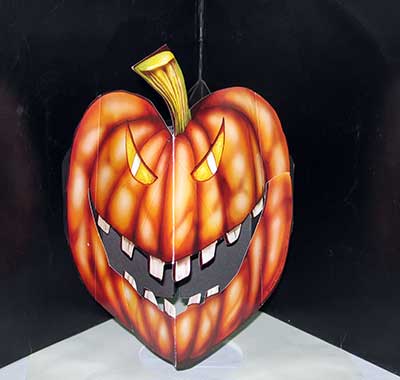
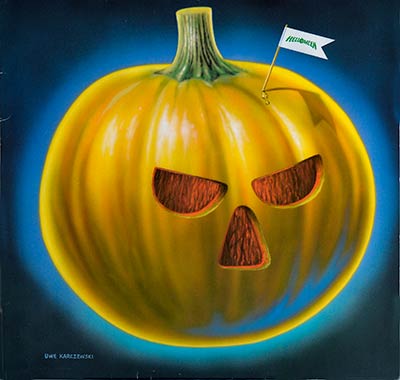
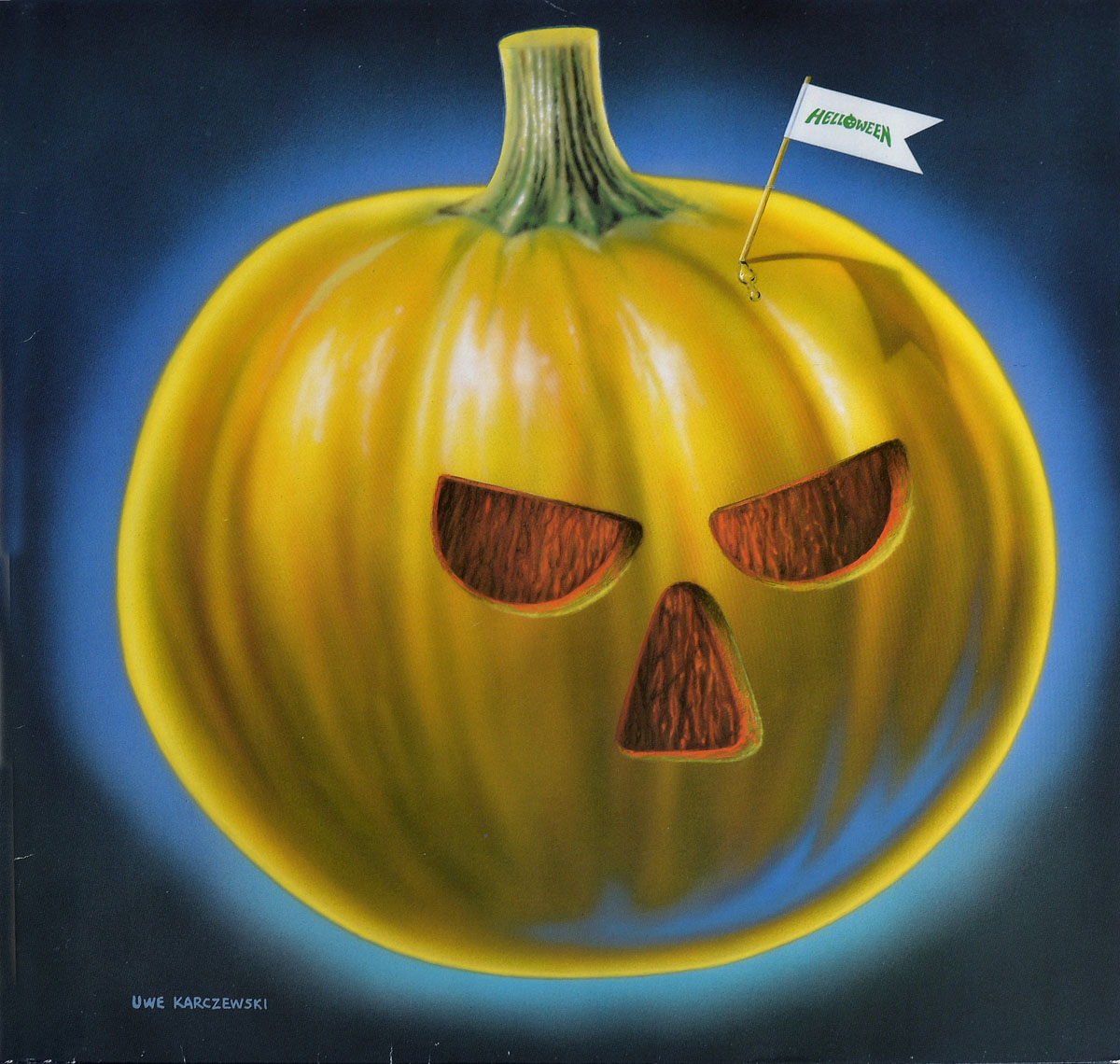
    Front cover of Helloween’s Judas / Ride The Sky / Guardians EP showing a large yellow-orange pumpkin with carved, angular eyes and nose on a deep blue-black background; a small white Helloween flag is pinned into the pumpkin’s upper right side, highlighting the band’s early mascot and clean, minimal Noise Records sleeve design.

    Front cover still hits fast. No warm-up. One pumpkin, way too big for the sleeve, shoved right into the center like it refuses to share space. Yellow leaning hard into orange, the stem still sickly green. Everything else backs off into that dark blue fade. Nothing competes. Nothing dares.

    The face isn’t friendly and it’s not trying to be. Eyes cut on a slant, impatient, almost annoyed. Nose punched out in a blunt triangle. No mouth at all. That’s the part people forget. No grin, no joke yet. This pumpkin hasn’t learned how to sell itself. It just stares.

    Look closer and the surface gives it away. This isn’t a real pumpkin and it doesn’t pretend to be. Airbrush work all over it—smooth gradients, soft highlights, those darker vertical bands faked just enough to suggest weight. Studio logic. 1980s logic. The kind where control mattered more than realism.

    Then there’s that flag. Small. Almost cheeky. White triangle, green HELLOWEEN lettering, pinned in with a tiny gold fastener like a claim staked in cardboard. That detail always feels louder than it looks; less decoration, more declaration.

    The background stays empty because it has to. No liner text. No band photo. No shouting. The sleeve trusts the symbol to do the work. Uwe Karczewski’s credit sits low and quiet, where it belongs. Blink and you miss it. That restraint didn’t last forever.

    Seen from across a room, this sleeve still works. That’s not nostalgia talking—that’s physics. High contrast, dumb clarity, zero clutter. This is the Noise Records presentation before regional tweaks and later branding crept in. Some covers age into classics. This one just waited.

    Album Back Cover Photo
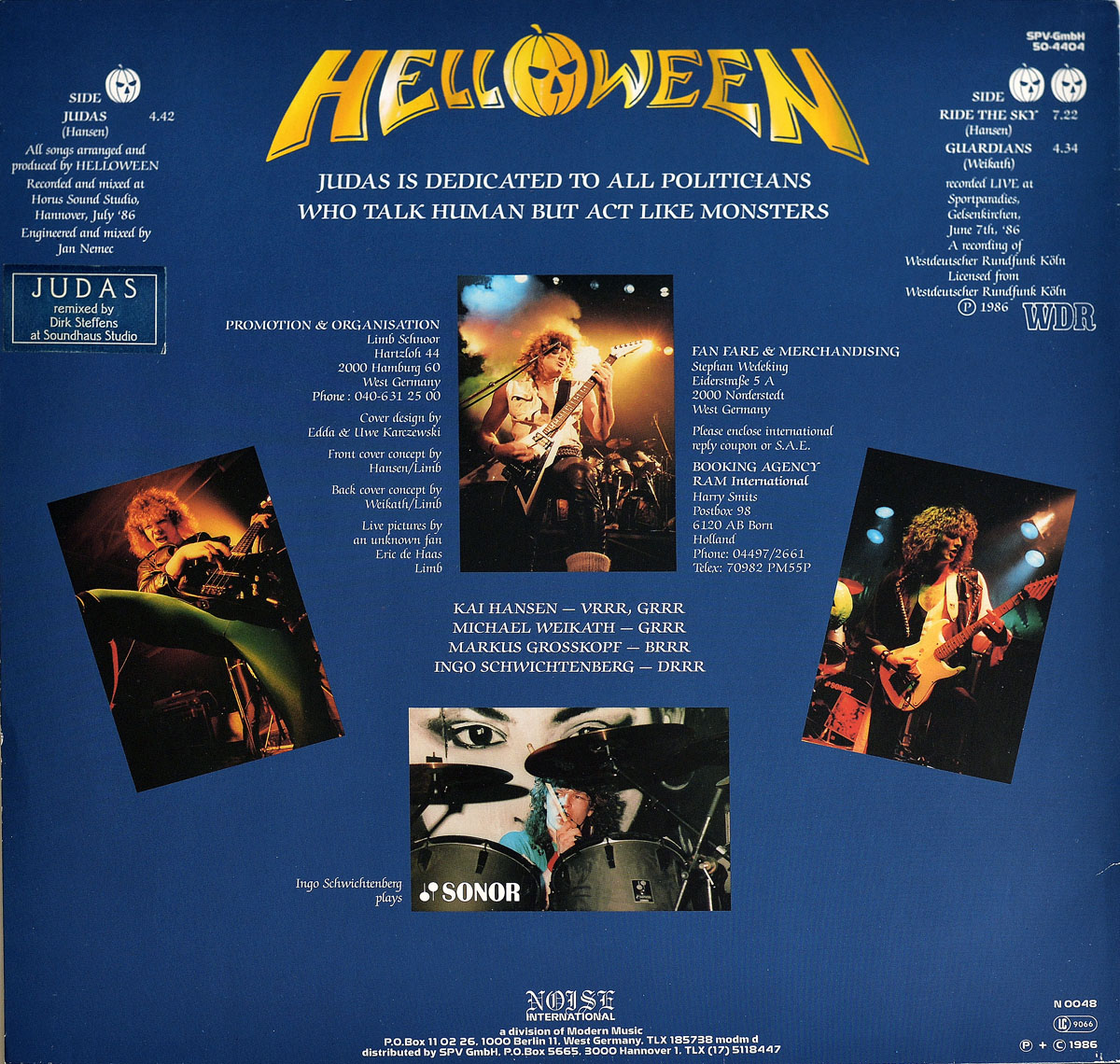
    Back cover of the HELLOWEEN Judas / Ride the Sky / Guardians Noise Records 12-inch vinyl, deep blue background, oversized yellow HELLOWEEN logo with pumpkin O, political dedication text, left and right track listings, multiple live band photos, dense credits and addresses, drummer photo with SONOR logo, and Noise International distribution details along the bottom edge

    The back cover of the original Noise Records 12" is a slab of unapologetic, flat blue—the kind of saturated hue that dominated West German print shops in 1986. It’s a color that doesn't age gracefully; it reveals every hairline fracture in the cardboard and every white-scuffed corner. If you find a "near-mint" copy now, someone either never played it or treated it like a religious relic.

    The HELLOWEEN logo dominates the top, a massive canary-yellow banner with the pumpkin face locked into the “O.” It’s pure ink-on-cardboard. No Photoshop glows, no digital trickery. Just bold, aggressive typography. Below it, the political dedication is typeset in all caps with a bluntness that feels almost naive today: “JUDAS IS DEDICATED TO ALL POLITICIANS WHO TALK HUMAN BUT ACT LIKE MONSTERS.” There’s no irony here. This was a time when a bunch of kids from Hamburg actually thought a liner note could puncture a suit’s ego.

    Side A is the business end: “Judas”, 4:42. You can almost smell the stale coffee and cigarette smoke of Horus Sound Studio in Hannover. Jan Nemec engineered it, but the collectors—the real obsessives—zero in on that boxed note about Dirk Steffens’ remix at Soundhaus. It sits there like a nervous footnote, a tiny admission that the first pass maybe wasn't quite lethal enough.

    Flip the gaze to Side B. “Ride the Sky” and “Guardians.” These aren't pristine studio captures; they’re raw documents from Sportparadies Gelsenkirchen, June '86. The credits don't try to mythologize the night. They just list the facts: WDR Köln, ©1986, SPV distribution. It’s a paper trail for a sonic assault.

    The photography is a mess of controlled German speed. Kai Hansen is center-stage, V-guitar angled toward the ceiling in that mandatory power-metal geometry. It’s a pose, sure, but in 1986, it was a manifesto. At the bottom, Ingo Schwichtenberg stares out from behind the SONOR kit, his face half-swallowed by shadow. There’s something claustrophobic about his shot—the room feels smaller, the air thinner. The SONOR logo is rendered with the crispness of a corporate stamp of approval.

    Then there’s the band list. No instruments mentioned. Just VRRR, GRRR, BRRR, DRRR. It’s objectively stupid, the kind of joke told in a van at 3:00 AM, yet it’s the only thing on the sleeve that feels truly human. It breaks the Teutonic stiffness of the Noise International layout. It reminds you that between the booking agents in Norderstedt and the post office boxes in Berlin, there were just four guys having a laugh while playing faster than anyone else.

    By the time your eyes hit the LC 9066 code and the N 0048 catalog number, the spell is complete. It’s a rigid, intentional piece of design that somehow manages to vibrate with the frantic energy of the music inside. Most copies you find now are beaten to hell, the blue ink fading into grey at the edges—which is exactly how a record like this should look.

    NOISE INTERNATIONAL – a division of Modern Music
    P.O. Box 11 02 26, 1000 Berlin 11, West Germany, TLX 185738 mod d
    Distributed by SPV GmbH, P.O. Box 5665, 3000 Hannover 1, TLX (17) 5118447
    LC 9066 – N 0048 – © ℗ 1986
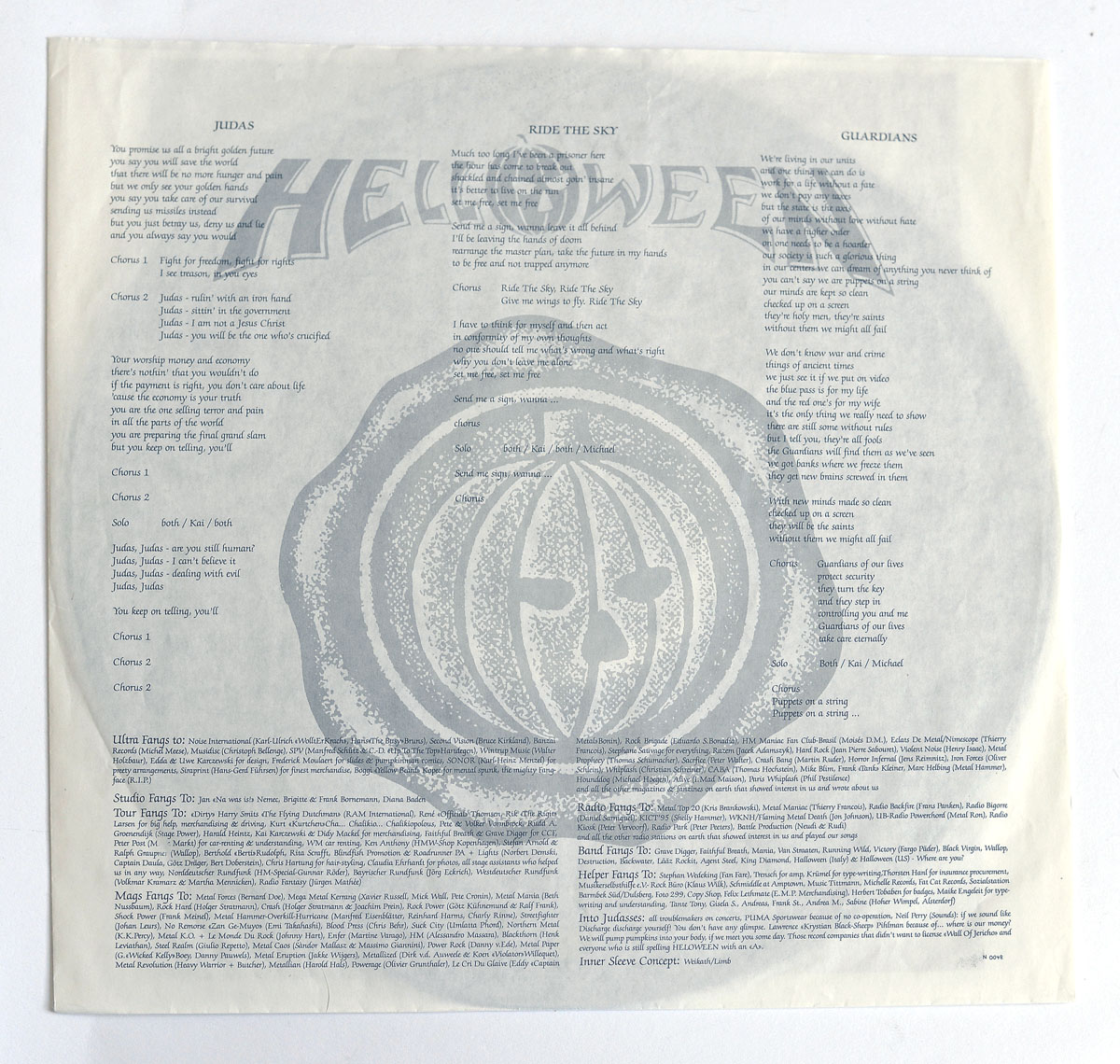
    First Photo of Custom Inner Sleeve
    Inner sleeve of the HELLOWEEN Judas / Ride the Sky / Guardians Noise Records vinyl, printed on off-white paper with three lyric columns, faint oversized HELLOWEEN logo watermark across the center, pumpkin-face emblem behind text, dense small-print credits along the bottom edge, and visible paper creasing typical of mid-1980s inner sleeves

    The inner sleeve is a flimsy, matte-white ghost. It’s printed on that specific mid-80s German paper stock—thin enough to be translucent if you hold it to the light, and prone to "waving" if the humidity in your room so much as thinks about changing. It’s a fingerprint magnet. If the original owner was eating chips while reading the lyrics to Judas, you’ll know. The stains are part of the provenance now.

    Three columns of text. Justified. Dense. Aggressive. There’s zero whitespace to breathe here; it’s a wall of information that demands you squint. JUDAS, RIDE THE SKY, GUARDIANS—the titles sit there in small, serif type like gravestones. No padding. No mercy. It’s the visual equivalent of a double-kick drum assault: relentless and crowded.

    Then there’s the watermark. A pale-grey HELLOWEEN logo and a ghosted pumpkin face lurking behind the lyrics like a threat. It’s a classic Noise Records move—layering branding under the content so you can’t look at one without the other. It creates this low-level visual vibration, a tension between the legibility of the words and the grinning mascot underneath.

    The bottom of the sleeve is a nightmare of fine print. A literal census of the 1986 metal underground. Studio credits, promoters, magazines, "Ultra Fangs" lists—it’s a chaotic sprawl of names that feels like scanning a phone book while falling down a flight of stairs. It’s obsessive. It’s thorough. It’s a record of a scene that was still small enough to fit on a single piece of paper.

    Weikath and Limb handled the "concept," which apparently meant: no jokes, no flares, just the facts. The typography is brutally functional. It’s the kind of layout that shouldn’t work—it’s too dry, too Teutonic—but against the speed-metal chaos of the music, it feels like the only sane way to organize the noise.

    Condition is everything. These sleeves split if you breathe on them. The glue dries out, the edges go yellow, and the seams blow out the moment you slide the vinyl back in too fast. Finding a copy that hasn't turned into a wrinkled, sepia-toned mess is a minor miracle. Most of them look like they’ve been through a war, which, considering the music, they probably have.

    Second Photo of Custom Inner Sleeve
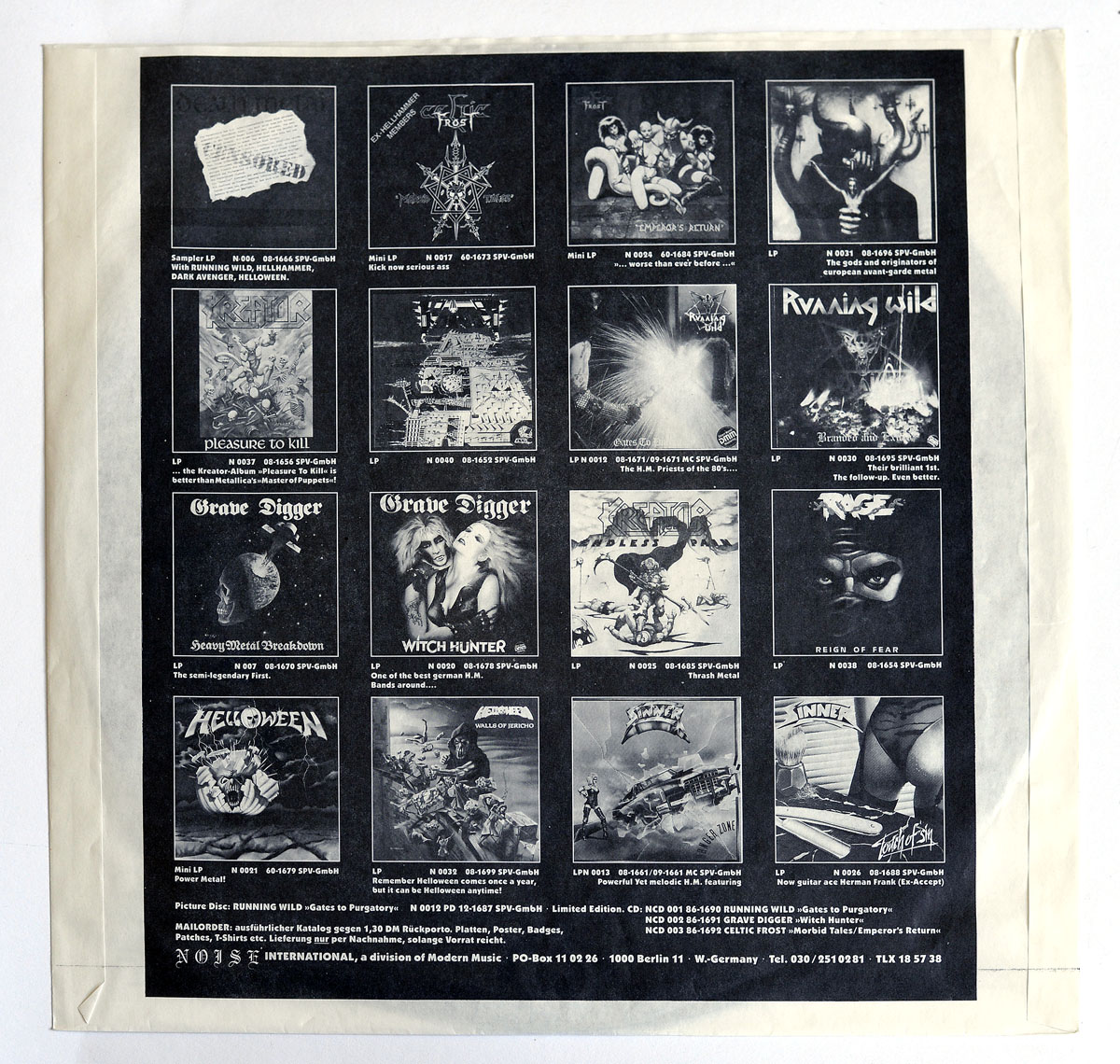
    Second inner sleeve of the HELLOWEEN Judas / Ride the Sky / Guardians Noise Records vinyl, showing a full-page black catalog grid with small album cover images, artist names, catalog numbers, format details, and Noise International branding, printed on off-white paper with visible edge wear

    The bottom edge is pure 1986 logistics. There’s a Telex number. A Berlin phone number. Ordering instructions that feel more like a military directive than a sales pitch. This wasn't "marketing" in the modern sense; it was a lifeline. When you're fifteen, stuck in a bedroom in a town where the local shop only stocks Phil Collins, this grid was your only map to the underground. You didn't just look at it; you studied it until the catalog numbers were burned into your retinas.

    Black ink is a cruel mistress on cheap paper. This is where the ring wear hits first—a ghostly, circular scuff that marks exactly where the vinyl has been pressing against the sleeve for three decades. The creases at the corners turn white against the dark background, highlighting every time you were too impatient to slide the record back in properly.

    You used to sit on the floor, the smell of old paper and static-charged PVC in the air, imagining what a band called Grave Digger actually sounded like based on a half-inch square of blurry artwork. It was a slow, tactile way to discover music—one that required patience and a bit of a leap of faith. Today’s streaming algorithms are more efficient, sure, but they’ll never feel as significant as a dirty thumbprint on a Noise Records catalog.

    Close up of Side One record’s label
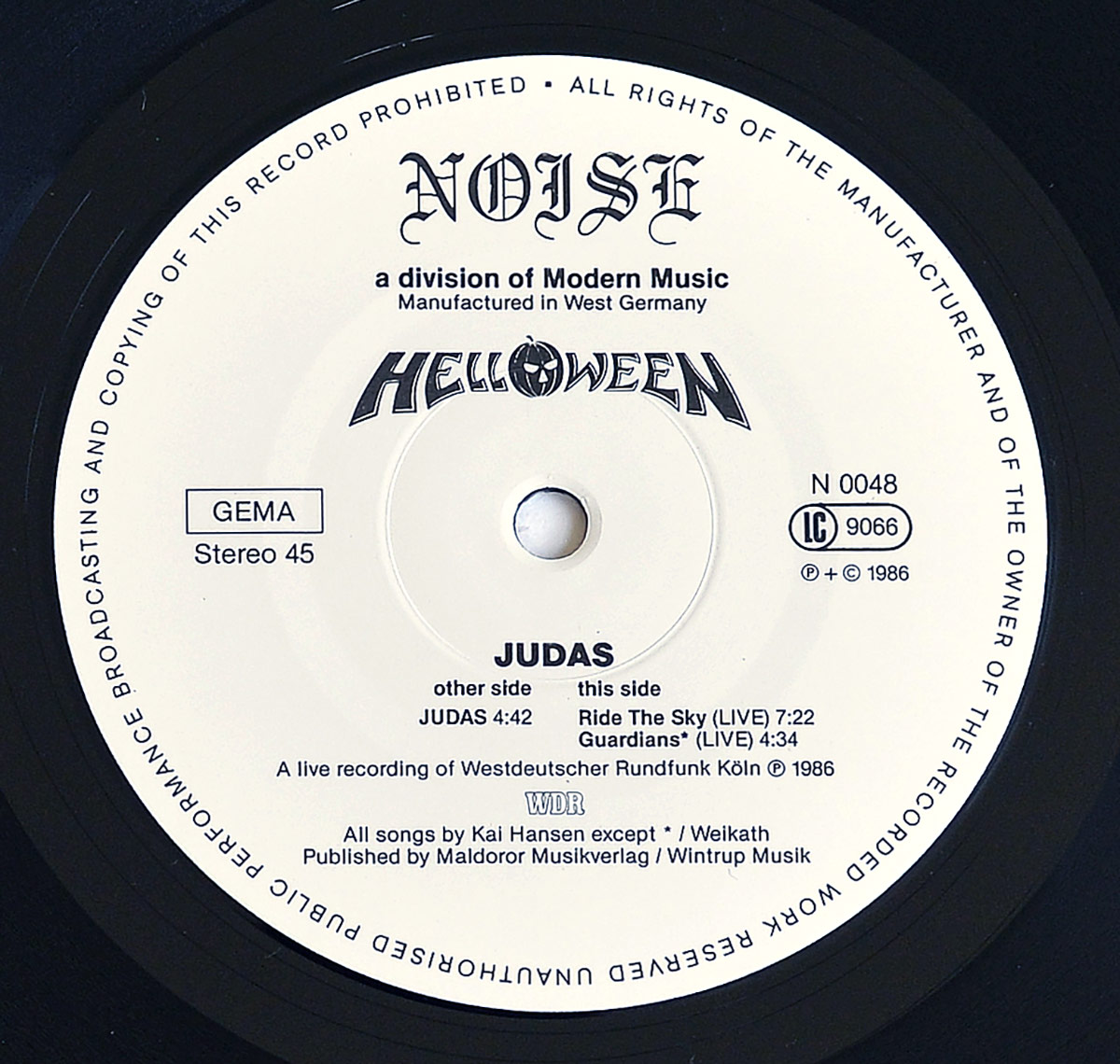
    Close-up of the white Noise Records Side One label on the HELLOWEEN Judas / Ride the Sky / Guardians 12-inch vinyl, showing black gothic NOISE logo, HELLOWEEN band logo, catalog number N 0048, LC 9066, GEMA box, Stereo 45 marking, track listing for Judas and live versions of Ride the Sky and Guardians, and circular copyright text around the label edge

    The white label of Side One hits you first—stark, clinical, and jarring against the black expanse of the vinyl. It’s a 12-inch slab from 1986, and it feels like it. There’s a certain heft to these West German pressings, a lack of flex that suggests the engineers at Modern Music weren’t interested in shortcuts. The grooves are tight, concentric rings of math and mayhem, catching the light without a single cloud or pressing bubble to ruin the view.

    Up top, the NOISE logo looms in that severe blackletter type. It looks more like a medieval decree than a record label, punctuated by the cold geography of Manufactured in West Germany. In '86, that line was a promise of silent noise floors and Teutonic precision. It’s a ghost of a country that doesn’t exist anymore, printed in ink that hasn't faded a shade.

    The HELLOWEEN logo is tucked underneath, small enough to be humble but featuring that ridiculous pumpkin-face “O” peering through the spindle hole. It’s perfectly centered. You look for the wobble—the slight off-kilter drift of a lazy press—but it isn't there.

    On the right, the numbers stack up: N 0048. Catalog numbers are the secret language of the obsessed, the coordinates we use to find our way home. Then there’s the GEMA box on the left, sitting next to Stereo 45. It’s a reminder that this isn't an LP to be endured; it’s a high-speed assault.

    The tracklist is a bit of a tease. JUDAS gets the top bill, but the real meat is buried in the fine print: those live cuts from Westdeutscher Rundfunk Köln. Broadcast metal. You can almost hear the hum of the WDR cables and the smell of stale beer in the Cologne air just by looking at the logo. It’s an official capture of a band about to explode, documented with the bureaucratic sobriety of a tax form.

    A fence of copyright warnings wraps around the rim in cramped, angry capitals. It’s the usual legal static—don't copy, don't broadcast, don't breathe too loud—that nobody ever read but everyone respected as part of the ritual.

    This copy is suspiciously clean. No spindle trails—those tiny, tell-tale scratches that reveal a previous owner was too drunk or too tired to find the center hole on the first try. No thumbprints. No grease. It’s a pristine artifact that feels almost too quiet for the music it holds. It’s the real deal, even if it looks like it’s spent forty years hiding from the sun.

    Side Two Close up of record’s label
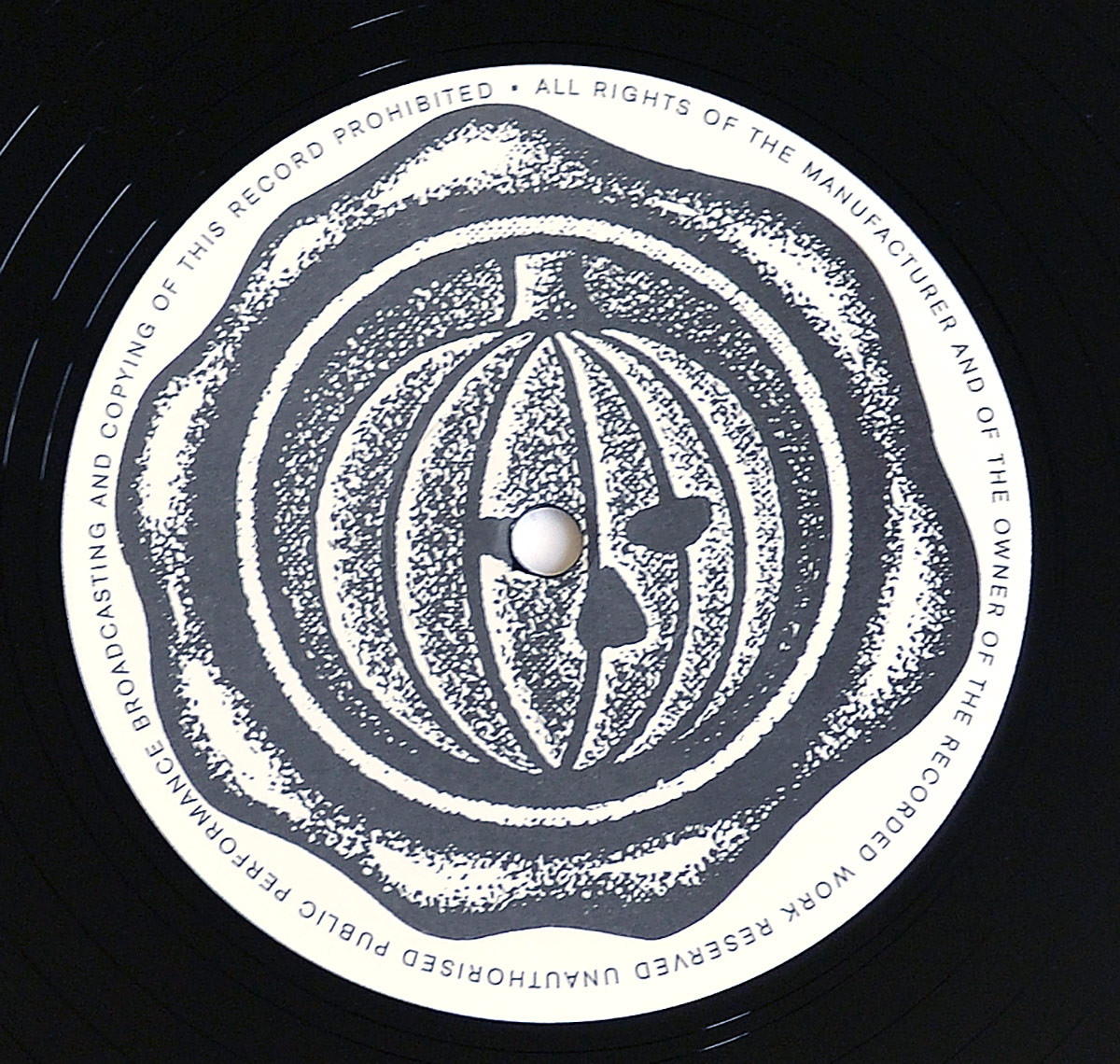
    Close-up of the Side Two vinyl label for HELLOWEEN Judas / Ride the Sky / Guardians, featuring a large grey pumpkin-face emblem filling the center, white label background, circular copyright text around the edge, and black vinyl grooves framing the design with visible light reflections

    Flip the disc over and the bureaucracy of Side One vanishes. No tracklist, no credits, no fine-print reassurance. Just the pumpkin. It’s a large, grainy smudge of grey ink that feels less like a corporate logo and more like something photocopied in a basement and slapped onto the white label with a shrug. It stares back at you through the spindle hole, a blank-eyed mascot for a subgenre that was still figuring out its own punchlines.

    The texture is the thing. It’s not "clean." It looks like speckled concrete or a low-resolution transmission from a dead frequency. The outer ring of the face isn’t a perfect circle; it wobbles and bleeds, carrying the raw, DIY thumbprint of the early Noise Records era. It’s messy. It’s lo-fi. It’s exactly how 1980s power metal was supposed to feel before the digital polish stripped away the grit.

    The only thing keeping the whole thing from looking like a bootleg is the ring of legal static hugging the edge. That thin halo of small capitals—all the usual threats about broadcasting and public performance—provides the only structural fence on an otherwise lawless white field. It’s a strange contrast: the rigid German legalities of the rim protecting a giant, grinning vegetable in the center.

    You don’t look for information here; you look for the ritual. When the platter starts spinning, the face blurs into a grey strobe, a rotating signature that tells you exactly which tribe you belong to. The vinyl itself is suspiciously well-behaved, catching the light in long, oily arcs that suggest the previous owner treated this like a religious relic rather than a party record. No frantic scuffs or "drunk-at-3-AM" spindle gouges to be found.

    It’s a cocky move, honestly. Noise Records trusted the image enough to leave the label essentially mute. It forces you to actually remember what you’re about to hear instead of reading it off a list. It’s a quiet bit of theater for the obsessed—though you’ll still find yourself flipping it back over in five minutes just to double-check the track times. Old habits die hard.

    All images on this site are photographed directly from the original vinyl LP covers and record labels in my collection. Slight differences in color may occur due to lighting and camera equipment used over the years. Images may be used for personal or non-commercial purposes with a link back to this site; commercial use requires permission.

    The Complete HELLOWEEN 1980s Vinyl Albums Discography

    Thumbnail of HELLOWEEN - The Best The Rest The Rare incl free 12" Record album front cover
    HELLOWEEN - The Best The Rest The Rare incl free 12" Record

    "Helloween - The Best, The Rest, The Rare" is a seminal compilation album showcasing the German power metal band's diverse catalog. Released in 1991, it features a curated selection of their finest tracks, including rare gems. The inclusion of a free 12" vinyl LP adds a collector's touch. This album stands as a testament to Helloween's musical prowess and enduring influence in the metal genre.

    Learn more
    Thumbnail of HELLOWEEN - Dr Stein Transparent Vinyl popup Phallus Cover album front cover
    HELLOWEEN - Dr Stein Transparent Vinyl popup Phallus Cover

    Helloween's "Dr. Stein" 12" Vinyl LP Album, limited to 750 copies, boasts a rare transparent vinyl pressing and a gatefold cover. The surprise lies within – an amusing pop-up phallus-shaped pumpkin. This unique release marries musical artistry with playful creativity, captivating collectors and fans alike, showcasing Helloween's commitment to delivering exclusive and memorable experiences in the realm of rare vinyl.

    Learn more
    Thumbnail of HELLOWEEN - Dr Stein Accord France album front cover
    HELLOWEEN - Dr Stein Accord France

    The French release of Helloween's "Dr Stein" 12" Maxi-single on Accord Records in 1988 marked a pivotal moment in the band's ascent to global metal acclaim. A strategic collaboration with the French label showcased the growing demand for collectible formats. The release, with extended mixes and captivating cover art, remains a cherished relic, reflecting the vibrant era when metal transcended borders and became a dynamic subculture.

    Learn more
    Thumbnail of HELLOWEEN - Dr Stein Picture Disc album front cover
    HELLOWEEN - Dr Stein Picture Disc

    The Helloween "Dr. Stein" picture disc 12" maxi-single/mini-LP vinyl is a rare and coveted collector's item. Featuring the band's infectious track "Dr. Stein", this picture disc edition adds a visual dimension to the experience. With its unique artwork and limited availability. This special edition captures the essence of the band's energetic sound and makes for a prized addition to any music collection.

    Learn more
    Thumbnail of HELLOWEEN - Dr Stein 12" Maxi-Single  album front cover
    HELLOWEEN - Dr Stein 12" Maxi-Single Vinyl

    The 12" Maxi-Single Vinyl of Helloween's "Dr. Stein" stands as a collector's gem in Germany. Released on a distinctive yellow record label adorned with captivating "pumpkin" artwork, this edition embodies the band's iconic presence. A cherished piece among enthusiasts, its historical significance is rooted in the vibrant tapestry of Helloween's musical journey, reflecting an era when vinyl reigned supreme in the realm of musical expression.

    Learn more
    Thumbnail of HELLOWEEN - Dr Stein 12" Yellow Coloured Vinyl album front cover
    HELLOWEEN - Dr Stein 12" Yellow Coloured Vinyl

    Helloween's iconic "Dr. Stein" EP, now available on a stunning Yellow Vinyl 12", encapsulates the essence of the band's power metal prowess. This edition, a testament to the enduring appeal of physical formats, stands out with its vibrant color. Released amid Helloween's illustrious career, the Yellow Vinyl EP pays homage to the era when such extended plays were cherished collector's items, a sonic treasure for fans of metal's golden age.

    Learn more
    Thumbnail of HELLOWEEN - Dr Stein / Savage + Poster 7" Single album front cover
    HELLOWEEN - Dr Stein / Savage + Poster 7" Single

    Helloween's 1988 7" vinyl single, "Dr. Stein" b/w "Savage," epitomizes the band's rise in the power metal scene. Released by Noise International, the A-side's iconic "Dr. Stein" and its B-side counterpart "Savage" showcase the group's dynamic sound. The inclusion of a Derek Riggs-designed poster enhances its collector's appeal, cementing its status as a treasured relic from the golden era of European power metal.

    Learn more
    Thumbnail of HELLOWEEN - Future World Picture Disc album front cover
    HELLOWEEN - Future World Picture Disc

    Helloween's "Future World" 12" Vinyl Picture Disc, born in the late '80s during the band's peak, epitomizes the marriage of auditory and visual artistry. Crafted amidst the vinyl era's zenith, this collector's gem features vibrant artwork directly printed onto the disc's surface. With limited availability, it stands as a coveted relic, blending melodic power metal with striking visuals for an immersive musical journey.

    Learn more
    Thumbnail of HELLOWEEN - S/T Self-Titled Picture Disc album front cover
    HELLOWEEN - S/T Self-Titled Picture Disc

    The Helloween self-titled vinyl picture disc mini-LP is a true gem for fans of the band. This superb 186gr picture disc not only showcases the band's iconic sound but also features a surprise track that adds an element of excitement. With the addition of Michael Kiske's exceptional vocals, this release becomes a must-have for collectors and enthusiasts, offering a unique and captivating listening experience.

    Learn more
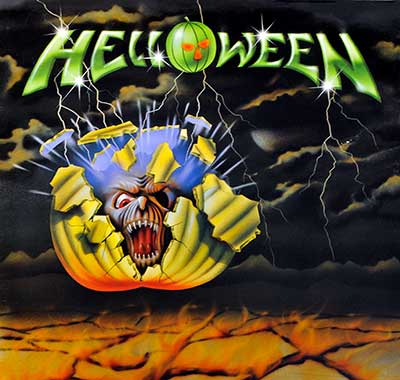
    Thumbnail of HELLOWEEN - Self-Titled Debut Album Mini-LP album front cover
    HELLOWEEN - Self-Titled Debut Album Mini-LP

    Helloween's self-titled debut, released on 26 May 1985, stands as a pivotal moment in power metal history. Produced by Harris Johns, the mini-LP showcased the band's fusion of speed and melody. With tracks like "Starlight" and "Murderer," it left an indelible mark on the metal scene, influencing a new wave of bands. This iconic album remains a testament to Helloween's innovation and enduring impact on the genre.

    Learn more
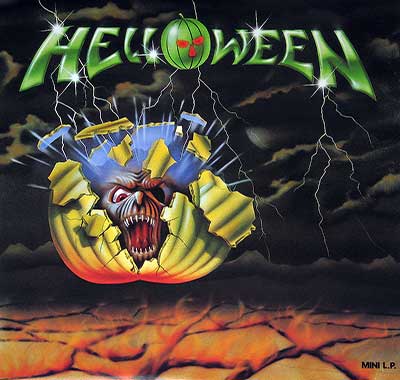
    Thumbnail of HELLOWEEN - Self-titled Debut Mini-LP Banzai Records Canada album front cover
    HELLOWEEN - Self-titled Debut Mini-LP Banzai Records Canada

    Helloween's self-titled debut EP, the Banzai Mini-LP, marks the genesis of the German metal band's journey in the early 1980s. Produced by Harris Johns, the Canadian release through Banzai Records propelled Helloween onto the international stage. With tracks like "Starlight" and "Murderer," the EP showcases the band's signature melodic riffs and powerful vocals, leaving an indelible mark on the global heavy metal scene.

    Learn more
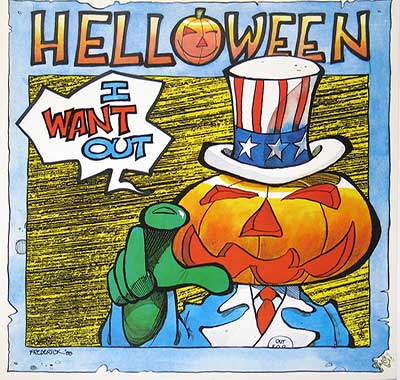
    Thumbnail of HELLOWEEN - I Want Out 12" Maxi-Single album front cover
    HELLOWEEN - I Want Out 12" Maxi-Single

    "I Want Out" was written by Kai Hansen, who confirmed in an interview, that it was a hint of him really wanting "out" of the band. Musically, the song is characterised by a recognisable introduction and Michael Kiske's trademark high pitched singing in the chorus

    Learn more
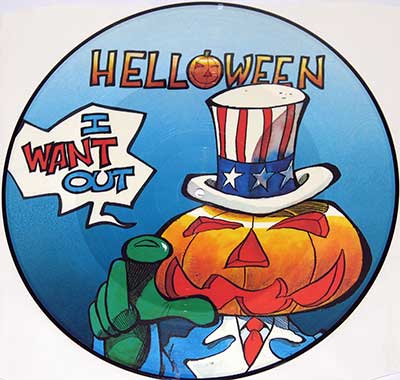
    Thumbnail of HELLOWEEN - I Want Out Picture Disc  album front cover
    HELLOWEEN - I Want Out Picture Disc

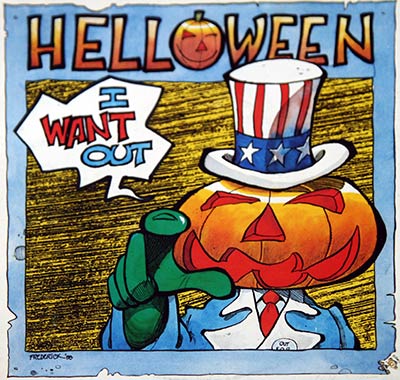
    The Helloween "I Want Out" PD Picture Disc 12" Vinyl Maxi-Single showcases their iconic sound and features the unforgettable tracks "I Want Out", "Save Us", and "Don't Run For Cover". The artwork screams late-’80s rebellious metal energy, with its cartoonish, anarchic Uncle Sam pumpkin daring you to break free from the system—loud, bold, and utterly defiant.

    Learn more
    Thumbnail of HELLOWEEN - I Want Out / Don't Run for Cover + Poster 7" Single album front cover
    HELLOWEEN - I Want Out / Don't Run for Cover + Poster 7" Single

    Helloween's 7" vinyl single, "I Want Out" b/w "Don't Run for Cover," is a collector's delight. Released in the Picture Sleeve format, this edition boasts a compelling fusion of melodic metal. Accompanied by a Large Poster, the release not only delivers musical prowess but also visual appeal. A must-have for enthusiasts, it encapsulates Helloween's sonic excellence and adds a touch of artistry to the vinyl experience.

    Learn more
    HELLOWEEN - Judas / Ride The Sky / Guardians 12" Vinyl EP Album front cover vinyl EP album https://vinyl-records.nl

    No Barcode, No Mercy: Helloween’s First Shot Fired on Noise Records

    HELLOWEEN - Judas / Ride The Sky / Guardians 12" Vinyl EP Album

    This 12" EP is Helloween arriving loud and early: their inaugural release with "Judas" plus the live blasts "Ride The Sky" and "Guardians." Early pressings came without a barcode (collector alarm bells: yes), while later reissues added one. It’s a lean mid-80s Noise artifact—raw, fast, and historically pivotal.

    Thumbnail of HELLOWEEN - Keeper Of The Seven Keys Part I Gatefold  album front cover
    HELLOWEEN - Keeper Of The Seven Keys Part I Gatefold

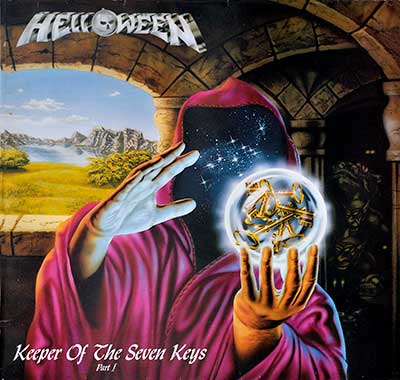
    "Helloween's 'Keeper of the Seven Keys" Part I,' a pivotal 1987 power metal album, emerges as a collector's gem with its genuine German gatefold 12" vinyl issue. Marked by a distinctive black label and white artwork, this edition embodies the band's evolution and showcases the allure of vinyl's tactile experience. A sought-after artifact, it encapsulates a crucial chapter in heavy metal history."

    Learn more
    Thumbnail of HELLOWEEN - Keepers of the Seven Keys Part I France Gatefold  album front cover
    HELLOWEEN - Keepers of the Seven Keys Part I France Gatefold

    "HELLOWEEN's iconic album, 'Keeper of the Seven Keys Part I,' marked its French debut on a distinctive 12" Vinyl LP. Released with a unique light blue label adorned with captivating white artwork, this edition stands out in the vibrant tapestry of musical history. The fusion of melodic mastery and visual aesthetics encapsulates HELLOWEEN's influential journey, offering French enthusiasts a cherished sonic experience through this carefully crafted vinyl release."

    Learn more
    Thumbnail of HELLOWEEN - Keeper of the Seven Keys Part II  album front cover
    HELLOWEEN - Keeper of the Seven Keys Part II

    Released in 1988, "Keeper of the Seven Keys Part II" is Helloween's third studio album, following the triumph of Part I. This German power metal masterpiece seamlessly continues its predecessor's legacy, captivating audiences across Europe, Asia, and the United States. The 12" Vinyl LP format enhances the sonic experience, making it a cherished gem for metal enthusiasts and a pivotal chapter in Helloween's illustrious career.

    Learn more
    Thumbnail of HELLOWEEN - Keeper of the Seven Keys Part II France  album front cover
    HELLOWEEN - Keeper of the Seven Keys Part II France

    This album "HELLOWEEN - Keepers of the Seven Keys Part II" is the third studio album by German power metal band Helloween, released in 1988. The album capitalized on the success of Keeper of the Seven Keys Part 1 and picks up where it left off.

    Learn more
    Thumbnail of HELLOWEEN - Limited Edition Interview Picture Disc album front cover
    HELLOWEEN - Limited Edition Interview Picture Disc

    This album "HELLOWEEN - Limited Edition Interview Picture Disc" is an unofficial recording of an interview with Helloween .

    Learn more
    Thumbnail of HELLOWEEN - Live in the UK  album front cover
    HELLOWEEN - Live in the UK

    "Live in the U.K." is the first live album released by the band Helloween. It was released in some countries as "Keepers Live". In the United States, it was released as "I Want Out – Live "without the track "Rise and Fall", and with a shorter edit of the introduction.

    Learn more
    Thumbnail of HELLOWEEN - Live in the UK Picture Disc album front cover
    HELLOWEEN - Live in the UK Picture Disc

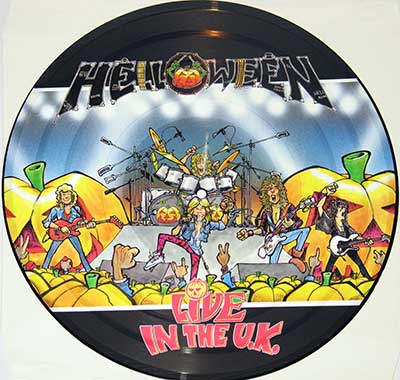
    Helloween's "Live In The UK" Picture Disc 12" Vinyl LP stands as a coveted gem for collectors. This limited edition release showcases the band's electrifying live performance, offering fans a unique auditory and visual experience. The intricate design of the picture disc adds an extra layer of allure to this hard-to-find album, making it a prized possession for enthusiasts of both Helloween and vinyl records.

    Learn more
    Thumbnail of HELLOWEEN - Pink Bubbles Go Ape Gatefold  album front cover
    HELLOWEEN - Pink Bubbles Go Ape Gatefold

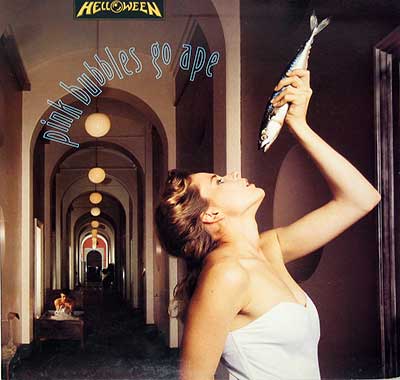
    Helloween's "Pink Bubbles Go Ape" Gatefold + Lyrics Sleeve 12" Vinyl LP Album, released in 1991, signifies a pivotal moment in the band's history as guitarist Kai Hansen departs and Roland Grapow assumes the role. This collector's edition, featuring a gatefold and lyrics sleeve, encapsulates the evolution of Helloween's sound, making it a must-have for aficionados seeking a tangible piece of the band's transformative musical journey.

    Learn more
    Thumbnail of HELLOWEEN - Pumpkin Box 4-CD + Book + 2 Posters Japan album front cover
    HELLOWEEN - Pumpkin Box 4-CD + Book + 2 Posters Japan

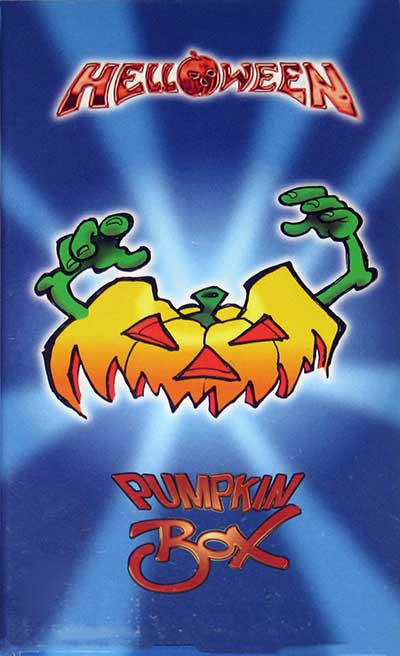
    The Helloween Pumpkin Box, a rare gem from Japan, is a collector's dream. This box set encompasses four CDs, a captivating book, and two sizable posters, offering enthusiasts an immersive journey into the band's musical and visual universe. With limited availability, this treasure trove is a testament to Helloween's enduring legacy, making it a prized possession for ardent fans and collectors alike.

    Learn more
    Thumbnail of HELLOWEEN - Ride The Sky Live Tilburg Red Vinyl album front cover
    HELLOWEEN - Ride The Sky Live Tilburg Red Vinyl

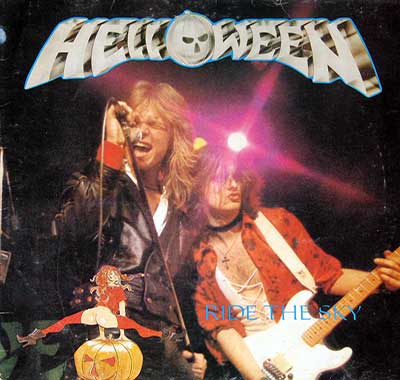
    This is the Red Vinyl release of Helloween recorded live at Noorderligt, Tilburg, Netherlands 28 March 1987. This web-page has hi-res photos of the album covers, record label and a detailed description.

    Learn more
    Thumbnail of HELLOWEEN - Walls of Jericho  album front cover
    HELLOWEEN - Walls of Jericho

    "Helloween's 1985 release, 'Walls of Jericho,' epitomized the birth of power metal. Crafted by guitarist Kai Hansen and vocalist Michael Weikath, the album melded speed, melody, and fantasy-themed lyrics. Its impact reverberated, influencing the genre's trajectory. This iconic work remains a cornerstone in the evolution of power metal, leaving an indelible mark on heavy metal history."

    Learn more
    Thumbnail of HELLOWEEN - Walls of Jericho Banzai Records Canada  album front cover
    HELLOWEEN - Walls of Jericho Banzai Records Canada

    Released in 1985 by Banzai Records, Helloween's "Walls of Jericho" 12" vinyl LP marked a pivotal moment in metal history. Fusing speed and melody, the album's biblical themes and distinctive sound influenced the power metal genre. The iconic artwork, featuring the band's pumpkin-headed mascot, became synonymous with Helloween. This vinyl masterpiece remains a cherished collector's item, embodying the spirit of the vibrant European metal scene of the 1980s.

    Learn more