Accept - Staying A Life (1990, Germany) - 2LP vinyl album teutonic heavy metal

- live chaos captured mid-stride before accept tore itself apart

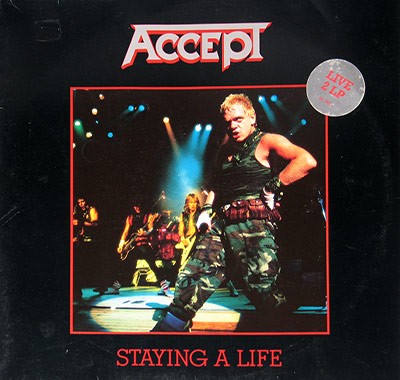
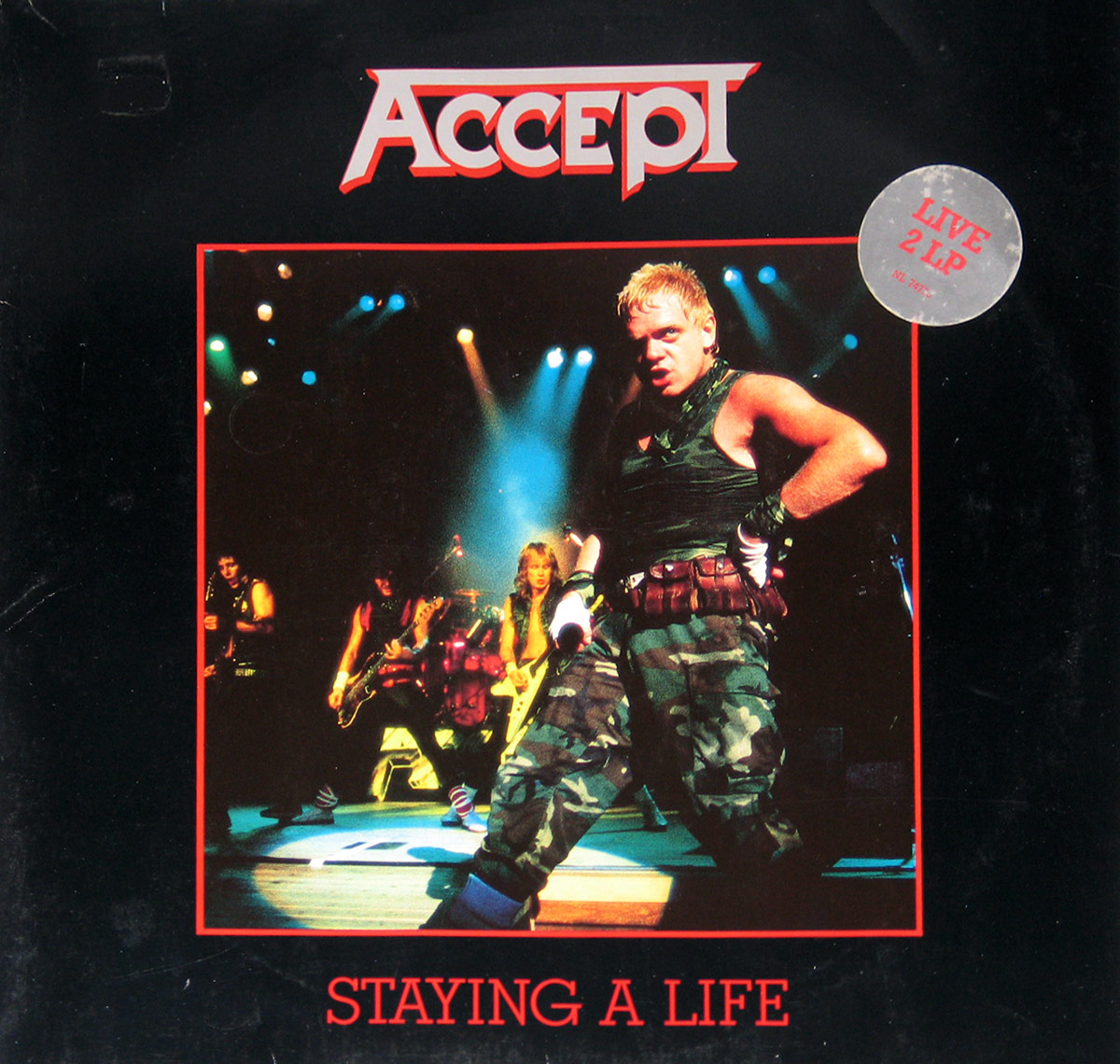
Front cover of Accept Staying A Life live 2LP album: band performing on stage with Udo Dirkschneider in camouflage pants lunging forward in foreground, guitarists and drummer behind under colored stage lights, black sleeve with red border, band logo at top, silver Live 2LP sticker on right, slight surface scuffs visible

A live stage shot dominates the cover, framed in red against a black field. The frontman Udo lunges forward in camo gear, caught mid-performance under harsh colored lights, while the band looms behind him. A silver “Live 2LP” sticker adds a raw retail touch, typical late-80s urgency.

Accept – Staying A Life didn’t arrive quietly; it landed like a steel boot on a fragile stage, reminding everyone what real Teutonic metal sounded like before things got polite. Pulled from their 1985 Osaka shows and released in 1990 like a delayed victory lap, this double live set captures a band that had already done the hard miles and wasn’t asking for permission anymore. You hear it straight away—tight, aggressive, but never sloppy. “Metal Heart” cuts with precision, “Fast as a Shark” still feels slightly out of control, and “Balls to the Wall” turns into something heavier than the studio version ever managed. No tricks, no fake crowd sweetening—just volume, discipline, and a band that knew exactly how dangerous they were when everything clicked.

Staying a Life: the farewell blast that still smells of sweat and stage smoke
Album Description:

Most live albums are souvenirs. "Staying a Life" is not. It feels more like a steel-toed reminder of what Accept could do when the machine was fully locked in: Udo barking like a riot alarm, Hoffmann and Fischer cutting twin-guitar lines through the fog, Baltes and Kaufmann driving the whole thing forward with that clipped Teutonic Metal snap that lesser bands always wanted and rarely found. This is the sort of double live set that does not ask for nostalgia. It grabs it by the throat.

Historical Context

By the time this came out in October 1990, the band had already cracked apart once, which gives the record its sting. The performance itself goes back to Festival Hall in Osaka, 18 September 1985, right in that period when Accept had turned German Heavy Metal into something leaner, sharper, and frankly more dangerous than a lot of their rivals. A farewell release built from a moment of peak confidence always carries a bit of irony. That tension helps this one. It sounds alive because it came from a band that had not yet started talking like survivors.

Musical Exploration

What keeps pulling me back is the physical feel of it. “Metal Heart” comes out with that cold blade-of-steel precision, then “Fast as a Shark” tears in like somebody kicked the lights over. “Princess of the Dawn” stretches out and breathes; “Balls to the Wall” lands heavier here than it does in the studio, all stomp and command. Even the familiar tracks carry a different weight when the crowd noise and stage pressure get into them. Plenty of live albums just repeat the catalogue. This one bites down on it.

Not every double live record deserves to be a double live record. Some should have been edited with a sharper knife. This one mostly earns its size because Accept were built for the stage in a way the more polished studio documents only hint at. The band had discipline, but not the dead kind. No limp jamming, no endless self-congratulation, no fake grandeur. Just a hard-running set from a band that understood momentum.

Genre and Influences

Calling this merely Teutonic Metal is accurate, but a bit too tidy for what is actually happening. The Judas Priest influence is there in the frame, sure, and the classical pull that Hoffmann liked to talk about shows up in the melodic shape of “Metal Heart,” but Accept always sounded less theatrical and more street-tough than most of the pack. There is a military stomp to the rhythm guitar, a drill-yard certainty to the beat, and then that rough human edge in Udo’s voice stopping the whole thing from becoming chrome-plated nonsense.

Production and Recording

Stefan Kaufmann produced it, and that was the right call. A drummer producing his own live band can go horribly wrong when ego gets involved, but here the smart move was obvious: keep the punch, keep the width, do not polish the blood off the knuckles. Uli Baronowsky’s mix at Dierks Studios gives the guitars room to slash and keeps the rhythm section from turning to mud. That matters more than studio gloss ever could. Live metal should sweat a little. When it comes out too clean, something has usually been killed.

References

Album Key Details: Genre, Label, Format & Release Info

Music Genre:

German Heavy Speed Metal

A high-voltage strain of heavy metal forged in Germany during the 1980s, combining razor-sharp guitar riffs, relentless tempo, and militaristic precision. This style leans into speed and aggression without losing melodic hooks, delivering a tight, disciplined sound that hits like steel on steel.

Label & Catalognr:

RCA – Cat#: NL74720, BMG Ariola Hamburg

Album Packaging

Gatefold/FOC (Fold Open Cover) Album Cover Design.

This album includes a review (in English) of the Accept band by Andreas Kraatz

Media Format:

Record Format: 12" Vinyl LP Gramophone Record
Total Weight: 380g

Release Details:

Release Date: 1990

Release Country: Germany

Production & Recording Information:

Producers:
  • Stefan Kaufmann – Producer for Breeze Music GmbH

    Accept's drummer was never just the bloke keeping time; he had the instincts of an arranger and the cool head of someone who understood how a band should hit on record.

    Stefan Kaufmann, the German drummer and later producer best known for his long runs with Accept and U.D.O., brought more than band loyalty to "Staying A Life". On this album he shaped the live material from Osaka into something tight without sanding off the danger. That matters. The performances still sweat, still lunge, still sound like five men forcing the room to obey, but the sequencing and production keep the whole double set from turning into a blur of volume.

Sound & Recording Engineers:
  • Uli Baronowsky – Mixing Engineer

    A mixing engineer like this does not need fireworks in the credits; the proof sits in the way the guitars bite and the crowd never smothers the band.

    Uli Baronowsky, the engineer credited with mixing "Staying A Life" at Dierks Studios, gave this record one of its real strengths: separation without sterility. That is not a small thing on a live double album. The drums still punch, the twin guitars still slash across the speakers, and Udo's bark stays right where it should be, out front and a bit dangerous. Nothing feels over-scrubbed. The band sounds disciplined, but still like it might knock a monitor over.

Mixing Studio & Location:
  • Dierks Studios – Stommeln, Germany

    This was one of those German rooms with real rock history in the walls, not some anonymous box where sound goes in and personality goes missing.

    Dierks Studios, the Stommeln facility long tied to major German rock productions, was the right place to pull this material into shape. Studios matter; some flatten bands, others understand how to let size breathe. Here the Osaka recordings were mixed with enough width and clarity to keep Accept sounding massive without turning them into polished chrome. The room's pedigree suits the album too. "Staying A Life" needed weight, not perfume, and that is what this place helped preserve.

Album Cover Design & Artwork:
  • CCCP/Köln – Cover Design

    A good design credit on a live album has one job: frame the noise without making it look like a cheap souvenir from the merch table.

    CCCP/Koln handled the cover design, and the result fits the record better than glossy overstatement ever could. Live albums can so easily end up looking cluttered or desperate, as if the sleeve is begging you to believe the band mattered. This one does not need to. The layout, typography and image balance push the live atmosphere forward without drowning it in decoration. That restraint helps. It leaves room for the sweat, the stage light and the sense that this was captured at the right moment.

  • Deaffy - Lyrics, management, cover concepts

    I always liked the fact that one of Accept's sharpest weapons never stood at the mic or under the spotlights.

    Gaby Hauke, better known as Deaffy, was the unseen iron hand behind Accept's sharpest words and boldest visual instincts. I never bought the lazy idea that she was merely "the manager's wife"; from 1981 she helped steer Accept, got them moving on bigger stages, and from "Restless and Wild" (1982) through "Death Row" (1994) her lyric credits stamped the band's language in steel. She also crossed into U.D.O., writing on "Animal House" (1987), shaping the cover concept for "Mean Machine" (1988), and returning for "Timebomb" (1991). Earlier, in 1981, she helped Don Dokken get traction; later came a writing credit with Casanova on "One of These Days" (1992) and Mad Max's "All of My Heart" (2008). I hear her as the engine, not the footnote.

Photography:
  • Gutchie Kojima – Photography

    Japanese live photography from this era often caught the heat without turning the band into a blur, and that matters on a record like this.

    Gutchie Kojima is credited among the photographers, and the images tied to this package help sell the central idea of the album: Accept at full voltage in Japan, not posing for posterity but caught in motion. Those live shots matter more than people admit. They give the sleeve its pulse. Stage light, sweat, distance, glare, all of it works with the music rather than sitting beside it like decoration. The photos do not soften the band; they keep the tension alive.

  • Uli Magnusson – Photography

    A photographer on a live metal sleeve earns his keep by catching force and shape at the same time, which is harder than the casual eye thinks.

    Uli Magnusson, credited here among the photographers, helped build the visual side of "Staying A Life" through images that support the album's live-document purpose. This sort of material is easy to get wrong. Too posed and it dies. Too chaotic and it becomes noise. What works here is the balance: enough stage atmosphere to feel real, enough definition to hold onto faces, posture and movement. That gives the package a sense of occasion instead of just proving the band once owned amplifiers.

  • Marc Weiss – Photography

    Marc Weiss knew how rock bands looked under pressure, and photographs like these never come from someone afraid of stage light or ego.

    Marc Weiss, well known for photographing hard rock and metal acts, fits this album like a leather jacket that has already survived a few tours. His credited images add credibility to the package because they understand scale: not just faces, but bodies in light, movement against darkness, the stage as theatre. On "Staying A Life" that helps enormously. The photos reinforce the idea that this was a band with command, not just volume, and the sleeve ends up feeling lived in rather than assembled.

Additional Credits:

Music and Words by Accept & Deaffy

Contact: Breeze Music, P.O. Box 3149, 5024 Pulheim 3, Germany

Band Members / Musicians:

Band Line-up:
  • Udo Dirkschneider – Vocals

    I still hear his bark in my head whenever "Fast as a Shark" lights the fuse.

    Udo Dirkschneider is the rasping tank-commander who made Accept's choruses feel like steel boots on concrete. I heard him first with Accept (1976-1987), and by the early '80s he was turning "Fast as a Shark" into a riot alarm, then stomping out "Balls to the Wall" and "Metal Heart" with that clipped, unforgiving bark. He quit in 1987, built U.D.O. (1987-1992; 1996-present) to keep the machine running when the business wanted prettier noises, returned for Accept stints (1992-1997; 2005), and later toured as DIRKSCHNEIDER (2015-2016) to give the classics a proper bruising. He doesn't sing at you; he drills through you, like a shout trapped inside a turbine. That voice is half attitude, half armor.

  • Wolf Hoffmann – Guitars

    Accept always needed a guitarist who could sound surgical without turning cold, and Hoffmann was exactly that blade.

    Wolf Hoffmann, founding Accept guitarist and the band's chief melodic architect through their classic run, gives "Staying A Life" its clean steel edge from the first attack onward. The solos do not just decorate the set; they lift it, especially on "Metal Heart", "Restless and Wild" and "Fast as a Shark", where his phrasing cuts through the live roar with that disciplined, almost classical control that always made Accept sound smarter than most of their rivals.

  • Peter Baltes – Bass Guitar

    Plenty of metal bassists disappear in live mixes; Baltes never had that problem, because his playing carries weight and shape at the same time.

    Peter Baltes, Accept's longtime bassist, occasional lead vocalist and one of the band's real musical anchors, keeps "Staying A Life" grounded when the guitars and crowd threaten to run wild. That low-end push is all over this record. Songs like "London Leatherboys" and "Balls to the Wall" hit harder because his bass does more than follow the riff; it locks the groove in place and gives the whole performance that thick, road-tested heft.

 
  • Jörg Fischer – Guitars

    Second guitar on a live Accept record is not background wallpaper, and Fischer knew exactly how to make that point without grandstanding.

    Jörg Fischer, one of Accept's key guitar partners during their strongest mid-80s years, helps give "Staying A Life" its width, muscle and proper twin-guitar bite. The record would feel noticeably smaller without him. Rhythm parts land with extra weight, harmonized runs have room to breathe, and the stage attack feels complete rather than merely efficient. That is the sort of contribution casual listeners miss and collectors learn to hear fast.

  • Stefan Kaufmann – Drums, Guitars

    Kaufmann always played like he had no interest in showing off for its own sake; the man wanted force, order and impact, in that order.

    Stefan Kaufmann, Accept's drummer during their defining 80s stretch and later an important producer, drives "Staying A Life" with the kind of hard, exact pulse this band needed. Nothing floppy, nothing wasted. The double-bass work keeps the faster songs from flying apart, while the mid-tempo material gets a real backbone instead of mere volume. On a live album like this, that discipline matters more than flashy fills ever could.

Note: Duplicate listing of "Wolf Hoffman" in original source has been corrected to "Wolf Hoffmann". No additional musician data was omitted.

Complete Track-listing:

Tracklisting Record One:
  1. Metal Heart
  2. Breaker
  3. Screaming for a Love-Bite
  4. Up to the Limit
  5. Living for Tonight
  6. Princess of the Dawn
  7. Neon Nights
  8. Burning
Tracklisting Record Two:
  1. Head over Heels
  2. Guitar Solo Wolf
  3. Restless and Wild
  4. Son of a Bitch
  5. London Leatherboys
  6. Love Child
  7. Flash Rockin' Man
  8. Dogs on Leads
  9. Fast as a Shark
  10. Balls to the Wall
  11. Outro (Bound to Fail)

ACCEPT – Steel, Sweat and Discipline: Inside the Band That Refused to Play It Safe

From Osaka '85 to the last stand of "Staying A Life" — a band at full power, onstage and off, with nothing left to prove
Transcript of the Original Liner Notes

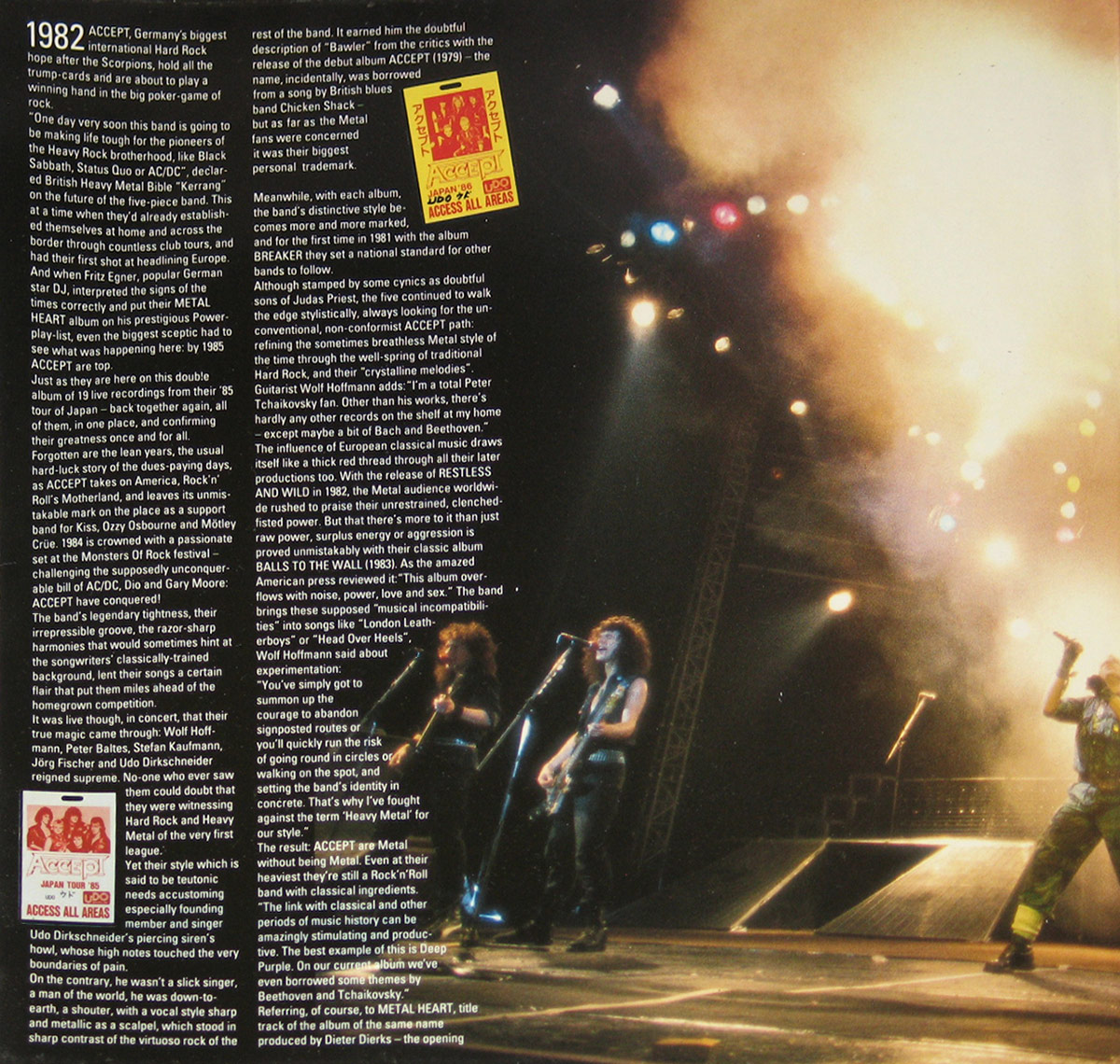
1982 ACCEPT, Germany's biggest international Hard Rock hope after Scorpions, hold all the trump-cards and are about to play a winning hand in the big poker-game of rock.

"One day very soon this band is going to be making life tough for the pioneers of the Heavy Rock brotherhood, led Black Sabbath, Status Quo or AC/DC", declared Heavy Metal Bible 'Kerrang' back to the future of the five-piece band. This at a time when they'd already established themselves at home and across the border through countless club tours, and had their first shot at headlining Europe. And when Fritz Egner, popular German star DJ, interpreted the signs of the times correctly and put their METAL HEART album on his prestigious Power-play list, even the biggest sceptic had to see what was happening here: by 1985 ACCEPT are top.

Just as they are here on this double album of 19 live recordings from their '85 tour of Japan — back together again, all in one place, confirming their greatness once and for all.

Forget the lean years, the usual hard-luck story of the dues-paying days, as ACCEPT takes on America, Rock'n'Roll's Motherland, and leaves its unmistakable mark on stage as a support band for Kiss, Ozzy Osbourne and Motley Crüe, 1984 is crowned with a passionate set at the Monsters Of Rock festival — shattering the supposedly unconquerable bill of AC/DC, Dio and Gary Moore: ACCEPT have conquered!

The band's legendary tightness, their irresistible groove, the razor-sharp harmonies that would sometimes hint at the songwriters classically-trained background, lend their songs a certain flair that put them miles ahead of the homegrown competition.

It was live though, in concert, that their true magic came through: Wolf Hoffmann, Peter Baltes, Stefan Kaufmann, Jörg Fischer and Udo Dirkschneider reigned supreme. No-one who ever saw them could doubt that they were witnessing Hard Rock and Heavy Metal of the very first league.

Yet their style which is said to be teutonic needs accustoming especially founding member and singer Udo Dirkschneider's piercing siren's howl, whose high notes touched the very boundaries of pain.

On the contrary, he wasn't a slick singer, a man of the studio, he was down-to-earth, a showman, with a vocal style sharp and metallic as a scalpel, which stood in sharp contrast of the virtuoso rock of the rest of the band. It earned him the doubtful description of "Bawler" from the critics with the release of the debut album ACCEPT (1979) — a name, incidentally, was borrowed from a song by British blues band Chicken Shack — but as far as the Metal fans were concerned it was their biggest personal trademark.

Meanwhile, with each album, the band's distinctive style becomes more and more marked, and for the first time in 1981 with the album BREAKER they set a national standard for other bands to follow.

Although stamped by some cynics as doubtful sons of Judas Priest, the five continued to walk the edge stylistically, always looking for the unconventional, non-conformist ACCEPT path: refining the sometimes breathless Metal style of the time through the well-spring of traditional Hard Rock, and their "crystalline melodies". Guitarist Wolf Hoffmann adds: "I'm a total Peter Tschaikowsky fan. Other than his works, there's hardly any other records on the shelf at home — except maybe a bit of Bach and Beethoven.

The influence of European classical music draws itself like a thick red thread through all their later productions. With the release of RESTLESS AND WILD in 1982, the Metal audience worldwide rushed to praise their unrestrained, clenched-fisted power. But there's more to it than just raw power, surplus energy or aggression is proven unmistakably with their classic album BALLS TO THE WALL (1983). As the amazed American press reviewed it: "This album overflows with noise, power, love and sex." The band brings these supposed "musical incompatibilities" into songs like "London Leatherboys" or "Head Over Heels".

Wolf Hoffmann said about experimentation: "You've simply got to summon up the courage to abandon signposted routes or you'll quickly run the risk of going round in circles or walking on the spot, setting the band's identity in concrete. That's why I've fought against the term 'Heavy Metal' for our style."

There's ACCEPT - pure Metal without being Metal. Even at their heaviest they're still a Rock'n'Roll band with classical ingredients.

"The link with classical and other periods of music history can be amazingly stimulating and productive. The best example of this is Deep Purple. On our current album we've even borrowed some themes by Beethoven and Tschaikowsky."

Referring, of course, to METAL HEART, title track of the album of the same name produced by Dieter Dierks — the opening

```html id="9dls2x"

number at many of their shows. Here the songwriting skill of Kaufmann, Hoffmann and Baltes is shown in its purest form: joined to Beethoven's "Für Elise" is a song full of atmosphere, a pulsating melody topped with Udo Dirkschneider's scalding, piercing voice. Rock of the was indeed that in the middle of the 80s was already showing the door into the 90s wide open.

Don't get me wrong: ACCEPT do indeed play Heavy Metal songs - they're there from their earliest songs right up to modern-day stuff, songs like "Fast As A Shark" or "Restless And Wild" - but with important additions that these are well-thought-out compositions, real songs.

And it's precisely this mixture of spontaneity and structure that laid the foundation for their triumphant breaking of the states - 100 gigs in the U.S. and Canada in 1985 after already making their name in North and Middle Europe.

In autumn '86, Europe lay at their feet once again, and ACCEPT set off for the second time to Japan. There they put the seal on the high point of their career.

Singer Udo Dirkschneider, guitarists Wolf Hoffmann and Jörg Fischer, bassist Peter Baltes and drummer Stefan Kaufmann gave the Far Eastern empire a real lesson in modern rock with power and personality. A typical scene: Udo thunders, glowers and snarls in the foreground as usual, the two guitars and bass fill out the mid-field, and lastly, throned on his drum-riser and taking care of the necessary power beat with the double bass drums, Stefan Kaufmann, who works together with bassist Peter Baltes on the aggressive rhythm and the irresistible groove. Loyal to the motto: United we are unbeatable!

To put it simply, when ACCEPT were on top form, none of their rivals could match them.

More than once there were girls who wanted to touch guitarist Wolf Hoffmann though, swarming around him during his impressive solos. But a more reluctant guitar hero would be hard to find. A man who found the whole idea of a cult of personality totally repugnant, there couldn't have been one person in the crowd of Osaka, Nagoya and Tokyo who didn't notice his shy and reserved manner. As confident and flash as the band are onstage, offstage they're as unassuming and as unshowy as you get. They cut themselves off, keep themselves to themselves. A typical scene from 1984 comes to my mind: This evening ACCEPT have a gig at the Country Club, California's Metal Mecca in Reseda, L.A. There's a throng of prominent fellow-rockers waiting around for ages to come backstage and hang out. And what happens? As soon as the show's over, all five members plus manager Gaby Hauke hide away in one modest dressing room whose door is written in no uncertain words: "No Entry" - which means "Leave us alone". Once again giving their personal view of the old Sex & Drugs & Rock'n'Roll cliché - which the band had never much time for anyway.

Not even - surprisingly for Metal - in the lyrics of their songs. A German magazine "Musik Szene" confirmed on the occasion of ACCEPT's 7th album RUSSIAN ROULETTE (1986): "This album's lyrics are highly explosive, political, willful and thoughtful all at the same time. ACCEPT got to great trouble and don't close their eyes to reality. Descent into Heavy Metal cliché has no place in their music."

ACCEPT come out in their since 1984 together with Deaffy mutually-written lyrics as firm critics of the military, of religious fanatics and ideologues. As Udo sings in "Metal Heart": "It's 1999, the human race has to face it... (and two lines later) The human race is dying."

The constant search for up-to-date meaning and self-expression, especially in their lyrics, shaped the band's entire creative work. Which, by the end of their legendary 1986 tour of Japan, showed them at the very peak of their prowess.

A year later, 1987, saw the amicable departure of singer Udo for his own solo tour and later also guitarist Jörg Fischer left ACCEPT. Still, with a new vocalist and guitar player they gathered themselves up once again and made their last studio album EAT THE HEAT.

With STAYING A LIFE - drummer Stefan taking on the responsibility of producer and director in the background - ACCEPT, in its original incarnation, want to say one more goodbye to their friends and fans and thank them for their many years of loyalty. The 19 tracks, from the BREAKER to the METAL HEART era, show ACCEPT at the zenith of Teutonic Metal: five personalities who for nearly ten years shaped and wrote music history. Not only here in Germany, but also left behind them a great crack in the international Rock scene that up until this date, 1990, no-one has still been able to fill.

Andreas Kraatz /ME/Sounds)

Translation: Sylvie Simmons
First thing I notice is the gloss on that front cover — not overly thick, but just enough to catch the light when you tilt it. You can see faint hairlines if it’s been handled a bit, especially around the darker areas. The typography sits tight, no wasted space, typical late-80s German restraint. Flip it over and the back cover feels busier, packed with live shots that almost blur together if you don’t stop and look. The gatefold is where it opens up — literally — fireworks, grainy stage light, that slightly washed print you only get from that era. The paper isn’t heavy, but it’s not flimsy either. Then the label… that RCA layout, catalog number stamped clean, no nonsense. That’s where the real clues start showing up, if you bother to look closely.

Album Front Cover Photo
Front cover of Accept Staying A Life live 2LP album: band performing on stage with singer in camouflage pants lunging forward in foreground, guitarists and drummer behind under colored stage lights, black sleeve with red border, band logo at top, silver Live 2LP sticker on right, slight surface scuffs visible

First thing that hits is that black field—deep, almost swallowing the edges of the sleeve if the light isn’t right. Tilt it slightly and the gloss gives you away: faint hairline scuffs, the kind that come from sleeves being slid in and out a few hundred times without much care. The red border feels deliberate, almost like someone wanted to cage the chaos inside, but it’s a bit too clean for a band that sounded this rough live.

The central photo does the heavy lifting. Udo’s planted right up front, mid-lunge, caught in that awkward split-second where it’s either power or overacting depending on your mood. Camouflage trousers, sleeveless top, belt sitting too high—very mid-80s, very practical, not particularly subtle. The rest of the band sits behind him, slightly swallowed by stage light haze. You can see the drummer’s kit just enough to confirm it’s real, not a staged shoot, but the lighting does most of the storytelling here.

That silver “Live 2LP” sticker is the kind of thing that always annoys. Looks like it was slapped on to make sure nobody mistakes this for a studio album, but it breaks the balance of the cover. Worse, it leaves that faint circular pressure mark once it’s been on there long enough. Seen copies where the glue dries unevenly, leaving a ghost ring even after removal.

Typography is tight, almost stubborn. The Accept logo up top—sharp, red, no nonsense—still cuts through like it should. Down below, “Staying A Life” sits a bit too politely for what’s actually on the record. Feels like the design is trying to behave while the photo is clearly not interested in that idea.

Edges usually tell the real story. Light whitening along the spine, tiny knocks on the corners, especially bottom right where hands tend to grab it. Nothing dramatic, but enough to remind you this isn’t a museum piece—it’s been handled, played, probably dragged out when someone wanted to remember what a real live band sounded like before things got tidy.

Album Back Cover Photo
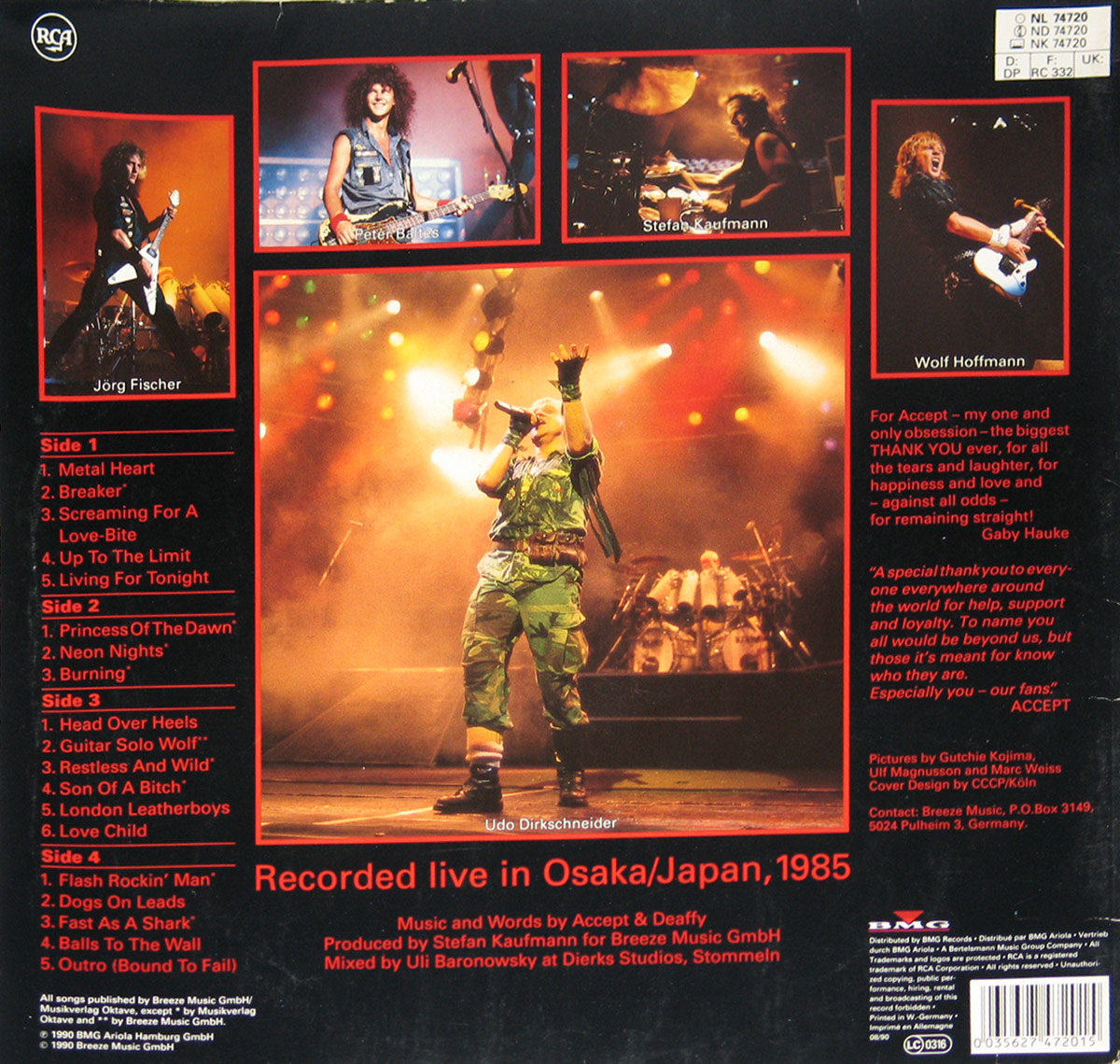
Back cover of Accept Staying A Life 2LP vinyl album showing large central live performance photo with singer under bright stage lights, smaller band member (Fischer, Baltes, Kaufmann, Hoffmann) photos in red frames along top, track listing on left, production credits and thank-you text on right, RCA logo top left, catalog sticker top right, barcode bottom right, black background with red text and borders, visible surface wear and edge scuffing

Turn it over and the whole thing suddenly gets busy—almost too busy. Black background again, but now it’s fighting for space with red text, red frames, white credits, and that oversized central live shot that looks like it refused to be cropped properly. The stage lights blow out into that familiar yellow haze, the kind that hides detail but somehow makes everything feel louder. Not subtle, but then again, neither was the band.

The layout feels like it was assembled in layers rather than designed in one go. Smaller band photos sit up top in those red boxes—Jörg, Baltes, Kaufmann, Hoffmann—all looking like they were lifted from different nights, maybe even different tours if you’re picky. The print grain is obvious when you get close. Not terrible, just… honest. Cheap reproduction creeping in where the original slides probably had more bite.

Left side is where the collector instinct kicks in. Tracklisting stacked tight, almost squeezed into place. Red ink on black always looks sharp at first glance, but tilt the sleeve and you’ll see slight ink bleed on some copies, especially around the smaller text. Nothing dramatic, but it tells you this wasn’t printed yesterday. The alignment isn’t perfect either—look closely and the margins drift just enough to notice once you’ve seen it.

Top right corner has that catalog sticker—practical, ugly, necessary. Slightly crooked on some copies, and once it’s been there long enough, it leaves a faint rectangle even if removed. Same story near the barcode at the bottom right: light ring wear creeping in, especially if the sleeve’s been stored tight between others.

The central photo of Udo—arms up, mic in hand—does most of the talking. It’s loud, chaotic, a bit blown out, and completely in character. But the surrounding text tries to behave. Thank-you notes, production credits, neat little blocks of information pretending this is all under control. It isn’t. And that mismatch—between the disciplined layout and the unruly image—is exactly why this sleeve works better than it should.

Photo One of Inside Page Gatefold Cover
Inside gatefold of Accept Staying A Life 2LP vinyl album showing dense liner notes text on left panel with small band photo and Japan ‘85 access pass  graphic, and live stage photo on right with musicians under bright concert lights, visible haze and warm color tones, slight print grain and fold crease at center

Open the gatefold and the first thing that happens is your eye gets dragged left whether you like it or not. Dense block of text, tightly packed, no breathing room, like someone decided every inch of cardboard had to earn its keep. White print on black, slightly softened at the edges if the ink settled unevenly. Seen copies where the letters blur just enough to make you lean in, which is probably not what they had in mind.

That little pass graphic—Japan ’85, access all areas—feels almost thrown in, like a last-minute proof that this actually happened. It’s a nice touch, but it sits there a bit awkwardly, not fully committed to being part of the layout. Same with the small band photo beneath it. You can tell it’s been reproduced a generation too far, losing sharpness, picking up that dull grain that only shows up when you get close.

Then the right side kicks in and wipes all that away. Full stage, blown-out lights, haze doing half the work. Colors drift toward yellow and orange, not entirely by choice—this is what happens when these prints age, especially if they’ve seen daylight. The blacks don’t stay black either; they lift slightly, giving everything that faint washed look that collectors recognize immediately.

The fold line is always the giveaway. Run a finger across it and you’ll feel the pressure crease, sometimes with tiny cracks in the ink if the sleeve’s been opened too often. That’s where the real wear shows up, not the corners this time. It’s a working sleeve, not a display piece.

What works here is the imbalance. One side all discipline, text, explanation. The other side just noise and light. Feels like two different people signed off on it, and somehow that suits the band better than a neat, well-behaved design ever could.

Photo Two of Inside Page Gatefold Cover
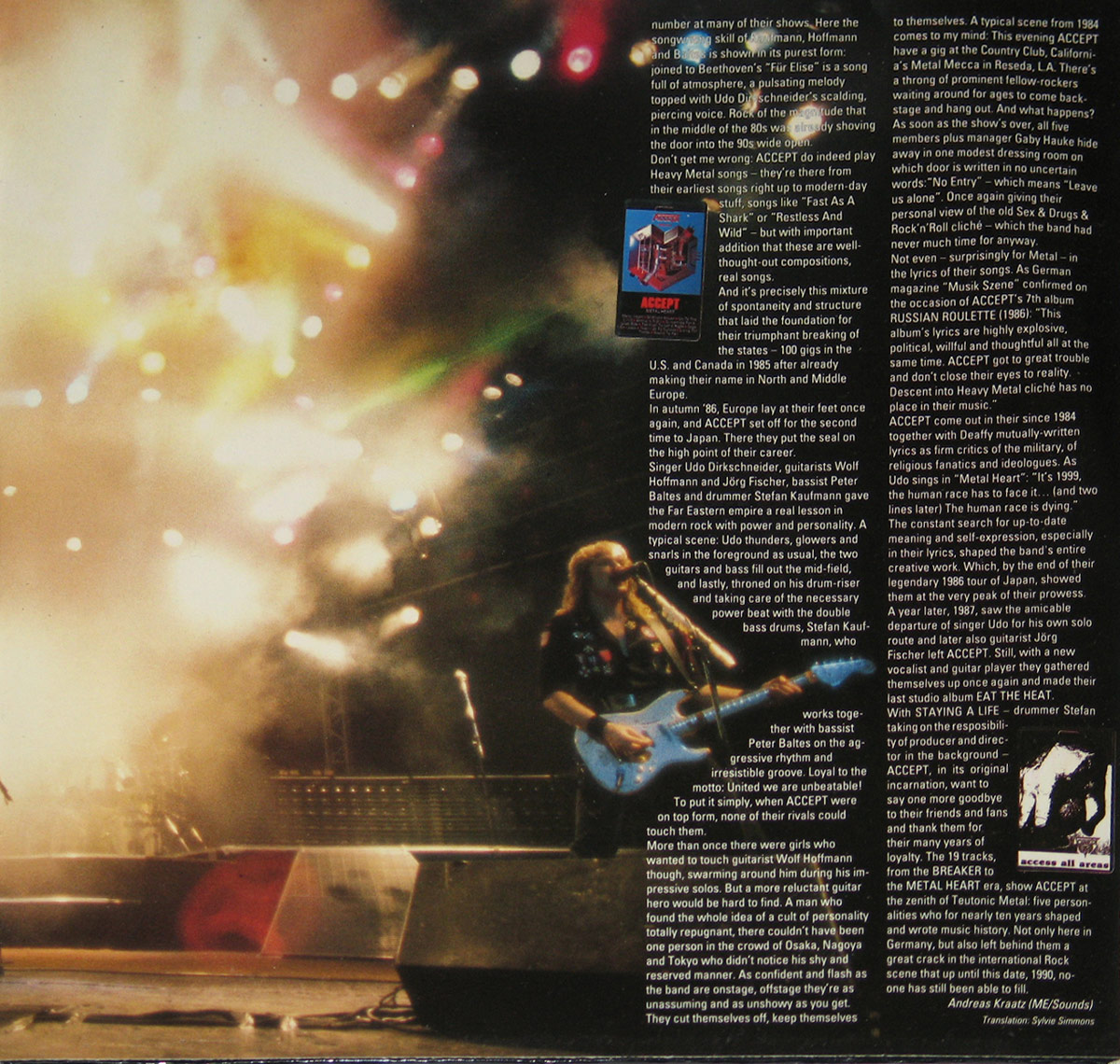
Inside gatefold right panel of Accept Staying A Life 2LP vinyl album showing large stage lighting effects on left with bright yellow and white beams, guitarist performing mid-stage with electric guitar in foreground, and dense liner notes text column on right, visible fold line, slight color fade and print grain across surface

This side opens up differently—less cramped, more air, but not exactly calmer. Left half is almost all light. Blown-out stage beams, yellow-white flares that bleed into the paper like the ink couldn’t quite hold them. Underneath it, you can just make out the stage floor and that wedge monitor sitting there like it’s doing all the quiet work nobody notices. The image feels slightly overexposed, but that’s half the point—it’s not trying to be neat.

The guitarist stands off-center, caught mid-song, not posing, not really acknowledging the camera either. That’s the part that works. No fake “live energy” nonsense, just someone doing the job while the lights go wild around him. The edges of the figure soften if you look too closely, typical print loss from enlarging a stage shot beyond what it really wanted to be.

Right side goes back to business—text again, tight columns, barely any margin. Same story as the other panel: white on black, slightly dulled ink, especially where the sleeve’s been opened and closed enough times to stress the surface. Run a finger along the fold and you’ll feel it immediately—tiny ridges, sometimes even micro-cracks where the print has given up first.

There’s a faint color shift here too. The blacks aren’t quite black anymore, leaning toward a soft charcoal, especially near the fold where light tends to catch it. Seen copies where the left side looks brighter simply because it’s been exposed more often while people read the liner notes. Not intentional, but it becomes part of the object over time.

What stands out is how uneven it all feels—and that’s not a complaint. One side drowning in light and noise, the other trying to explain it all in neat paragraphs. The sleeve can’t quite decide if it’s documentation or atmosphere, so it ends up being both, slightly at odds with itself. That tension fits the record better than any polished layout ever would.

Close up of Side One record’s label
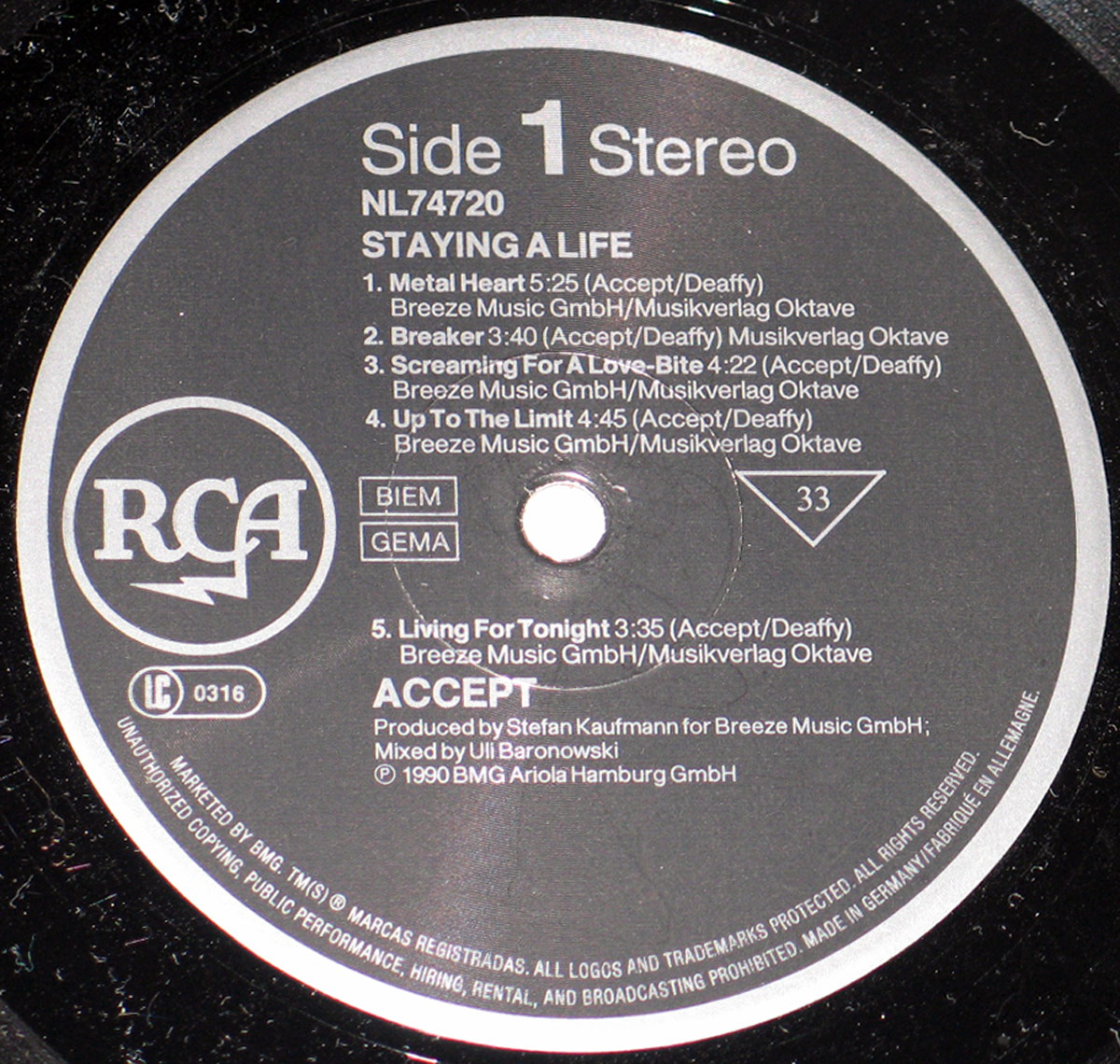
Close-up of Side 1 record label for Accept Staying A Life 2LP vinyl album: dark grey RCA label with white text and silver ring, large Side 1 Stereo heading at top, track listing and credits centered around spindle hole, BIEM GEMA boxes and 33 speed mark, visible paper scuffs, spindle wear, fine scratches and dust on surrounding black vinyl

Now this is where the sleeve stops talking and the record starts telling the truth. Side 1 on that dark RCA label looks clean at first glance, but get it under a decent lamp and the little signs show up straight away. Faint spindle marks around the centre hole, a few light paper scuffs near the outer black vinyl, and that slightly dulled sheen that says this copy was played, not worshipped from a distance by some white-glove clown. Good. Records are supposed to be used.

The design itself is pure late-period RCA practicality. No colour splash, no decorative nonsense, just a dark grey field, white print, a silver outer ring, and that oversized “Side 1 Stereo” line sitting across the top like it owns the place. It works because it wastes no time. Catalog number NL74720 is easy to spot, the title sits in block capitals underneath, and the track list is broken up in that slightly awkward label-copy way, where publishing credits and timings crowd each other because somebody had more information than space.

The big RCA logo on the left still does most of the visual lifting. Always liked that mark. Solid, unfussy, recognisable from across the room. BIEM and GEMA boxes are tucked in neatly, the little triangle with “33” sits to the right, and the legal text runs around the lower edge in that usual curved border that nobody reads until they are trying to identify a pressing. That is the collector trapdoor, of course. Ordinary listeners see a label. Collectors start checking type weight, spacing, rights societies, and whether the rim text matches the copy they already own twice by accident.

Print quality here is decent, though not immaculate. The white text holds up well against the charcoal background, but there is a slight softness to some of the smaller lines, especially where the credits dip around the spindle hole. Nothing disastrous, just enough to remind you this was manufactured, not carved by monks. The ring around the centre has the usual hairline wear from handling, and that matters more than people think. A dead mint label on a record from this period often tells a suspicious story.

Best part is how honest the whole thing feels. No fake glamour, no overdesigned vanity. Just track titles, credits, rights text, and a label built to survive being lowered onto a turntable again and again. Exactly as it should be.

Note: the above pictures are actual photos of the album and allow you to judge the quality of cover. Slight differences in color may exist due to the use of the camera's flash.

Index of ACCEPT (Band, Germany ) 1980s Vinyl Discography

ACCEPT - Accept ( self-titled )
Thumbnail of ACCEPT - Accept ( self-titled )  album front cover

BRAIN 0060.188  , 1979 , Germany

"ACCEPT" is the self-titled debut album released by the German heavy metal band Accept. It was recorded in 1978 and released in early 1979 on the German label Brain Records. Drums on the record are played by Frank Friedrich, but he chose not to pursue a professional music career

Accept ( self-titled ) 12" Vinyl LP
ACCEPT - Balls to the Wall
Thumbnail of ACCEPT - Balls to the Wall  album front cover

 RCA PL 70186 / LC 0316 , 1983 , Germany

ACCEPT's iconic "Balls to the Wall" 12" LP, a cornerstone of heavy metal, delivers relentless energy and anthemic tracks. Released in 1983, the album's raw power, Udo Dirkschneider's distinct vocals, and socially conscious lyrics solidified its place in music history.

Balls to the Wall 12" Vinyl LP
ACCEPT - Best of Accept
Thumbnail of ACCEPT - Best of Accept Orig Brain  album front cover

Brain 811 994 , 1983 , Germany

"Best of Accept" is a compilation album by German heavy metal band Accept, released in 1983. The songs on the album were pulled from Accept's earliest four solo albums, namely Accept, I'm a Rebel, Breaker, and Restless and Wild

Best of Accept Orig Brain 12" Vinyl LP
ACCEPT - Breaker
Thumbnail of ACCEPT - Breaker  album front cover

Brain Records 0060.390 , 1981 , Germany

Released in 1981 on Brain Records, "Breaker" is Accept's third studio album and a definitive heavy metal classic. It features raw energy, powerful vocals by Udo Dirkschneider, and iconic tracks like "Starlight" and the title track "Breaker." This 12" vinyl LP captures the band's early sound

Breaker 12" Vinyl LP
ACCEPT - Eat the Heat
Thumbnail of ACCEPT - Eat the Heat  
 album front cover

 RCA PL74083 , 1989 , Made in Germany

"Eat the Heat" is the 1989 release by German Heavy metal band Accept. It was recorded at Dierks-Studios, in Cologne, from September 1988 to January 1989. Although Jim Stacey is presented as guitar player in the band on the album cover, the cover text also states that all guitars are by Wolf Hoffmann.

Eat the Heat 12" Vinyl LP
ACCEPT - Hungry Years
Thumbnail of ACCEPT - Hungry Years Digital Remix UK   album front cover

 Metronome Music GmbH 831 077-1 , 1987 , Made in Uk ( United Kingdom )

Accept's "Hungry Years Digital Remix" is a compilation album that offers a fresh take on the band's early catalog. Released in 1987, the album features digitally remastered versions of songs from their second, third, and fourth albums, including "Fast as a Shark," "Restless and Wild," and "Balls to the Wall."

Hungry Years 12" Vinyl LP
ACCEPT - I'm a Rebel
Thumbnail of ACCEPT - I'm a Rebel   album front cover

 BRAIN 0060.389 , 1980 , Made in Germany

Accept's 2nd album, "I'm a Rebel" (title-less), is a raw, high-energy heavy metal record. Though not as polished as their later work, it showcases Udo Dirkschneider's distinct vocals, Wolf Hoffmann's powerful guitar riffs, and the band's signature sound in its early stages.

I'm a Rebel 12" Vinyl LP
ACCEPT - Kaizoku-Ban / Live in Japan
Thumbnail of ACCEPT - Kaizoku-Ban / Live in Japan   album front cover

 RCA NG70941 , 1985 , Made in Germany

Accept's 'Kaizoku-Ban' is a live mini album that unleashes a sonic storm of heavy metal energy. Recorded in Nagoya, Japan in 1985, this genuine 1st issue vinyl LP captures the raw power of a legendary performance. Udo Dirkschneider's commanding vocals, Wolf Hoffmann's scorching guitars

Kaizoku-Ban / Live in Japan 12" Vinyl LP
ACCEPT - Metal Heart
Thumbnail of ACCEPT - Metal Heart   album front cover

 RCA PL 70638 , 1985 , Made in Germany

Accept's "Metal Heart" (1985) is a landmark heavy metal album showcasing the band's signature sound of powerful riffs, soaring vocals, and anthemic choruses. Tracks like "Metal Heart," "Midnight Mover," and "Screaming for a Love-Bite" explore themes of technology, rebellion, and love with a hard-hitting edge.

Metal Heart 12" Vinyl LP
ACCEPT - Metal Masters
Thumbnail of ACCEPT - Metal Masters   album front cover

 RCA PL 70638 , 1985 , Made in Germany

Accept's "Metal Masters" is a double LP compilation album showcasing the band's early raw energy and signature heavy metal sound. Featuring tracks from their first two albums, "I'm a Rebel" and "Breaker," this collection highlights Udo Dirkschneider's powerful vocals and the band's driving riffs.

Metal Masters 12" Vinyl LP
ACCEPT - Restless and Wild
Thumbnail of ACCEPT - Restless and Wild ( France )  album front cover

Venus Records / Polydor 810 987 , 1983 , Made in France

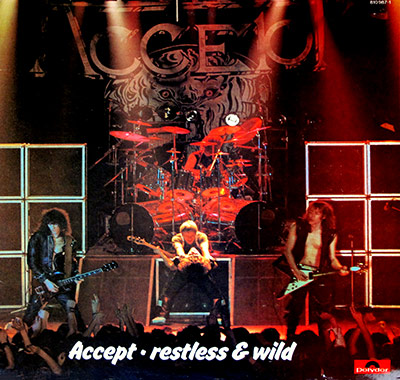
This is the French release of "Restless and Wild" by the German Heavy Metal band "ACCEPT" and has been released on the Venus records. The album front cover shows the Accept band live on stage and this front cover is different from other European releases (which show two white "Gibson Flying V" guitars

Restless and Wild 12" Vinyl LP
ACCEPT - Restless and Wild
Thumbnail of ACCEPT - Restless and Wild ( Germany )   album front cover

BRAIN 0060.513  , 1982 , Germany

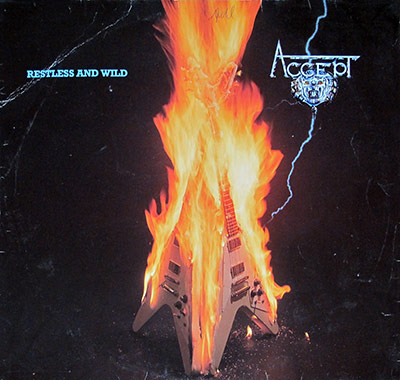
Accept's "Restless and Wild" (1982) is a seminal heavy metal album that marked a turning point in the band's career. With its faster tempos, aggressive riffs, and anthemic choruses, the album solidified Accept's signature sound and launched them into the international spotlight.

Restless and Wild 12" Vinyl LP
ACCEPT - Russian Roulette
Thumbnail of ACCEPT - Russian Roulette  album front cover

RCA PL 70972 / LC 0316 , 1986 , Made in Germany

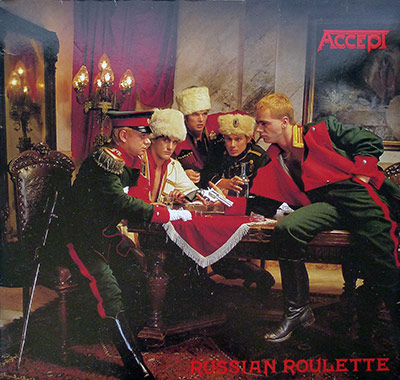
"Russian Roulette" is the 1986 release by German heavy metal band Accept. It was again recorded at Dierks-Studios, but the band chose to self-produce rather than bring back Dieter Dierks as producer. It would be the last Accept album to feature Udo Dirkschneider as lead vocalist

Russian Roulette 12" Vinyl LP
Updated ACCEPT - Staying A Life album front cover vinyl LP album https://vinyl-records.nl

No studio perfume here — just Teutonic metal sweat, volume and damage

ACCEPT - Staying A Life

ACCEPT’s "Staying A Life" is a bruising Teutonic heavy metal live set built from Osaka fury, crowd pressure, and sheer stage discipline. No fake gloss, no polite smoothing-out — just a band hitting hard in real time, with Udo barking over riffs that land like steel plates dropped on concrete.