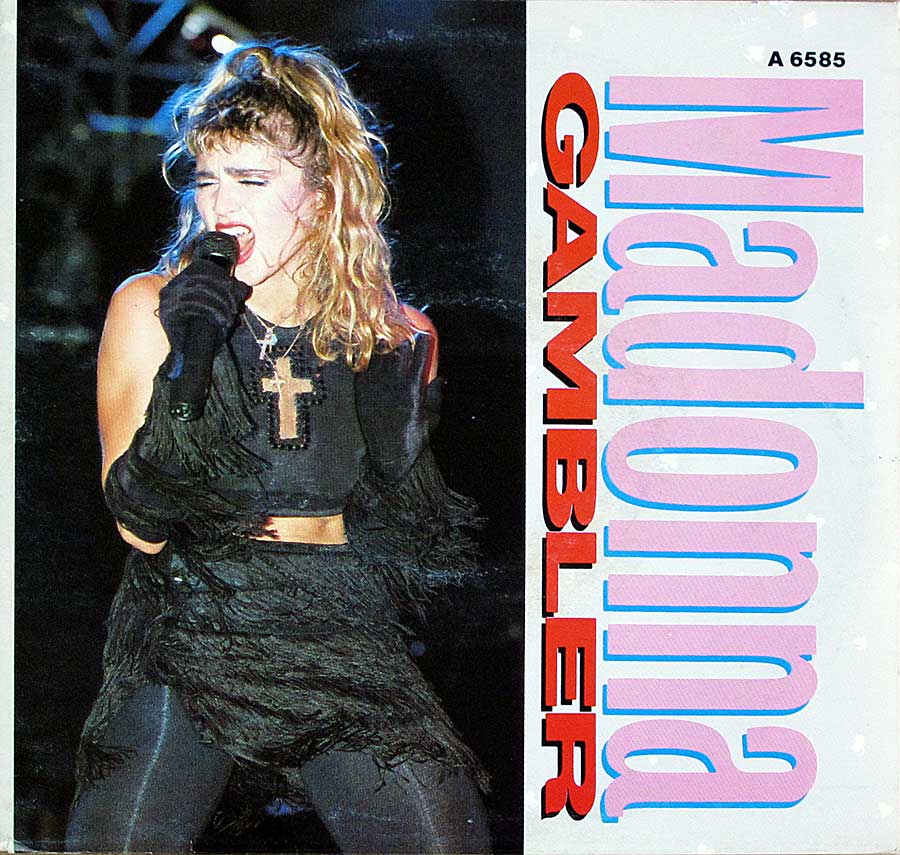
Madonna - Gambler 7" 45RPM Picture Sleeve SINGLE VINYL

- a sweat-soaked snapshot of 1985 ambition, attitude, and full-throttle pop

Album Front cover Photo of Madonna - Gambler https://vinyl-records.nl/

Madonna shot mid-performance, the image freezes raw momentum: clenched mic, half-shout vocal, sweat and movement caught under harsh stage light. The cropped framing and black outfit push energy over polish, while the bold vertical title screams urgency rather than glamour.

Madonna didn’t need “Gambler” in 1985 to prove anything, which is exactly why this 7" matters: it’s a punchy side-step from pure dance-pop, wired straight into that soundtrack-era hunger tied to Vision Quest. The sound is lean and impatient—bright guitars, hard-edged drums, and a hook that grins while it swings. “Gambler” is the obvious knockout, but the single mix and the punchier radio feel are the real selling points here: everything is clipped, shiny, and moving forward. John “Jellybean” Benitez keeps it tight enough to ricochet off the walls, and the Dutch-made picture sleeve looks like it’s still trying to outrun the decade.

"Gambler" (1985) Album Description:

Madonna didn’t need another trophy in 1985—she needed a left turn, fast, before the world filed her under “lace gloves + MTV.” Madonna’s "Gambler" hit like a caffeine jolt from the Vision Quest soundtrack: impatient, bright, a little sharp around the edges, and weirdly rock-minded for a pop star who could’ve coasted on pure sugar. The beat snaps, the synths glare, and the vocal has that “try and stop me” bite that doesn’t ask permission.

1985: what was in the air

America was selling confidence by the gallon—Reagan-era gloss, brand-new cable culture, and movie soundtracks treated like product launches with better hair. Pop was getting bigger, louder, and more choreographed; rock was learning to behave on camera; and the clubs kept feeding the whole machine with rhythm ideas the radio couldn’t invent on its own. "Gambler" comes out of that exact pressure cooker: a soundtrack cut that refuses to sit politely behind the film credits.

Where it sits in the scene

This isn’t the coy, diary-page Madonna; it’s the sprinting Madonna. The track lives in that mid-80s overlap zone—synth-pop muscle with a pop-rock posture—closer to the punch of a club mix than the soft-focus romance of a power ballad.

  • Cyndi Lauper was still coloring outside the lines with personality; "Gambler" is less cartoon, more clenched fist.
  • Pat Benatar had the guitars and the grit; Madonna borrows the attitude and keeps the chrome.
  • Tina Turner was owning the grown-up triumph; "Gambler" sounds like the younger cousin kicking the door because it’s faster than knocking.
  • The Bangles and the radio-rock crowd were polishing hooks into shine; this one keeps a little sand in the gears.
Musical feel: attack, space, tension

The groove doesn’t “bounce”—it snaps. Drums and handclaps come in tight like someone cutting a tape with scissors, and the synth bass keeps the floor moving even when the chords want to hang around. The energy is forward-leaning, almost stubborn: verses shove, choruses flare, and the whole thing feels like it’s lit by fluorescent streetlight instead of candlelight.

That’s the trick here: the record is glossy, but it’s not soft. It’s got a little teeth.

Key people, practical work

John “Jellybean” Benitez produces this like a guy who learned structure from a dance floor, not a conservatory—everything aimed at impact and momentum, nothing left lounging in the corners. Arrangement credit goes to Stephen Bray, and the song benefits from that kind of editing mindset: tighten the turns, make the hook land clean, keep the tension up so the track never sags between lines.

One extra detail that says a lot: music director Phil Ramone reportedly pushed "Gambler" as a fit for the film’s opening shots—because it sounds like motion. Not romance, not nostalgia. Motion.

Another quiet oddity: it’s one of the last times she wrote a single entirely by herself for a long stretch. That’s not a medal, it’s a mood—one sharp self-contained statement before collaboration became the default engine.

Controversy (or the lack of it)

No big scandal trail follows this release—no bonfires, no Senate hearings, no pearl-clutching headline that aged into comedy. The mess is smaller and more typical: confusion.

  • People assume it was a normal U.S. hit single because it feels built for radio—industry politics said otherwise.
  • It gets misfiled as a "Like a Virgin" era extra; the context is the Vision Quest soundtrack world, where rock, pop, and soundtrack marketing all share the same cramped elevator.
One quiet anchor

Picture a late-night record shop with the soundtrack section looking like a mixtape rack—Journey next to Dio next to Madonna—while the clerk tells you it “makes sense in the movie.” That’s how you knew it was the mid-80s: the bins were doing the genre-blending before anyone wrote essays about it.

External references

Album Key Details: Genre, Label, Format & Release Info

Music Genre:

80s American Pop

Label & Catalognr:

GEFFEN – Cat#: GEFA 6585

Media Format:

Record Format: 7" Vinyl Stereo Gramophone Record

Release Details:

Release Date: 1985

Release Country: Made in Holland

Production & Recording Information:

Producers:
  • John "Jellybean" Benitez – Producer

    Club-seasoned and razor-tight behind the desk on this cut; Produced for Jellybean Productions, Inc.

    John "Jellybean" Benitez, an American DJ/producer with a club-born sense for punch and momentum. On "Gambler" he steers the whole production so the track hits like a bright, impatient chase scene: tight drums, glossy edges, and that pop snap that refuses to sit politely in the background.

Arrangement:
  • Stephen Bray – Arrangement

    A pop craftsman who knows exactly when to tighten the screws and when to let the hook breathe.

    Stephen Bray, a songwriter/producer from the Madonna universe with a feel for clean structure and restless energy. His arrangement on "Gambler" keeps the song moving forward without wasted space, shaping the dynamics so the chorus lands hard and the verses don’t sag between the sparks.

Album Cover Design & Artwork:
  • Tomcat – Sleeve Design

    The sleeve design does the job a good 7" should: sell the mood fast, from a record rack distance.

    Tomcat, credited here for the sleeve design on this "Gambler" picture sleeve single. The design contribution is all about instant recognition and momentum: a punchy, era-perfect presentation that matches the track’s quick-footed attitude and keeps the single looking like a proper 1985 pop weapon.

Photography:
  • Armando Gallo – Cover Photography

    A seasoned rock-photo eye brought into pop territory here; Retna Pictured Ltd

    Armando Gallo, an Italian photographer known for capturing musicians with a crisp, human immediacy. On this release he provides the cover photography that gives the single its face and attitude, turning a small square of cardboard into the first “listen” before the needle even drops.

Complete Track-listing:

Tracklisting Side A:
  1. Gambler Single
    Released as a single.
Madonna singing Gambler:

Disclaimer: Track durations shown are approximate and may vary slightly between different country editions or reissues. Variations can result from alternate masterings, pressing plant differences, or regional production adjustments.

Album Front Cover Photo
Front cover of Madonna – Gambler 7-inch picture sleeve single on Geffen GEFA 6585, photographed mid-performance with a handheld microphone, black fringed outfit and cross necklace, vertical pink-and-blue GAMB LER typography at right, catalog number A 6585 printed at top, typical mid-80s thin card stock showing edge wear and light surface scuffing from decades of handling.

Halfway out of the sleeve, the first thing that hits is how much ink they pushed into this thing. The blacks aren’t polite; they soak the card and show it, especially where fingers usually land pulling the single out. There’s a slight dullness where the gloss never really existed to begin with, that familiar Geffen-era semi-matte stock that picks up pressure marks if you so much as stack two records wrong. The image itself looks like it was grabbed between beats, mouth open mid-line, mic clenched hard enough to crease the glove, hair already starting to frizz where stage sweat met heat.

That big cross necklace sits dead center and refuses to behave like decoration. It’s heavy-looking, catching the light in a way the printer didn’t quite tame, and it always feels one shade louder than the rest of the photo. The black outfit reads textured even through the ink, the fringe blurring slightly at the edges as if the press operator was rushing. On older copies, that area is where you see the first rub marks, a grayish bloom where black should stay black, because that’s where hands slide when the sleeve gets shoved back into a rack.

The typography on the right side does most of the shouting. “GAMBLER” runs vertically in thick red letters, tight against “Madonna” in oversized pastel pink with a blue shadow that never quite lines up perfectly. That misalignment always looks deliberate until you notice it drifting a hair on different copies, which suggests production tolerance rather than attitude. Up in the corner, “A 6585” sits small and functional, the kind of catalog number placement meant for shop staff and distributors, not fans. It’s there because it has to be, and it doesn’t try to charm anyone.

Age shows fast on this sleeve. Corners soften early, especially the lower edge, and there’s often a faint ring where the vinyl pressed from behind during long years on a shelf. Sometimes a ghost of a price sticker lurks near the top, glue residue catching dust in a way you only notice under bad light. None of it feels precious, which is exactly the point. This sleeve was built to be handled, flipped, leaned, and forgotten in a soundtrack bin, not framed. That honesty is what still makes it work, even when the paper has had enough.

Album Back Cover Photo
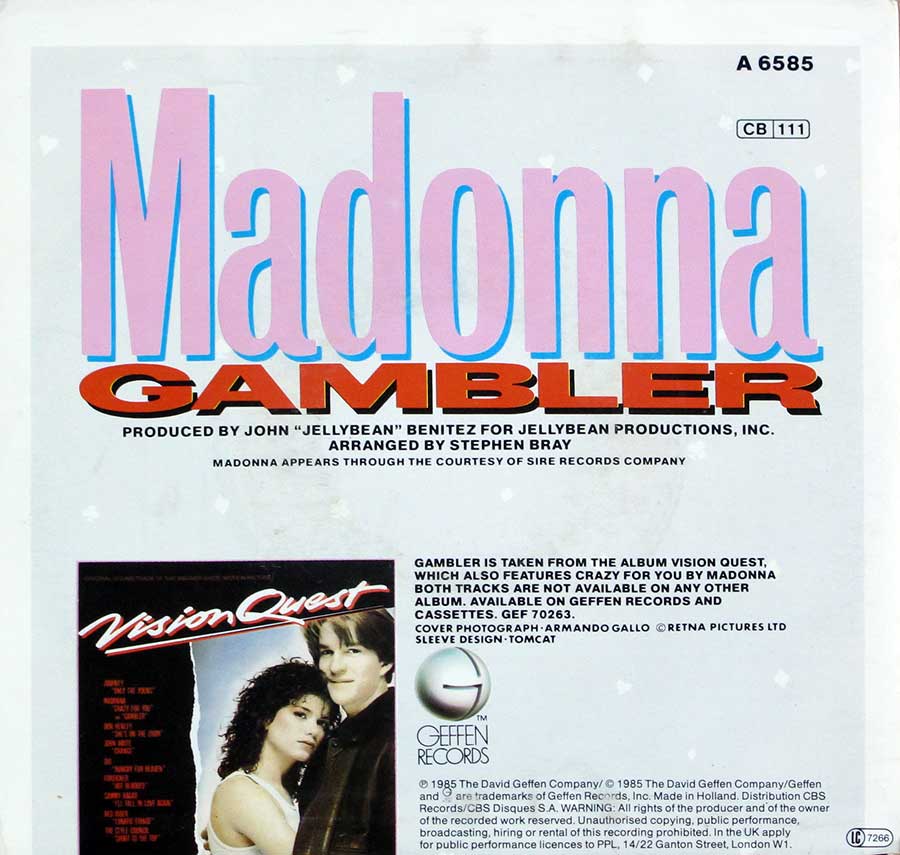
Back cover of Madonna – Gambler 7-inch picture sleeve single on Geffen GEFA 6585, white-dominated layout with oversized Madonna and Gambler titles, small Vision Quest soundtrack image inset at lower left, dense credit text, Geffen Records logo, legal lines, catalog and rights codes, thin mid-80s card stock showing edge wear and pressure marks.

Flipped over in the hand, the back is all business and a little smug about it. The white background shows everything—every thumb smudge, every faint gray rub where the sleeve slid against others in a shop rack. This isn’t glossy white; it’s that slightly chalky stock Geffen used in the mid-80s, the kind that yellows unevenly and loves to hold pressure marks from the record inside. Near the top edge there’s often a shallow wave, a reminder that these sleeves spent years leaning rather than lying flat.

The typography does most of the heavy lifting. “Madonna” stretches wide in pastel pink with a blue drop shadow that feels just a fraction off-register, enough to notice if you tilt it under light. “Gambler” sits underneath in thick red-black letters, heavier, flatter, less forgiving. The contrast isn’t subtle, and it doesn’t try to be. Up in the corner, “A 6585” and “CB 111” float like inventory tags, printed small and crisp, clearly meant for logistics rather than romance.

Down left, the little Vision Quest soundtrack image looks almost apologetic in size, as if it was dropped in late to justify the whole operation. It’s surrounded by dense text blocks spelling out exactly why this song matters and where else you can find it, the kind of copy nobody read carefully but everyone glanced at once. On handled copies, that area shows the most wear, the ink thinning where fingers lingered while scanning credits.

The Geffen logo and legal paragraph anchor the bottom, packed tight and unapologetically small. There’s no breathing room, no design flourish—just rights, warnings, addresses, and the quiet admission that this was made in Holland. Over time, the lower corners soften first, and a faint ring impression creeps in, especially visible against all that white. It feels less like a canvas and more like packaging, which is probably why it survives scrutiny better than it should. Nothing here pretends to be precious.

Close up of Side One record’s label
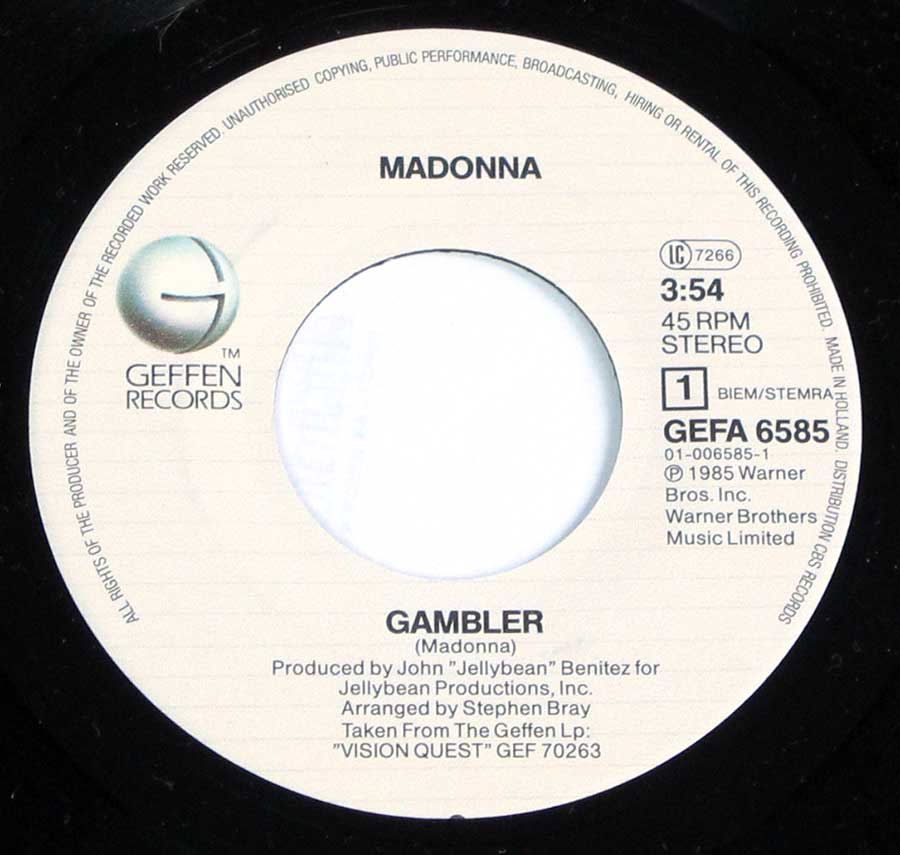
Close-up of Side A record label for Madonna – Gambler 7-inch single, Geffen Records GEFA 6585, cream-colored label with black text, Geffen logo at left, running time 3:54, 45 RPM stereo marking, BIEM/STEMRA box, catalog and matrix numbers, visible spindle wear and light surface scuffs from repeated play.

Pulled halfway from the sleeve, the label comes into view with that familiar Geffen cream tone that never stays clean for long. The paper isn’t white and never was; it leans warm, slightly fibrous, and it shows every encounter with a turntable spindle. There’s a soft gray halo around the center hole where hands missed by a millimeter, a pattern that only forms after years of casual drops and impatient cueing. The surface has fine hairline scuffs that don’t photograph well unless the light hits them just wrong.

The Geffen logo sits to the left, printed with a smoothness that contrasts with the slightly grainy text elsewhere. It’s sharper than the surrounding type, like it came from a different plate, which wouldn’t surprise anyone who’s handled enough mid-80s pressings. “MADONNA” at the top is set clean and unadorned, spaced just enough to breathe, while “GAMBLER” below the spindle hole feels heavier, more anchored, as if it’s doing the work of keeping the label from drifting.

Details stack tightly on the right: 3:54, 45 RPM, STEREO, boxed BIEM/STEMRA, all squeezed in without ceremony. GEFA 6585 is printed with confidence, and below it the matrix line 01-006585-1 sits small but legible, the kind of number collectors lean closer for, even if they pretend not to care. “Made in Holland” is there too, slipped in vertically, easy to miss until you’ve turned the record a few times and wondered why the vinyl feels just a touch different from UK copies.

At the bottom, the production credits run straight and factual: produced by John “Jellybean” Benitez, arranged by Stephen Bray, lifted from Vision Quest. No flourish, no hype, just the facts laid flat. The outer edge text wraps around in that dense legal ring nobody reads anymore, but it’s printed crisply enough to remind you this was a mass-produced object meant to circulate, not a keepsake. The whole thing feels honest in a workmanlike way. Nothing here is trying to impress; it’s trying to get played, again and again.

All images on this site are photographed directly from the original vinyl singles in my collection. Earlier blank sleeves were not archived due to past storage limits. Photo quality varies because images were taken over several decades with different cameras. You may use these images for personal or non-commercial purposes if you include a link to this site; commercial use requires my permission. Text on covers and labels has been transcribed using a free online OCR service.

Like a Discography: The Complete 1980s Collection of Madonna's Vinyl Records

MADONNA - Angel 7" Vinyl Single
MADONNA - Angel album front cover vinyl record

Madonna's 1985 single "Angel," a synth-pop anthem from her era-defining album "Like a Virgin," received a distinct visual treatment for its European 7" vinyl release. This sleeve offered a more intimate look at the pop icon compared to the US version.

Learn more
MADONNA - Burning Up b/w Physical Attraction 12" Vinyl LP
MADONNA - Burning Up b/w Physical Attraction  album front cover vinyl record

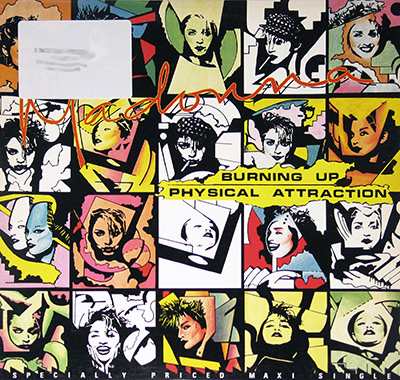
Released in 1983, Madonna's 12" vinyl single "Burning Up" b/w "Physical Attraction" emerged during a transformative period in pop music. MTV had recently launched, and a new wave of artists was reshaping the industry with innovative sounds and visuals.

Learn more
MADONNA - Causing Commotion 12" Vinyl Maxi Single
MADONNA - Causing Commotion album front cover vinyl record

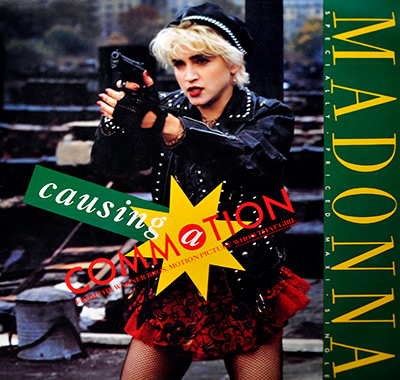
In the music scene of 1987, Madonna, the undisputed Queen of Pop, released "Causing a Commotion," a 12" maxi-single that became an instant sensation. The song, featured in the soundtrack of the film "Who's That Girl," captured the energy and spirit of the era, further solidifying Madonna's iconic status.

Learn more
MADONNA - Dress You Up 12" Vinyl LP
MADONNA - Dress You Up  album front cover vinyl record

In the music scene of 1985, Madonna, the undisputed Queen of Pop, released "Dress You Up," a 12" maxi-single that became a dance-pop anthem and further solidified her iconic status. The song, featured in her second studio album "Like a Virgin," captured the energy and spirit of the era,

Learn more
Updated MADONNA - The First Album front cover vinyl LP album https://vinyl-records.nl
MADONNA – The First Album 12" Vinyl LP

Madonna’s 1983 debut LP lit the fuse on her rise to pop royalty. Produced by Reggie Lucas, the album’s synth-pop pulse, catchy hooks, and street-smart confidence defined the sound of early MTV and turned club culture into a global phenomenon.

Madonna - Gambler album front cover vinyl single https://vinyl-records.nl

Madonna Runs Hot and Fast in 1985 — No Safety Net

Madonna - Gambler

Released in 1985, “Gambler” is Madonna stepping sideways from pure dance-pop into sharp, restless soundtrack territory. Built around bright guitars, clipped drums, and forward momentum, this Vision Quest single was produced by John “Jellybean” Benitez and pressed in Holland for Geffen (GEFA 6585). A lean, impatient 7-inch that sounds like motion.

MADONNA - Gambler (7" and 12" Versions)
MADONNA - Gambler (7" and 12" Versions) album front cover vinyl record

In 1985, Madonna, fresh off the success of her second album "Like a Virgin," released an standard and extended dance mix of "Gambler" as a 12" maxi-single. The track, originally featured on the soundtrack of the film "Vision Quest," received a pulsating makeover, transforming it into a club-ready anthem.

> - Gambler extended dance mix (1985, Holland)
MADONNA - Into The Groove b/w Shoo-Bee-Doo 7" Vinyl Single
MADONNA - Into The Groove b/w Shoo-Bee-Doo  album front cover vinyl record

In 1985, Madonna, at the peak of her pop stardom, released "Into the Groove," a single that became synonymous with the dance craze sweeping the globe. Originally featured in the film "Desperately Seeking Susan," the song's infectious beat and catchy lyrics propelled it to the top of charts worldwide.

Learn more
MADONNA - La Isla Bonita (Remix Edit) 7" Vinyl Single
MADONNA - La Isla Bonita (Remix Edit) album front cover vinyl record

In 1987, Madonna, already a global pop icon, released "La Isla Bonita" as a single from her third studio album, "True Blue." The song, a departure from her usual dance-pop sound, incorporated Latin and Caribbean influences, showcasing her versatility as an artist.

Learn more
MADONNA - Like a Prayer 12" Vinyl LP
MADONNA - Like a Prayer  album front cover vinyl record

In the late 1980s, Madonna had already established herself as a pop icon, pushing boundaries with her provocative image and infectious dance-pop anthems. However, with her fourth studio album, "Like a Prayer," released in 1989, she embarked on a new era of artistic exploration and maturity.

Learn more
MADONNA - Like a Virgin 12" Vinyl LP
MADONNA - Like a Virgin album front cover vinyl record

Madonna's 1984 album "Like a Virgin" was more than just a chart-topping success; it was a cultural earthquake that redefined the boundaries of female pop stars. The album's release coincided with the rise of MTV, and Madonna's provocative videos and image became synonymous with the era.

Learn more
MADONNA - Live to Tell 7" Vinyl Single
MADONNA - Live to Tell  album front cover vinyl record

In 1986, Madonna released "Live to Tell," the lead single from her third studio album, "True Blue." The song marked a significant shift in her musical direction, showcasing a more mature and introspective side of the pop icon.

Learn more
MADONNA - Self-Titled First Album 12" Vinyl LP
MADONNA - Self-Titled First Album front cover vinyl record

Emerging from the underground dance clubs of New York City, Madonna's music captured the spirit of a generation seeking self-expression and liberation. Her self-titled album blended elements of dance-pop, disco, and synth-pop, creating a sound that was both infectious and innovative.

Learn more
MADONNA - True Blue 12" Vinyl LP
MADONNA - True Blue  album front cover vinyl record

Madonna’s “True Blue” is a landmark album in her career that cemented her status as a pop icon. Released in 1986, it was her third studio album, and it was a massive commercial success, selling over 25 million copies worldwide. The album spawned many hits, including “Papa Don’t Preach,”

Learn more
MADONNA - Who's That Girl (7" and 12" Versions)
MADONNA - Who's That Girl (7" and 12" Versions) album front cover vinyl record

In 1987, Madonna unleashed the "Who's That Girl" 7" Single anf 12" maxi-single, a dancefloor extravaganza that expanded upon the infectious energy of the film's title track. This extended format allowed for a deeper exploration of the song's various remixes and extended versions, catering to both club DJs and avid fans.

- Who's That Girl 7" PS Single - Who's that Girl 12" Maxi-Single