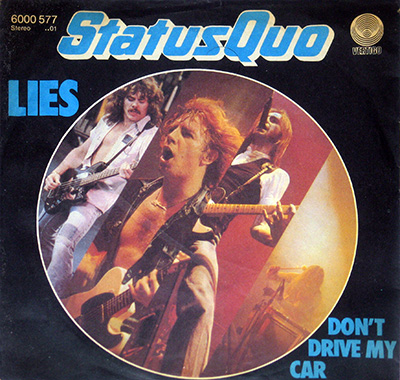
"Lies" / "Don't Drive My Car" (1980) Album Description:
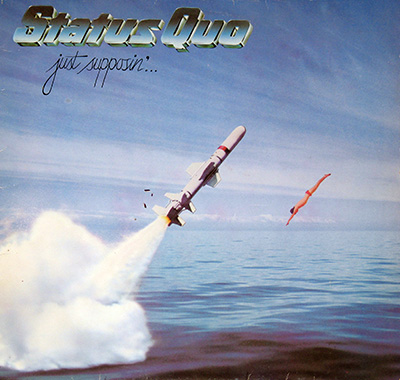
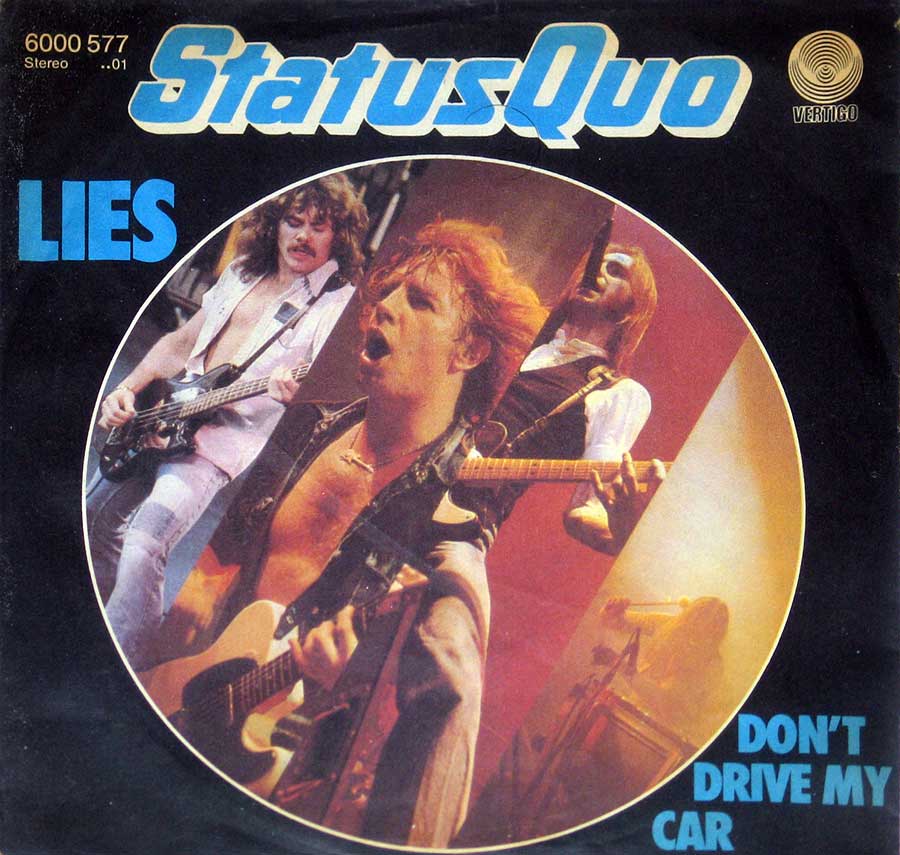
Status Quo didn’t reinvent the wheel here, they just bolted on a louder engine and drove it straight through late-1980 Britain with the windows down. Released on Vertigo in November 1980 as a double A-side, "Lies" and "Don't Drive My Car" feel like two moods from the same band-night: one aimed at radio punch, one built for the long haul groove. Both tracks come straight off "Just Supposin'", with the band and producer John Eden keeping the Quo machine tight, bright, and stubbornly alive.
What this single is, in plain English
It’s a 7-inch that flexes Quo’s core identity without pretending punk never happened. "Lies" comes in like a compact uppercut: clean riffing, a chorus designed to stick, and a production sheen that says the band understood 1980 was a broadcast era. "Don't Drive My Car" rides looser and longer, with a steadier pocket and more room for the guitars to breathe.
Britain in 1980: the mood behind the music
The UK in 1980 was tense, loud, and not particularly polite about it. Thatcher-era economics were biting, unemployment was climbing, and youth culture had that post-punk edge where everything felt both cynical and weirdly creative. Rock bands who’d survived the 70s were either adapting, doubling down, or getting pushed off the map by new sounds.
In that swirl, guitar music wasn’t “dead,” it was just competing with sharper silhouettes. New Wave and synth-pop were grabbing attention, punk had already kicked the door off its hinges, and heavy metal was regrouping into something faster and more militant. Status Quo landing a glossy, punchy single in that moment is basically them saying: sure, the city changed, but the bar still needs a band.
Rock, rock ’n’ roll, boogie: what Quo actually do
The Quo sound lives on repetition with purpose: a locked-in rhythm, twin-guitar grit, and riffs that don’t over-explain themselves. Call it boogie rock, hard-driving rock ’n’ roll, pub rock DNA—whatever label you pick, the mechanics are the point. It’s music that works because it moves, not because it lectures.
Around the same time, you could hear different branches of the same loud family tree doing their own thing. AC/DC were turning blunt-force riffing into an international language, ZZ Top were sharpening their blues-rock minimalism, and in the UK, the NWOBHM wave was pushing bands like Iron Maiden and Saxon into a tougher, faster lane. Status Quo didn’t chase those trends; they aimed their own formula at the new decade and made it chart-friendly.
Inside the songs: musical exploration without the art-school outfit
"Lies" is structured to hit quickly: the hook lands early, the guitars stay crisp, and the vocal phrasing keeps everything in motion. It’s Quo with a cleaner suit on, still swinging, just more camera-ready. The songwriting credit puts Francis Rossi together with Bernie Frost, and you can hear that “make it stick” instinct in how the chorus is built.
"Don't Drive My Car" stretches out more, and that matters. It leans into a steadier, road-tested groove, letting the band sound less like a single and more like a group in a room. The writing credit goes to Rick Parfitt and Andy Bown, and it plays like a band member’s side of the story: slightly less polished, slightly more lived-in, and proud of it.
Two sides, same engine: one track throws elbows at the charts, the other takes the long way home with the headlights on.
Key people who made this recording happen
The big production story here is control. The single’s production is credited to Status Quo and John Eden, and that’s the sound you get: a band protecting its identity while letting the mix come forward in a more modern way. This wasn’t the rawer, sweatier early Quo vibe; it’s the band tightening bolts and choosing the right shine.
- Francis Rossi (songwriter on "Lies") keeps the melodic center strong and the delivery direct.
- Rick Parfitt (songwriter on "Don't Drive My Car") leans into the groove-first, guitar-forward Quo heartbeat.
- Andy Bown (co-writer on "Don't Drive My Car") represents the band’s broader musical toolkit beyond just riffs.
- John Eden (co-producer) helps steer the sound toward a tighter, radio-capable finish without sanding off the bite.
Band history snapshot: how Quo got here
Status Quo started in the early 60s under earlier names before settling into the identity that actually stuck, and by the 70s they’d turned relentless touring and simple, durable rock structures into a national habit. That long runway matters, because by 1980 they weren’t trying to prove they belonged. They were operating like a factory that knew exactly what it produced and why people kept showing up for it.
Line-up stability was part of the Quo brand, but the era around 1980 sits near the edge of change. The classic engine room at the time centered on Rossi and Parfitt up front, with the rhythm section keeping the shuffle locked. Not long after this period, the band would see notable personnel shifts, which makes this single feel like part of the last stretch of a very specific Quo internal balance.
Controversies and friction: small single, real noise
The most literal controversy came from the manufacturing side: the "Don't Drive My Car" title has been documented as suffering misprints on some pressings, including the infamous “CAF” and the mangled “MYICAR.” It’s the kind of mistake that turns a clean product into a talking point, and it happened right on the face of the record where nobody can pretend not to notice.
The bigger, ongoing argument was cultural. In a Britain busy arguing about the future of music, Quo were still proudly selling a past that refused to die: riffs, rhythm, and no apologies. Critics could roll their eyes at the consistency, but the charts didn’t care about irony, they cared about whether the song hit, and this release clearly did.
Track facts at a glance
- Release: Double A-side single (Vertigo), released late November 1980
- Side 1: "Lies"
- Side 2: "Don't Drive My Car"
- Catalog: Vertigo 6000 577 (as commonly listed for the release)
- Source album: "Just Supposin'" (recorded at Windmill Lane Studios, Dublin)