TANK - This Means War 12" Vinyl LP Album

- Tank Rolls In With A RoadrunneR Sleeve That Looks Ready To Bite Back

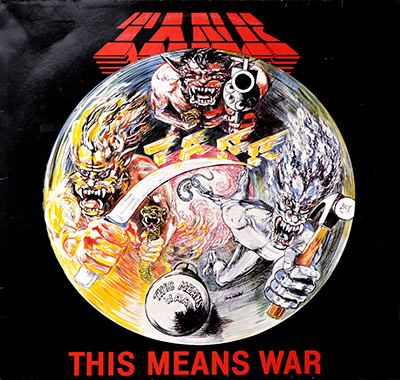
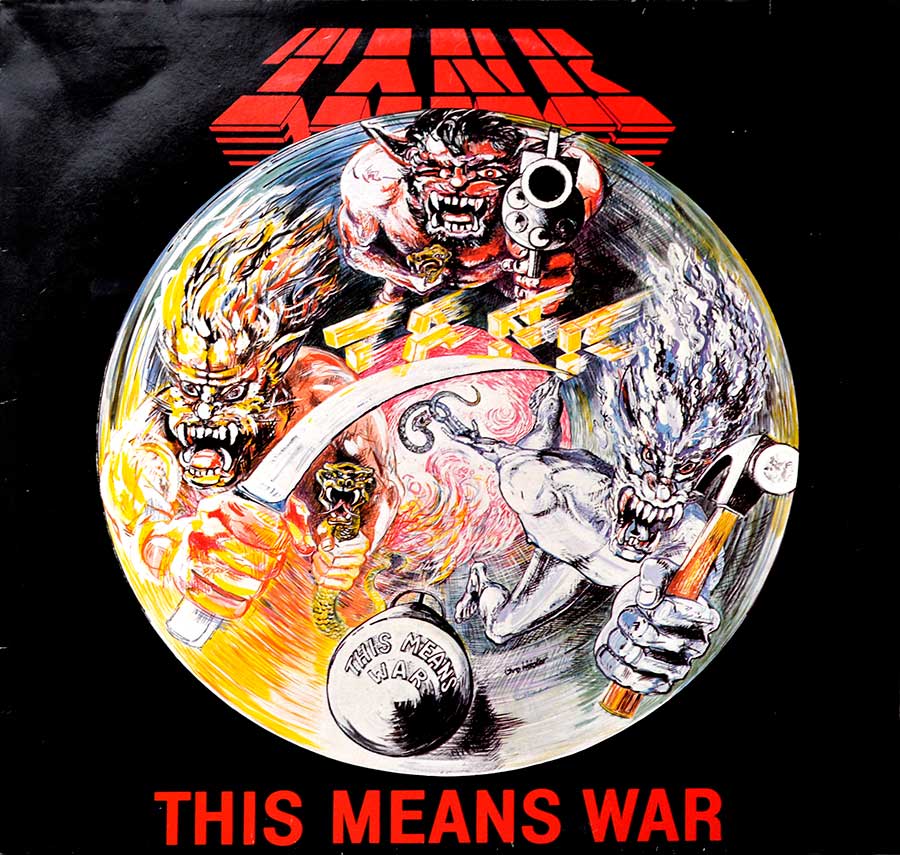
Album Front cover TANK - This Means War RoadrunneR Records 12" Vinyl LP Album showing a black sleeve with the red Tank logo at the top and the red album title along the bottom. In the centre, a circular war-zone illustration throws three snarling creatures into combat, with a gun, sword, fire, bomb, and club all crammed into one gloriously subtle little argument for peace. Very NWOBHM, naturally.

From above, the front cover is all black space framing one loud circular blast of comic-book violence. The red TANK logo sits like a warning sign at the top, while THIS MEANS WAR anchors the bottom in the same bright red. Inside the circle, three monstrous attackers charge out with gun, sword, bomb, fire, and club, because apparently one weapon was not dramatic enough. It is messy, loud, and exactly the sort of sleeve that refuses to behave.

"This Means War" is the third album by British heavy metal band Tank, released in 1983. On this album, the line-up expanded to a four-piece, with the addition of second guitarist Mick Tucker, former member of the NWOBHM band "White Spirit". Thanks to Tucker's songwriting contributions and to the sound expanded by an extra guitar, the band changed their music in comparison with their previous albums with longer, more melodic compositions, which helped differentiate Tank from Motörhead, the band they were often compared to.

"This Means War" (1983) Album Description:

By 1983, Tank had stopped sounding like a gang clinging to Motörhead's exhaust fumes and started dragging their own armour across the NWOBHM battlefield. "This Means War" is their third album, and the title is not exactly hiding behind poetry. British metal that year was splitting into bigger stages, faster riffs, cleaner studios, and uglier business decisions; Tank answered with longer songs, a second guitar, and Algy Ward still barking like charm school had personally offended him.

Open the rest of this and the interesting bit is not just the noise, though there is plenty of that. The album catches Tank in the awkward but useful middle ground between street-metal grime and a more deliberate twin-guitar shape, with Mick Tucker arriving from White Spirit and pushing the band away from the usual lazy comparison. The sleeve even tells on them: black ink, crowded credits, and a back cover that looks like a pub argument was typeset at closing time.

The British scene around this record was not short of noise. Iron Maiden were already working on a grander scale, Saxon still carried the road-warrior flag, Raven were sprinting like their amplifiers owed them money, Girlschool kept the grit practical, Diamond Head were drifting into stranger, sleeker territory, and Motörhead had their own 1983 complications with "Another Perfect Day". Tank did not try to out-theatre Maiden or out-chaos Raven. Sensible, really. They stayed low to the pavement and made the guitars do the damage.

What changes here is the density. Earlier Tank could feel like a blunt instrument swung in a small room, and that had its pleasures, especially if subtlety makes you itch. On "This Means War", Peter Brabbs and Mick Tucker give the riffs more width, more scrape, and more room to grind. "Just Like Something from Hell" sprawls at the start, heavy and stubborn, while "Hot Lead Cold Steel" has that greasy mechanical push where the tempo feels less like speed and more like something rolling downhill without brakes.

The title track is the obvious centre of gravity, because of course it is. It moves with a bigger chest than the earlier material, still rough, still bruised, but less tied to the quick-hit punk-metal jab. "Echoes of a Distant Battle" also matters, not because it tidies anything up, but because it lets Tank stretch the mood into something darker and more spacious. The record has bite, but it also has drag and weight. That is where it earns its keep.

Algy Ward remains the useful problem at the front of the band: vocals and bass together, all grit, pressure, and no interest in sounding house-trained. Coming through The Saints and The Damned before Tank gave him a kind of road-damaged authority that polished singers rarely manage, no matter how many dramatic hand gestures they throw at a microphone. Here he sounds less like a vocalist decorating the riffs and more like the engine room has learned to shout.

John Verity's production does not turn the album into chrome. Thank heavens for small mercies. His job here seems to be keeping the expanded line-up legible without scrubbing away the dirt, and that is where the record wins: the drums still thump, the guitars still rasp, and the bass still moves like a heavy object being dragged across concrete. It is cleaner than Tank at their most feral, but it never becomes polite. Polite would have killed it stone dead.

The album also corrects one common lazy mistake: this is not Tank merely copying Motörhead with a different badge on the jacket. The comparison hangs around because Ward's bass-and-bark attack makes it easy for people who listen with one ear and a checklist. But the longer writing, the twin-guitar pressure, and the more deliberate pacing make "This Means War" a different beast. Not refined. Not elegant. Different.

No great release controversy seems to cling to this album, unless one counts the usual collector irritation of mismatched descriptions, wrong track references, and sellers treating every early-eighties metal LP like it was smuggled out of a burning monastery. The real misconception is smaller and more persistent: Tank are too often filed as a footnote, when this record shows a band changing shape without surrendering its bad manners. That is rarer than it sounds.

The RoadrunneR RR 9907 Dutch/Benelux pressing adds the kind of small physical pleasure that only record people pretend not to care about. The grey labels, the stark black sleeve, the red title block, the slightly crowded back cover credits; none of it feels luxury-grade, and that is half the charm. Late at night, under a desk lamp, the Side One label looks more honest than most press releases ever managed.

"This Means War" sits in NWOBHM as one of those records that did not need royal robes to make its point. It has blunt force, longer shadows, and enough melody to prove Tank were not just swinging blindly in the dark. A fan favourite? Among the right crowd, absolutely. Scene-defining in the neat textbook sense? Spare me. It is better than that: a battered, loud, transitional record that still smells faintly of leather, cigarette smoke, and van diesel.

References

Album Key Details: Genre, Label, Format & Release Info

Music Genre:

NWOBHM, Heavy Metal

Label & Catalognr:

RoadrunneR – Cat#: RR 9907

Media Format:

Record Format: 12" Vinyl Stereo Gramophone Record
Total Weight: 230g

Release Details:

Release Date: 1983

Release Country: Made in Holland

Production & Recording Information:

Producers:
  • John Verity – Producer

    Bradford grit behind the desk, with enough road miles to know when Tank needed polish and when they needed bruises.

    John Verity, English guitarist, singer and producer from Bradford, West Yorkshire, is best known for his mid-seventies spell with Argent and later production work around British hard rock and Heavy Metal; on "This Means War" he gives Tank a hard, unfussy studio sound, keeping Algy Ward's bark, the guitars' metallic bite, and the rhythm section's blunt-force shove intact instead of sanding everything smooth for polite company.

Photography:
  • Alan Ballard – Photography

    British sleeve photographer linked to Motörhead, Girlschool and Tank, with a useful eye for grit instead of glamour.

    Alan Ballard — British photographer with a sharp eye for bands who looked better with dust, sweat, and bad lighting than with studio polish. I place him among those sleeve workers who did not try to civilise heavy music; he caught the grime and let it stand. After early press work at the Evening Standard, assisting John Cowan, and a spell around American Vogue, Ballard drifted into rock’s rougher rooms. For Motörhead he shot "Ace of Spades" in 1980 and later back-cover work for "Orgasmatron" in 1986. With Tank, his credit runs through the early Bronze/independent years, including "Crazy Horses" and "Power of the Hunter" in 1982 and "This Means War" in 1983. Girlschool also passed through his lens in 1983. Not glossy. Better than that.

Collector’s Note: Why This Means War Still Earns Its Place

By 1983 Tank were no longer just the grubby little cousin being dragged behind Motörhead’s exhaust pipe. "This Means War" pushed them into a broader, heavier twin-guitar attack, with Algy Ward still barking from the front like a man who had no interest in polished nonsense.

This Dutch Roadrunner RR 9907 pressing is not some mortgage-level holy grail, but it has proper NWOBHM weight: period label, strong cover, decent collector presence, and that lovely early-eighties smell of leather jackets, beer, and slightly dangerous amplifiers. For the archive, this one deserves more than a lazy dust-off.

Band Members / Musicians:

Band Line-up:
  • Algy Ward – vocals, bass
  • Algy Ward - Singer, Bass Guitarist, Record Producer

    From The Saints to The Damned to Tank: Algy Ward's bass always sounds like it wants a fight.

    Algy Ward is the rare beast who carried punk's spit into heavy metal's engine room. With The Saints (1977-1979) he learned how to make a bass line snarl; with The Damned (1979-1980) he helped drive the "Machine Gun Etiquette" comeback like the amplifier was on fire. In 1980 he formed Tank and stayed on the front line - vocals and bass slung low - through the first run (1980-1989), the later revival (1997-2003), and his own late-era return (2013-2023). He wasn't chasing studio perfection; he leaned into volume, grit, and speed, and he also stepped into production work when needed. I always hear him as a moving wall: not fancy, not polite, just forward motion until it hurts.

  • Peter Brabbs – guitar
  • Mick Tucker – guitar
  • Mark Brabbs – drums

Complete Track-listing:

Tracklisting Side One:
  1. Just Like Something from Hell
  2. Hot Lead Cold Steel
  3. This Means War
Tracklisting Side Two:
  1. Laughin in the Face of Death
  2. (If We Go) We Go Down Fighting
  3. I (Wont Ever, Let You Down)
  4. Echoes of a Distant Battle

Disclaimer: Track durations shown are approximate and may vary slightly between different country editions or reissues. Variations can result from alternate masterings, pressing plant differences, or regional production adjustments.

This gallery has that plain, no-nonsense RoadrunneR look I always enjoy on early-eighties metal records: not too glossy, not too clever, just sleeve, ink, attitude and a grey label doing its job. The front cover photo shows the album as a handled collector copy rather than some museum-clean fantasy, which is usually more useful anyway. The back cover gives the band shot, the sort of thing you check twice when matching editions. The labels are where it gets properly interesting: RoadrunneR RR 9907, grey colour, sharp enough typography, and the kind of small pressing details that tell more than a sales blurb ever could. The real clues sit deeper in the gallery, especially on the label close-ups.

Album Front Cover Photo
Front cover of TANK - This Means War on a black vinyl LP sleeve. A red TANK logo sits at the top and the red album title at the bottom. In the centre, a circular illustration shows three snarling monsters with a gun, curved sword, bomb, fire, and club. The sleeve surface shows gloss, light scuffs, small edge wear, and uneven flash reflections.

Seen flat from above, this front sleeve does not ease itself into the room. It lands. The black background is the first thing under the fingers, glossy enough to catch light in dull patches, especially along the upper left where the surface shows handling shine and those little cloudy scuffs that black sleeves collect just by existing. The red TANK logo sits at the top like block lettering cut from machinery, hard-edged and slightly brutal, while the album title at the bottom shouts in the same red, because subtlety had clearly been locked outside with the press kit.

The centre is a circular riot of comic-book violence: three snarling creatures jammed into one round battlefield, all teeth, weapons and motion. A revolver points out from the upper monster, a curved blade sweeps across the middle, fire burns on the left, a bomb marked “THIS MEANS WAR” sits near the lower edge, and a club comes in from the right. It is overstuffed, frankly. That is also why it works. NWOBHM sleeves often looked like someone had fifteen ideas and no adult nearby to remove twelve of them. Here the chaos feels deliberate, almost proud of itself, with the bright yellow and red ink fighting against grey, white and black scratchy linework.

Handling the sleeve close up, the print has that slightly harsh early-eighties feel: the colours punch hard, but the fine drawing lines look restless, almost impatient. Around the circular artwork there are tiny white specks in the black field, some likely print dust, some sleeve wear, some just the usual crimes of age. The lower edge has faint pressure marks and light rubs where a record has clearly lived inside it rather than been stored like royal porcelain. Good. Records should look as if they have survived a few rooms, not a laboratory.

What catches me most is the contrast between the controlled red typography and the lunatic mess inside the circle. The logo and title know exactly where they are going; the artwork behaves like it has just kicked the door off its hinges. Annoying? A bit. The circular composition gets crowded enough that the eye has to fight through it, and the white beast on the right nearly collapses into the background scratches. But that impatience suits Tank. This is not a sleeve pretending the album is cleverer than it is. It promises noise, teeth, bad temper, and a small pile of collector fingerprints under the light. For once, the sleeve is not lying.

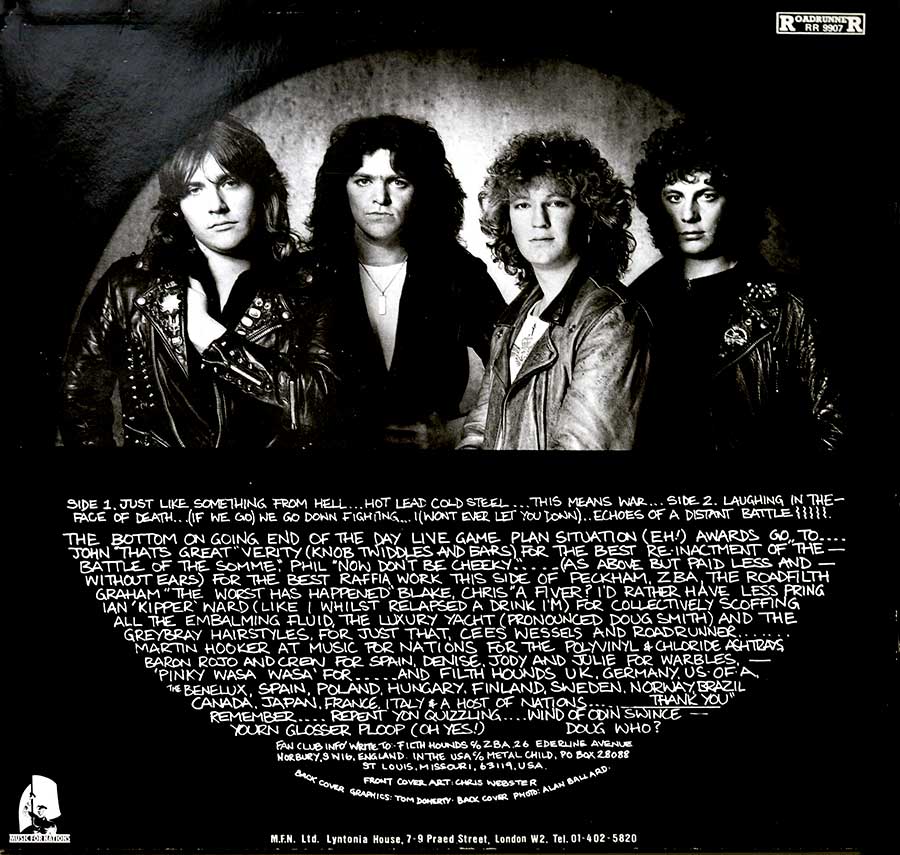
Album Back Cover Photo
Back cover of TANK - This Means War on a black 12 inch vinyl LP sleeve. Four band members appear in a black-and-white photo across the upper half, with the RoadrunneR RR 9907 logo at top right. Below are handwritten-style track titles, credits, thanks, fan club details, Music for Nations logo, and M.F.N. Ltd. London address.

Turned over flat on the desk, this back cover feels less like a neat album layout and more like someone emptied the Tank notebook onto black card and told the printer to get on with it. The upper half is dominated by a black-and-white band photo, four leather-jacketed faces lined up under a soft grey arch of studio light. Not smiling. Naturally. The RoadrunneR RR 9907 logo sits in the top right corner, small and tidy, doing its label duty while the rest of the sleeve mutters at you in white handwriting.

The lower half is where the real collector digging starts. The track listing runs in a rough handwritten style across the black field, with Side 1 and Side 2 crammed together like the sleeve ran out of patience. Under that comes a dense block of thanks, jokes, names, addresses, fan club notes and record-business breadcrumbs. It is not elegant. Good. Elegance would be suspicious here. The white ink has that slightly uneven printed look, with some letters fattening, some thinning, and a few lines almost daring tired eyes to give up. Been there, usually with a bad desk lamp and a cup of coffee going cold.

Physical wear shows up most clearly around the edges and darker zones. The top left has a rubbed, cloudy patch where the black finish catches the light in a tired rectangular smear, as if another sleeve or plastic outer has been leaning on it for years. Tiny white specks sit in the black background, some dust, some print noise, some age doing its usual quiet vandalism. Along the bottom edge, the sleeve shows fine scuffing and pressure rubs; nothing catastrophic, just the sort of honest handling marks that remind you this record was filed, pulled out, argued over, and probably not treated like a government archive.

What works here is the blunt contrast: stern band photo above, chaotic written evidence below. The photo says metal band. The handwriting says pub table, tour van, small office, cheap phone calls, and somebody trying to remember every name before the artwork deadline bit them. Slightly annoying? Absolutely. The credits are packed so tightly that reading them becomes a small act of stubbornness. But that is also the charm. This back cover gives more than decoration; it gives paperwork, attitude, and a few loose ends. For a Tank sleeve, that feels about right.

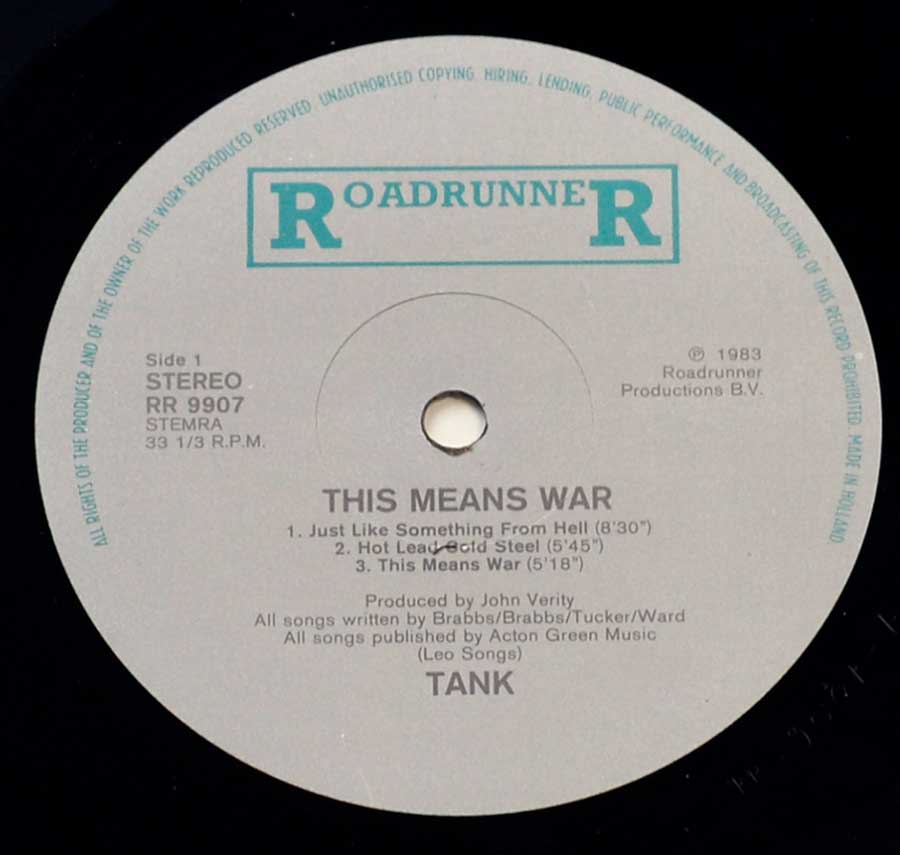
Close up of Side One record’s label
Close-up of the Side 1 record label for TANK - This Means War on black vinyl. A pale grey label fills the centre, with a turquoise RoadrunneR logo across the top, circular rim text, and black text blocks showing Side 1, Stereo, RR 9907, STEMRA, 33 1/3 R.P.M., track titles, production and publishing credits. The spindle hole shows small wear marks.

Set down flat and looked at properly, this Side 1 label is exactly the sort of thing that separates a real collector photo from the usual fuzzy sales nonsense. The label itself is a pale grey, almost off-white under the light, with the turquoise RoadrunneR logo stretched across the top in that blocky frame design they used so often. Around the outer edge runs the fine circular rim text, pale and a bit ghostly, the sort of print that makes you lean in closer than your eyes appreciate. The black vinyl around it forms a heavy border, and that contrast does most of the work. Clean, direct, no decoration beyond what the record needed.

The useful details are laid out in a practical, old-fashioned way. On the left: Side 1, STEREO, RR 9907, STEMRA, 33 1/3 R.P.M. On the right: the 1983 Roadrunner Productions B.V. credit. In the middle sits the album title THIS MEANS WAR in plain capitals, followed by the three Side 1 tracks and their timings. Under that comes “Produced by John Verity,” the songwriting credit to Brabbs/Brabbs/Tucker/Ward, and the publishing line for Acton Green Music (Leo Songs), with TANK printed boldly near the bottom. Nothing glamorous, which is exactly why it is trustworthy. Labels that try too hard usually have something to hide.

Handling-wise, a few small things give the game away. The spindle hole has slight wear and a tiny dark nick on the lower edge, so this copy has plainly been played rather than worshipped from across the room. A faint dusting of tiny white specks sits across the paper surface, especially noticeable in the upper half where the light hits the label more harshly. The print itself is mostly sharp, though some of the finer lines and smaller letters soften a bit, which is not unusual on these early-eighties pressings. Down on the black vinyl at lower right there are a few fine surface marks catching the light. Not pretty, but honest.

What works here is the restraint. The turquoise logo gives the label just enough identity without turning it into a circus. Mild irritation comes from the pale rim text, which is always harder to read than it needs to be; somebody in a design office clearly thought subtlety was helping. It wasn’t. Still, this is the kind of label layout collectors like because it gives you facts first and lets the music do the swaggering later. No fake grandeur, no pointless clutter, just catalog number, credits, track timings, and that faintly worn spindle hole whispering that this record actually earned its keep.

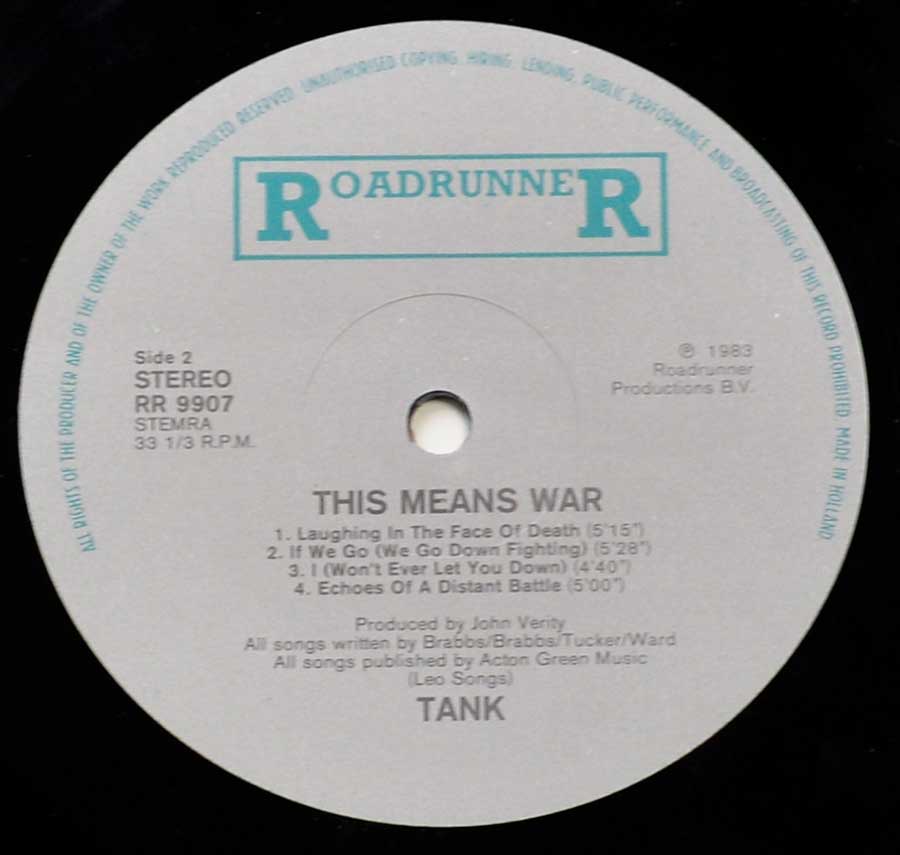
Side Two Close up of record’s label
Close up of Side Two label for TANK - This Means War RoadrunneR Records 12" Vinyl LP Album

Side Two close up of the record label, again showing the grey RoadrunneR design and RoadrunneR RR 9907 catalog detail. Side Two labels can be dull as dishwater on some albums, but they still matter when checking whether both sides belong together properly. Boring? Sometimes. Useful? Absolutely.

All images on this site are photographed directly from the original vinyl LP covers and record labels in my collection. Earlier blank sleeves were not archived due to past storage limits, and Side Two labels are often omitted when they contain no collector-relevant details. Photo quality varies because the images were taken over several decades with different cameras. You may use these images for personal or non-commercial purposes if you include a link to this site; commercial use requires my permission. Text on covers and labels has been transcribed using a free online OCR service.

TANK: Four Decades of Raw Power and Enduring Influence in the Metal Scene"

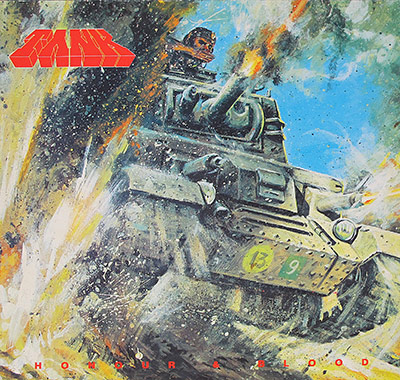
Honour and Blood ( RoadrunneR , Netherlands )
TANK - Honour and Blood (Netherlands & USA Releases )

- Honour and Blood ( RoadrunneR , Netherlands )

- Honour and Blood ( USA, CANADA )

The sonic intensity and precise production of "Honour and Blood" owe a great deal to the sound engineering talents of Alvin Clark and Peter Rackham. Working tirelessly to capture Tank's explosive energy, they ensured that every riff, vocal line, and drum beat reverberated with power and clarity.

 This Means War ( RoadrunneR Record Label )
TANK - This Means War ( Netherlands & French Releases )

- This Means War ( Netherlands, RoadrunneR Record Label )

This Means War ( France, MFN Music For Nations Record Label )

"This Means War" picks up where their debut left off, but with a newfound intensity and focus. From the opening salvo of the title track, it's clear that TANK is here to conquer. Ward's snarling vocals spit out lyrics of rebellion and defiance, while the guitars churn out riffs that could level a city block.

This Means War ( France )
TANK - This Means War ( France )

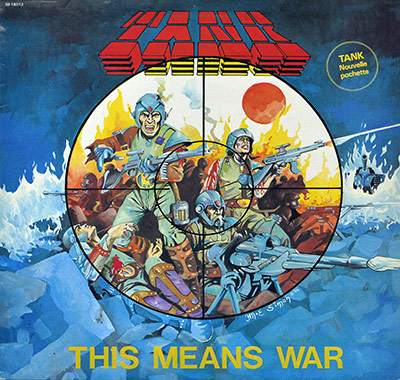
This is the hard to find French release of Tank's This Means War which has a diffent illustration on the album cover.