RAVEN - Stay Hard (1985, Germany) 12" Vinyl LP Album

- The Atlantic Raven sleeve that traded denim grit for sweat, chrome and cheek

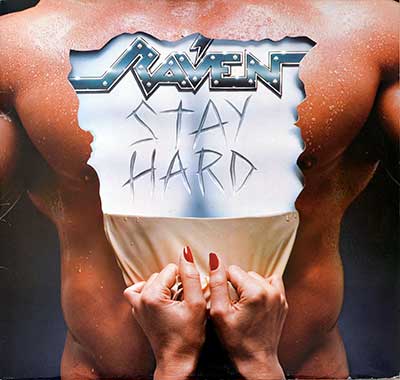
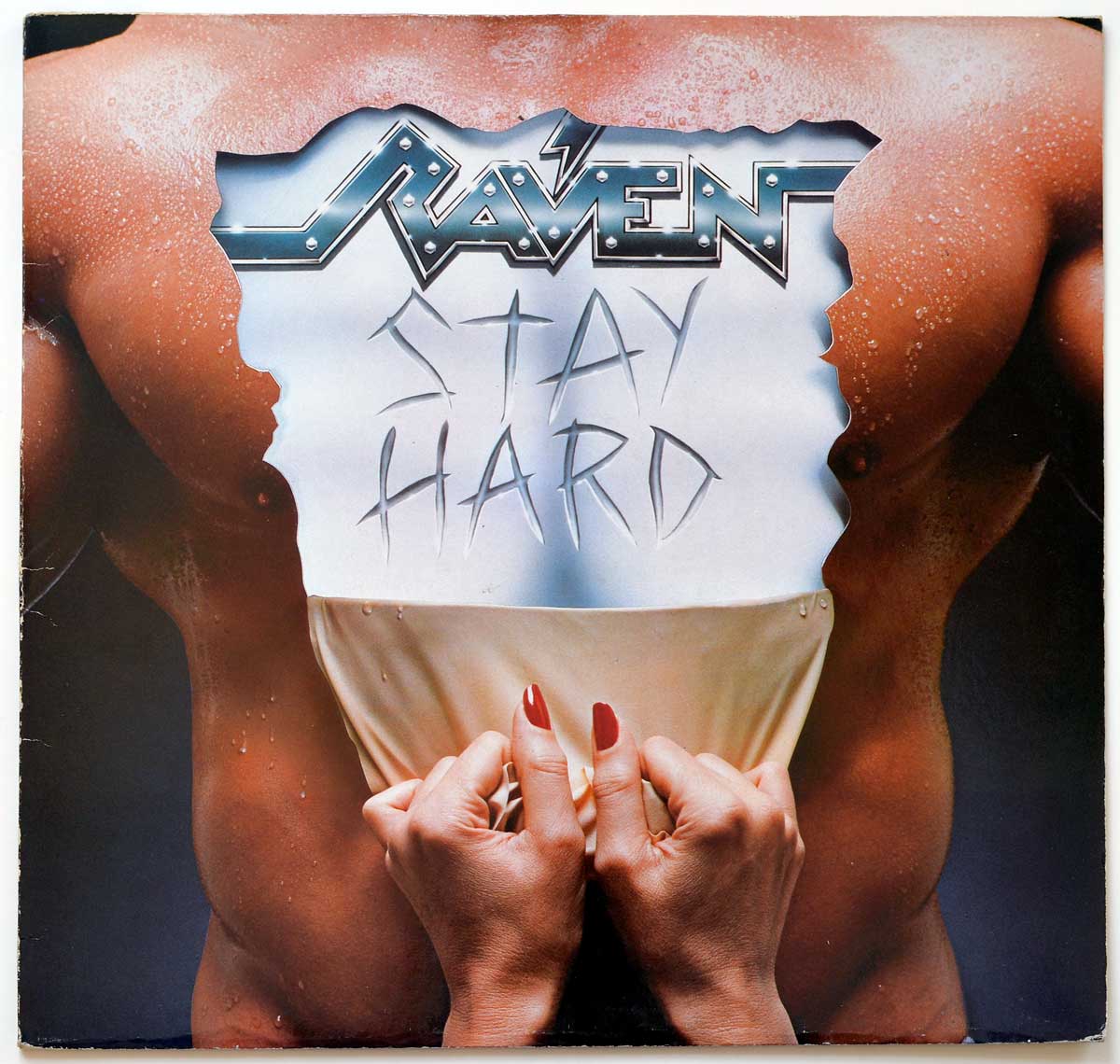
Album Front cover showing a close-cropped torso with water droplets across the skin, hands pulling down pale fabric, and a torn metallic panel across the chest carrying the chrome Raven logo and scratched Stay Hard title. The sleeve leans hard into mid-1980s shock-rock salesmanship: glossy, cheeky, sweaty, and about as subtle as a brick through a record-shop window.

The front sleeve is built like a billboard from the age when metal albums still tried to stop you dead in the shop aisle. From above the record jacket, the eye lands first on skin, water beads, and those red-painted nails gripping the fabric, then crawls upward to the torn silver panel with Raven’s chrome logo and the scratched "Stay Hard" lettering. It is ridiculous, memorable, and very 1985 — which is exactly why collectors still look twice.

Raven hit a strange but fascinating turning point with "Stay Hard", the 1985 Atlantic Records LP that dragged their Newcastle NWOBHM madness into the bigger, shinier American metal market. Not their grubbiest record, and some purists probably clutched their denim jackets in horror, but it mattered: this was Raven trying to break wider without losing the athletic lunacy that made them dangerous. Michael Wagener gives the sound a cleaner bite, with drums snapping, bass bouncing, and guitars sharpened like fresh-cut sheet metal. "Stay Hard", "On and On", and the reworked "Hard Ride" show the band chasing size, speed, and hooks in one sweaty package. This German pressing catches that exact major-label moment.

"Stay Hard" (1985) Album Description:

Raven's "Stay Hard" is the sound of a Newcastle British Heavy Metal trio being pushed through the Atlantic Records machinery and coming out shinier, louder, and slightly less grubby than some of us would like. Released in 1985 on Atlantic, this German 12" vinyl LP catches John Gallagher, Mark Gallagher and Rob "WACKO!" Hunter at that awkward major-label moment where speed, sweat, chrome, and commercial pressure all start elbowing each other in the same room. The old Raven athletic-metal madness is still there, but now it has cleaner edges, bigger hooks, and a sleeve that looks as if a marketing department discovered hormones and never recovered.

The interesting thing is not simply whether "Stay Hard" is better or worse than the rougher Neat/Megaforce-era records. That argument gets boring fast, usually after the second denim-jacket lecture. The real question is how much Raven could polish before the lunacy stopped feeling dangerous, and this album keeps that question buzzing from the front-cover flesh-and-chrome sales pitch right down to the Atlantic labels with their GEMA/BIEM box, LC 0121, catalogue number 781 241-1, and all the dull little manufacturing clues collectors pretend not to love.

By 1985, British Heavy Metal was no longer the fresh pub-and-club explosion it had been at the turn of the decade. Iron Maiden had moved into empire-building territory, Saxon were smoothing their attack, Venom were still throwing filth and theatre around the room, Girlschool had been fighting the same industry machine from a different angle, and plenty of smaller NWOBHM names were discovering that enthusiasm does not pay studio bills. Raven came from that earlier, scrappier wave, but "Stay Hard" stands in the doorway between two worlds: the old British steel-toecap stomp and the American appetite for bigger choruses, clearer production, and sleeves you could spot from the other side of a record shop.

The album was recorded at Pyramid Sound Recording Studios in Ithaca, New York, a long way from Newcastle working clubs and the damp electricity of early NWOBHM. Norman Dunn handled the engineering, with Alex Perialas and Peter Bombar assisting, and that matters because Raven are not a band you simply "capture" neatly. John’s bass wants to bounce forward, Mark’s guitar wants to cut sideways, and Rob’s drums have that restless physical shove that made the band’s athletic-rock tag feel less like a slogan and more like a warning label.

Michael Wagener’s fingerprints are heard most clearly in the mix and the cleaner bite of the record. The sound has less cellar dust than earlier Raven, but more punch in the upper edges; the guitars do not smear, the drums snap, and the choruses are pushed forward like Atlantic expected radio programmers to suddenly become sensible. Nice fantasy, that. Still, the production is not a betrayal by itself. The betrayal, where some old fans heard one, was the suspicion that Raven had started smiling for the wrong camera.

On the turntable, "Stay Hard" has a hard, bright attack rather than a murky underground drag. The title track hits with compact force, "When the Going Gets Tough" swings in that slightly daft Raven way, and "On and On" carries the sort of hook that explains why Atlantic thought there might be a larger market hiding behind the sweat. "Hard Ride", reworked from the debut-album era, is the giveaway: Raven were carrying their past into a cleaner American room and seeing how much dirt survived the crossing.

Some of it works better than it probably has any right to.

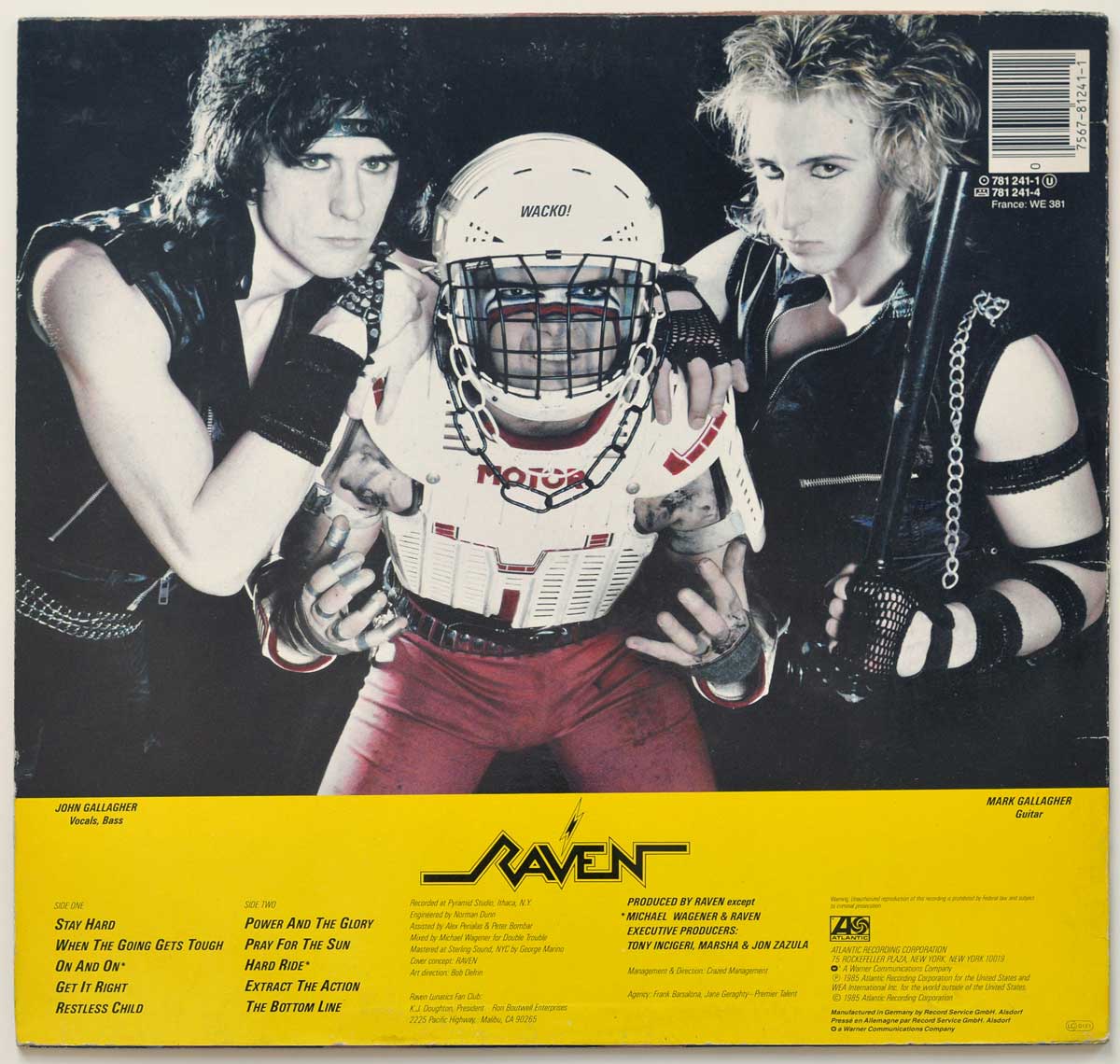
John Gallagher remains the centre of gravity, with lead vocals and bass doing the heavy pushing. His voice was never about elegance, thank heaven; it is about pressure, speed, and the feeling that the microphone is being treated as a piece of gym equipment. Mark Gallagher’s guitar keeps the steel in the frame, cutting through the major-label sheen with riffs that still know where they came from. Rob "WACKO!" Hunter, pictured on the back cover in full padded combat nonsense, keeps the drums tight without losing the cartoon violence that made Raven feel different from the more straight-faced British metal crews.

The sleeve tells the same story, only less politely. The front cover is pure 1985 provocation: skin, water, red nails, torn metal fantasy, chrome Raven logo, and the scratched "Stay Hard" title. It is ridiculous. It is also effective, which is annoying when taste wants to object but the collector’s eye refuses to look away. The back cover is better for evidence: John Gallagher named at the left corner, Mark Gallagher at the right, Rob wedged in the middle like sports equipment has become a religion, and the yellow bottom band carrying the practical credits that actually separate one pressing from another.

Bob Defrin’s art direction sits firmly inside the Atlantic hard-rock universe: bold, direct, and built for shelf impact rather than quiet appreciation. No need to pretend otherwise. The Atlantic logo, barcode, German manufacturing notes, France: WE 381 mark, and catalogue details turn the sleeve into a useful collector object, not just a noisy piece of mid-80s bravado. The labels continue the job in their green, white, and orange Atlantic layout, with STEREO, GEMA / BIEM, side markers, LC 0121, and the triangular 33 speed mark doing their dry little paperwork routine.

There was no grand censorship scandal around "Stay Hard", no moral panic worth dragging out with a lantern. The real argument was internal to the metal audience: had Raven sharpened their attack for a bigger stage, or had Atlantic sanded away too much of the old bite? That is the more interesting controversy because it still happens every time a rough band gets a bigger budget and suddenly the snare drum sounds expensive.

Late at night, this is the kind of record that looks better slightly tilted under a lamp, the black vinyl catching dust around the label while the sleeve sits nearby looking far too pleased with itself. The music has that same problem: too polished to be filed with the earliest Raven bruisers, too energetic to dismiss as surrender.

Historically, "Stay Hard" belongs to the Atlantic phase that came after Raven had already helped carry British Heavy Metal across the Atlantic through the Neat and Megaforce years. The Gallagher brothers had formed the band in Newcastle in the 1970s, with the classic John-Mark-Rob line-up locking into the frantic style that would later make thrash musicians pay attention. By this album, Raven were not breaking up, not rebuilding, not limping through replacement drama; they were trying to scale up. That is a different danger. Sometimes bigger rooms make bands louder. Sometimes they make them behave.

Compared with Iron Maiden’s grand machinery, Saxon’s road-hardened hard rock, Venom’s evil-circus grime, Girlschool’s sharper pub-metal punch, or Tank’s blunt-force grit, Raven on "Stay Hard" sound like a band sprinting across a polished floor in boots meant for concrete. The traction is not always perfect. But when the songs lock, the record still kicks with speed-metal nerves, hard-rock hooks, and enough British Heavy Metal stubbornness to stop the Atlantic gloss from turning everything into showroom plastic.

That is why this German pressing earns its shelf space. Not because it is the purest Raven album, because it is not. Not because the sleeve is tasteful, because please. It matters because it catches the exact moment when Raven tried to trade some grime for reach, some chaos for impact, and some underground credibility for a louder amplifier in a bigger building. Whether that bargain was wise depends on the mood, the volume, and how forgiving the listener feels after the needle drops.

References

Album Key Details: Genre, Label, Format & Release Info

Music Genre:

NWOBHM, Heavy Metal / Hard Rock

By 1985, Raven were still carrying the rough spark of the New Wave of British Heavy Metal, but "Stay Hard" pulls that sound into a cleaner, more American hard-rock frame. The riffs still kick, the rhythm section still sounds like it has been fed on stage volume and bad decisions, but the Atlantic Records polish gives the album a sharper, more commercial edge.

Label & Catalognr:

Atlantic – Cat#: 781 241-1

Release Details:

Release Date: 1985

Release Country: Germany

Media Format:

Record Format: 12" Vinyl Stereo Gramophone Record
Total Weight: 230g

Production & Recording Information:

Producers:
  • Michael Wagener – Producer
  • Michael Wagener – Producer, Sound Engineer

    The German set of ears that can make a wall of amps sound lethal, not muddy.

    Michael Wagener is the German-born producer/engineer who taught heavy guitars to sound huge without turning into soup. Back in the late 1970s and early 1980s he helped shape Accept's steel-plate punch, then in the 1980s Los Angeles grind he became a go-to set of ears for Dokken—tight, glossy, and still mean. By the late 1980s he was guiding arena-sized hard rock for Skid Row and White Lion, and in the 1990s he kept that balance of bite and clarity alive for bands like Extreme. I can spot his signature fast: drums snapping, guitars spread wide, and reverb kept on a short leash. From his WireWorld room in Tennessee, he mixes like a craftsman: edges sharp, low end disciplined, vocals sitting just forward enough to start trouble.

  • Raven – Producer

    The band kept its own fingerprints on the controls, which is exactly where Raven fingerprints belong.

    Raven, the Newcastle heavy metal trio built around John and Mark Gallagher with Rob Hunter behind the kit, had already earned its reputation through fast, physical, slightly unhinged metal before Atlantic came knocking. On "Stay Hard", their production credit matters because the album still needs that Raven shove: the daft momentum, the gang-built energy, and the stubborn refusal to become just another glossy mid-80s hard-rock product.

Sound & Recording Engineers:
  • Norman Dunn – Sound / Recording Engineer

    The practical studio hand keeping Raven’s racket from spilling all over the floor.

    Norman Dunn, a sound and recording engineer connected with several hard-and-heavy records from the 1980s, sits in the credits where the real discipline happens. On "Stay Hard", his contribution is the nuts-and-bolts capture of a band that plays like it has elbows; the drums need punch, the bass needs room, and the guitars need bite without turning the whole thing into a metal soup. Glamorous? No. Essential? Obviously.

  • Alex Perialas – Assistant Sound Engineer
  • Alex Perialas – Audio Engineer, Mixer, Record Producer

    In my book, his credit is the “this is gonna hit hard” stamp—Pyramid Sound vibes all day.

    Alex Perialas is an American audio engineer, mixer, and record producer who helped lock in the tight, punchy thrash sound of the mid-1980s through the early 1990s from Pyramid Sound Studios in Ithaca, New York—working with bands like Anthrax, Overkill, Testament, Nuclear Assault, S.O.D., and Flotsam & Jetsam. Later on, his work stretches into other lanes (Bad Religion, Pro-Pain), and he’s also been tied to teaching sound recording at Ithaca College—because apparently someone had to explain to the next generation how to make guitars sound like a chainsaw with manners.

  • Peter Bombar – Assistant Sound Engineer

    Peter Bombar a sound engineer who has been working together with Alex Perialas, Norman Dunn, Jon Zazula. During the 1980s he has been responsible for the sound recording for albums of the Heavy Metal bands: Attila, Raven, Thrasher, T.T. Quick and others.

Recording Location:
  • Pyramid Sound Recording Studios – Recording Studio

  • Pyramid Sound Recording Studios – Recording Studio (Ithaca, New York)

    Downtown Ithaca’s secret weapon: the room where a ton of ’80s riffs learned discipline and learned to punch.

    Pyramid Sound Recording Studios is a long-running Ithaca, New York recording spot launched by Alex Perialas (the guy with the “your snare will be heard” philosophy). From the mid-1980s into the early 1990s, it became a thrash-metal magnet—bands like Anthrax, Overkill, Testament, Nuclear Assault, and S.O.D. rolled through to capture that tight, aggressive East Coast bite. It didn’t stay boxed into metal either: later decades saw punk/hardcore and other genres pass through the same rooms, because good engineering doesn’t care what jacket you’re wearing. The studio’s downtown location (105 E. Clinton Street) has even had its share of real-world drama tied to nearby construction over the years—because of course the universe can’t just let a legendary studio exist in peace.

Mastering Engineer & Location:
  • George Marino – Mastering Engineer at Sterling Sound, New York City
  • George Marino – Mastering Engineer

    When my site brain goes full 1980s metal mode, his name keeps showing up like a hidden signature in the dead wax.

    George Marino is one of those behind-the-glass legends who made heavy music feel larger than the room it was playing in. Before the mastering console became his throne, he was a Bronx guitarist doing the NYC band grind in the 1960s with groups like The Chancellors and The New Sounds Ltd. Then he went pro for real: starting at Capitol Studios in New York (1967), and eventually becoming a long-running force at Sterling Sound (from 1973 onward). For a collector like me—living in that sweet spot where 1980s heavy metal, hard rock, and a dash of prog-minded ambition collide—Marino’s credits read like a stack of essential sleeves: Holy Diver (Dio), Tooth and Nail (Dokken), Stay Hard (Raven), Master of Puppets (Metallica), Somewhere in Time (Iron Maiden), Among the Living (Anthrax), Appetite for Destruction (Guns N’ Roses), Slippery When Wet (Bon Jovi), and Blow Up Your Video (AC/DC). That’s the kind of resume that doesn’t just “master” records—it weaponizes them, but with taste. George Marino Wiki

Mastering Studio & Location:
  • Sterling Sound – Mastering Studio, New York City

    The New York mastering room where plenty of rock records learned how to stand up straight.

    Sterling Sound, the New York mastering studio long associated with high-level rock, pop and metal releases, supplied the final mastering environment for "Stay Hard". Its role here is the last stage of discipline: taking Raven’s polished but still muscular Atlantic recording and making it translate to vinyl with enough level, clarity and punch that the album feels intentional, not merely expensive. Big difference.

Album Cover Design & Artwork:
  • Bob Defrin – Album Art Direction
  • Bob Defrin – Art Director / Album Cover Designer

    The Atlantic Records visual architect who helped hard rock look like it sounded: loud, sharp, and built to last.

    Bob Defrin, gets filed in my head as one of those behind-the-curtain operators who quietly shaped what a whole era thought “rock” was supposed to look like. Work at Atlantic Records put him in the blast zone where sleeve art wasn’t decoration, it was stage lighting on paper. Late 1970s into the 1980s, his art-direction fingerprints show up around AC/DC as the logo era locks in (1977’s Let There Be Rock, then the blood-and-thunder run through If You Want Blood You’ve Got It in 1978, Highway to Hell in 1979, Back in Black in 1980, and on into mid-80s titles like Fly on the Wall). Same period energy spills into other big-label moments too, like Foreigner’s 4 in 1981, where the final cover design became the one the world actually remembers. By 1992 he’d gone independent with Bob Defrin Design in Amenia, New York—still doing what the best art directors do: making the music feel inevitable before the needle even drops.

Band Members / Musicians:

Band Line-up:
  • John Gallagher – Lead Vocals, Bass

    The voice and bass engine of Raven, still pushing the songs forward like the stage floor owes him money.

    John Gallagher, bassist, lead vocalist and co-founder of Raven, came out of Newcastle’s hard-working metal scene with a voice built for speed, sweat and raised fists. On "Stay Hard", his bass keeps the album moving with that spring-loaded Raven shove, while his vocals cut through the cleaner Atlantic production without becoming polite. Good, because polite Raven would be a crime against common sense.

  • Mark Gallagher – Lead Guitar

    Raven’s guitar blade, all speed, bite and that slightly dangerous Gallagher-family electricity.

    Mark Gallagher, guitarist and co-founder of Raven, helped shape the band’s athletic metal attack from the rough NWOBHM years into their bigger Atlantic period. On "Stay Hard", his guitar work sits inside a glossier frame, but the riffs still have teeth, elbows and a bit of Newcastle dirt under the nails. His playing gives the album its steel edge beneath the major-label shine.

Band Line-up Continued:
  • Rob "WACKO!" Hunter – Drums

    The drummer with the nickname that was less branding and more fair warning.

    Rob "WACKO!" Hunter, Raven’s drummer during their classic early-80s climb, brought the physical madness behind the kit that made the band’s “athletic rock” tag feel less like a slogan and more like a medical warning. On "Stay Hard", his playing is tighter and better framed by the production, but the character is still there: restless fills, hard accents, and absolutely no interest in behaving like a session robot.

Complete Track-listing:

Tracklisting Side One:
  1. Stay Hard
  2. When the Going Gets Tough
  3. On and On
  4. Get it Right
  5. Restless Child
Tracklisting Side Two:
  1. The Power and the Glory
  2. Pray for the Sun
  3. Hard Ride
  4. Extract the Action
  5. The Bottom Line

This "Stay Hard" gallery is very much an Atlantic-era Raven object: loud front sleeve, clean label layout, and that mid-80s push toward bigger presentation without completely losing the scrappy metal fingerprints. The front cover is all muscle, glare, and shiny confidence, while the back cover settles into the more practical business of credits, layout, and record-company orderliness. The Atlantic labels are the real collector bait here: catalogue number, German pressing clues, side text, and the kind of label typography that looks boring until you actually start comparing copies. The deeper gallery is where the little pressing and printing quirks begin to earn their keep.

Album Front Cover Photo
Raven Stay Hard front cover showing a close-cropped bare torso covered with water droplets, hands with red nails pulling down pale fabric, and a torn metallic chest panel carrying the chrome Raven logo above the scratched Stay Hard title. Dark side margins frame the body, with worn sleeve corners and light edge wear visible around the jacket.

This front cover of Raven’s Stay Hard is one of those sleeves that does not so much ask for attention as grab the front of your jacket in the record shop and shout in your face. Held in the hand, the first thing that hits is the close crop: bare skin filling the sleeve, water droplets everywhere, the chest area turned into a shiny metal plate with the Raven logo bolted across the top like a car badge from a very loud garage. The title is scratched into the silver area below, all jagged letters and fake danger. Subtle? Not for one second. Atlantic wanted this record noticed, and subtlety was clearly thrown out of the meeting before coffee arrived.

The hands at the bottom pull the pale fabric down just enough to make the whole thing feel calculated, and yes, it is calculated. The red nails are doing half the sales pitch. Still, there is a strange honesty in how shameless it is. This is 1985 heavy metal packaging with no patience for mystery: chrome logo, sweat, skin, ripped-metal fantasy, and a title that practically elbows the browser in the ribs. The left and right sides fall into darker shadow, which helps push the central torn panel forward. The corners are worth noticing too: black wear at the top edges, scuffs along the lower border, and that tired sleeve rim that tells me this copy has spent real time in shelves, hands, and probably a few badly stacked piles.

Nothing here tells the useful collector story the way the back cover, labels, or inner sleeve usually do. No support personnel names, no production credits, no reassuring bottom-line legal clutter to chew on. Just the sales attack. That annoys me a little, because the front sleeve is all theatre while the proper evidence lives elsewhere. But as a front cover, it works. The chrome Raven logo looks properly heavy, the scratched lettering has enough teenage vandal energy to fit the band’s athletic metal racket, and the whole thing captures that odd Atlantic-era moment where Raven were being polished for a wider market without being allowed to look sensible. Sensible Raven would have been a disaster anyway.

Album Back Cover Photo
Raven Stay Hard back cover with John Gallagher on the left, Rob “Wacko” Hunter in hockey-style shoulder pads and helmet at centre, and Mark Gallagher on the right holding a bat. The upper image is a dark studio band photo, while the yellow lower panel carries the Raven logo, track columns, album credits, Atlantic Records logo, barcode, catalogue numbers, and German pressing text.

This back cover of "Stay Hard" does exactly what Raven wanted it to do: grab the sleeve by the collar and shout at it until the cardboard gives in. The top half is all hard flash, black leather, pale faces, and theatrical menace, with John Gallagher staring out from the left like he has just been told the photographer only has one roll of film left. Rob “Wacko” Hunter sits shoved into the centre in full padded hockey-warrior gear, helmet marked WACKO!, cage over his face, red trousers underneath, hands out like he is about to crawl through the sleeve. Mark Gallagher on the right gets the bat, the chain, the fingerless gloves, and that properly suspicious glare. Subtle? Absolutely not. That would have been a disaster anyway.

The design concept is blunt enough to dent furniture: take Raven’s athletic-metal lunacy and make the back cover feel less like a record sleeve and more like a backstage dare gone slightly too far. The photograph eats most of the space, but the yellow information band across the bottom is where the collector’s hand slows down. Left corner gives John Gallagher as vocals and bass; right corner gives Mark Gallagher as guitar. The song lists sit low and small, tucked into the yellow like someone remembered at the last minute that albums usually need administrative details too. In the middle, the Raven logo sits above the credits, with Pyramid Studios, Ithaca, N.Y. named for recording, Norman Dunn for engineering, John Rollo and Vince Bonanno for assisting, and Michael Wagner at Double Trouble for mixing. The mastering credit goes to Sterling Sound, N.Y.C. by George Marino, which is always worth noticing because these names matter more than half the promotional guff printed on sleeves.

The production block is nicely crowded, almost too crowded, which is part of the charm and part of the annoyance. Produced by Raven except Michael Wagener & Raven gets its little territory, followed by executive producers Tony Incigeri, Marsha & Jon Zazula, plus management by Crazed Management and agency names Frank Barsalona and Jane Geraghty at Premier Talent. Down at the far right sits the Atlantic logo, the Warner Communications company line, the manufacturer and pressing notes for Germany, and that very useful bottom-edge legal and distribution text. The barcode and catalogue numbers up in the top-right corner are not decorative, thank heaven; they nail this as the Atlantic 781 241-1 presentation, with France: WE 381 printed nearby. A sleeve like this is noisy, silly, slightly overcooked, and still far more honest than a tasteful band portrait. Raven were selling impact, not wallpaper.

Close up of Side One record’s label
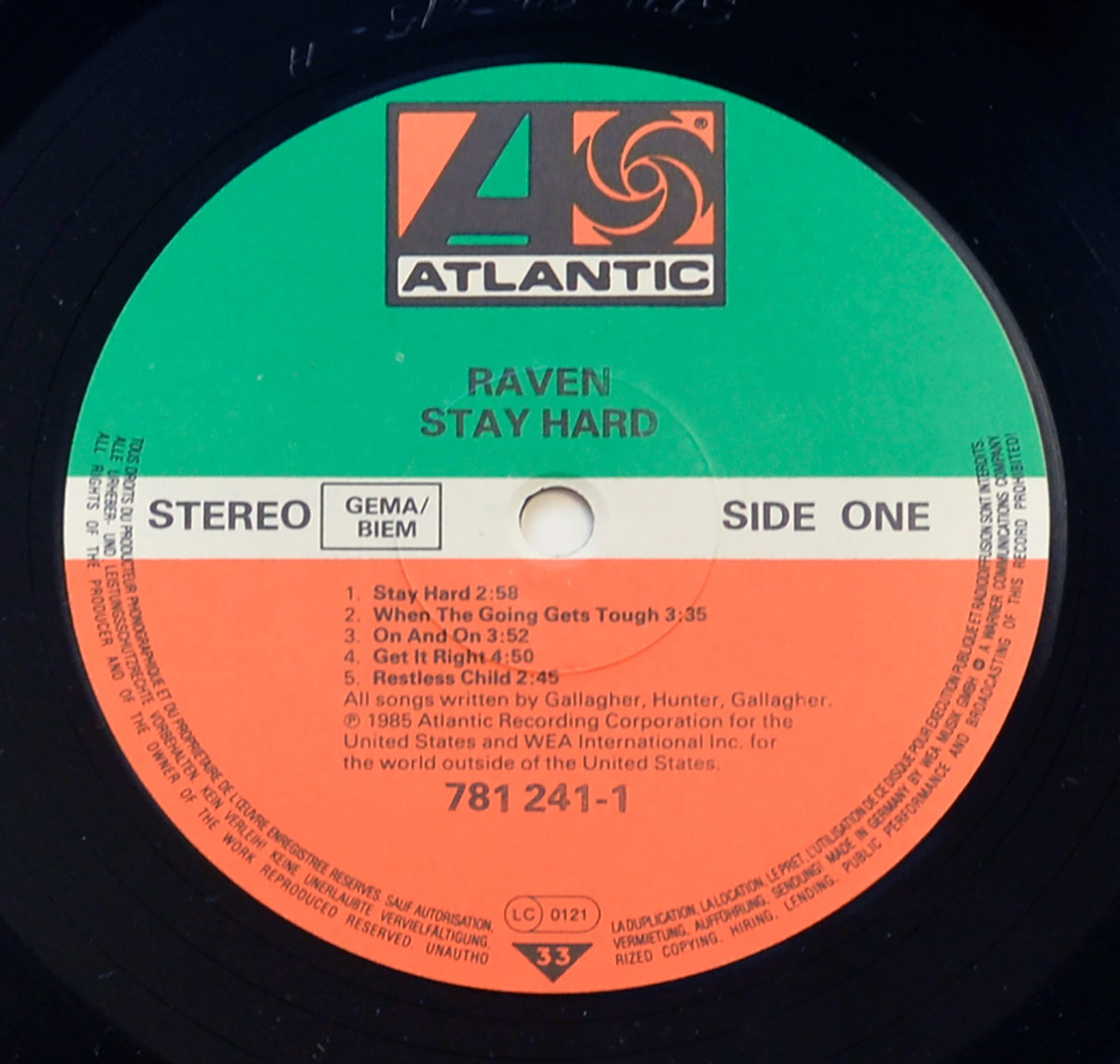
Close-up of Raven Stay Hard Side One vinyl record label on Atlantic Records, with the green, white, and orange label design, Atlantic logo at top, Raven and Stay Hard printed above the spindle hole, stereo and GEMA/BIEM at left, Side One at right, track titles and durations below, catalogue number 781 241-1, LC 0121, and 33 speed triangle near the bottom.

This Side One label for "Stay Hard" is where the sleeve stops shouting and the record starts doing proper collector business. The Atlantic label sits close and large in the frame, with that green top half, white centre band, and orange lower field doing the old record-company traffic-light routine. Not glamorous, not pretending to be. Just functional, loud enough to spot in a stack, and slightly off-kilter in the way only a real handled copy can be. The Atlantic logo at the top has the orange-and-black block mark, and beneath it the band name and album title sit in plain dark type. No fantasy lettering here. Apparently the label department had already spent its quota of madness on the back cover.

The spindle hole cuts through the white band, which is always the part that makes a label feel like an object rather than a scan. On the left, STEREO is printed big enough for nobody to miss, with the boxed GEMA / BIEM rights notice beside it. On the right, SIDE ONE is equally blunt. Down in the orange area, the track information is printed tight and practical, followed by the writing credit to Gallagher, Hunter, Gallagher and the 1985 Atlantic Recording Corporation copyright line. The catalogue number 781 241-1 sits in heavy type below the text, the sort of number that actually matters when comparing pressings and not just admiring the label like a tourist.

Around the lower rim, the multilingual warning text curves along both sides, partly disappearing into the dark vinyl edge, which is annoying but useful: it tells you this is not some generic mock-up but the real Atlantic/WEA European label layout. Near the bottom are LC 0121 and the small triangular 33 speed mark, sitting like tiny bureaucratic stamps after all the noise. The black vinyl around the label shows light dust, sleeve rub, and the usual circular grooves catching the light. That is the good stuff. A label like this does not try to seduce you. It gives you the side, the rights society, the catalogue number, the speed, and enough manufacturing language to keep a collector happily suspicious for another ten minutes.

Side Two Close up of record’s label
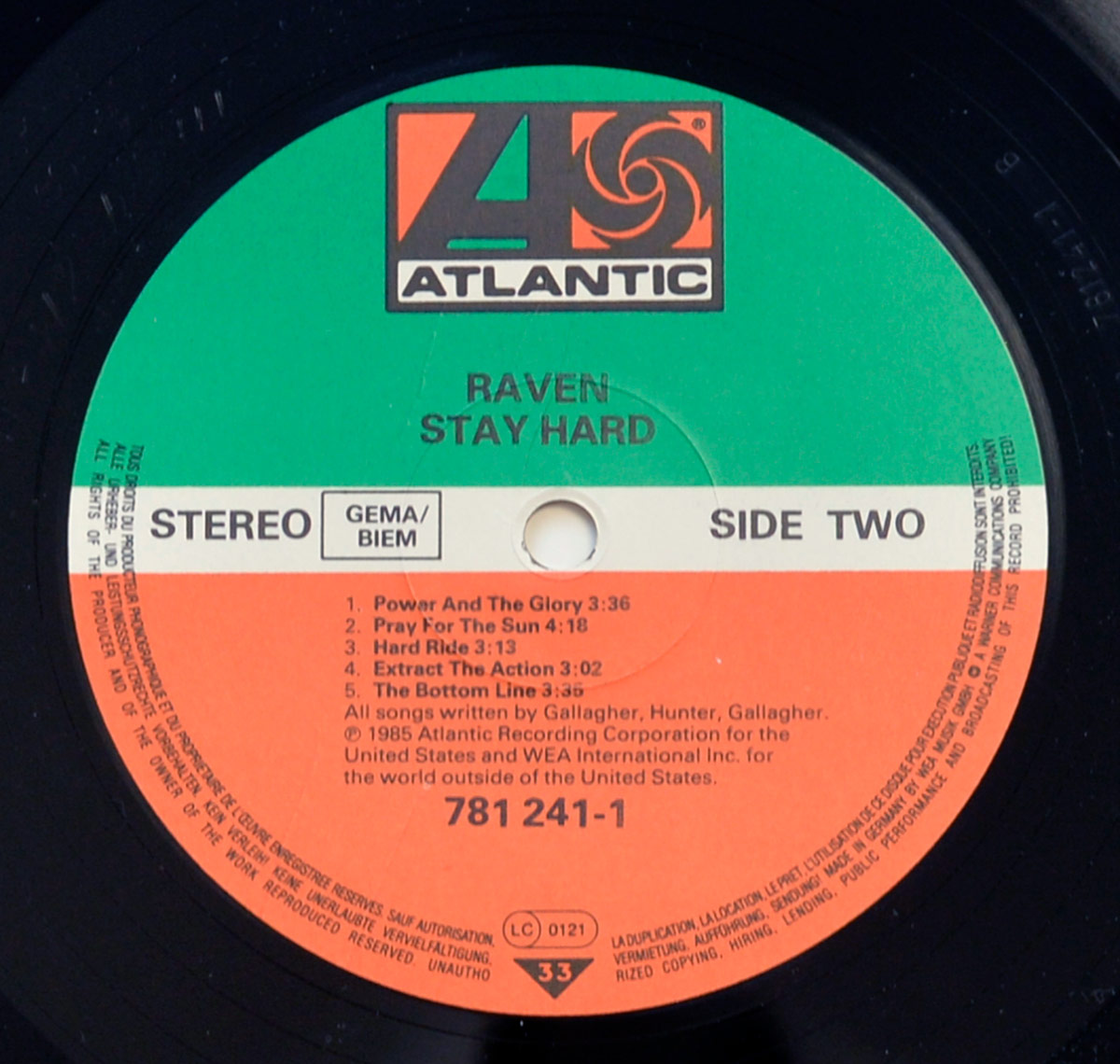
Close-up of Raven Stay Hard Side Two vinyl record label on Atlantic Records, with green, white, and orange label sections, Atlantic logo at top, Raven and Stay Hard printed above the spindle hole, stereo and GEMA/BIEM at left, Side Two at right, track titles and durations below, catalogue number 781 241-1, LC 0121, and 33 speed triangle near the bottom.

This Side Two label of "Stay Hard" is the sort of thing that looks plain until the record is actually in the hand, tilted under a desk lamp, and then all the small collector nonsense starts doing its little dance. The Atlantic colour split is loud and practical: green across the top, a white band through the spindle hole, orange underneath. Nothing delicate, thank God. The big Atlantic logo sits at twelve o’clock like a corporate stamp dropped onto a metal record that probably wanted something more dangerous. Beneath it, RAVEN and STAY HARD are printed in simple dark type, almost suspiciously calm for an album that has Rob “Wacko” Hunter charging around in protective gear on the sleeve.

The useful details are packed around the centre. On the left, STEREO is printed large, with the boxed GEMA / BIEM rights notice sitting beside it. On the right, SIDE TWO is just as blunt, no decorative nonsense, no attempt to be clever. The orange section carries the second side’s track information, the Gallagher, Hunter, Gallagher writing credit, and the 1985 Atlantic Recording Corporation copyright line for the United States and WEA International Inc. for the world outside the United States. The catalogue number 781 241-1 is printed below in heavier type, which is exactly where the collector’s eye lands after pretending not to care. Yes, of course we care. That number is the whole point.

The lower rim text curves along the label edge in several languages, squeezed tightly enough to be useful and irritating at the same time. Near the bottom, LC 0121 sits above the small triangular 33 speed mark, both doing their dry little paperwork routine. The black vinyl around the label shows the usual groove shine and scattered dust, with a few marks catching the light near the rim. That is not a flaw in the story; that is the story. This label does not have the drama of the back sleeve, but it has the fingerprints of the pressing: rights society, side marker, speed, catalogue number, company text. The stuff that separates a real copy from a pretty picture.

All images on this site are photographed directly from the original vinyl LP covers and record labels in my collection. Earlier blank sleeves were not archived due to past storage limits, and Side Two labels are often omitted when they contain no collector-relevant details. Photo quality varies because the images were taken over several decades with different cameras. You may use these images for personal or non-commercial purposes if you include a link to this site; commercial use requires my permission. Text on covers and labels has been transcribed using a free online OCR service.

The Ultimate Gallery and Discography of RAVEN's Vinyl LP Albums in the NWOBHM Genre

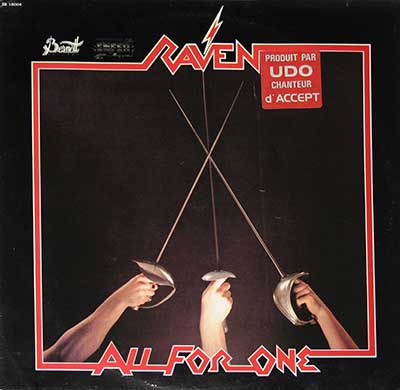
RAVEN - All For One album front cover vinyl LP album https://vinyl-records.nl

Newcastle speed freaks turn French vinyl into a glorious metal fistfight

RAVEN - All For One

Raven's "All For One" lands like three lads from Newcastle trying to win a bar fight with amplifiers. Released in France by Bernett Records in 1983, the band's third album pushes NWOBHM into faster, nastier territory, mixing speed, aggression and enough battered melody to keep the whole racket dangerously memorable. Not subtle, thank heavens, and all the better for it.

RAVEN - All For One album front cover vinyl LP album https://vinyl-records.nl

Three blades, one oath, and Raven running loose on Italian Neat vinyl

RAVEN - All For One

Raven’s 1983 "All For One" is NWOBHM with the brakes cut: John Gallagher’s bass clanking like loose machinery, Mark Gallagher throwing sparks, and Rob Hunter hammering away as if subtlety owed him money. Produced under the Double Trouble banner by Michael Wagener and Udo Dirkschneider, this Italian Base/Neat pressing adds a fine collector twitch.

RAVEN - Live at the Inferno album front cover vinyl LP album https://vinyl-records.nl

A live NWOBHM furnace where Raven turn sweat, speed and chaos into vinyl

RAVEN - Live at the Inferno

Raven’s "Live at the Inferno" catches the Newcastle trio in full 1984 flight: fast, sweaty, sharp-edged NWOBHM with no patience for polite behaviour. This Dutch RoadrunneR double LP throws "Take Control", "Mind Over Metal" and "Rock Until You Drop" into the fire, with Raven producing their own glorious stage racket.

RAVEN - The Pack Is Back album front cover vinyl LP album https://vinyl-records.nl

Atlantic Gloss, NWOBHM Bite, And One Gloriously Loud Locker-Room Disaster

RAVEN - The Pack Is Back

Raven’s "The Pack Is Back" catches the band in full Atlantic-era mutation: still powered by NWOBHM sweat, but now pushed through Eddie Kramer’s bigger, shinier 1986 production. The title track charges hard, "Gimme Some Lovin’" gets a cheeky metal makeover, and the whole thing sounds like Raven trying to outrun the polish machine.

RAVEN - Life's A Bitch album front cover vinyl LP album https://vinyl-records.nl

Raven Bares Its Teeth Again On A Nasty Atlantic-Era Metal Slab

RAVEN - Life's A Bitch

Released in 1987 on Atlantic, "Life's A Bitch" catches Raven clawing back grit after the glossy wobble of "The Pack Is Back". Produced by Raven and Chris Isca, this late-eighties NWOBHM/hard rock LP bites hardest on "The Savage and the Hungry", the title track, and "On the Wings of an Eagle".

RAVEN - Stay Hard album front cover vinyl LP album https://vinyl-records.nl

Raven Goes Atlantic, Sweaty, Shiny, and Still Dangerous

RAVEN - Stay Hard

Released in 1985, Raven's "Stay Hard" catches the Newcastle NWOBHM trio at their Atlantic Records turning point: cleaner, louder, and shamelessly aimed at the bigger metal market. Produced by Michael Wagener and Raven, it keeps the athletic metal charge alive through "Stay Hard", "On and On", and the reworked "Hard Ride". Polished, yes. Tame? Not quite.

RAVEN - Wiped Out album front cover vinyl LP album https://vinyl-records.nl

Raven go full-voltage on this Italian Neat Records blast

RAVEN - Wiped Out

Raven's "Wiped Out" captures the Newcastle trio tearing NWOBHM into faster, nastier speed-metal territory. This 1982 Italian Neat Records LP, complete with its bonus 7" single, has the raw Keith Nichol production, frantic sleeve artwork, and collector bait that makes a crate-digging hand suddenly stop behaving normally.