"Life's A Bitch" (1987) Album Description:
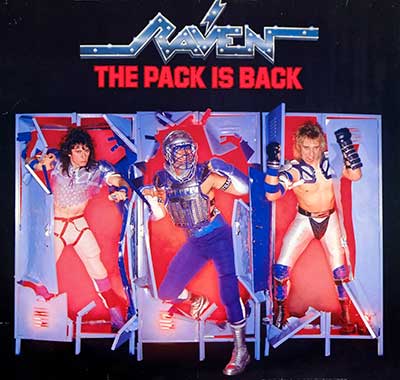
"Life's A Bitch" did not turn Raven into Atlantic Records' great heavy-metal payday, and that is almost part of its charm. Released in 1987, it lands after the slicker detour of "The Pack Is Back" and sounds like John Gallagher, Mark Gallagher, and Rob "Wacko" Hunter deciding that enough varnish had already been spilled. The result is a late-eighties NWOBHM record with hard rock muscle, speed-metal bite, and a slightly bad-tempered sense of repair work. Not a comeback parade. More like the band dragging the engine back onto the garage floor and kicking it until it fires.
The interesting thing is not simply that Raven got heavier again. The real story sits in the contradictions: a major-label Atlantic LP recorded at Bearsville Studio, carrying a custom inner sleeve full of sweaty live shots, tiny support credits, a "Total Death" recording note, and a record label that tells more truth than half the front-cover drama. Open the rest and the album starts looking less like a failed commercial move and more like a stubborn bridge between NWOBHM's old street voltage and the thrash era that had already stolen the faster lanes.
Raven had been there early. Newcastle, 1974, the Gallagher brothers building a power-trio racket long before NWOBHM became a useful shop-bin label. By the time the scene was being filed between Iron Maiden, Saxon, Tygers of Pan Tang, Diamond Head, Venom, and half a dozen hopefuls with bad vans and good riffs, Raven already had that speed-crazed, body-checking thing going. They called it athletic rock, which sounds daft until the records start moving. Then it makes horrible sense.
In Britain by 1987, NWOBHM was no longer the fresh pub-floor explosion. Iron Maiden were operating like an empire, Motörhead kept grinding forward with grease under the nails, Venom had pushed shock and filth into stranger corners, and younger thrash metal had turned the old British attack into something sharper, meaner, and less patient. Across the water, Metallica, Anthrax, Megadeth, Slayer, and Testament were taking the speed Raven helped normalize and making it the new law of the road. Raven's role in that chain matters: not because "Life's A Bitch" rewrote the map, but because it shows one of the map-makers trying to survive the country that came after.
The sound is tight, bright, and restless. "The Savage and the Hungry" opens with the sort of forward shove that makes the earlier Atlantic gloss feel like a bad memory. The title track has a blunt chorus bite, all teeth and elbows, while "On the Wings of an Eagle" stretches the record out without turning into soft-focus nonsense. There is melody here, yes, but it is not polished into safety. Mark cuts through with wiry guitar lines, John pushes the bass and voice like both are running late, and Wacko keeps the whole thing clattering with that busy, physical drumming that always sounded one cymbal stand away from trouble.
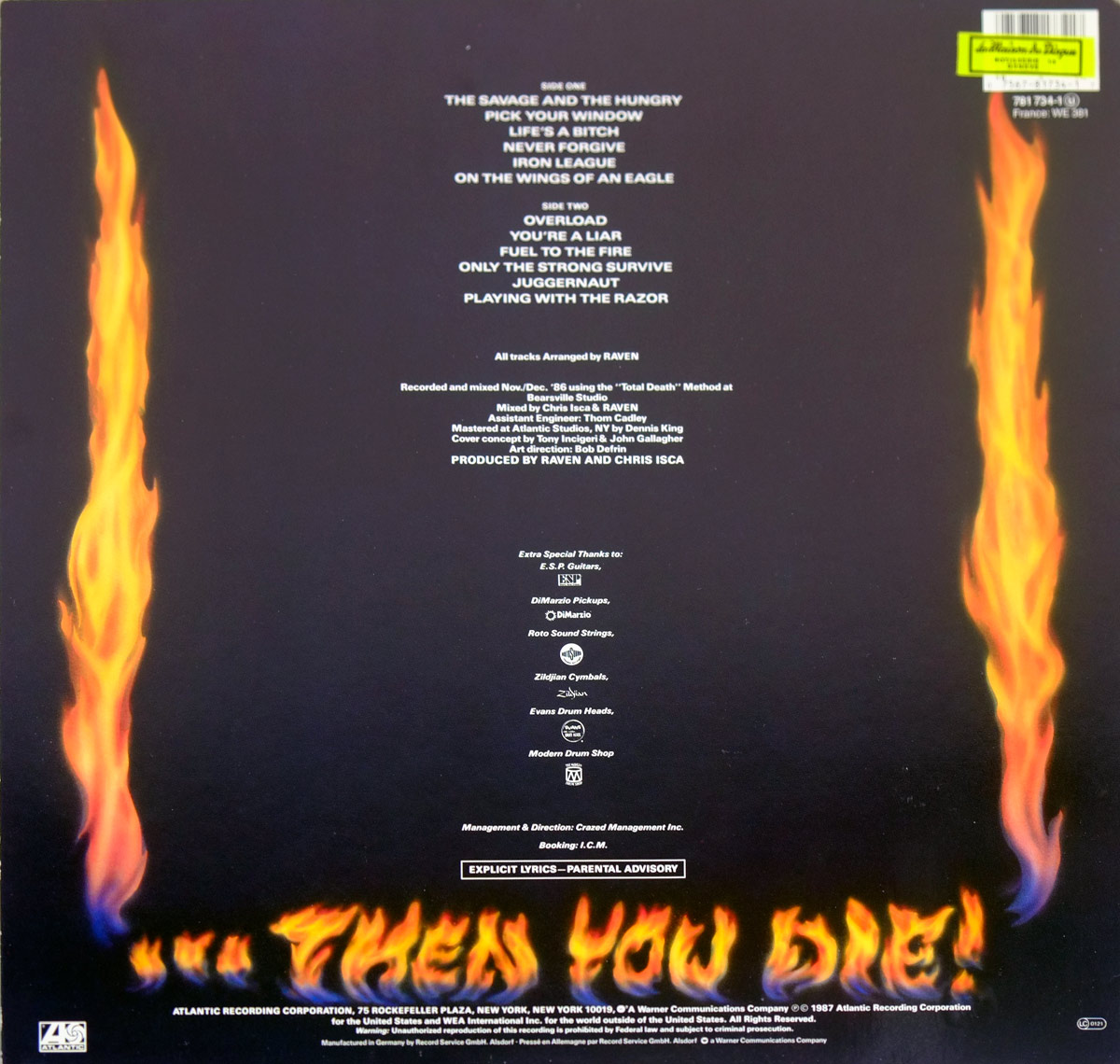
Production-wise, this is where the old page copy needed a broom taken to it. "Life's A Bitch" was produced by Raven and Chris Isca, not by Roy Thomas Baker; that confusion belongs to the previous Atlantic era and its bigger, shinier headaches. The back cover pins the sessions to Bearsville Studio, recorded and mixed in November and December 1986 using the gloriously ridiculous "Total Death" Method. Ridiculous name, useful result. Chris Isca gives the record enough studio order to keep the guitars readable, while Raven keeps the bite from being filed down into harmless radio furniture.
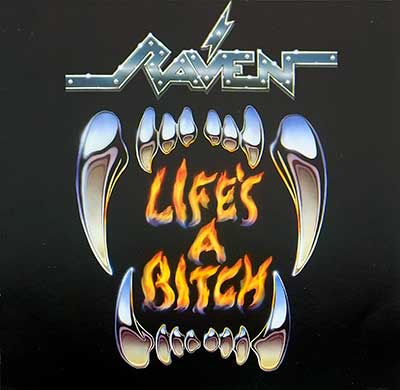
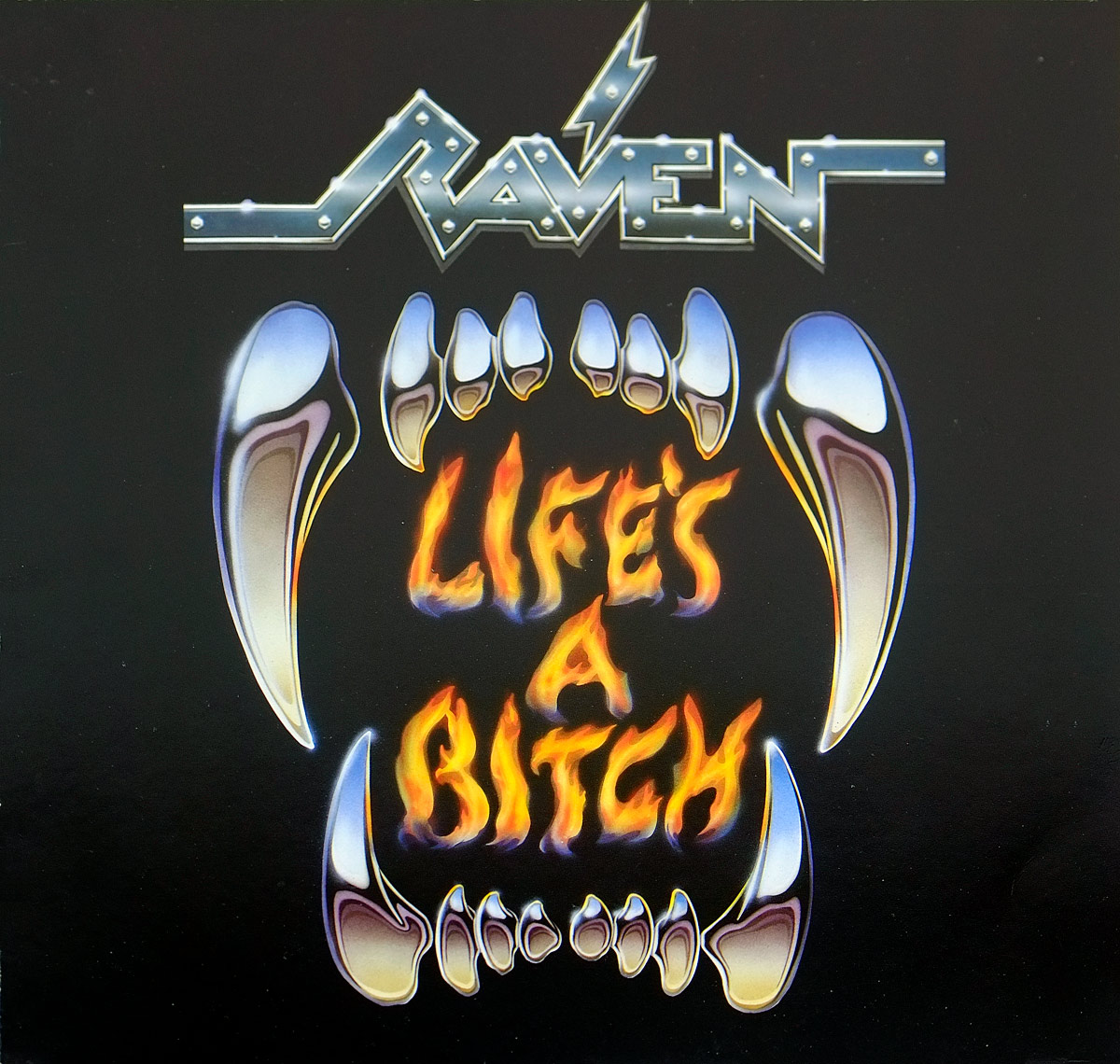
The support credits tell their own story, and this is where the record collector's hands get interested. Thom Cadley appears as assistant engineer, Dennis King handles mastering at Atlantic Studios in New York, Tony Incigeri and John Gallagher share the cover concept, and Bob Defrin takes art direction. These are not decorative crumbs. They explain why the LP looks and sounds like a fight between corporate Atlantic tidiness and Raven's own impatience. The sleeve says flames, fangs, barcode, parental advisory, German manufacturing line, and tiny print that dares older eyes to complain. Naturally, older eyes complain anyway.
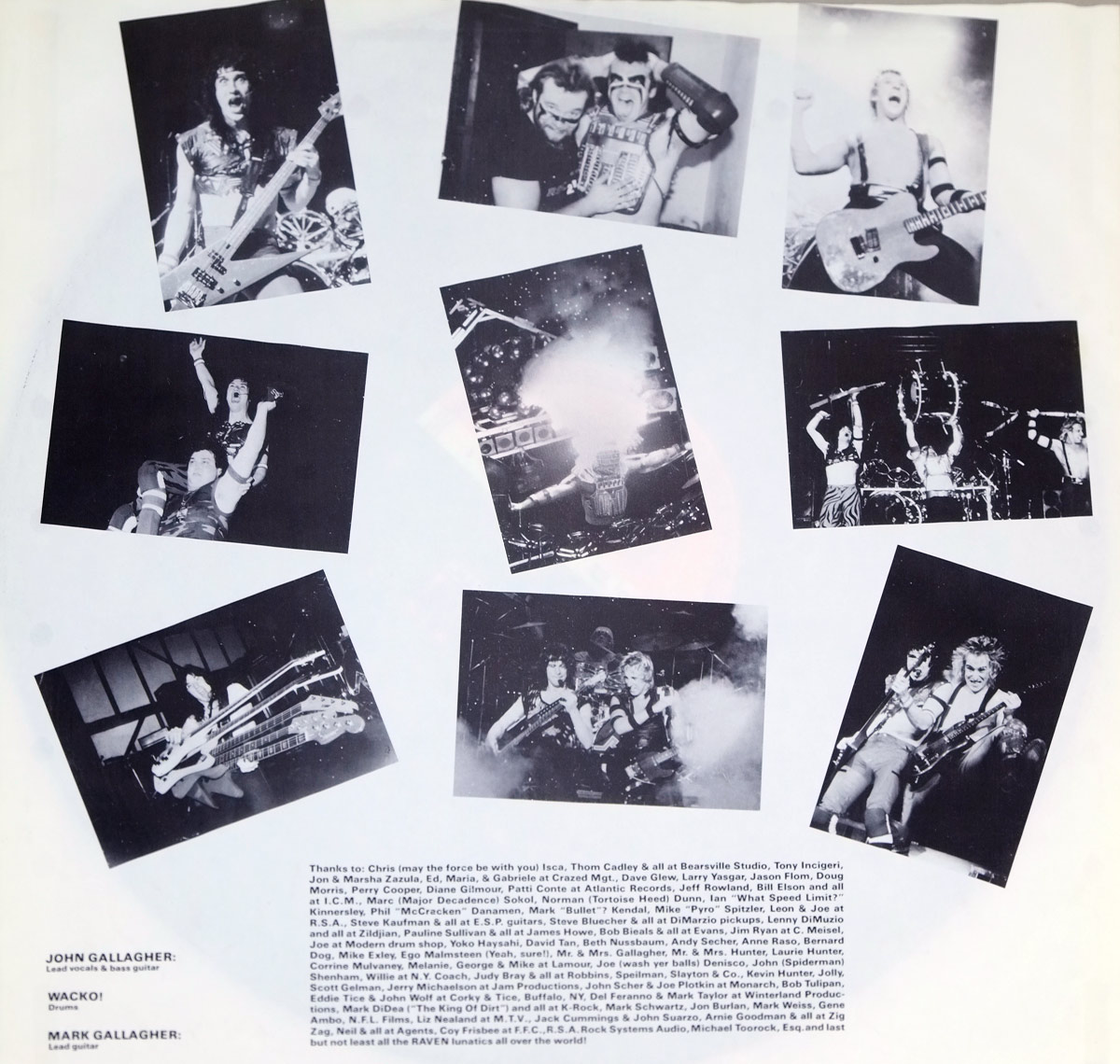
The custom inner sleeve is better than the front cover, and no, that is not a polite collector exaggeration. One side throws nine black-and-white live photographs across a white field: John with bass and vocals, Mark doing guitar damage, Wacko caught in the drum-storm, smoke and lights swallowing details just when the curious part of the brain wants to see more. The lower-left musician list and the dense thanks block along the bottom give the LP a working-band pulse. Jon and Marsha Zazula, Eddie Trunk, gear names, contacts, favours, the whole little support ecosystem. That stuff is history in small type.
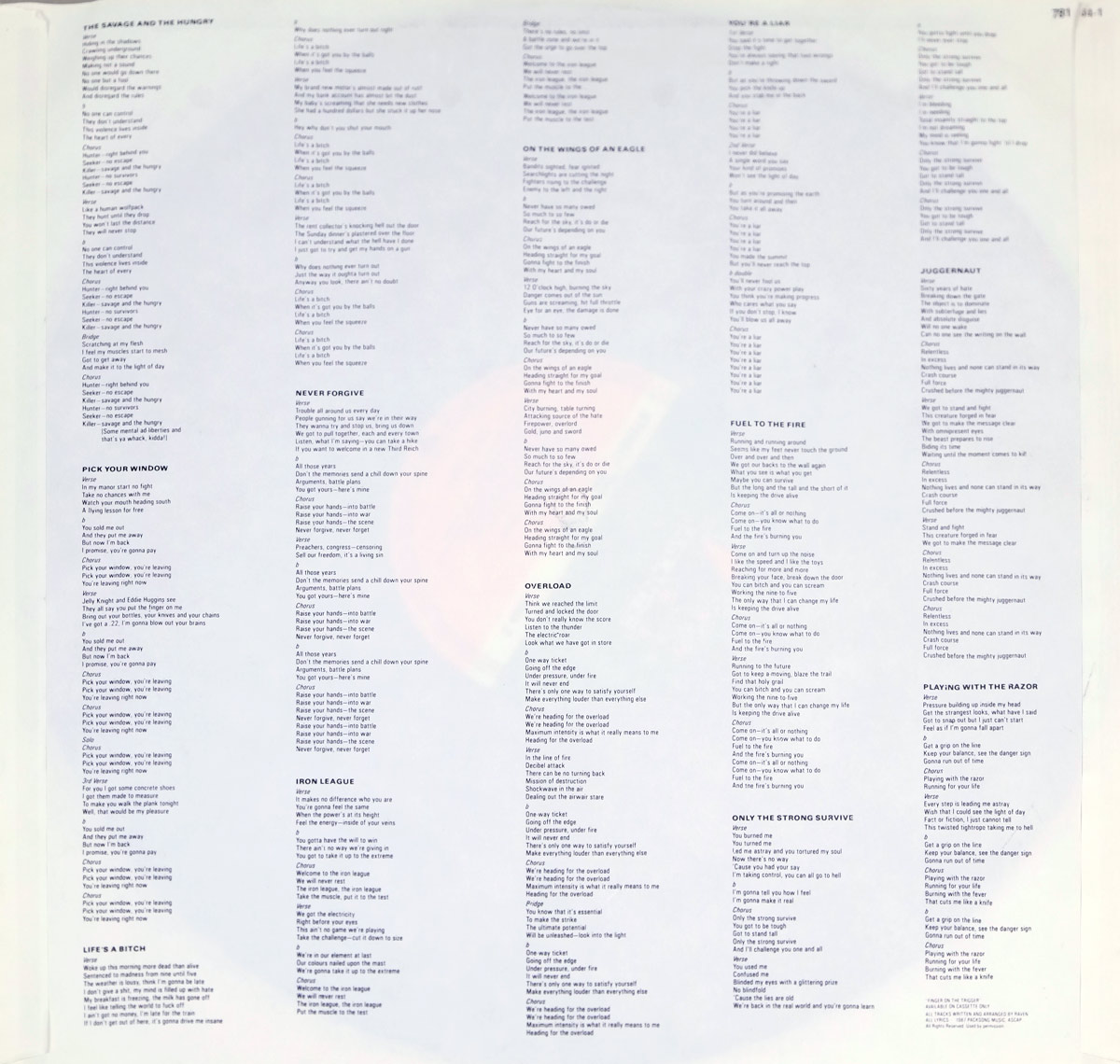
The lyric side of the inner sleeve has no romance about it. It is a pale sheet packed with narrow black columns, song titles in uppercase, and Cat#: 781 734-1 tucked into the top right like a proper little identifier. The lower-right publishing and rights text does the unglamorous archival work. This is exactly why front covers are often the least honest part of a record. The label and inserts give you the fingerprints; the front cover gives you the sales pitch.
As for scandal, there is no grand controversy attached to "Life's A Bitch" beyond the expected late-eighties parental-advisory bark and the sleeve's cheerful fondness for flames, teeth, and miserable slogans. The bigger misconception is musical: some listeners treat the album as just another Atlantic-era compromise. That is lazy filing. It still carries the major-label finish, but the songs push back harder than that label suggests. "Overload" and "Juggernaut" have more steel in the jaw than the doubters usually admit.
This was also the last Raven studio album with Rob "Wacko" Hunter, and that gives the record a hinge-point feel. After this, Joe Hasselvander would enter the story and the band would head into a heavier post-Atlantic chapter. So "Life's A Bitch" sits in an awkward but useful place: not the raw Neat Records riot of the early years, not the slick gamble of "The Pack Is Back", and not yet the later self-produced rebuild. It is the sound of Raven trying to leave a bad haircut behind without losing the skull underneath.
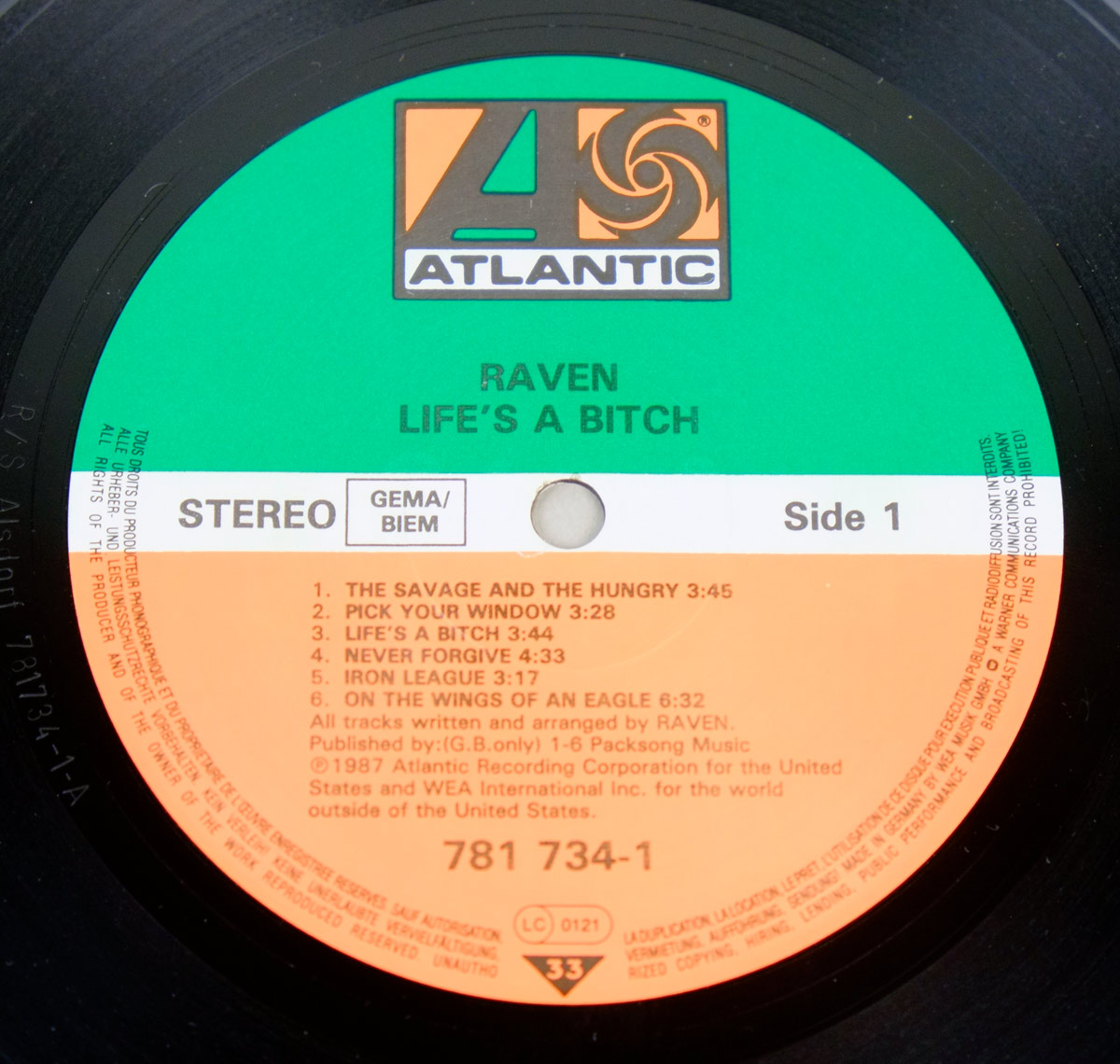
Late at night, with the Side One Atlantic label under a desk lamp, the album makes more sense than it does in a quick digital skim. The green, white, and orange label, GEMA/BIEM box, LC 0121, 33 RPM mark, and Alsdorf-style runout clues all say: this is a physical object with a paper trail, not just twelve tracks floating in the usual internet soup.
Its influence on 1980s NWOBHM and heavy metal is not the easy kind where one album changes everything and writers pretend the sky cracked open. Raven had already done the heavy lifting earlier with speed, nerve, and the sort of stage attack that helped future thrash musicians realize British metal could run faster than its own boots. "Life's A Bitch" matters because it confirms that lineage after the scene had shifted. It is a stubborn aftershock, a late Atlantic LP with enough old Raven voltage left to remind you why the faster American bands had been paying attention in the first place.
Not perfect. Better than its reputation deserves. And far more useful to understand when the back cover, inner sleeve, and label are sitting in front of you instead of hidden inside some lazy thumbnail. Funny how the paper tells the truth once the marketing smoke clears.