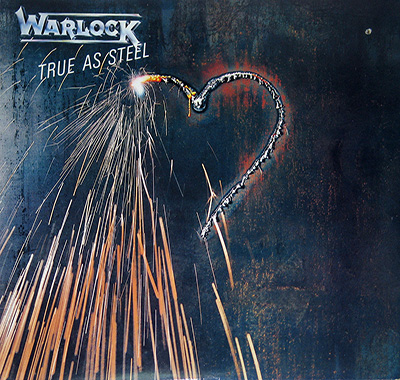
"True as Steel" (1986) Album Description:
In 1986, West German metal was not one tidy scene marching in step. Accept were tightening the bolts, Helloween were adding lift and velocity, and Kreator and Sodom were already busy scraping skin off the walls. Into that lovely little Stahlgewitter came Warlock with "True as Steel", a record that sounds like Dusseldorf leather trying to survive a gust of American chrome without losing its teeth.
That tension is the hook. The title promises Teutonenstahl, but the songs keep slipping between street-level riff bite, chant-along choruses, and a very obvious push toward bigger rooms, brighter lights, and export ambition. You can hear the band reaching. You can hear them bristle while they do it. That is why this album is worth the extra few minutes, because the story is not smooth and the sound is not polite.
West Germany Had More Than One Metal Accent
By the time "True as Steel" landed, the home scene had split into tribes. Accept still dealt in disciplined steel, Helloween were pushing speed into something brighter and more melodic, and the young thrasher lot were turning ugliness into a weapon. Warlock did not belong fully to any of those camps. They were less formal than Accept, less airborne than Helloween, and far too song-minded to live in the same cellar as Sodom or Kreator. That awkward in-between space is exactly where this record breathes.
The Line-Up Changed the Angle
After "Hellbound", guitarist Rudy Graf was out and Niko Arvanitis stepped in beside Peter Szigeti. That mattered more than people admit. Arvanitis brought a harder, needling edge to the guitar work, and this line-up sounds like a band that had been road-tested enough to stop decorating every idea. Doro Pesch was still the obvious focal point, naturally, but this was not a singer with wallpaper behind her. Frank Rittel and Michael Eurich keep the thing moving like men who know what a cramped stage and a bad monitor mix can do.
What the Production Actually Does
Henry Staroste produced the album again, and you can hear his hand in the way the songs stay compact even when they want to flare up. The recording moved through Munich and Dusseldorf, then the material was mixed by Michael Wagener in Hollywood, and that border crossing left fingerprints all over the grooves. The drums hit cleaner than on the earlier records, the guitars carry more gloss, and the choruses are pushed right to the front. Not by accident. Somebody wanted this one to travel.
How It Sounds When the Needle Drops
"Mr. Gold" does not creep in; it struts. "Fight for Rock" arrives with that clipped, chanted insistence that practically begs for fists and beer in the air, but the better clue to the album is "Love in the Danger Zone", where the groove keeps moving under the riff instead of just sitting there like a crate in a rehearsal room. "Midnite in China" and the title track throw off a proper Riffgewitter, sharp and bright and just rough enough to stay honest.
Even the softer turn in "Love Song" does not feel like surrender. It feels like a band testing how much drama it can carry without going soft in the head. That is an important distinction. Plenty of metal albums from 1986 chased the American market by bleaching out the danger. Warlock did not bleach this one. They brushed the jacket, maybe. The boots still hit the floor hard.
I can picture this album the way a lot of mid-80s metal first lived: half-heard on a late-night radio show, then spotted in a shop bin the next week with the sleeve staring back like trouble in shoulder pads. It did not feel underground, exactly. It felt hungry.
The "Fight for Rock" Confusion
One thing still gets mangled when people talk about this record: they blur the LP with the separate "Fight for Rock" EP and then act as if the whole album was some one-song corporate ambush. That is lazy. The EP reused album cuts and mixed them with earlier non-album material, which muddied the memory, but the LP itself is broader, stranger, and more restless than that easy accusation allows. You can dislike the commercial push. Fine. Just dislike the right thing.
No Great Scandal, Just Metal Tribalism
There was no grand controversy here, no courtroom melodrama, no priest collapsing in aisle three. What the album did stir up was the usual metal border patrol: the crowd that hears a brighter mix, a sharper chorus, or a touch of ambition and starts yelling "sellout" before the second track has finished. I never bought that in full. "True as Steel" is more commercial than "Hellbound", yes, but it is still too wiry, too impatient, and at times too oddly German to pass for clean American product.
Doro is the center of gravity, and she keeps the whole thing from floating away. She does not glide above the band like a label invention; she leans into the songs, barks through the tight corners, then lifts a chorus with that rough-edged insistence that made her impossible to ignore in 1986. Plenty of singers wanted power. She sounded like she meant pressure.
And you can already hear the next fracture forming. The American push is in the mix, in the pacing, in the way the choruses square their shoulders, but the band still plays like a unit built on club floors and van miles, not on boardroom strategy. That tension would matter soon enough, because the pull toward the United States and the strain inside the line-up were already beginning to lean on Warlock from the inside. On this record, though, the strain still throws sparks. Laut, stubborn, a little overdressed, and very much alive.