- French Heavy Metal Gatefold Edition (1983, Epic Records)
Idéal landed in 1983 at the exact moment TRUST stopped being just a loud French outlier and became a fully formed European heavy metal force. Recorded during the restless early-80s metal surge and shaped with producer Andy Johns, the album hits hard without losing clarity, balancing street-level anger with disciplined riffs and muscular pacing. Tracks like Varsovie and Idéal sound tense, direct, and unapologetically French, avoiding fantasy for confrontation. This European gatefold pressing on Epic Records adds extra collector weight, pairing stark artwork with a sound that still feels wired to sweat, concrete, and conviction.
"Idéal" is the moment where TRUST sound less like a loud French secret and more like a band daring Europe to keep up. Released in 1983, this gatefold edition captures them mid-stride: confident, sharp-edged, and absolutely uninterested in playing nice. It’s heavy metal with something to say, and it says it loudly, in French, without subtitles.
Early-80s France wasn’t exactly a playground. Unemployment was high, politics were tense, and the optimism of the previous decade had worn thin. Across Europe, heavy metal was mutating fast — the NWOBHM wave was crashing everywhere — and TRUST plugged straight into that voltage, but filtered it through distinctly French anger and street-level realism.
By the time "Idéal" took shape, TRUST were no longer wide-eyed newcomers. They had toured, clashed, and learned how quickly ideals meet reality once labels and expectations enter the room. Bringing in Andy Johns wasn’t about polishing them up; it was about capturing weight, volume, and intent without neutering the band’s bite.
Sonically, "Idéal" is tight, muscular, and restless. The riffs don’t sprawl — they punch, retreat, then punch again — while the rhythm section keeps everything tense, like it might snap if pushed any harder. Tracks like “Varsovie” and “Idéal” feel built for sweaty rooms, not radio rotation, and that’s exactly the point.
In 1983, metal listeners were spinning albums like Iron Maiden’s "Piece of Mind" or Accept’s "Balls to the Wall". Compared to those, TRUST sound less theatrical and more confrontational. Where others aimed for grandeur, "Idéal" stays grounded, trading fantasy for frustration and lived experience.
TRUST never needed shock tactics; their lyrics did the heavy lifting. Singing about power, compromise, and decay in French rubbed some people the wrong way, especially outside France where metal was expected to arrive in English. Some critics dismissed it as too blunt, while fans just turned it up and nodded along.
You can hear a band negotiating control on this record. There’s discipline here, but also friction — moments where the songs feel like they’re pushing against invisible limits. That tension gives "Idéal" its edge; it sounds like a group refusing to be smoothed out, even when the tools to do so were right there.
At release, "Idéal" didn’t chase universal praise, and that was never its job. Over time, it’s become one of those records collectors quietly respect: not flashy, not trend-chasing, but solid and sincere. It sits comfortably in TRUST’s catalogue as a statement rather than a compromise.
French Heavy Metal
French Heavy Metal from the early 1980s sits at the crossroads of classic NWOBHM influence and a distinctly European sense of melody and precision. It favors sharp riffing, galloping rhythms, and clear song structures, often balancing aggression with tuneful hooks rather than sheer speed or extremity.
EPIC – Cat#: EPC 2566
Record Format: 33RPM 12" Vinyl Stereo Gramophone Record
Total Weight: 230g
1983 – Netherlands / Holland
The musicians are not credited on the album cover. No official band line-up or individual musician roles are listed for this release.
Any musician credits found in external sources are intentionally omitted here to stay faithful to the original album packaging and documented release information.
Disclaimer: Track durations shown are approximate and may vary slightly between different country editions or reissues. Variations can result from alternate masterings, pressing plant differences, or regional production adjustments.
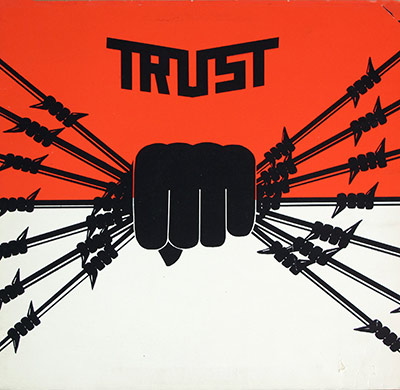
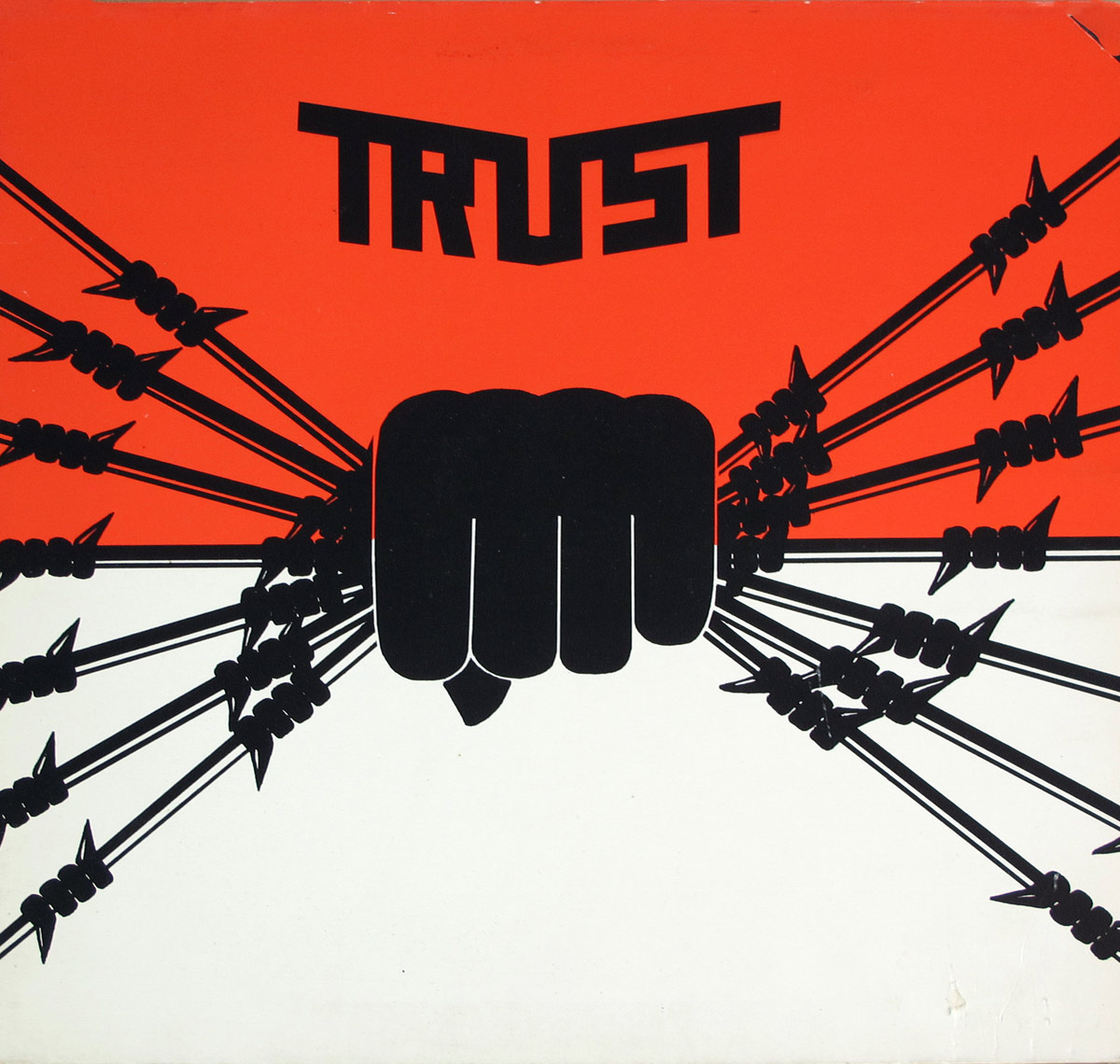
This image shows the original gatefold front cover of TRUST’s album Idéal, and it wastes absolutely no time explaining what kind of record this is. The background is divided horizontally into two stark color fields: aggressive red on the upper half and flat white on the lower half. There is no texture, no gradient, no photographic softness here. The colors are solid and confrontational, printed to hit hard rather than look pretty.
Centered on the cover is a large black clenched fist, drawn in a bold, simplified silhouette. The fist is cropped tightly and faces forward, filling the visual center like a threat or a statement of intent. There are no visible knuckles or skin details—just mass and shape—which gives it a graphic, almost emblem-like quality. This isn’t about realism; it’s about impact.
From both sides of the fist, multiple strands of black barbed wire stretch outward at sharp angles. The wire is stylized but clearly readable, with evenly spaced barbs that look sharp and hostile. The wires appear to be pulled taut, as if tension is radiating from the fist itself. This creates a strong sense of pressure and resistance, visually reinforcing the album’s themes of conflict, control, and pushback.
At the top of the red field sits the TRUST logo in black, using a heavy, angular custom typeface. The letters are blocky and compact, with hard edges that match the overall severity of the design. There is no album title on the front—just the band name—an intentional move that signals confidence and refusal to explain further.
From a collector’s perspective, this cover is all about discipline and intent. No unnecessary text, no decorative elements, no production credits cluttering the front. The layout is perfectly balanced, the ink coverage is heavy, and the contrast is high, making any fading, edge wear, or color shift immediately noticeable on physical copies. It’s a design that demands a clean, well-preserved sleeve to fully work—and when it is clean, it hits like a punch.
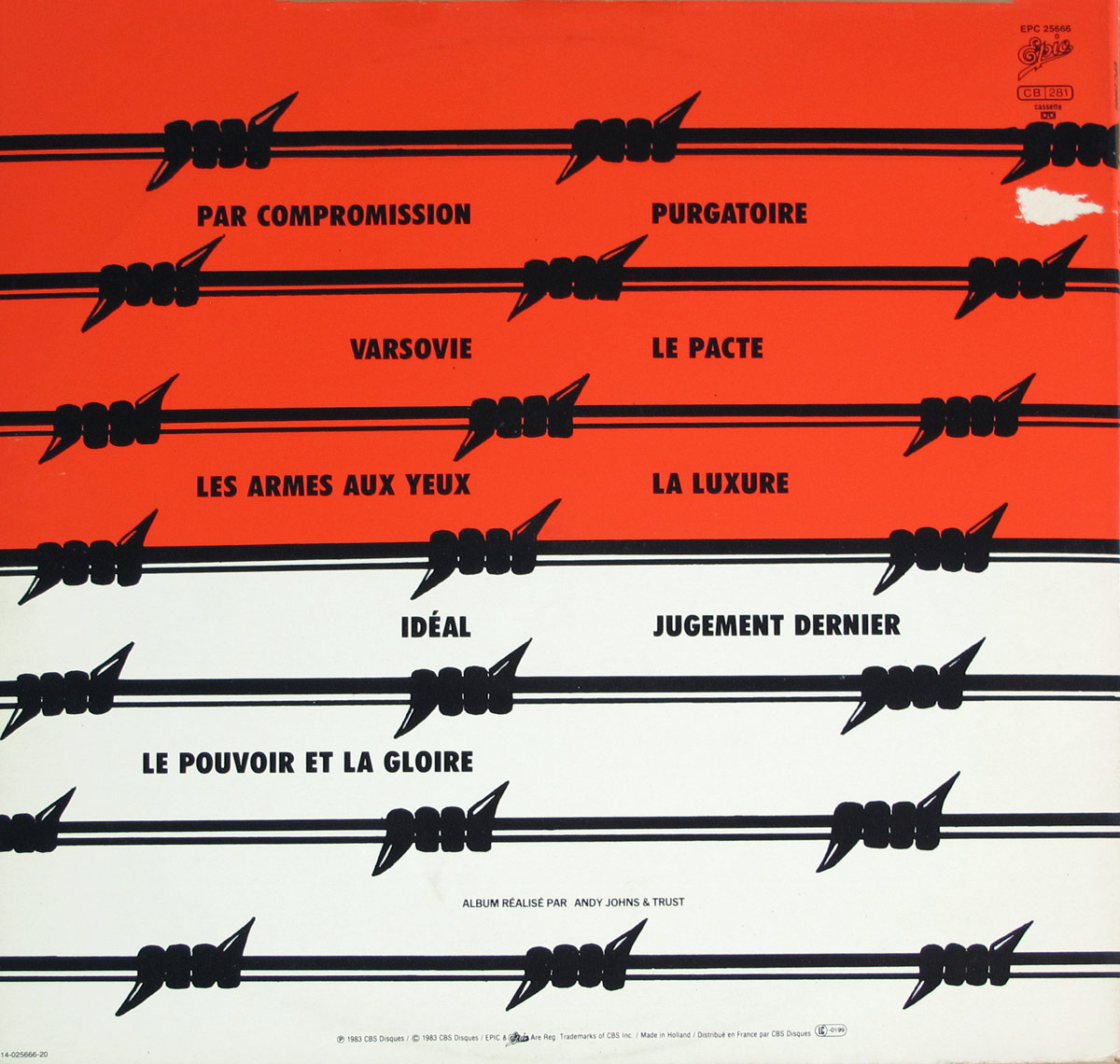
This image shows the original back cover of TRUST’s Idéal LP, and it continues the same uncompromising visual language as the front. The background is again split horizontally into red and white fields, but here the layout becomes more functional, turning the design into a rigid framework for information rather than symbolism. The color blocks are flat and uniform, making the black elements jump off the sleeve with maximum contrast.
Multiple horizontal strands of black barbed wire run across the entire width of the sleeve, evenly spaced from top to bottom. These lines act as both separators and visual restraints, boxing in the song titles and reinforcing the album’s themes of control, pressure, and resistance. The barbs are sharp, repetitive, and mechanically consistent, giving the whole back cover a cold, industrial feel.
The track titles are printed in bold, all-capital black lettering, aligned cleanly between the wire rows. Side One and Side Two are not explicitly labeled, but the sequencing is visually clear through spacing and symmetry. Titles like Par Compromission, Varsovie, Purgatoire, and Jugement Dernier are easy to read, with no decorative fonts or styling tricks—just direct, legible typography designed for clarity at arm’s length.
Near the bottom center, small production credit text reads “Album réalisé par Andy Johns & Trust,” printed discreetly but precisely. Along the lower edge runs the fine-print copyright line, including the 1983 CBS Disques credit, Epic branding, and manufacturing details noting production in Holland. In the top-right corner, the Epic logo, catalog number, and rights box are clearly visible, which is exactly where collectors look first when checking pressings and regional variants.
From a collector’s standpoint, this back cover is brutally honest: no photos, no band poses, no filler. Any wear, discoloration, ring wear, or seam damage shows immediately against these solid color fields. A clean copy stays razor-sharp; a tired one gives itself away instantly. It’s a sleeve that rewards careful storage and punishes neglect.
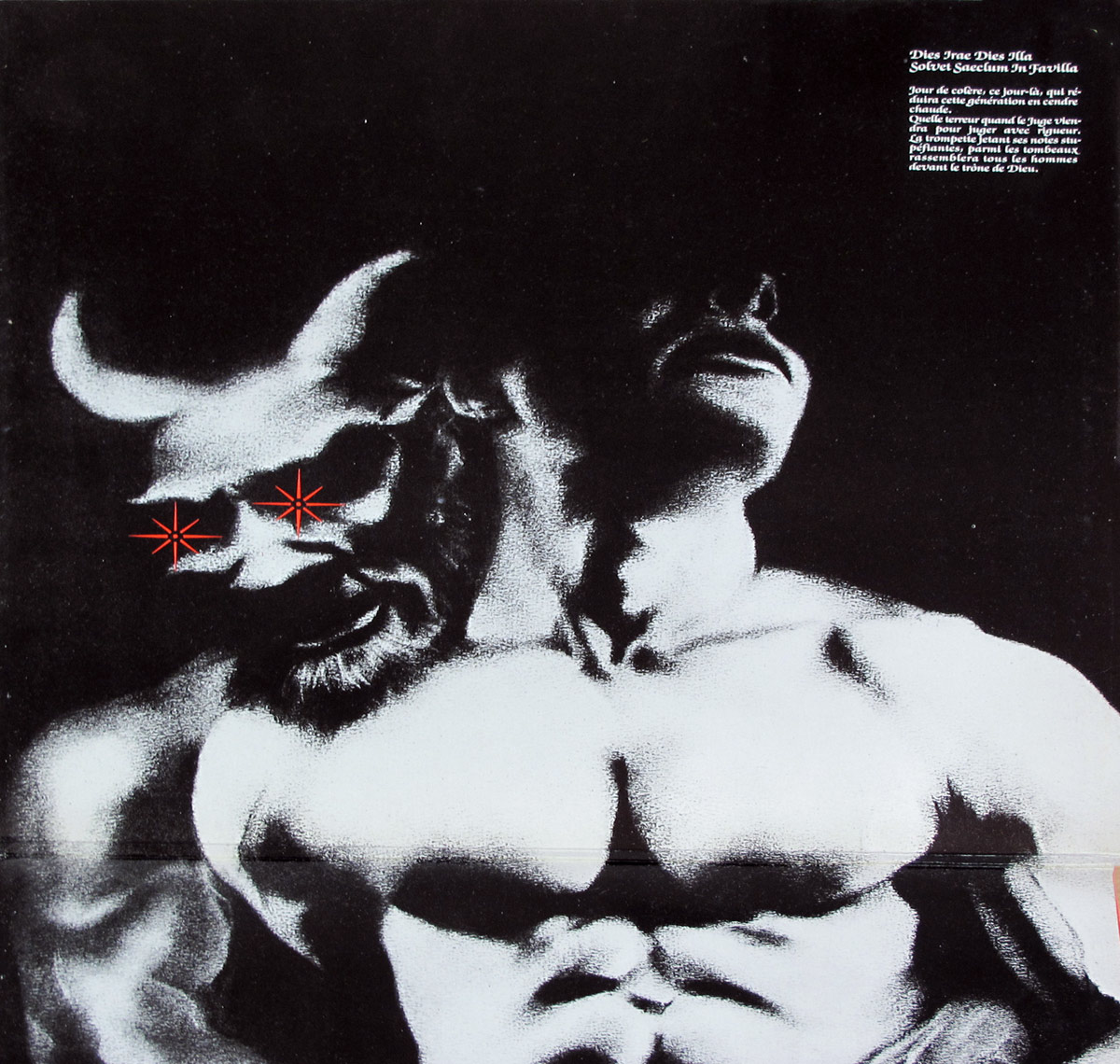
This image shows one side of the original inner sleeve included with TRUST’s Idéal gatefold LP, and it shifts the album’s visual language from graphic symbolism to raw physical imagery. The photograph is printed in harsh black and white with extreme contrast, eliminating midtones and exaggerating muscle definition. The subject is a shirtless male figure, cropped from mid-torso upward, with the head thrown back and the face partially obscured by shadow.
The lighting is brutal and directional, carving out the chest, shoulders, and neck while letting large areas fall into deep black. The body feels monumental and tense, not heroic in a classical sense but strained and pushed, as if caught in a moment of resistance or judgment. The grain of the print is clearly visible, giving the image a coarse, almost abrasive texture that fits the album’s sonic character.
The eyes are deliberately marked with small red star-like symbols, the only color present in the entire image. These red accents immediately draw attention and break the monochrome discipline, suggesting violence, ideology, or imposed vision rather than natural sight. From a collector’s perspective, these tiny red details are important: fading or ink loss here is often the first thing to check when assessing inner sleeve condition.
In the upper right corner, a block of white text is printed cleanly against the black background. It reads:
Dies Irae Dies Illa
Solvet Saeclum In Favilla
followed by French explanatory text describing the Day of Wrath, the day when generations are reduced to ashes, when God will judge humanity, and the trumpet will sound to gather all people before the throne of God.
This text is taken from the medieval Latin hymn Dies Irae, traditionally associated with judgment, death, and reckoning. Its inclusion reinforces the album’s themes of confrontation, moral pressure, and final accounting. This is not decorative filler; it is conceptual framing. As part of the original packaging, this inner sleeve matters just as much as the outer jacket, and any creasing, seam splits, or discoloration here directly affect the completeness and value of a proper copy.
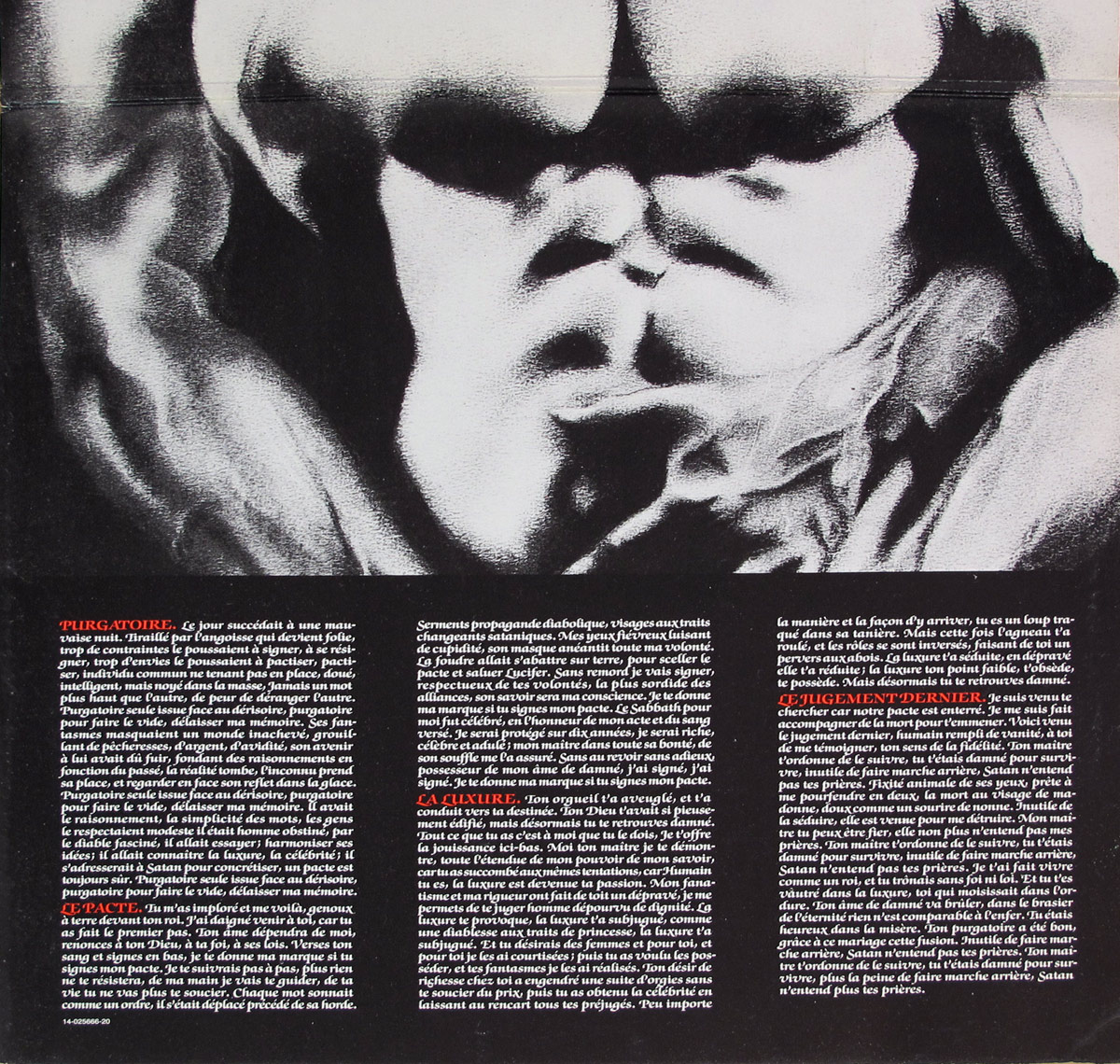
This image shows the second side of the original inner sleeve for TRUST’s Idéal, completing the visual and conceptual statement that starts on the first inner panel. The upper half of the sleeve is dominated by a harsh black-and-white photographic close-up of a muscular torso. The image is cropped tightly at the chest and abdomen, eliminating the head entirely and turning the body into an anonymous, almost sculptural mass.
The photographic treatment is extremely high-contrast, with blown-out whites and deep blacks swallowing most midtones. Muscle definition is exaggerated, veins and contours appearing almost carved rather than photographed. The grain is coarse and obvious, suggesting either deliberate print degradation or a reproduction pushed to its technical limits. This is not beauty photography; it is confrontational and uncomfortable by design.
A horizontal fold line runs across the image, reminding the viewer this is a functional inner sleeve meant to be handled, opened, and folded—not framed. For collectors, this crease is critical when grading condition, as wear, cracking, or discoloration along this line is common and immediately visible against the stark tonal range.
The lower half of the sleeve is filled edge to edge with dense blocks of French text, printed in white on a black background. The typography is compact and tightly set, with minimal line spacing, demanding deliberate reading rather than casual scanning. Certain phrases appear in red, cutting through the monochrome field like warning signals and reinforcing the sense of judgment and accusation that runs through the album.
This inner sleeve is not decorative packaging filler. It functions as a manifesto, pairing physical imagery with text-heavy ideological content. Any stains, paper thinning, or seam damage here significantly affect the integrity of a complete copy, making this piece just as important as the outer sleeve for serious collectors.
This image shows a collage-style inner sleeve design made up of multiple Polaroid photographs, printed as part of the original gatefold packaging for TRUST’s Idéal LP. The background is clean white, deliberately neutral, allowing the individual photos to stand out as physical objects rather than a seamless montage. Each image is framed by the distinctive white Polaroid border, complete with handwritten-style captions beneath some of the shots.
The photographs capture informal, behind-the-scenes moments inside a recording studio environment. Several images show band members and associates seated on couches, standing near mixing desks, or relaxing between sessions. Clothing is casual—jeans, T-shirts, leather jackets—very early-1980s and entirely unstyled. The rooms are wood-paneled, with visible studio furniture, analog equipment racks, and mixing consoles, grounding the album firmly in a real working studio rather than a staged promo setting.
The Polaroids are arranged at slight angles, overlapping just enough to feel spontaneous without becoming chaotic. Some images are labeled with short French captions such as “Le début d’une histoire”, “La flamme”, or “Happy Birthday”, adding documentary context rather than narrative explanation. Faces are visible but not posed; expressions range from bored to amused to mildly confrontational, reinforcing the sense of downtime rather than performance.
From a collector’s perspective, this inner sleeve is critical because it documents the album’s creation environment. The Polaroid aesthetic ties the sleeve firmly to its era, and any discoloration, foxing, seam wear, or creasing immediately disrupts the clean white field. A well-preserved copy keeps the borders bright and the photo details sharp; wear shows fast and cannot be hidden. This piece completes the visual story of Idéal by showing the people behind the confrontation.
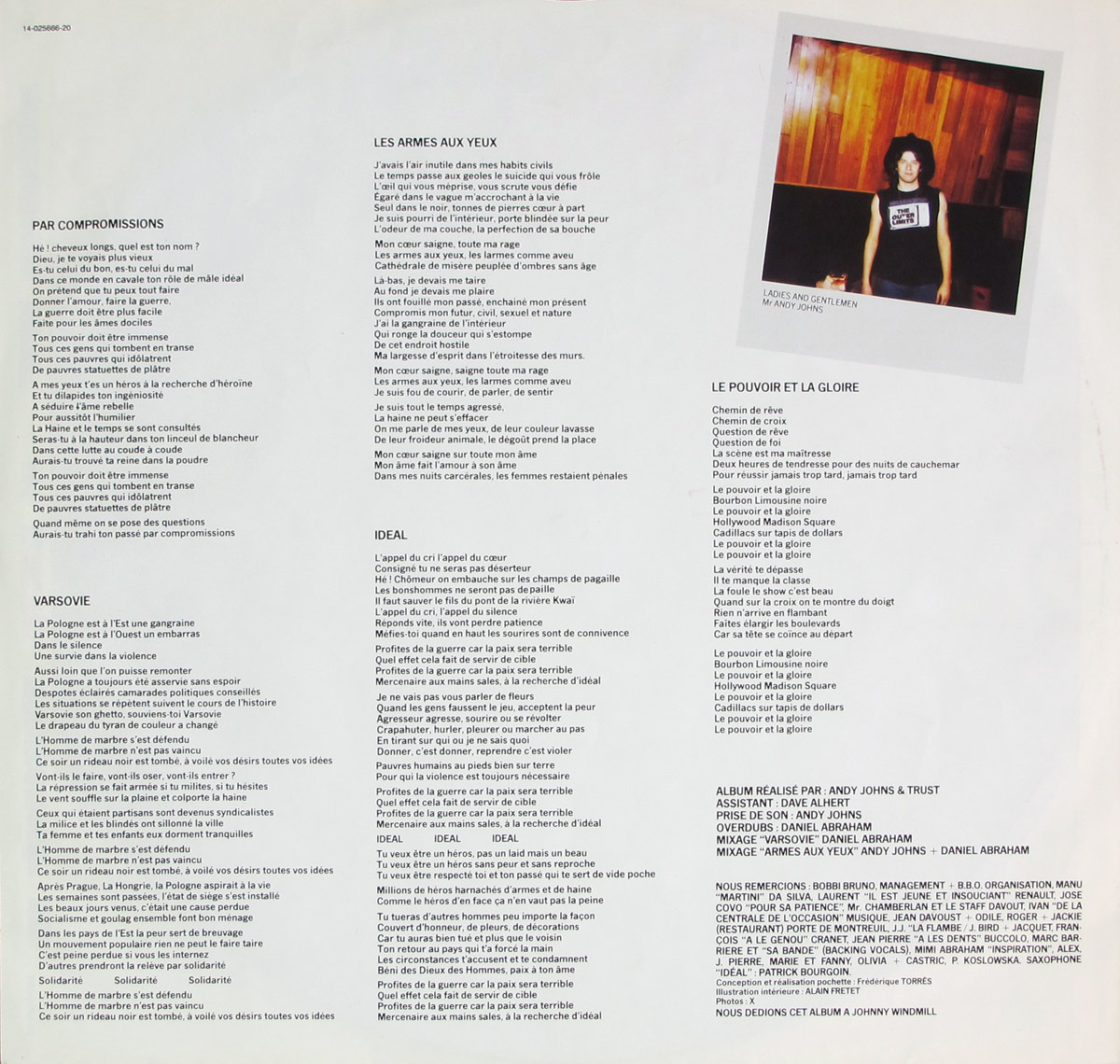
This image documents the second interior panel of the gatefold sleeve for TRUST’s Idéal, and it is where the album’s message becomes fully textual and explicit. The background is plain white, intentionally neutral, allowing the typography to dominate without distraction. The surface is flat and evenly printed, which makes any discoloration, foxing, or handling marks immediately visible to the collector’s eye.
The majority of the panel is filled with dense blocks of French lyrics, arranged in multiple narrow columns. Song titles such as Par Compromissions, Varsovie, Les Armes Aux Yeux, Idéal, and Le Pouvoir Et La Gloire are clearly separated by spacing and bold headings. The typography is clean, compact, and utilitarian, designed for readability rather than style. Line spacing is tight, maximizing information while demanding focused reading.
On the right-hand side sits a small Polaroid-style photograph, bordered in white and printed as part of the layout. The photo shows a casually dressed person standing against wood-paneled studio walls, reinforcing the documentary tone established elsewhere in the packaging. Beneath the photo is a caption identifying the subject, printed in small, neat type that integrates cleanly into the overall design.
Along the lower section, production and technical credits are printed in a compact block. Names such as Andy Johns and Trust are clearly credited for album production, with additional roles listed beneath. This area is especially important for collectors verifying first pressings, as print sharpness and alignment here often reveal later reprints or wear.
From a condition standpoint, this gatefold panel is unforgiving. The white background highlights every crease, edge nick, and handling trace. A clean example shows crisp text edges and consistent ink density, while even light wear quickly dulls the presentation. This panel completes the album’s physical narrative, turning the gatefold into a fully documented artifact rather than just a protective sleeve.
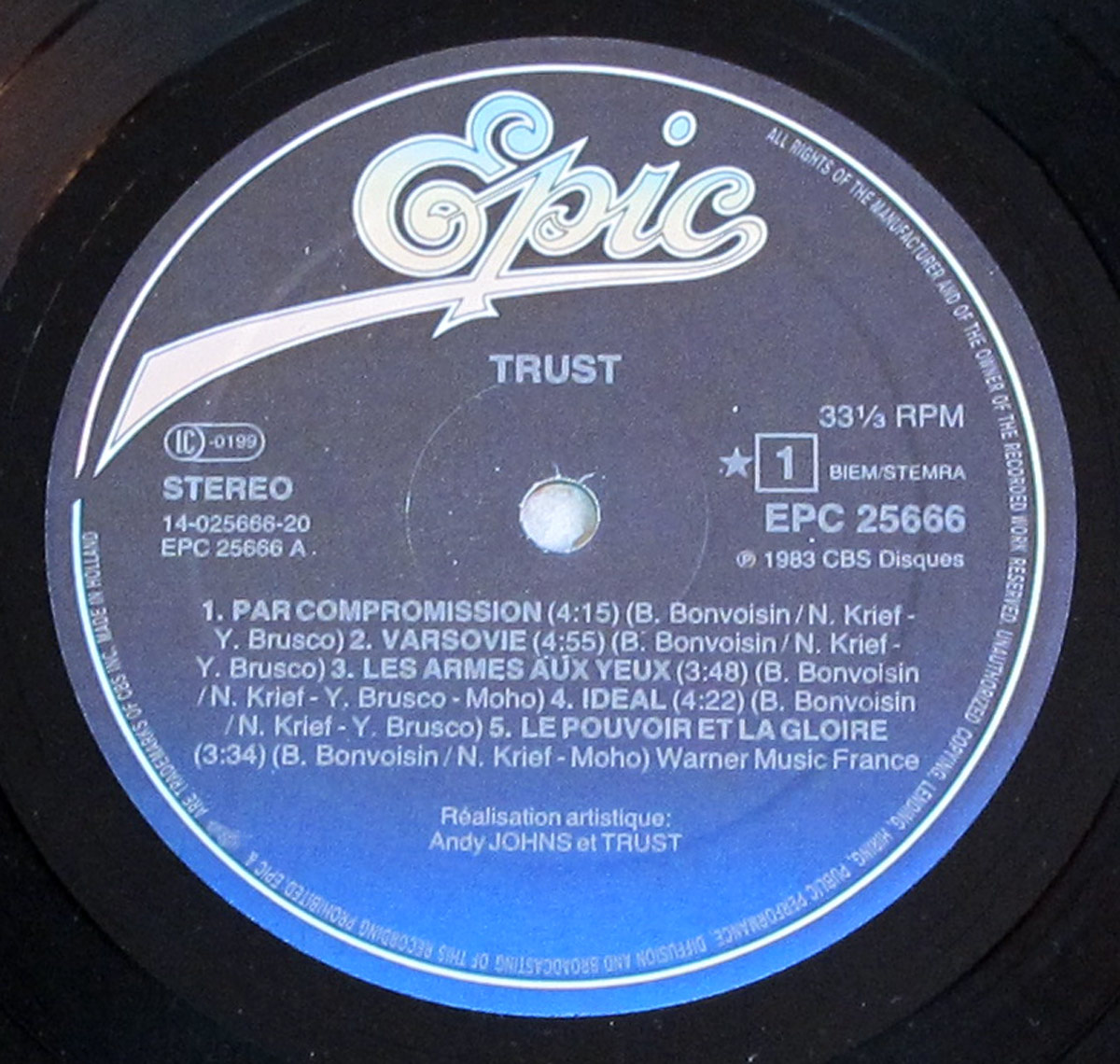
This image shows a close-up of the original vinyl label on Side One of TRUST’s Idéal LP, pressed on Epic Records in 1983. The label uses the familiar early-80s Epic design: a deep blue background with a lighter blue gradient toward the bottom, topped by the large silver-and-white Epic script logo. The contrast between the metallic logo and the matte blue field is strong and clean, making this label easy to authenticate at a glance.
Centered beneath the logo is the band name TRUST, printed in straightforward uppercase lettering with no decoration. To the right sits the boxed number 1, clearly indicating Side One, alongside the 33⅓ RPM speed marking and the BIEM/STEMRA rights information. The catalog number EPC 25666 is printed prominently, with the side designation EPC 25666 A appearing on the left, a critical detail for collectors checking matrix and label consistency.
The track listing for Side One is laid out in compact, readable lines, including song titles, durations, and songwriting credits. Titles such as Par Compromission, Varsovie, Les Armes Aux Yeux, Idéal, and Le Pouvoir Et La Gloire are all present, confirming this as the correct first side of the album. Below the track list, the production credit reads Réalisation artistique: Andy Johns et Trust, tying the label directly to the album’s documented production.
Around the outer edge runs the standard rights and manufacturing text, including the © 1983 CBS Disques credit. The center spindle hole is cleanly punched, with light wear visible around the hole—normal for a played copy. From a condition perspective, label scuffs, spindle marks, and fading are immediately obvious on this blue surface, making this close-up essential for accurately grading the record itself, not just the sleeve.
All images on this site are photographed directly from the original vinyl LP covers and record labels in my collection. Earlier blank sleeves were not archived due to past storage limits. Photo quality varies because the images were taken over several decades with different cameras. You may use these images for personal or non-commercial purposes if you include a link to this site; commercial use requires my permission.
Epic Records EPC 2566 , 1983 , Netherlands
This is the record where TRUST stop flirting with chaos and start weaponizing it. I hear a band fully locked in, riffs tight as barbed wire and vocals from Bernie Bonvoisin that cut straight through the mix with zero mercy. No fantasy, no escape routes — just hard French heavy metal with teeth, grit, and attitude. This album hits like concrete: cold, heavy, and impossible to ignore.
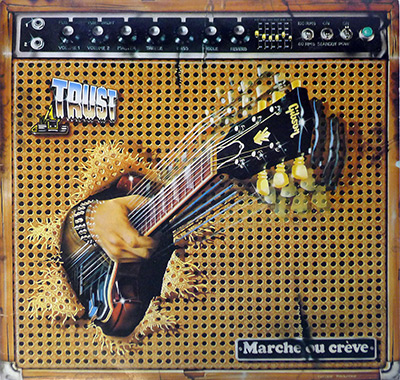
In the heart of the early 1980s, amidst a wave of social unrest and economic uncertainty in France, a hard rock band named Trust emerged, their raw energy and rebellious spirit resonating with a generation disillusioned by the status quo. Their 1981 album, "Marche ou Crève" (Walk or Die), became an anthem
Marche Ou Crève 12" Vinyl LP
"Paris by Night" arrived at a time when French rock music was experiencing a resurgence, fueled by a desire for authenticity and a rejection of mainstream trends. Trust, with their uncompromising sound and provocative lyrics, embodied this spirit, channeling the frustrations and aspirations of a generation.
Paris by Night 12" Vinyl LP
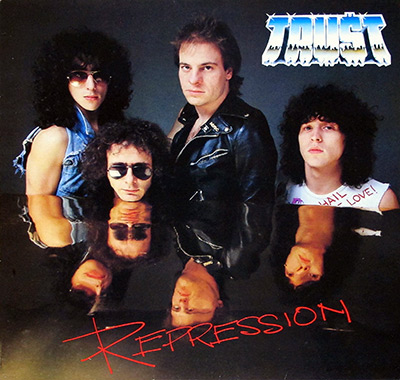
"Répression" is a dichotomous creation, reflecting the band's vision and their desire to appeal to a wider audience. The album was released in two distinct versions: the French iteration, titled "Répression", with catalog number CBS 84 318, and the English version, "Repression", with catalog number CBS EPC 84811.
Repression 12" Vinyl LP
The 1984 TRUST Rock 'n' Roll 12" LP Vinyl Album is a classic album that showcases the talent of one of the most iconic French rock bands of the 1980s. The album was released on 30 November 1984, and was the band's fourth studio album. It features nine tracks that demonstrate the band's signature sound
Rock 'n' Roll 12" Vinyl LP
Emerging amidst the economic and social turmoil of the late 1970s, Trust's raw, aggressive sound and socially conscious lyrics resonated with a youth grappling with unemployment, political unrest, and a sense of alienation. While drawing inspiration from classic heavy metal bands like Black Sabbath and Led Zeppelin
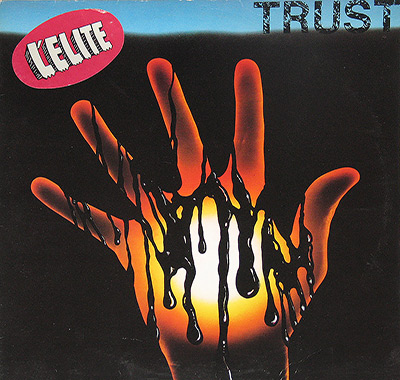
TRUST - Self-Titled (1978, France) TRUST - Self-Titled (L'Élite)