Trivia
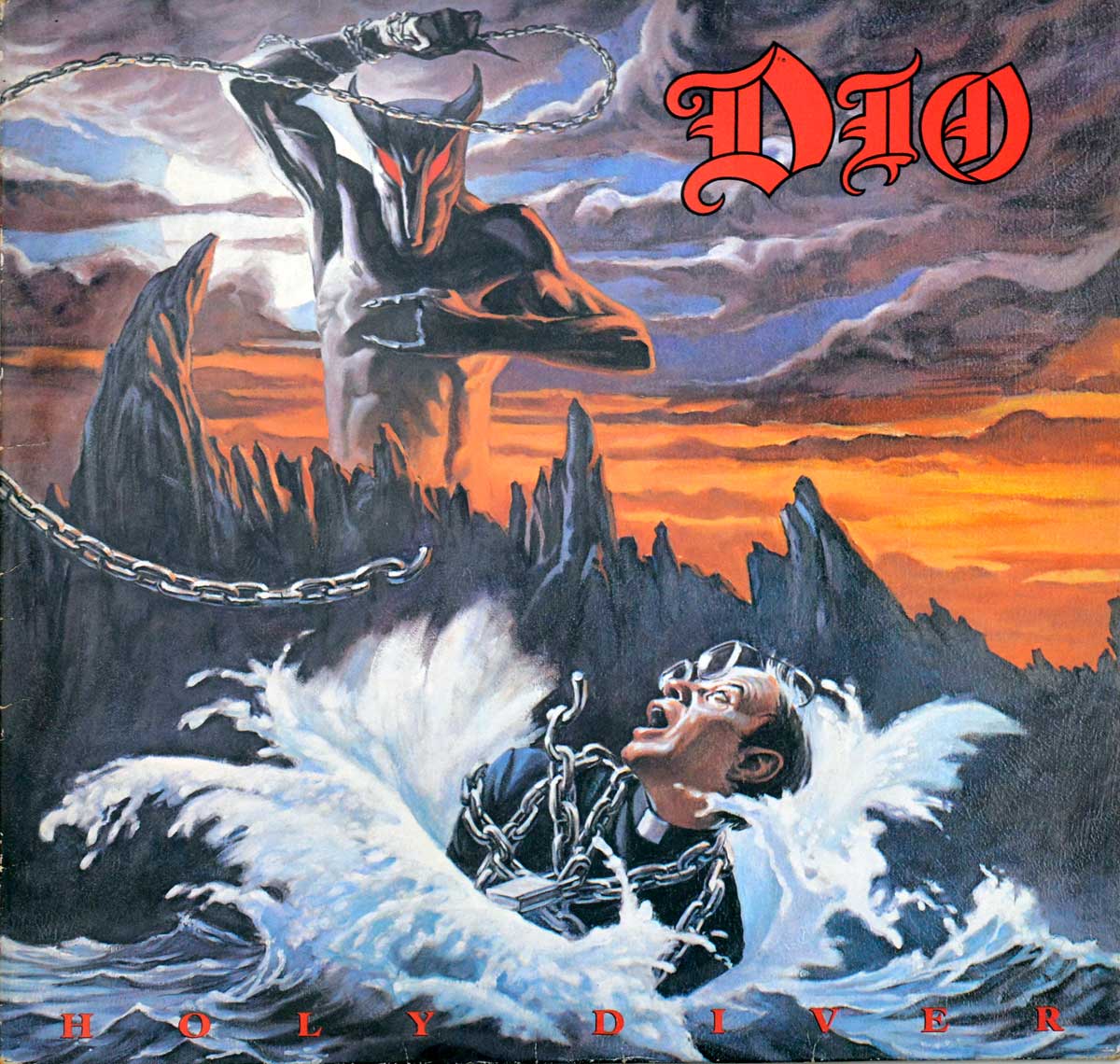
The album cover for DIO's "Holy Diver" depicts a devil-like creature, with horns , diving into a pool of water, where a person is shown drowning. This image was seen as offensive and controversial by some people, particularly in the Netherlands, where the album was released with an additional sticker warning about the graphic content.
The depiction of a demonic creature and the imagery of someone drowning could be seen as promoting violence or glorifying evil. In addition, some people found the cover to be disturbing or frightening. This led to some retailers refusing to stock the album or displaying it in a way that obscured the cover.
However, others argued that the cover was simply a representation of the album's themes and that it was not meant to be taken literally. Many heavy metal and rock bands of the time used similar imagery in their album art, and some fans appreciated the provocative and edgy nature of the cover.
Overall, the album cover of DIO's "Holy Diver" was controversial due to its use of violent and demonic imagery, which some found offensive or disturbing.
Production & Recording Information
This album "DIO Holy Diver" includes the original custom inner sleeve with a collage of the DIO band-members,
The album: "DIO Holy Diver" was produced by:
Ronnie James Dio
Ronnie James Dio – VocalsI always loved how he could turn a one-word hook into scripture, then grin and hit you again. Read more...
Ronnie James Dio, the pocket-sized volcano whose voice could turn a pub into a cathedral, and whose phrasing hit like a boxer's jab. I watched him climb from Ronnie Dio and the Prophets (1961-1967) and the hard-touring Elf (1967-1975) into Rainbow (1975-1979), where he helped bottle that mix of medieval melody and street-fight hard rock. He rebooted Black Sabbath in two spells-1979-1982 and 1991-1992-then ran his own ship with Dio (1982-1991; 1993-2010), delivering anthems like "Holy Diver" without ever sounding cute. Late in the game he returned with the Sabbath lineup as Heaven & Hell (2006-2010), still singing on stage like the lights might go out mid-chorus.
Sound/Recording Engineer(s):
Angelo Arcuri
This album was recorded at:
Sound City Studios , Van Nuys, California , 1983
Mastering by George Marino (1947-2012) - Mastering Engineer
George Marino – Mastering EngineerWhen my site brain goes full 1980s metal mode, his name keeps showing up like a hidden signature in the dead wax. Read more...
George Marino is one of those behind-the-glass legends who made heavy music feel larger than the room it was playing in. Before the mastering console became his throne, he was a Bronx guitarist doing the NYC band grind in the 1960s with groups like The Chancellors and The New Sounds Ltd. Then he went pro for real: starting at Capitol Studios in New York (1967), and eventually becoming a long-running force at Sterling Sound (from 1973 onward). For a collector like me—living in that sweet spot where 1980s heavy metal, hard rock, and a dash of prog-minded ambition collide—Marino’s credits read like a stack of essential sleeves: Holy Diver (Dio), Tooth and Nail (Dokken), Stay Hard (Raven), Master of Puppets (Metallica), Somewhere in Time (Iron Maiden), Among the Living (Anthrax), Appetite for Destruction (Guns N’ Roses), Slippery When Wet (Bon Jovi), and Blow Up Your Video (AC/DC). That’s the kind of resume that doesn’t just “master” records—it weaponizes them, but with taste. George Marino Wiki
Gene Kirkland - Photography
Jerry McManus - Art Direction
Mark (Weiss Guy) Weiss - Photography
Mark Weiss – Rock music photographerThe “Weissguy” behind a huge chunk of the 1980s rock image—backstage, on tour, and way too close to the hair spray. Read more...
Mark Weiss, Mark “Weissguy” Weiss is the rock photographer whose images basically taught the 1980s how to pose. His origin story is wonderfully punk: in 1977 he got arrested for selling his KISS photos outside Madison Square Garden, and by June 1978 he’d landed a national splash with a Steven Tyler (Aerosmith) centerfold for Circus—then ended up on staff. In the 1980s, he wasn’t just “covering” bands; he was riding alongside them as a tour photographer for artists like Ozzy Osbourne, Bon Jovi, Mötley Crüe, Poison, Metallica, and Twisted Sister, helping lock in that whole glam-and-guts look while it was still hot and loud. Later on, his lens also tracked bigger pop-culture gravity wells—acts like The Rolling Stones, Madonna, and Wu-Tang Clan—but the heart of the Weiss legend is still that late-’70s-to-’80s run where rock didn’t just sound larger-than-life; it looked like it too.
Randy Barrett - Artwork
Rick Brackett - Photography
Sharon Weisz - Photography
Simon Levy - Art Direction
Gene Hunter - Original Art Rendering
Ray Leonard - Sound Engineer
Wendy Dio - Cover Concept