- This is the 1978 issue on Spoon with white labels, bearing only one catalogue number (SPOON 004) and NO barcode.
Monster Movie hits that perfect early-Krautrock sweet spot where raw experimentation meets unstoppable groove, and this 1978 Spoon reissue gives the whole trip a fresh edge. Pressed with white labels and marked only by catalogue number SPOON 004—with absolutely NO barcode—it’s a collector’s delight. Recorded at Schloss Norvenich, the album unleashes “Father Cannot Yell” and the 20-minute trance-mission “Yoo Doo Right,” wrapped in Wandrey Studios’ stark artwork and fueled by CAN’s signature hypnotic drive.
Krautrock, Acid, Psychedelic
Can’s Monster Movie turns krautrock into a raw, hypnotic engine: long-form grooves, motorik pulse, and wild improvisation melting into one swirling trip. The band pushes repetition until it mutates, creating a proto-punk, psychedelic storm that feels both chaotic and laser-focused — pure early-era German experimentation in full flight.
White Label Spoon Records – Cat#: Spoon 004 / 66.22.237-01
Standard sleeve.
Record Format: 12" LP Vinyl Stereo Gramophone Record
Total Weight: 230 gram
1969 – Germany
Eine neue Richtung ist geboren . . .
Modern Art & Jazz & Beat & Stockhausen Komplex = THE CAN.
Neue Musik, voller Vorurteile, keine "crazy swinging' effects",
Talente, die sich einordnen wollen, aber nicht können,
Konservatorium ohne Notenpult (der Dirigent sitzt an der Orgel).
THE CAN bleiben immer 5 Solisten, (eine Super-Group?).
Wozu arbeiten sie dann zusammen?, . . . weil es die beste Gruppe ist,
die wir je vom Kontinent gehört haben!" meinen englische Experten.
Karlheinz Freynik
Birth of new line . . .
modern (he)art – beat = THE CAN
new way of music – full of prejudice
no "crazy swinging effects" talented
young people, who want to stay in line,
but can't – conservatory without music-stand
(the conductor works an the organ) THE CAN
will always consist of 5 (five) soloists (a super-group?)
why then do they play together?
in the opinion of english experts:
". . . 'cause they are the best thing
that ever came from the continent!"
Karlheinz Freynik
Schloss Norvenich – Germany
Disclaimer: Track durations shown are approximate and may vary slightly between different country editions or reissues. Variations can result from alternate masterings, pressing plant differences, or regional production adjustments.
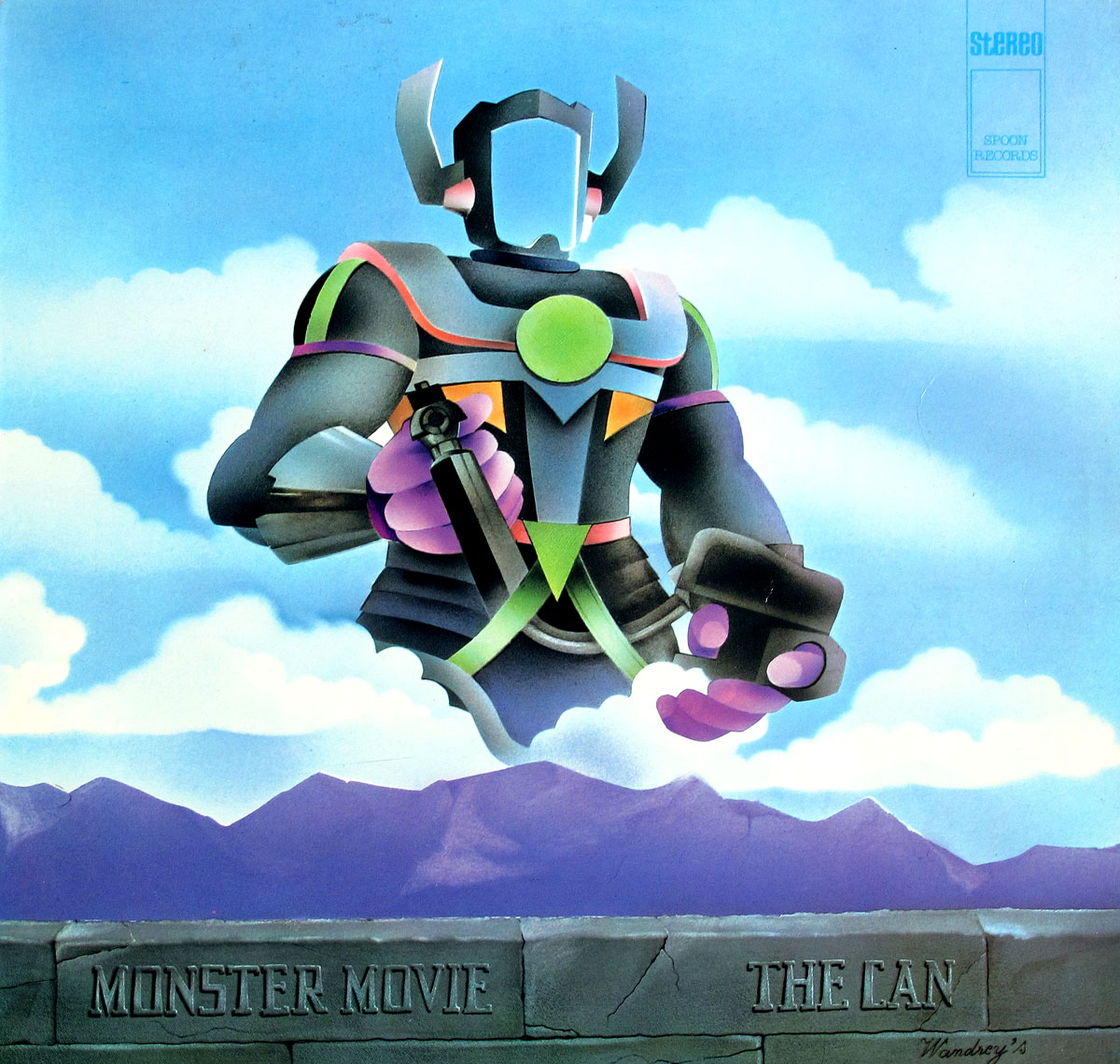
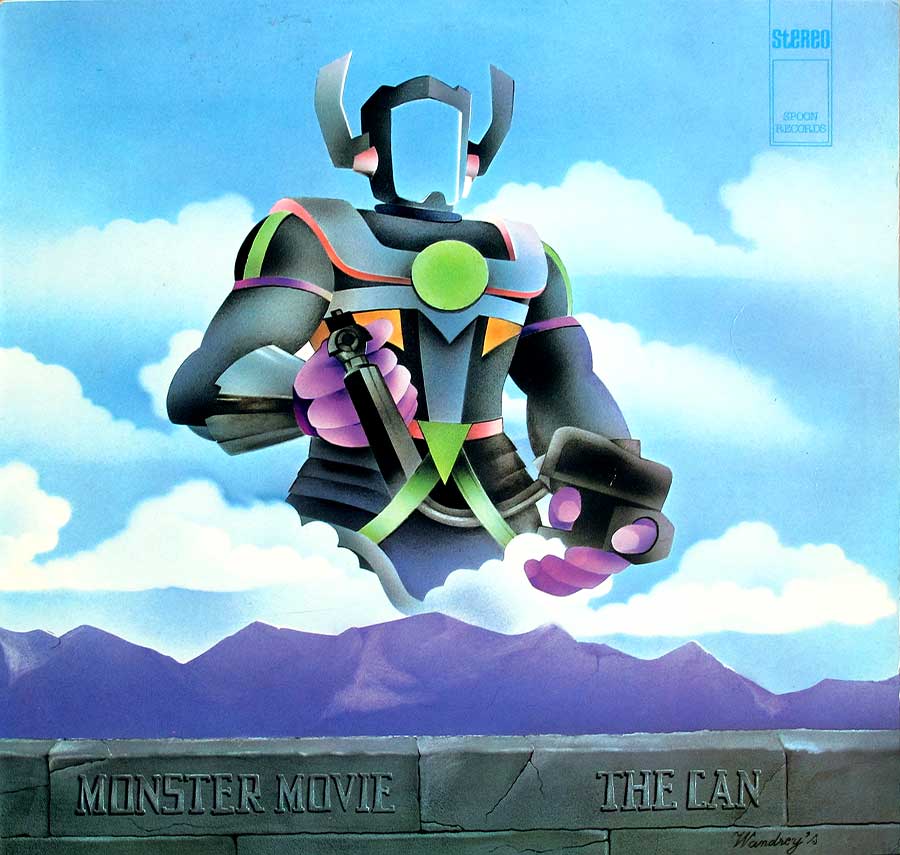
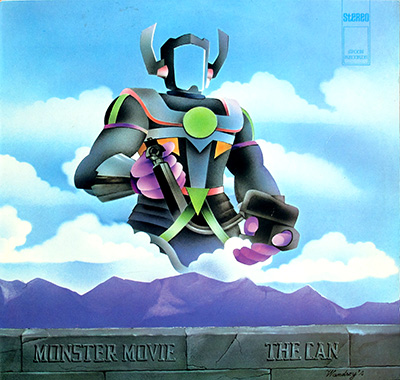
Front cover artwork of Monster Movie shows a towering robot-like figure emerging from a layer of soft, airbrushed clouds. The style is unmistakably Wandrey's: clean gradients, geometric armor plating, and a faceless helmet that makes the character read more like an icon than a person. The figure dominates the sky, framed by crisp blue tones and a distant line of purple mountains that create a low, cinematic horizon.
The robot holds two objects that matter for collectors studying variations: in the right hand, a black-and-silver sword hilt is angled downward; in the left, a detachable helmet or headpiece with two glowing eye shapes. Both shapes are sharply shaded, showing the classic late-60s airbrush technique used across early CAN sleeves. The layout positions the whole character as if rising from behind a cracked stone slab engraved with MONSTER MOVIE on the left and THE CAN on the right.
The upper right shows the original Spoon Records branding box with STEREO printed above it. The entire front is uncluttered: no barcode, no clutter text, only the artwork and the essential imprint. Condition indicators visible here include mild edge fade typical of 1970s storage, slight surface grain from the original print texture, and the consistent Wandrey signature in the lower right corner. Everything aligns with the known characteristics of the 1969 artwork reused on the 1978 Spoon white-label reissue.
Back cover built around Spoon Records’ early minimalist layout: black field, tight white typography, and a centered block that carries all the essential data. Text alignment stays strictly grid-locked, with the album title and band name set in that heavy, gothic-styled typeface that defined the first wave of CAN reissues and original issues. Tracklists for both sides sit cleanly in the middle, each title followed by “(The Can)” just as on the original 1969 layouts.
Credits run directly underneath with the classic five-member CAN lineup: Irmin Schmidt, Jaki Liebezeit, Holger Czukay, Michael Karoli, and Malcolm Mooney. Recording info calls out live takes at Schloss Nörvenich, a detail that matters to collectors because this confirms the true first-album production environment. Left and right columns carry German and English liner notes, both printed in dense blocks without ornamentation — exactly the kind of layout that makes Spoon pressings instantly recognizable.
A small monochrome band photo anchors the lower section, showing the group as silhouettes with light falling hard from behind. This image is typical for Monster Movie copies and helps authenticate the pressing when comparing against later Spoon variations. Bottom edge includes production credits for Inner Space and Spoon Records, plus address details set in fine, low-contrast print. Paper texture shows light reflection from the camera flash, which subtly shifts the blacks into soft charcoal tones — normal for photographing matte-black covers.
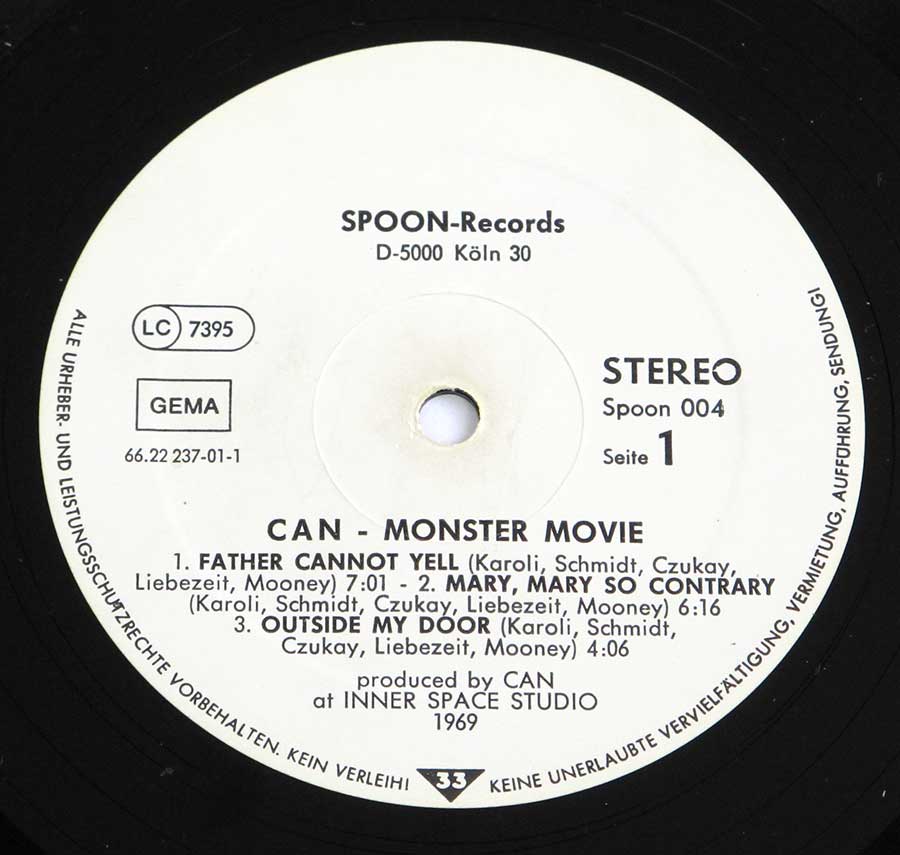
A stark white Spoon Records label with sharp black text, using the early layout that collectors recognize from the late-60s CAN pressings. The label is fully matte, no gloss, and the print sits crisply on the paper without bleed. The top carries the “SPOON-Records” imprint with the Köln address, printed in a light sans-serif font that immediately pins this label to Germany.
The left side features two important identifiers: the LC 7395 label code and the boxed GEMA rights society logo. Both symbols are printed with thick outlines that stand out clearly from the background. The matrix number 66.22.237-01-1 sits directly below, crucial for verifying this pressing generation.
Track titles are centered and bolded: “Father Cannot Yell,” “Mary, Mary So Contrary,” and “Outside My Door,” each with the full composer lineup beneath — Karoli, Schmidt, Czukay, Liebezeit, Mooney — confirming this as the true Monster Movie personnel. The stereo marking on the right is heavy and unmistakably 1960s German typography.
The 33-rpm triangle mark at the bottom is a simple geometric symbol, printed with a thick border. No artwork sits in the background; it’s a pure functional label meant for readability and manufacturing efficiency. The rim text forms a continuous legal ring in German, stating reproduction and duplication restrictions, another hallmark of German-pressed Spoon editions.
Early Spoon Records white-label design used on German pressings of CAN’s “Monster Movie.” Built for maximum legibility, it reflects the label’s no-nonsense production approach during the band’s Inner Space years. This particular label design was used by Spoon Records between 1969 and the early 1970s.
All images on this site are photographed directly from the original vinyl LP covers and record labels in my collection. Earlier blank sleeves were not archived due to past storage limits, and Side Two labels are often omitted when they contain no collector-relevant details. Photo quality varies because the images were taken over several decades with different cameras. You may use these images for personal or non-commercial purposes if you include a link to this site; commercial use requires my permission. Text on covers and labels has been transcribed using a free online OCR service.
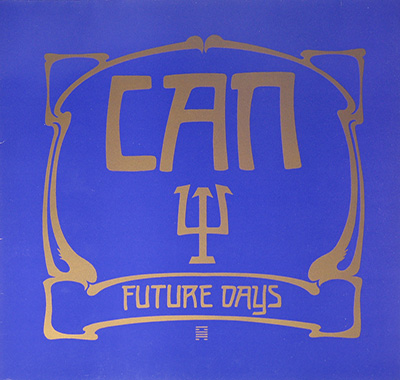
CAN's "Future Days" marks a turning point. Damo Suzuki's last album with the band, it explores ambient soundscapes. Tracks like the title piece and "Bel Air" create a mesmerizing, atmospheric journey that defines Krautrock innovation.
- Future Days (1973, Germany) - Future Days (1973, Germany, Re-Issue) CAN - Future Days ( 1973 , England )
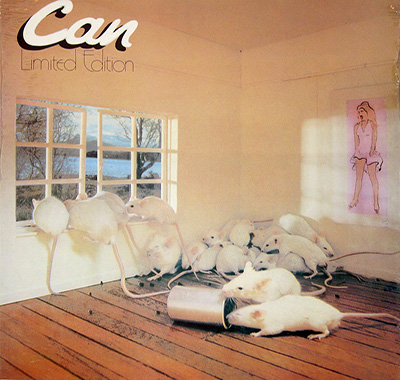
"Limited Edition"was recorded at Inner Space Studios, a fitting name for a place that became the laboratory for sonic experimentation. Inner Space Studios provided CAN with the freedom to push boundaries and redefine the possibilities
Learn more
Spoon Records 004 - 1969 - Germany
Whenever I revisit Monster Movie, I’m reminded how Can built an entire universe out of rhythmic grit and psychedelic swagger. Karoli’s guitar carves loops in my skull and Mooney’s raw-edge delivery keeps the whole krautrock engine burning hot. It’s a fierce, off-the-rails debut that still feels ahead of its time.
"Out Of Reach" emerged from the creative womb of Inner Space Studio, where the genius of CAN's musicians was captured and immortalized. The album marked yet another chapter in the band's storied history
Learn more
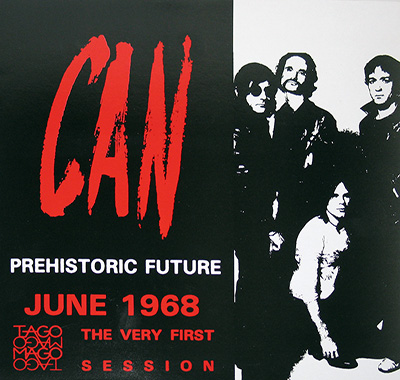
"Prehistoric Future" is an album by the influential German experimental rock band (akak Krautrock) CAN, originally released in 1981. The album features tracks from the band's early years
Learn more
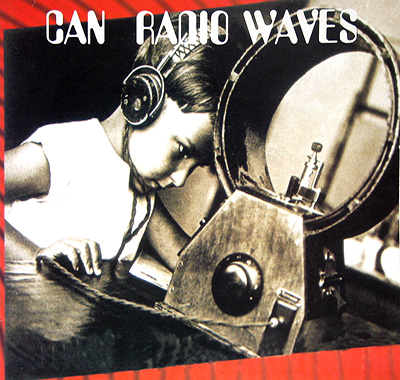
The album opens with "Paperhouse," a mesmerizing track recorded during a Beat-Club TV session in the spring of 1971. Clocking in at 6:31, the song unfolds with hypnotic rhythms and unconventional structures
Learn more
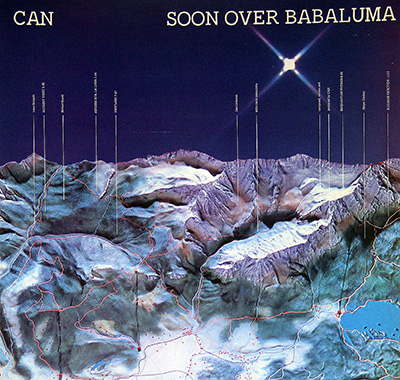
The album, released in 1974 on Spoon Records in Germany, holds a distinctive place in the band's discography for various reasons, most notably the unique production process employed during its creation. "Soon Over Babaluma"
- Soon Over Babaluma ( 1973 , England ) - Soon Over Babaluma ( 1974 , Germany )
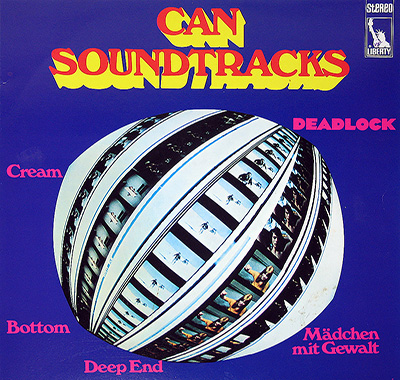
Soundtracks is a soundtrack album by the Krautrock group Can. It was first released in 1970 and consists of tracks written for various films. The album marks the departure of the band's original vocalist Malcolm Mooney
Learn more
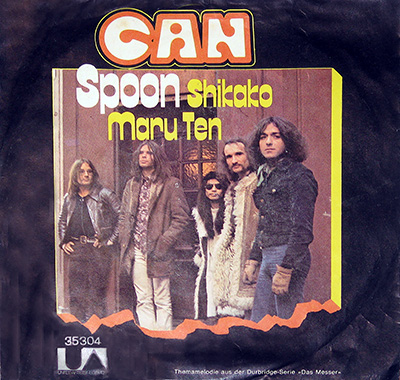
CAN, a pioneering German experimental rock band formed in the late 1960s, was known for pushing the boundaries of conventional rock music. The release of "Spoon b/w Shikako Maru Ten" showcases the band's innovative approach to sound
Learn more
"Tago Mago" encapsulates Can's relentless spirit of exploration. Tracks like the chaotic opener "Paperhouse", the hypnotic "Halleluwah", and the rhythmic intensity of "Aumgn" defy categorization. Damo Suzuki's enigmatic vocals
Learn more
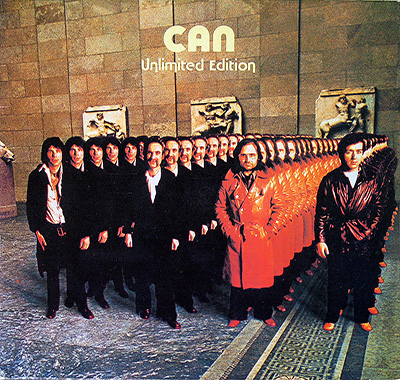
"Unlimited Edition" is a Can rarities collection spanning 1968-1976. It features singers Damo Suzuki & Malcolm Mooney. Cover photos were taken in the British Museum's Pantheon room.
Learn more