- A 1978 Roots Reggae Statement Carved in Smoke and Defiance
Listening to Bush Doctor always feels like stepping straight into 1978, when Peter Tosh was sharpening roots reggae into something heavier and more uncompromising. Cut between Dynamic Sounds and Joe Gibbs Studio in Kingston, the album hits with deep rhythmic authority from Sly & Robbie, a fierce title track, and that unexpected duet with Mick Jagger. The cover shot by Ara Gallant adds its own mystique, while the early German pressing is a longtime collector favorite thanks to its crisp mastering and bold artwork that still commands attention on any shelf.
Peter Tosh’s “Bush Doctor” hit 1978 like a lit match in a room already full of smoke. The world was shifting, reggae was mutating, and Tosh stepped forward with a record that felt equal parts prophecy and provocation. This album doesn’t just groove — it stares you down and dares you to listen closer.
Late-70s Jamaica was a pressure cooker of politics, economic unrest, and a booming roots-reggae scene that insisted on saying the quiet parts out loud. Globally, reggae was exploding thanks to Marley’s international rise, but Tosh was never in the shadow — he was the flame itself, burning hotter and less politely. “Bush Doctor” landed right as Western labels finally realized reggae had teeth, not just sunshine.
Tosh had already carved his own path after leaving The Wailers, swapping band diplomacy for pure militant clarity. By 1978, he teamed up with Rolling Stones Records — yes, those Rolling Stones — which gave him the muscle to push his music far beyond the reggae faithful. You can hear the freedom: a man who finally gets a bigger megaphone and refuses to whisper.
The connection wasn’t born in a boardroom — it sparked from genuine admiration. Mick Jagger had long respected Tosh’s firebrand lyrical style, and Keith Richards was fascinated by the rhythmic weight of roots reggae. When the Stones were expanding their own label, they wanted someone with vision, edge, and a message that could shake the walls. Tosh fit that profile too perfectly to ignore. Their partnership grew out of late-night musical curiosity and mutual rebellious streaks — three men allergic to silence, rules, and anything resembling safe choices.
The album pulses with a deep, confident roots heartbeat — the kind Sly Dunbar and Robbie Shakespeare practically invented in their sleep. The title track feels like a ritual under moonlight, slow and smoky; “(You Gotta Walk) Don’t Look Back” becomes a swaggering duet with Mick Jagger that nobody expected; and “Creation” glides with a gentler spiritual pull. Everything sounds warm, earthy, and sharpened with intent.
Reggae in ’78 was fierce. While Marley’s “Kaya” drifted into mellow sweetness and Burning Spear kept things ceremonial, Tosh chose steel over silk. “Bush Doctor” leans heavier, tougher, more defiant — like a cousin to Steel Pulse’s rising British edge but more rooted in Jamaican soil. Its grooves walk slower, but every step lands harder.
The album arrived with one of the most legendary vinyl marketing stunts ever: a scratch-and-sniff sticker that smelled like ganja. British retailers panicked, banned it, and accidentally handed Tosh the greatest free promo campaign imaginable. Classic overreaction to something Tosh had never hidden — the title “Bush Doctor” wasn’t exactly subtle.
Tosh carried the band like a general leading a spiritual army — disciplined, fiery, uncompromising. Robbie Shakespeare anchored the pulse, Sly Dunbar carved the groove, and the guest spots from Richards and Jagger dragged the global spotlight whether roots purists liked it or not. That tug-of-war between authenticity and global reach gives the album an electric tension from first groove to last.
Fans were split between “Tosh has gone international” and “finally, the world is listening.” With distance, “Bush Doctor” now stands as a bridge record — pure roots spirit polished just enough to travel the world without losing its teeth. Today, it still feels like a sermon broadcast through bass bins, half-meditation, half-warning.
Listening to the music on the stereo today feels like opening a resin-scented time capsule from a louder, braver decade. The grooves still roll heavy, the message still whispers loud, and the whole record carries that unmistakable Tosh energy — fearless, grinning, unbowed. Some albums age; this one just settles deeper into your bones.
Reggae Music
Reggae always hits me with that warm, rolling heartbeat Jamaica shaped in the late 60s — deep bass, relaxed grooves, and lyrics rooted in real life. It’s a sound that pulls me straight into sunshine, beaches, and that unmistakable waft of ganja drifting through the air. Spiritual fire, political honesty, and everyday stories blend into a vibe that shaped roots reggae, dub, and so much of the music I grew up loving.
Rolling Stones Records – Cat#: 1C 064-61 708 (06461708)
Standard sleeve.
No custom inner sleeve included.
Record Format: 12" Vinyl LP Gramophone Record
1978 – Made in Germany
Dynamic Sounds, Kingston, Jamaica
Joe Gibbs Studio, Kingston, Jamaica
Bearsville Studio – USA
Atlantic Studios – New York, USA
Theresa Del Pozzo
Herbie Miller
116 Lexington Ave.
New York, N.Y. 10016
(212) 725-1413
c/o Music Fair
2 Little Premier Plaza
Kingston 10, Jamaica WI
9266385
Disclaimer: Track durations shown are approximate and may vary slightly between different country editions or reissues. Variations can result from alternate masterings, pressing plant differences, or regional production adjustments.
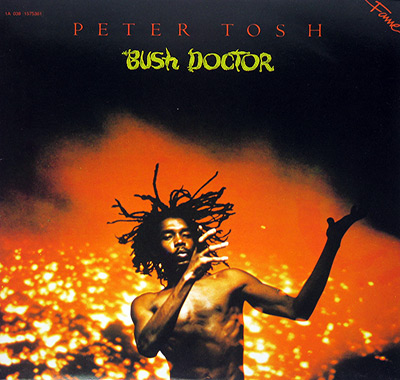
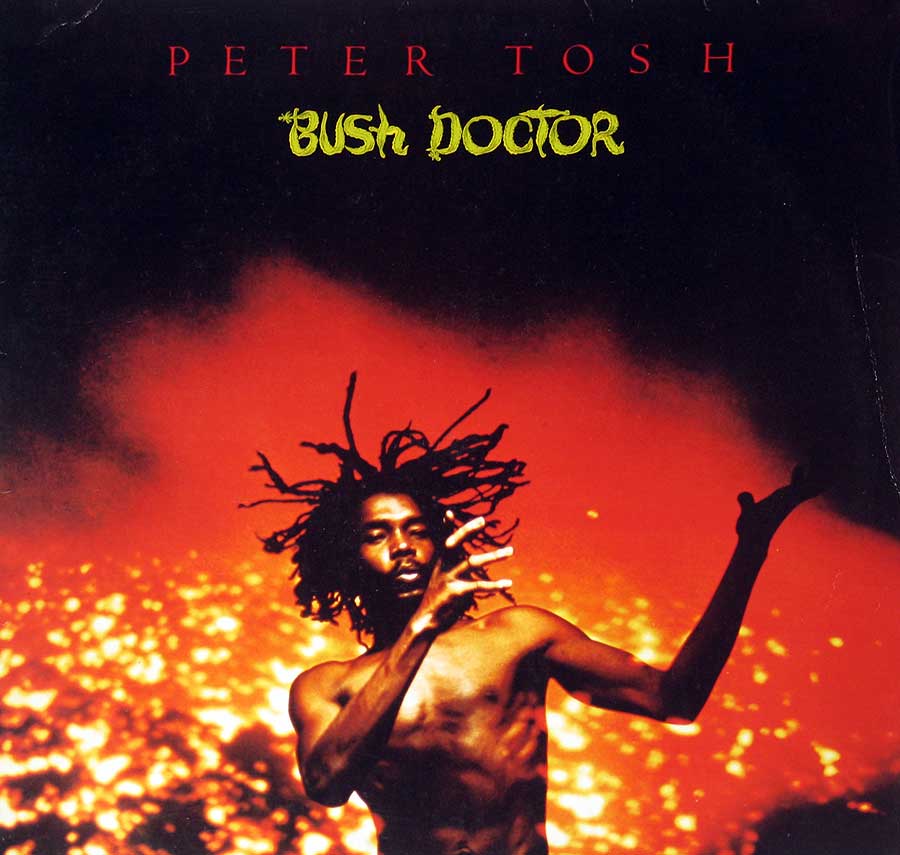
The cover shows a sharply focused portrait of Peter Tosh against a blazing field of orange and yellow light that resembles a wall of sparks or molten reflections. His upper body is bare, lit from the front, revealing a lean, defined build and an intense facial expression that adds weight to the album’s militant roots-reggae attitude. His dreadlocks fan outward in mid-motion, captured with enough crisp detail to see the individual strands lifting away from his head.
The background dominates the composition: a sprawling mass of glowing particles filling the bottom half of the frame and fading upward into deep black and red shadows. The contrast between Tosh’s dark silhouette and the fiery color field gives the cover its unmistakable punch. The lighting emphasizes contours around his arms and shoulders, making the pose feel both deliberate and raw — a look that stands out immediately in a crate.
Typography sits cleanly above the image: PETER TOSH appears in thin red uppercase letters spaced widely across the top border, while BUSH DOCTOR sits beneath it in a bold, distressed yellow-green font that looks almost hand-brushed. The German pressing shown here carries the typical late-70s print tones, with a slightly warm saturation and a semi-gloss finish that collectors recognize instantly.
The overall design mixes stark portraiture with explosive background color, making this one of those album covers that’s easy to identify even from across the room. Condition details such as faint edge wear and soft corner shadows are visible at the right border, consistent with handling on late-70s European sleeves. For collectors, these small details help distinguish this specific pressing from other international variations.
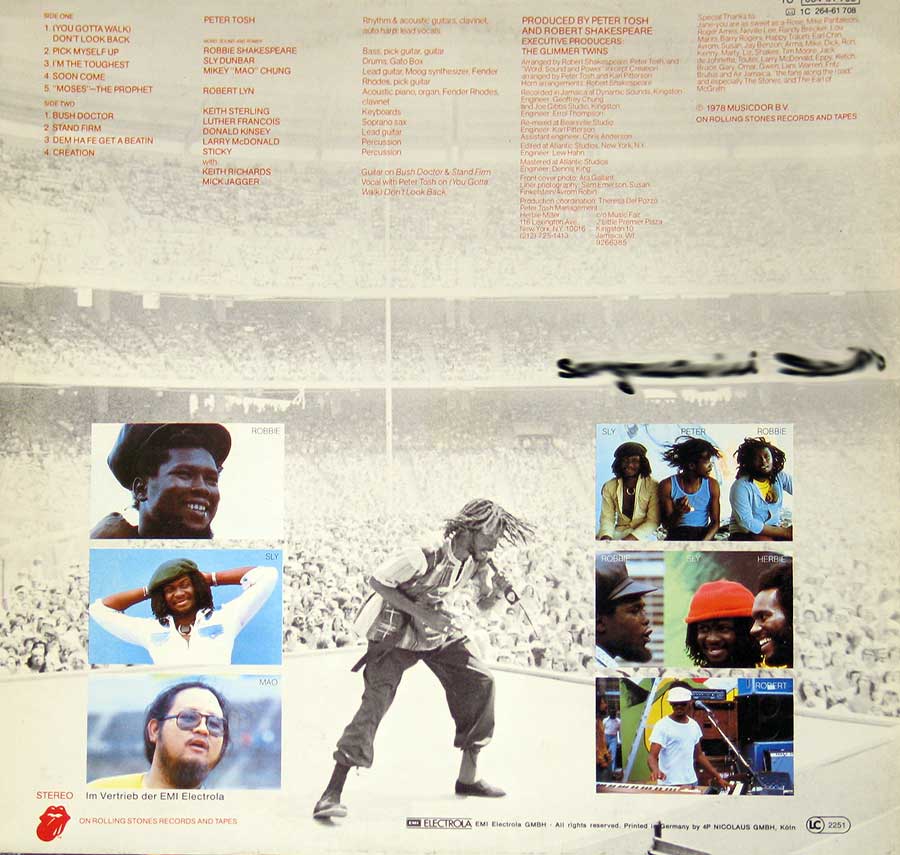
The back cover is built around a dominant black-and-white concert shot, printed large across the lower half. Peter Tosh stands mid-movement on a wide stadium stage, body leaning forward and one leg lifted as if caught in the middle of a step. The background fades into a sea of blurred spectators, giving the whole lower frame a sense of depth and scale that instantly signals a late-70s live-era aesthetic. The print has that slightly soft contrast familiar from German pressings of the time.
The upper half switches to a dense, text-heavy layout. Red sans-serif type lists every track, musician, studio location, and production credit. The spacing is tight but consistent, creating an orderly grid that collectors immediately recognize as typical for Rolling Stones Records manufacturing in Germany. The mastering, engineering, and management lines run across the top in multiple columns, all aligned cleanly against the pale background.
Along the left and right edges, a stack of color portraits breaks the monochrome field. Robbie, Sly, and Mao appear in individual squares on the left, each photographed in casual outdoor light with natural expressions. On the right, additional small portraits show Sly, Peter, Robbie, Herbie, and Robert Lyn in similar candid moments, adding a personal layer to the otherwise formal credit layout. These little color blocks help identify the early German sleeve variant instantly.
Branding and manufacturing information runs along the bottom: the Rolling Stones tongue logo at left, the EMI Electrola distribution credit, and LC 2251 in a small circle. Even slight wear around the edges and a faint smudge in the upper right quadrant are visible, the kind of real-world details that give the sleeve personality and help confirm authenticity when cataloging a collection.
STEREO Im Vertrieb der EMI Electrola
ON ROLLING STONES RECORDS AND TAPES EMI Electrola EMI Electrola GMBH • All rights reserved • Printed in Germany by © NICOLAUS GMBH, Köln
LC 2251
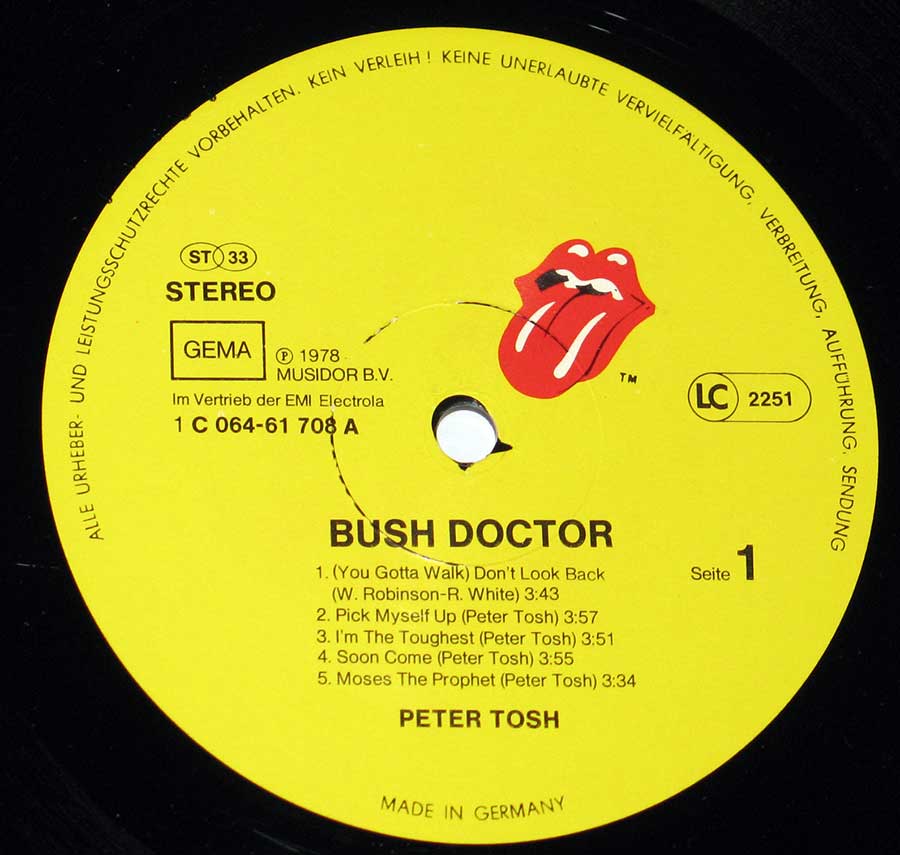
The Side One label stands out with its strong yellow background, a signature look for German-pressed Rolling Stones Records releases from this era. The red tongue-and-lips logo sits prominently in the upper right quadrant, printed cleanly with sharp color edges. The spindle hole is centered cleanly with a thin circular wear mark surrounding it, the kind of detail that appears on well-played but carefully handled copies.
Text layout follows the strict Electrola style: the ST 33 speed icon sits at the upper left, next to the STEREO marking and a neatly boxed GEMA rights indicator. Just below it, the line reads “© 1978 MUSIDOR B.V.” followed by “Im Vertrieb der EMI Electrola,” establishing the correct German distribution lineage. The catalog number 1C 064-61 708 A is printed in bold, slightly larger than surrounding text for quick crate identification.
The tracklist fills the center section in a balanced, easy-to-read column: five titles including “(You Gotta Walk) Don’t Look Back,” “Pick Myself Up,” and “I’m the Toughest.” Songwriting credits appear in small parentheses just beneath the titles, printed with crisp alignment typical of EMI’s metal type-setting of the period. The word BUSH DOCTOR appears in bold uppercase, centered above the tracklist.
The bottom segment shows PETER TOSH in uppercase, followed by “MADE IN GERMANY” curved along the edge of the label rim. Surrounding text in German circles the outer edge, stating copyright and reproduction restrictions. Light surface reflections and a faint scuff mark across the left side show normal age but confirm this is an authentic vintage pressing, not a later reproduction.
All images on this site are photographed directly from the original vinyl LP covers and labels in my collection. Earlier blank sleeves were not archived due to storage limitations, and Side Two labels are sometimes omitted when they contain no collector-relevant details. Quality varies because photos were taken over several decades with different cameras. Personal or non-commercial reuse is allowed with a link back to this site; commercial use requires permission. Text on covers and labels has been transcribed using a free online OCR service.
"Bush Doctor" is the album by Peter Tosh. It was released in 1978. A British record retailer banned the album upon its release because of a scratch-n-sniff sticker on its cover, that apparently smelled of ganja (marijuana)
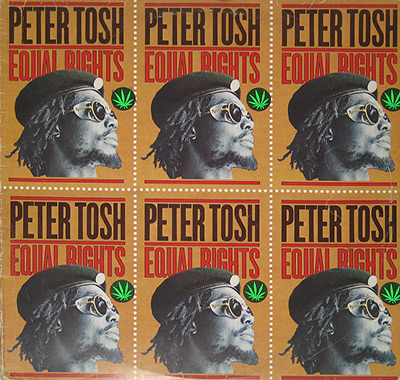
- Bush Doctor (1978, Italy) - Bush Doctor (1978, EEC Europe) - Bush Doctor (1978, Germany) *** - Bush Doctor ( 1978 , Netherlands )“Equal Rights” hits like a manifesto carved straight into vinyl. Tosh fires his sharpest lyrics over deep, militant grooves powered by Sly Dunbar and Robbie Shakespeare. A defining roots-reggae milestone, the album blends grit, conviction, and hypnotic rhythm into a fierce political statement that still lands with full force.
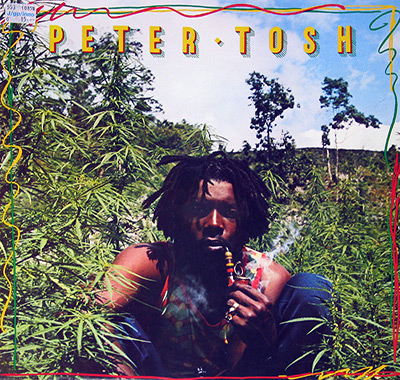
In the world of reggae history, Peter Tosh's debut solo album, "Legalize It," stands as a seminal work that not only marked a significant moment in the artist's career but also carried profound cultural and social implications. Released in 1976, this iconic 12" vinyl LP album remains a cornerstone
- Legalize It (1978, EEC) - Legalize it (1978, Holland)
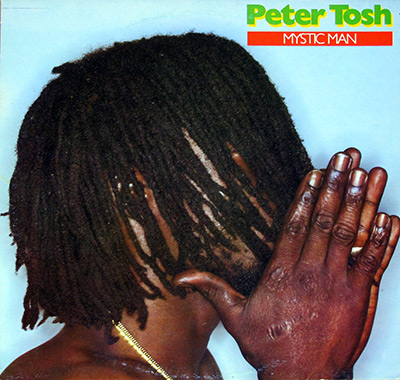
Peter Tosh's "Mystic Man" 12" Vinyl LP, released in 1979, stands as a testament to the artist's profound impact on the reggae music scene during that era. Produced by Peter Tosh himself, the album showcases not only his musical prowess but also his prowess in the role of a producer.
- Mystic Man (1979, Italy) - Mystic Man (1979, USA)
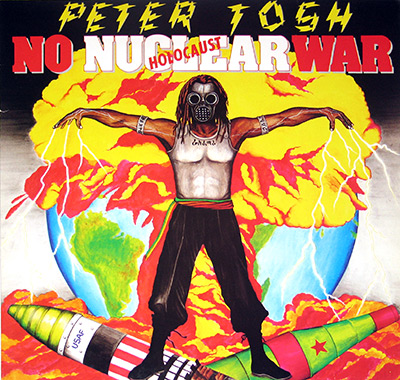
"No Nuclear War" marked Tosh's final studio album before his untimely death in 1987. The album's title track, "No Nuclear War", stands as a poignant and prophetic anthem against the threat of nuclear conflict. Tosh's lyrics convey a sense of urgency, denouncing the devastating consequences of war
No Nuclear War 12" Vinyl LP