MOTORHEAD - Orgasmatron (1986, France) 12" Vinyl LP Album

- Snaggletooth rides the iron rails straight into heavy metal trouble -

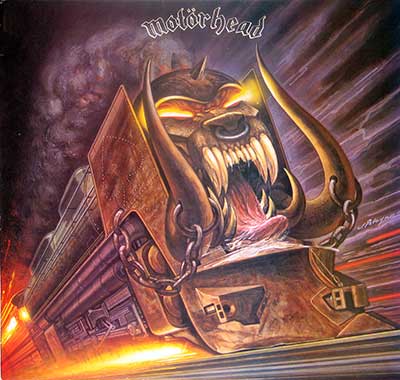
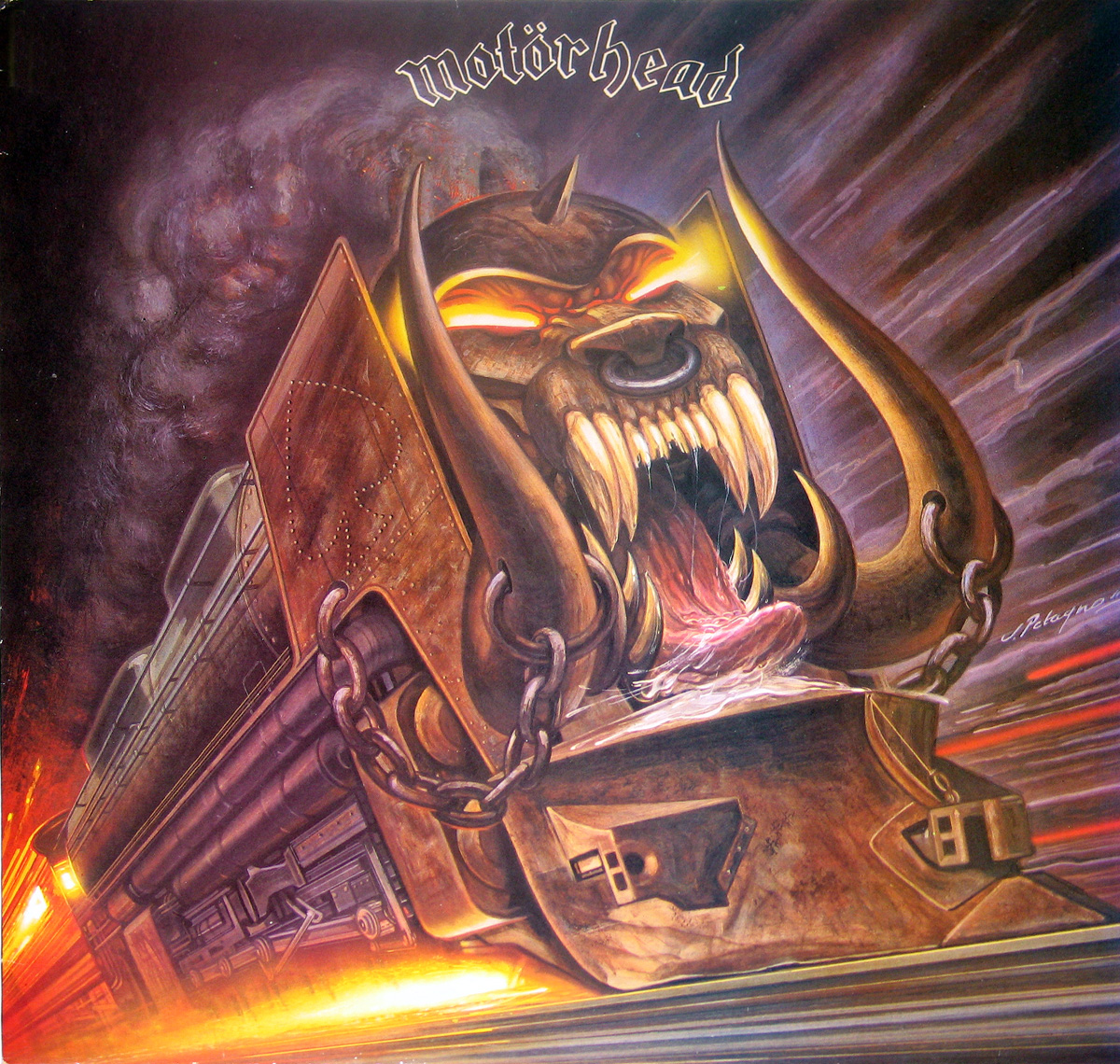
Album front cover of MOTORHEAD - Orgasmatron, showing the band’s snarling Snaggletooth mascot fused with a roaring locomotive, all tusks, chains, armour plates and furnace glare. The Motorhead logo sits at the top against purple smoke and stormy brushwork, while orange speed lines and sparks below make the whole sleeve feel like heavy metal being delivered by rail, badly maintained and probably uninsured.

The sleeve hits like a nightmare train poster left too close to a blast furnace. Snaggletooth dominates the centre, bolted onto a locomotive with huge curved horns, chains hanging off the front, tusks bared and mouth wide open. Purple smoke rolls across the background, orange fire streaks along the rails, and the Motorhead logo floats up top like a warning sign nobody sensible would ignore. Subtle? Not even slightly. Good.

Motorhead came storming back in 1986 with "Orgasmatron", a hard-edged GWR-era reset that proved the band could survive line-up shifts, label changes, and the usual music-business nonsense without polishing the dirt off its boots. It sits deep in British heavy metal’s post-NWOBHM afterglow: heavier, colder, meaner, and less interested in charming anyone’s auntie. "Deaf Forever" opens like a tank chewing gravel, "Built for Speed" keeps the throttle pinned, and the title track crawls in with that nasty, sermon-from-the-gutter weight. Bill Laswell’s production gives it a dense, industrial shove, making this French pressing feel like a proper slab of mid-eighties Motorhead menace.

"Orgasmatron" (1986) Album Description:

Motorhead returned in 1986 with "Orgasmatron", and the record does not so much arrive as reverse over the flowerbed. This is the GWR Records era, French pressing, catalogue number 24 701 (24701), with Lemmy Kilmister on vocals and bass, Phil Campbell and Wurzel on guitars, and Pete Gill on drums. The sound is British Heavy Metal dragged into a darker mid-eighties room: less oily Bronze-era rock and roll swagger, more steel door, bare bulb, and bad news in the corridor.

What makes this album worth opening up is not just the Snaggletooth locomotive on the cover, although that beast does plenty of damage before the needle drops. The real dirt is in the shift: a changed Motorhead, a colder production hand from Bill Laswell and Jason Corsaro, and a British metal climate where the old NWOBHM charge was starting to splinter into speed, thrash, hard rock survival tactics, and record-company panic dressed as strategy. Lovely industry, always there with a clipboard when the room is already on fire.

By 1986, the British Heavy Metal landscape was no longer the tidy battlefield it had been at the dawn of the decade, assuming it was ever tidy, which it was not. Iron Maiden were operating on a huge theatrical scale, Judas Priest were sharpening the arena-metal machine, Saxon were chasing survival after their earlier charge, Girlschool were fighting through a changed market, and Tank still sounded like the alley behind the venue after closing time. Motorhead sat awkwardly beside all of them, too filthy for clean hard rock respectability and too stubborn to become anybody’s polite elder statesmen.

That awkwardness is exactly where "Orgasmatron" gets its teeth. "Deaf Forever" opens with a tank-track stomp rather than a friendly invitation, while "Built for Speed" keeps the title honest without turning into glossy speed-metal theatre. The title track is the real bruiser: slower, heavier, sermon-like, crawling forward with the ugly patience of something that knows the door will give way eventually.

Bill Laswell’s production is the great dividing line. Anyone expecting the old pub-wall sweat of early Motorhead may grumble, and fair enough, because this album does not breathe the same way. Laswell pushes the bottom end into a dense, almost industrial pressure, while Jason Corsaro’s recording gives the drums and guitars a hard, dry frame. The result can feel claustrophobic, but not by accident; it sounds like the room got smaller and nobody bothered to open a window.

Lemmy’s voice sits in that mix like rust on a blade. Not pretty. Never the point. Phil Campbell and Wurzel thicken the guitar attack into a twin-engine grind, less flash than forward motion, while Pete Gill keeps the kit tight and muscular. The line-up matters here because "Orgasmatron" is not merely Motorhead carrying on after changes; it is Motorhead proving that replacement parts can still rattle the whole chassis loose.

The sleeve tells on the record

The French GWR sleeve has the good collector clues in the places that make normal listeners yawn: barcode, catalogue identifiers, GWR marks, SACEM/SDRM on the label, and the useful production credits tucked where they belong. The front cover screams with Joe Petagno-style machinery and Snaggletooth madness, but the back cover and labels do the proper archival work. That is usually how it goes. The front cover gets the glory; the small print pays the rent.

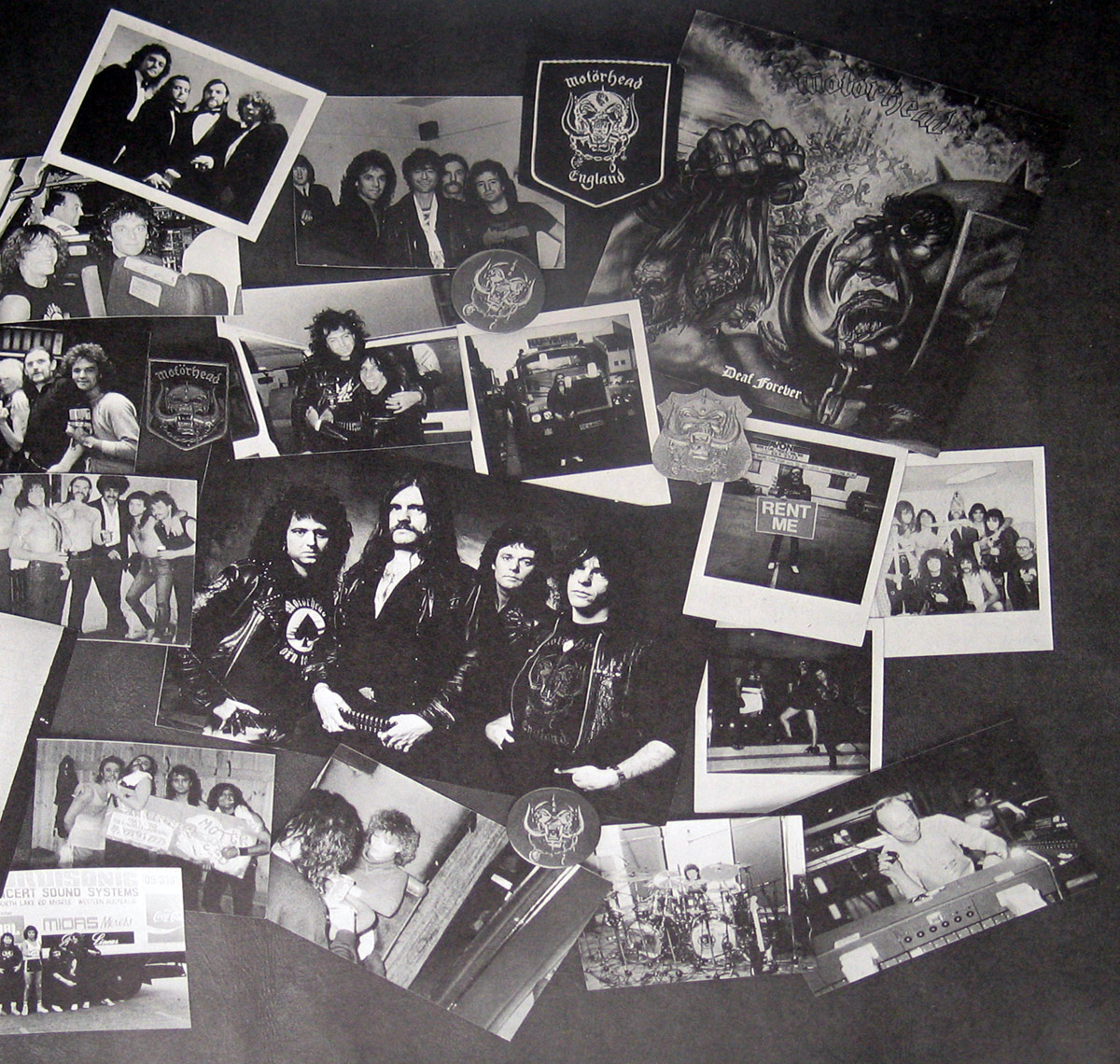
The custom inner sleeve is even better because it looks like a tour bag emptied across a table: band portraits, backstage scraps, badges, transport photos, studio corners, the odd little detail that should not matter but absolutely does. Those are the bits that make a copy feel handled rather than merely owned. Late at night, with the sleeve flat under a desk lamp, the whole package has that grey-black eighties smell of ink, paper, vinyl dust, and bad decisions pretending to be career momentum.

There was no major release controversy visible from the page material, despite the album title doing its best to sound like it had been designed to annoy somebody’s committee. The common lazy mistake is to treat "Orgasmatron" as just another loud Motorhead record with a rude name and a monster cover. That misses the point. This is not the band coasting; this is the band hardening, lowering the ceiling, and making the noise feel more mechanical.

As British Heavy Metal, it sits in a strange and useful pocket. It is not NWOBHM innocence, not thrash-metal sprinting, not polished arena muscle, and not nostalgia, thank the gods of scratched vinyl. It drags, bites, hammers, and occasionally lurches like the machine on the sleeve has found a rhythm section. A few moments could use more air, yes, but too much air would probably ruin the mood. Nobody buys "Orgasmatron" for fresh curtains.

For collectors, the French GWR pressing earns its place because the physical object keeps talking after the music stops. The labels confirm details, the back sleeve names Bill Laswell and Jason Corsaro, the insert supplies the road-life clutter, and the whole thing feels like a mid-eighties Motorhead document rather than a tidy product. It is heavy, awkward, grimly funny in places, and not remotely interested in apologising. Good. Apologies would sound ridiculous here.
References

Album Key Details: Genre, Label, Format & Release Info

Music Genre:

British Heavy Metal, Hard Rock, NWOBHM

A grimy mid-1980s Motorhead blend of British heavy metal and hard rock, still dragging some NWOBHM mud on its boots but already sounding heavier, meaner and less polite than most of the scene around it. No velvet curtains here, just throttle, rust, and amplifier fumes.

Label & Catalognr:

GWR Records – Cat#: 24 701 (24701)

Release Details:

Release Date: 1986

Release Country: France

Album Packaging

Original custom insert with album details, lyrics and photos.

Media Format:

Record Format: 12" Vinyl Stereo Gramophone Record
Total Weight: 230g

Production & Recording Information:

Producers:
  • Bill Laswell – Producer

    Laswell drags Motorhead into a darker, heavier studio room, with the bottom end shoved forward and no velvet polish in sight.

    Bill Laswell, an American bassist, producer and label owner, built his name across Material, avant-funk, dub, jazz, ambient music and wonderfully odd studio collisions. On "Orgasmatron" he gives Motorhead a colder, denser punch than the old Bronze years: less pub-wall sweat, more industrial pressure, with Lemmy's bass and voice pushed into the room like machinery nobody bothered to switch off.

  • Jason Corsaro – Producer

    Corsaro helps give the album its hard, slightly claustrophobic studio weight, the sort of sound that refuses to behave nicely.

    Jason Corsaro, an American engineer and producer, worked across rock, pop and heavy music, with credits tied to names like Duran Duran, Nile Rodgers, Peter Gabriel, Madonna, Ozzy Osbourne and The Power Station. On "Orgasmatron" he stands beside Laswell in shaping that thick 1986 GWR sound: guitars packed tight, drums dry enough to bruise, and just enough space for the record to feel nasty rather than tidy.

Band Members / Musicians:

Band Line-up:
  • Lemmy Kilmister – vocals, bass

    Lemmy sounds like the whole album is being shouted from the cab of a lorry with bad brakes and no patience.

    Lemmy Kilmister, English bassist, singer and songwriter, founded Motorhead in 1975 after Hawkwind and turned rock and roll into something louder, dirtier and far less house-trained. On "Orgasmatron" his bass is not background furniture; it grinds through the mix while that sandpaper voice gives the album its bad-tempered spine.

  • Phil Campbell – guitar

    Campbell cuts through the murk with the kind of guitar work that keeps the engine angry instead of merely loud.

    Phil Campbell, Welsh guitarist and former Persian Risk player, joined Motorhead in 1984 and became one of the band’s long-serving riff merchants. On "Orgasmatron" he brings the sharper bite in the twin-guitar setup, locking into the Laswell/Corsaro production without smoothing off the edges, which would have been criminally daft anyway.

Band Line-up Continued:
  • Wurzel – guitar

    Wurzel thickens the guitar wall, making the album feel less like a trio and more like machinery arguing with itself.

    Wurzel, born Michael Richard Burston, was an English guitarist who joined Motorhead in 1984 after playing with Bastard and Warfare, bringing grit rather than show-off sparkle. On "Orgasmatron" he helps bulk up the twin-guitar assault, giving the riffs that extra slab of concrete so the record lands heavy, blunt and slightly unfriendly.

  • Pete Gill – drums

    Gill hammers the album forward with a dry, muscular thump that makes cheap speakers look suddenly worried.

    Pete Gill, English drummer with earlier runs in The Glitter Band and Saxon, played with Motorhead during the mid-1980s and gave the band a different kind of shove behind the kit. On "Orgasmatron" his drumming is tight, dry and heavy, less pub brawl chaos than controlled punishment, which suits the album’s darker GWR-era mood.

Complete Track-listing:

Tracklisting Side One:
  1. Deaf Forever
  2. Nothing Up My Sleeve
  3. Ain't My Crime
  4. Claw
  5. Mean Machine
Tracklisting Side Two:
  1. Built for Speed
  2. Ridin' With the Driver
  3. Doctor Rock
  4. Orgasmatron

This gallery has the usual mid-eighties Motorhead bluntness: dark sleeve, hard lettering, no attempt to charm the neighbours. The front cover is all menace and machinery, while the back cover and custom insert do the more useful collector work, with the sort of band-photo collage that looks as if it was laid out between cigarettes and deadlines. The GWR labels are where the pressing starts talking properly: catalogue number 24 701, SACEM marks, and that small-print business that separates a real copy from a lazy memory. The front sleeve gets the attention, naturally, but the good stuff is deeper in the gallery, hiding in the insert, label ink, and those slightly awkward production-line details.

Album Front Cover Photo
Motörhead Orgasmatron front cover showing a horned metal train shaped like the Snaggletooth war-pig charging forward from lower left to upper right. The Motörhead logo sits at the top against a dark purple smoky sky. The foreground has huge tusks, chains, teeth, glowing eyes, flames, rail sparks, and Joe Petagno’s signature near the lower right.

Front cover of the French GWR Records pressing of "Orgasmatron", photographed from the actual vinyl LP sleeve. The first thing that hits me is not subtlety, thank heavens, but that great armoured Snaggletooth locomotive roaring straight across the sleeve like somebody decided a freight train was not aggressive enough unless it also had tusks, chains, glowing eyes, and a mouth full of dental nightmares. It is very Motörhead: loud before the needle even drops, overbuilt, slightly ridiculous, and somehow completely honest about it.

Held in the hand, the cover has that heavy painted-sleeve drama where the dark violet smoke in the upper corners does half the dirty work. The band logo sits high and arched, almost floating above the chaos, while the machine-beast takes the whole middle of the sleeve and refuses to leave breathing room for anyone else. Fair enough. The left side is all riveted metal, side panels, rail gear, and orange flare; the right side is the mouth, the horns, the chain links, and the little Joe Petagno signature tucked near the lower-right blast of motion. That signature matters. It tells me this is not anonymous record-company decoration but proper Motörhead mythology, painted with grease under the fingernails.

The bottom edge is wonderfully impatient: streaks of track, sparks, red and yellow heat, and not a polite production credit in sight. As a collector, this is where the front cover slightly annoys me, because the sleeve gives me attitude but hides the useful stuff; the back cover, inner sleeve, and labels usually do the real talking. Still, the design concept works because it is blunt as a hammer. No smiling band photo, no leather-trouser posing, no fake menace from a bored photographer. Just a demon train coming off the rails, which is about as close as a sleeve can get to explaining Motörhead without putting Lemmy in the frame.

Album Back Cover Photo
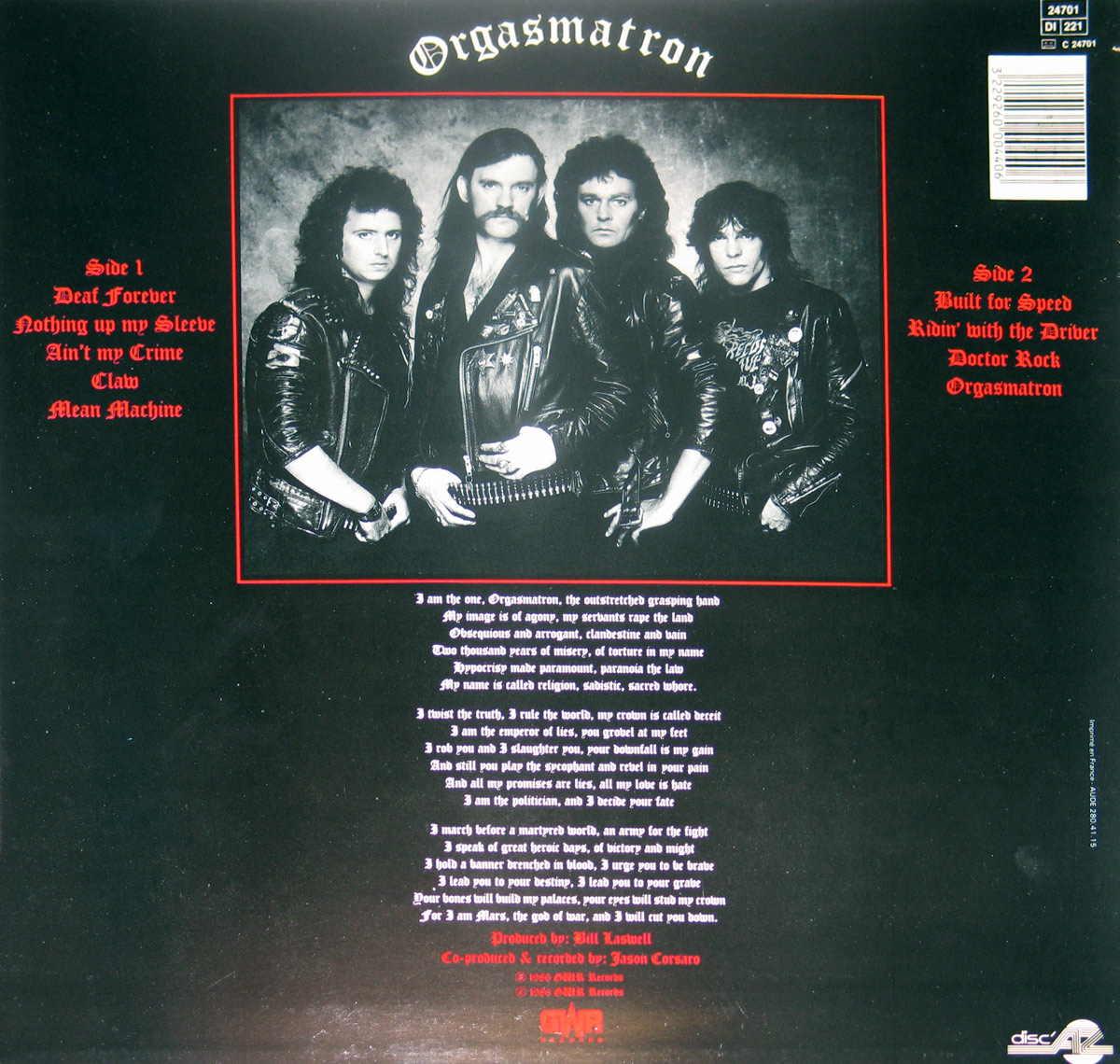
Back cover of Motörhead "Orgasmatron" French vinyl sleeve, showing Würzel, Lemmy Kilmister, Pete Gill, and Phil Campbell in a black-and-white band photograph framed in red. Red Gothic lettering lists album sides on the left and right. The arched album title sits at the top, with barcode and catalogue identifiers in the upper right, production credits and logos along the lower area.

The back cover of the French GWR Records pressing of "Orgasmatron" does not waste much time trying to look friendly, which is probably for the best. The whole thing sits on a flat black field, slightly scuffed by the sort of sleeve wear that always shows up once light hits it at the wrong angle. Across the top, the album title curves in white Gothic lettering, with that little circular Motörhead-style device tucked into the first letter like someone thought the logo still needed one more jab in the ribs. In the upper right corner are the collector’s little clues: 24701, DI 221, C 24701, and the barcode. Not glamorous. Very useful.

The central band photo is boxed in a thin red frame, and that red line does a lot of heavy lifting. Würzel, Lemmy Kilmister, Pete Gill, and Phil Campbell are packed shoulder to shoulder in leather, belts, badges, hair, and expressions that suggest nobody in the room was being paid to smile. Lemmy stands in the middle like the inevitable centre of gravity, while the others flank him with the grim patience of musicians who have already heard too many stupid questions. The monochrome photograph works because it is blunt. The sleeve around it is the theatrical bit.

The red Gothic side panels are pure heavy-metal bookkeeping, pushed out to the left and right so the photograph can dominate the centre. Below the photo, the lyric block sits in pale type, cramped enough to make my eyes complain, but that is also part of the charm. It feels less like decoration and more like a warning label written by someone with a fondness for small print and bad moods. Down near the bottom the useful names appear: Produced by Bill Laswell, co-produced and recorded by Jason Corsaro, followed by the GWR copyright lines and the GAP logo. Along the right edge, the tiny vertical French printing credit is easy to miss, because of course the interesting bits are always hiding where normal people stop looking.

Photo of Custom Inner Sleeve
Custom inner sleeve of Motörhead "Orgasmatron", showing a black-and-white collage of band photographs, backstage snapshots, crew images, badges, transport photos, studio equipment, and a large "Deaf Forever" artwork panel in the upper right. Lemmy Kilmister, Würzel, Pete Gill, and Phil Campbell appear in several images, including a larger central portrait near the lower left.

This custom inner sleeve is where "Orgasmatron" stops pretending to be a neat record-company object and starts behaving like a tour bag emptied across a black table. Photographs overlap at awkward angles, some with white borders, some cropped hard, some looking as if they have been rescued from a road crew envelope after a long night and a worse morning. That suits Motörhead. A polished layout would have been suspicious. Here I get the useful mess: Lemmy Kilmister, Würzel, Pete Gill, and Phil Campbell appearing in formal poses, backstage corners, van-and-truck moments, studio glimpses, and the sort of half-posed snapshots that usually tell more truth than the official portrait.

The largest pull on the eye is still the band. Near the lower left, the four musicians sit together in a dark, heavy photograph, leather catching the light just enough to separate them from the surrounding clutter. Lemmy’s moustache and central position do their usual work, because of course they do. Around them the sleeve throws in badges, a Motörhead England patch, small circular Snaggletooth emblems, a mobile sound system truck, a drum kit shot, a mixing desk scene, and a ridiculous little “RENT ME” photo that feels too odd to be accidental. That one makes me grin. It is exactly the kind of useless-looking detail that makes an inner sleeve worth turning over twice.

In the upper right, the "Deaf Forever" artwork panel gives the collage a nasty mythological punch: clenched fist, chained warrior head, clouds, Gothic Motörhead lettering, all the usual tasteful restraint thrown into a skip where it belongs. The rest of the sleeve is rougher and more human. Faces blur, corners tilt, borders collide, and the black background eats some of the edges. Mildly annoying? Yes, especially where the smaller photos become a bit of a grey soup. But as a collector, this is the good stuff. The inner sleeve does what the back cover cannot: it shows the machinery around the album, the band on the move, the crew-life crumbs, the greasy fingerprints of 1986 before somebody cleaned it up for the catalogue.

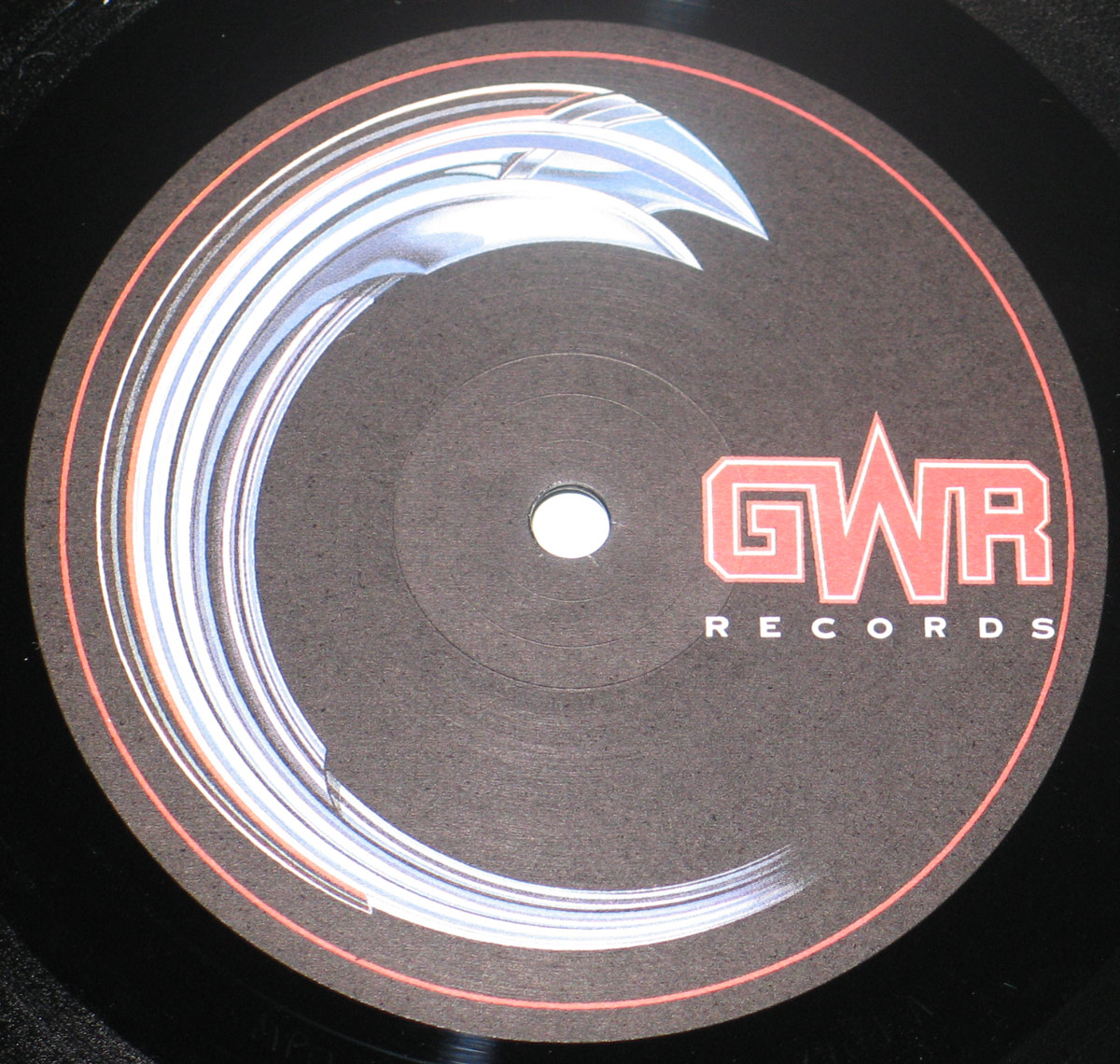
Close up of Side One record’s label
Close-up of the Side One record label from Motörhead "Orgasmatron", showing a dark GWR Records label on black vinyl. A large metallic silver and blue curved blade-like graphic sweeps around the left side, with a thin red circular border near the edge. The red GWR Records logo sits on the right, beside the centre spindle hole.

This Side One label from Motörhead’s "Orgasmatron" is not one of those overstuffed record labels trying to cram half a law office into a circle. Instead, GWR Records goes for the big visual punch: a dark charcoal centre, a thin red ring near the outer edge, and that huge sweeping metallic curve on the left, like a chrome claw or some sharpened fairground ride that probably failed a safety inspection. It takes up most of the label and leaves the practical information out of this photographed crop, which is mildly irritating for anyone trying to document matrix-level detail. Typical. The useful bit is just out of shot, because records enjoy making collectors work for their dinner.

The red GWR logo on the right is the anchor here, blocky and loud, with “RECORDS” spaced underneath in clean white letters. The spindle hole sits almost dead centre, surrounded by the faint pressed rings of the label paper and the slight texture of the printed surface. Around the outside, the black vinyl catches light in curved bands, reminding me this is not a flat scan but an actual disc lying under a camera. That matters. A label photograph like this tells me about the physical pressing in a way a typed catalogue number never quite manages.

What I like is the confidence. No band portrait, no fake flames, no desperate skull clutter. Just the GWR house design, dark and sharp enough to sit comfortably beside "Orgasmatron" without pretending it was drawn specially for Lemmy’s breakfast table. The red outline gives the label a little menace, the silver sweep gives it motion, and the whole thing feels more deliberate than decorative. Still, as a collector, I want the side text, catalogue number, and rights lines visible too. Lovely logo, lads, but next time turn the record half an inch. Documentation is not sorcery.

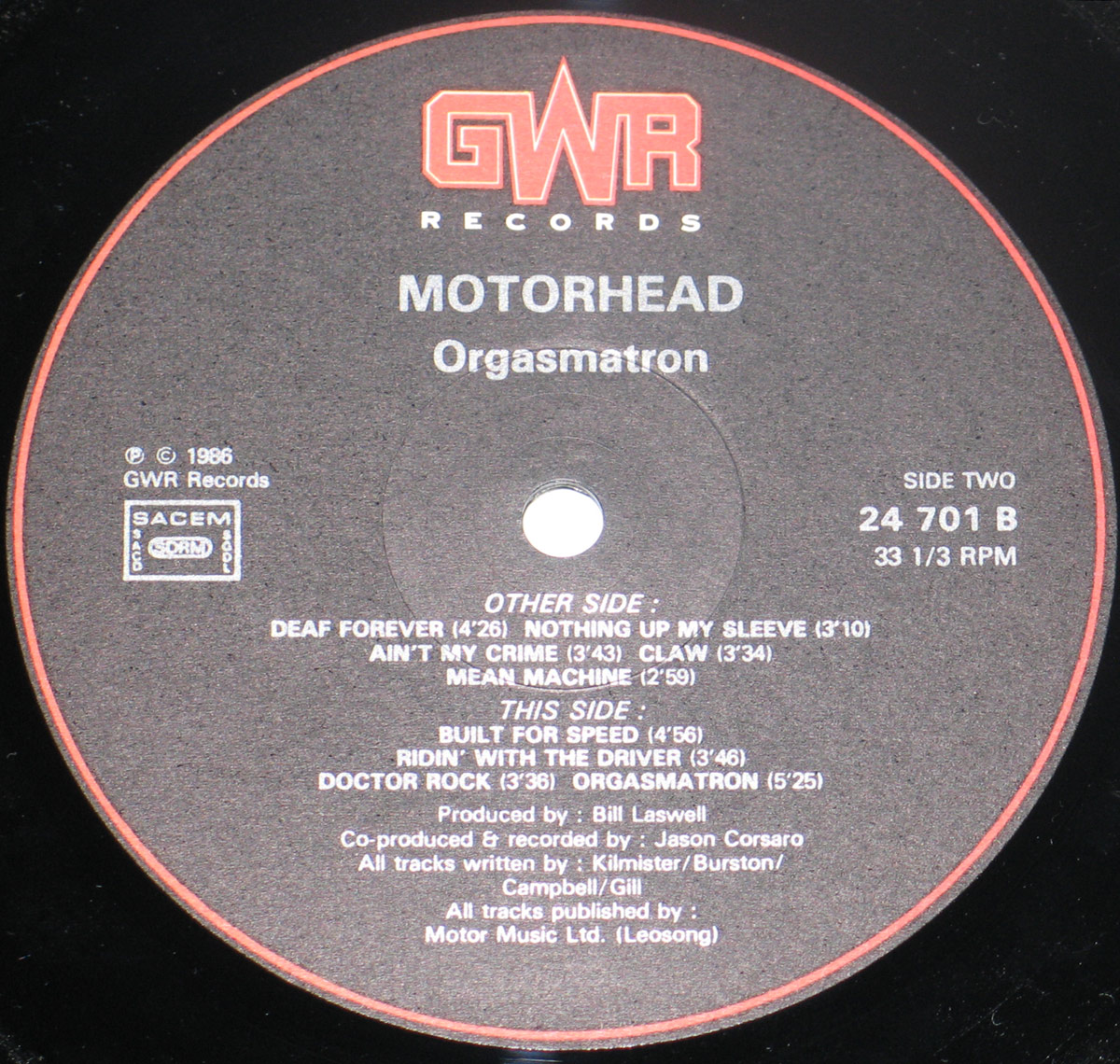
Close up of Side Two record’s label
Close-up of the Side Two record label from Motörhead "Orgasmatron", showing a dark grey GWR Records label on black vinyl. The red GWR logo is at the top, with Motörhead and Orgasmatron printed beneath. Side Two, catalogue number 24 701 B, 33 1/3 RPM, SACEM/SDRM box, track credits, and production details are visible.

This Side Two label from Motörhead’s "Orgasmatron" is the useful one, at last. After the more graphic Side One label, this side actually gives the collector something to chew on: GWR Records at the top in red, “MOTORHEAD” in plain block capitals beneath it, and "Orgasmatron" sitting there without any decorative nonsense. The label is dark grey, almost charcoal, with a red ring near the edge and black vinyl around it catching little scratches and light marks. Not glamorous, no. But readable, and that already puts it ahead of many 1980s labels designed by people who apparently hated eyesight.

The right-hand side carries the business end: SIDE TWO, catalogue number 24 701 B, and 33 1/3 RPM. On the left are the 1986 copyright marks, GWR Records, and the SACEM/SDRM rights box, which nails this firmly into French pressing territory. Around the spindle hole the pressed circular rings show clearly, and the paper texture has that slightly grainy look that never survives in database text. This is exactly why I like label photos. They do not just say what the record is; they show how it was manufactured, printed, handled, and slightly abused by time.

The lower half is packed with the cross-reference that makes the label a small filing cabinet: “Other Side” lists Side One, “This Side” lists Side Two, then come the real names worth noting. Produced by Bill Laswell, co-produced and recorded by Jason Corsaro, all tracks written by Kilmister, Burston, Campbell, and Gill, published by Motor Music Ltd. / Leosong. A bit crowded? Absolutely. The white type gets dense near the bottom and starts behaving like an eye test after two cups of bad coffee. Still, this is the sleeve archaeology I want. Front covers shout. Labels confess.

All images on this site are photographed directly from the original vinyl LP covers and record labels in my collection. Earlier blank sleeves were not archived due to past storage limits, and Side Two labels are often omitted when they contain no collector-relevant details. Photo quality varies because the images were taken over several decades with different cameras. You may use these images for personal or non-commercial purposes if you include a link to this site; commercial use requires my permission. Text on covers and labels has been transcribed using a free online OCR service.

MOTÖRHEAD's 80s Discography: A Thunderous Soundtrack of Heavy Metal and Hard Rock Classics
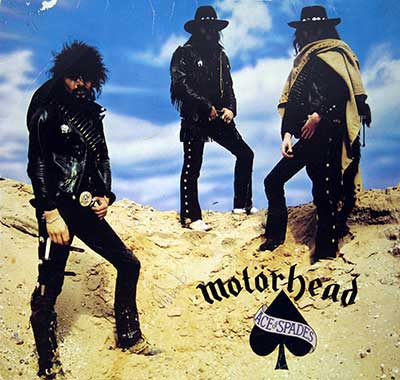
MOTORHEAD - Ace Of Spades album front cover vinyl LP album https://vinyl-records.nl

The 1980 metal detonation that still sounds like bad news

MOTORHEAD - Ace Of Spades

Motörhead's 1980 "Ace Of Spades" did not politely join the NWOBHM rush; it kicked the door in and left boot marks. Fast, filthy and wonderfully unreasonable, it turned the title track into a permanent metal warning sign while proving Lemmy, Eddie and Philthy could make chaos sound almost organised. Almost.

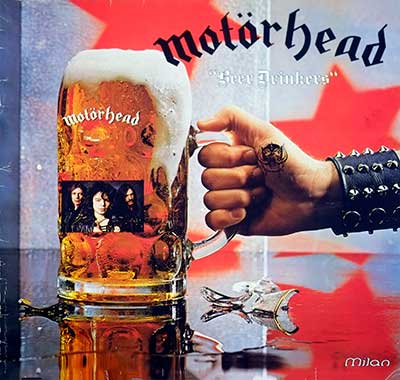
MOTORHEAD - Beer Drinkers

Thumbnail of MOTORHEAD - Beer Drinkers 12" Vinyl LP album front cover

MILAN A 120 174 , 1982 , France

Released under the label Milan, with the catalog number A 120 174, "Beer Drinkers" captures Motorhead's early years and showcases their evolution as a band. The album features a collection of tracks from their 12" EP of the same name, along with other notable songs from their early discography.

Beer Drinkers 12" Vinyl LP

MOTORHEAD - Iron Fist

Thumbnail of MOTORHEAD - Iron Fist 12" Vinyl LP album front cover

Bronze 893.048 , 1982 , France

'Iron Fist' wasn't a departure from Motorhead's established sound; rather, it was a refinement, a distillation of their essence. The album's opener, the title track, is a prime example, a breakneck-paced assault on the senses, Lemmy's gravelly vocals snarling over a maelstrom of distorted guitars

Iron Fist 12" Vinyl LP

MOTORHEAD - No Remorse

Thumbnail of MOTORHEAD - No Remorse 12" Vinyl LP album front cover

Bronze BRSP 6 , 1984 , Canada

In the heart of the grim, Orwellian year of 1984, amidst Cold War tensions and the looming threat of nuclear annihilation, Motörhead unleashed their aptly titled compilation album, "No Remorse". It was a defiant roar in the face of bleakness, a collection of their most ferocious tracks, both old and new

No Remorse 12" Vinyl LP

MOTORHEAD - No Sleep Til' Hammersmith

Thumbnail of MOTORHEAD - No Sleep Til' Hammersmith 12" Vinyl LP album front cover

Bronze 203 801 , 1981 , Germany

Recorded during their "Short, Sharp, Pain in the Neck" tour, the album featured performances from three iconic venues: Leeds Queens Hall, Newcastle City Hall, and, of course, the Hammersmith Odeon in London. The production team, led by Vic Maile, known for his work with artists like Jimi Hendrix, Led Zeppelin,

No Sleep Til' Hammersmith 12" Vinyl LP

MOTORHEAD - On Parole

Thumbnail of MOTORHEAD - On Parole 12" Vinyl LP album front cover

Liberty United Records LBR 1004 , 1976 , England

Recorded at Rockfield Studios in Wales under the watchful eye of producer Dave Edmunds, known for his work with artists like Brinsley Schwarz and Love Sculpture, "On Parole" was a raw, unpolished gem. It captured the band's early sound, a potent blend of blues-infused rock and roll, proto-punk aggression

On Parole 12" Vinyl LP
MOTORHEAD - Orgasmatron album front cover vinyl LP album https://vinyl-records.nl

Snaggletooth goes full locomotive nightmare on this 1986 French GWR slab

MOTORHEAD - Orgasmatron

Released in France on GWR Records 24 701 in 1986, "Orgasmatron" catches Motorhead in a colder, heavier mid-eighties mood. Produced by Bill Laswell with Jason Corsaro, the album drags British heavy metal through dense studio grit, with "Deaf Forever", "Built for Speed" and the title track doing the damage properly.