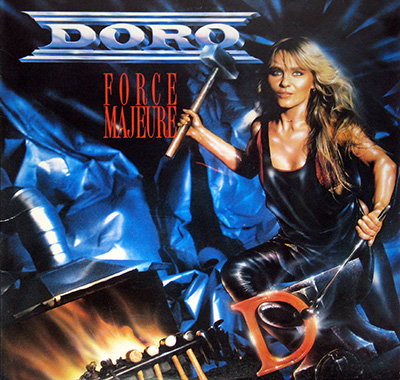
"Force Majeure" (1989) Album Description:
"Force Majeure" arrived at a bad moment and a useful one. Bad, because the old Warlock machinery had already buckled, the name was turning poisonous, and Doro Pesch was suddenly pushing forward without the shelter of the band that made her famous. Useful, because this record gave her a way through the smoke. Released in February 1989 on Vertigo in West Germany, it is less a triumphant solo debut than a hard reset with lipstick, steel and a little American studio gloss rubbed over the bruises.
The first surprise is almost cheeky: she opens with "A Whiter Shade of Pale." Not exactly the move impatient headbangers were waiting for after "Triumph and Agony". That is where the album gets interesting. It keeps wrong-footing you. You expect one thing, it swerves into something shinier, sadder, or meaner, and somewhere between "Mission of Mercy", "Hard Times" and "Under the Gun" you realize this is not Doro politely introducing herself. It is Doro testing how much pressure the new name can take.
The Year Had a Split Personality
West Germany in 1989 still had its old borders, its old nerves, its old feeling that the ground might shift even if the street outside looked perfectly ordinary. Metal felt that split too. One side of the scene was polishing itself for export, chasing bigger choruses, cleaner hooks and MTV-friendly angles. The other side was getting rougher and less patient, with faster drums, harsher guitars and less interest in being liked. "Force Majeure" sits right on that fault line: too polished to be bunker-born Teutonic attack, too stubbornly metallic to pass as harmless hard rock wallpaper.
Where It Sits in the 1989 Metal Crowd
Put it next to Helloween and you hear less fantasy lift, less sugar-rush speed, more street-level punch. Put it next to Sodom or Kreator and it sounds almost luxurious, like somebody wiped the beer off the control desk before the red light went on. It does not have the arena glide of the Scorpions, and it is nowhere near as blunt-force as old Accept at full stampede. If anything, Doro was trying to keep one boot in German heavy metal and the other on the American runway Joey Balin understood very well.
- Helloween were chasing skyward melody and double-bass lift.
- Sodom and Kreator were throwing sparks and broken glass.
- Scorpions had the arena language already locked in.
- Accept were between identities and feeling the strain.
- Doro came in with bite, gloss, and a bruised sense of purpose.
What the Record Actually Feels Like
The sound is broad-shouldered and bright, but not soft. Joey Balin produces it like he wants the choruses to hit clean and the drums to arrive in full boots-and-steel authority. Bobby Rondinelli gives the songs that arena-stomp backbone without turning them into gym music, and Tommy Henriksen helps keep the thing moving from underneath, not just with bass but with the kind of co-writing that stops a record from floating off into pure surface sheen. You can hear the practical intention in every track: make it land, make it memorable, make it loud enough to survive the name change.
Jeff Hendrickson and Dominick Maita keep the mix open enough for the voice to bite. That matters, because Doro does not sing these songs like a guest in a well-furnished room. She shoves at them. Even on the smoother material there is that familiar grain in her delivery, that push from the diaphragm that says she would rather overcommit than sound tasteful. Good. Taste is overrated. Especially in metal.
Why the Songs Pull You In
"Mission of Mercy" moves with a kind of controlled urgency, all forward lean and clenched emotion, while "Hard Times" has the blunt, street-corner hook of a song that knows exactly where to throw its elbow. "Under the Gun" snaps tighter, meaner, like the record briefly remembers the old Warlock appetite for pressure. And then there is "A Whiter Shade of Pale", which should not work on paper and yet makes a strange kind of sense here, because Doro does not treat it like a sacred relic. She drags it into her own weather.
There is a lot of space on this album compared with early Warlock. Not emptiness. Space. The guitars do not always crowd the vocal. The choruses are built to open outward. The tempos breathe more. That was clearly deliberate. Balin had already helped steer "Triumph and Agony" toward a more international hard-metal sound, and here he keeps going, sanding off some of the Keller roughness without bleaching the blood out of it.
Cause, Effect, and the New Band Around Her
The shape of the band explains the shape of the album. By the time this record happened, Doro was no longer working inside the chemistry that made the earlier Warlock albums snarl the way they did. The old lineup had splintered, the legal fight over the Warlock name had narrowed the road, and what came in was a more American-leaning cast of players. That is not trivia; that is the reason the album sounds like it does. Less gang mentality, more precision. Less Düsseldorf cellar air, more polished studio light. Same singer, different pressure.
Mick Rock's cover photography helps sell that transition without saying a word. He knew how to frame a face so it looked both staged and dangerous, which is exactly the sort of half-glam, half-combat mood this record lives on. Geoffrey Gillespie's design keeps the package direct and legible, but the real job is done by the image: Doro staring out like she knows the argument is still going and has decided not to blink first.
No Real Scandal, Just Confusion and Wrong Expectations
The album did not kick up some grand public controversy. The bigger issue was misunderstanding. People still talk as if Doro calmly walked away from Warlock to launch a neat solo career with fresh creative freedom and a nice label-approved smile. That is the clean fairy tale. The messier truth is that the Warlock name had become a legal problem, the record company did not want to gamble on another new band identity, and "Doro" became the workable answer. That is why some listeners heard "Force Majeure" as a debut, while others heard it as the last Warlock album wearing civilian clothes.
The other common complaint was simpler and more human: some fans wanted another "Triumph and Agony" and got something sleeker, more radio-minded, more hard-rock-shaped. Fair enough. But that is not a defect so much as the sound of circumstances getting into the grooves.
One Quiet Everyday Picture
I can still picture this kind of record coming on late at night when the room is half-dark, the radio louder than it should be, and that opening cover makes you lift your head because you are not quite sure whether it is brave or ridiculous. Then Doro leans into the next songs and the doubt starts backing out of the room.
What Makes It Worth Staying With
"Force Majeure" is not a pure Teutonic metal blitz and it is not a surrender either. It is a transition album with its jaw set. You hear a singer refusing to vanish, a producer trying to turn upheaval into shape, and a band built for the job rather than the myth. Some of it is polished enough to irritate purists. Fine. Purists are often wrong in the most boring way possible.
What matters is that the record carries tension instead of hiding it. The name has changed. The room has changed. The personnel has changed. But the voice still comes in like a warning light. That is enough to make "Force Majeure" feel alive, and alive beats flawless every time.