Woodstock Music from the original soundtrack USA 180g SD3-500 Vinyl 3LP Album

A Timeless Collection of Legendary Performances from the 1969 Woodstock Festival – Capturing the Spirit of a Generation on Vinyl

The biggest musical event in music history captured on 3 records. With historical performances of Richie havens, Joe Cocker, Santana, Ten Years After, Jimi Hendrix and many many others. This web-page has hi-res photos of the album covers, record label and a detailed description.

"Woodstock: Music from the Original Soundtrack and More" (1970) Album Description:

This is the record where a whole generation’s messy dream got pressed into something you can actually hold. “Woodstock: Music from the Original Soundtrack and More” isn’t just a soundtrack — it’s a three-LP time capsule that still smells faintly of wet grass, patchouli, and optimism that hasn’t been fact-checked yet.

Introduction on the band and the album

Calling this a “band” album feels wrong, because the real “band” here is the crowd, the mud, and the sheer audacity of putting so many legendary names on one gatefold and saying: yeah, this happened. It’s Various Artists, but it plays like one long, chaotic statement: folk, blues, rock, and acid-psych energy sharing the same sky.

This USA edition (Cotillion SD 3-500) is the classic triple-vinyl way to experience it: not tidy, not polite, and definitely not designed for background listening while you answer emails like a functioning adult.

Historical and cultural context

Woodstock was staged in Bethel, New York in August 1969, and it landed right in the pressure cooker of late-’60s counterculture — where music wasn’t “content,” it was a banner people marched under. By 1970, the aftershock was still ringing, and turning the festival into a film and a triple LP made the moment portable.

The story isn’t “perfect performances,” it’s “a public mood.” You can hear a society trying to sing itself into something better, even when the weather (and reality) refuses to cooperate.

How the band came to record this album

This set exists because Woodstock didn’t just happen on a stage — it happened as an event that begged to be captured, replayed, and argued about. The album was built from recordings of key performers, and it keeps the festival “there” by letting stage moments and crowd atmosphere leak into the music instead of scrubbing it clean.

Someone had to wrangle that live chaos into an actual listenable sequence, and that’s where producer Eric Blackstead enters the story: less “studio wizard,” more “sonic ringmaster trying not to get trampled.”

The sound, songs, and musical direction

The sound here is not glossy — it’s human. It moves from intimate folk confession to full-tilt rock catharsis, and it never pretends Woodstock was a calm, controlled environment (because lol, no).

Richie Havens’ “Freedom” hits like a door being kicked open: urgent, improvised, and weirdly timeless. Joe Cocker’s “With a Little Help from My Friends” is the kind of communal sing-along that makes you believe strangers won’t ruin everything, at least for seven minutes.

Santana’s “Soul Sacrifice” and Ten Years After’s “I’m Going Home” bring the sweat and the “how are their fingers still attached?” energy, while Jefferson Airplane’s “Volunteers” throws the political voltage right back into the crowd. Then Hendrix closes the set with a run that feels like history being bent in real time — and the needle doesn’t even flinch.

Comparison to other albums in the same genre/year

1970 had no shortage of live albums trying to prove rock wasn’t just a studio trick. What makes Woodstock different is that it’s not a single band flexing — it’s a whole scene documented mid-explosion.

  • The Who’s “Live at Leeds” is a razor-tight band-as-weapon document; Woodstock is the entire battlefield with the smoke still in the air.
  • The Rolling Stones’ “Get Yer Ya-Ya’s Out!” is arena swagger before arenas became malls; Woodstock is a hillside city that wasn’t supposed to exist.
  • Hendrix’s “Band of Gypsys” is focused, rhythmic reinvention; Woodstock gives you Hendrix as a cultural weather event.
Controversies or public reactions

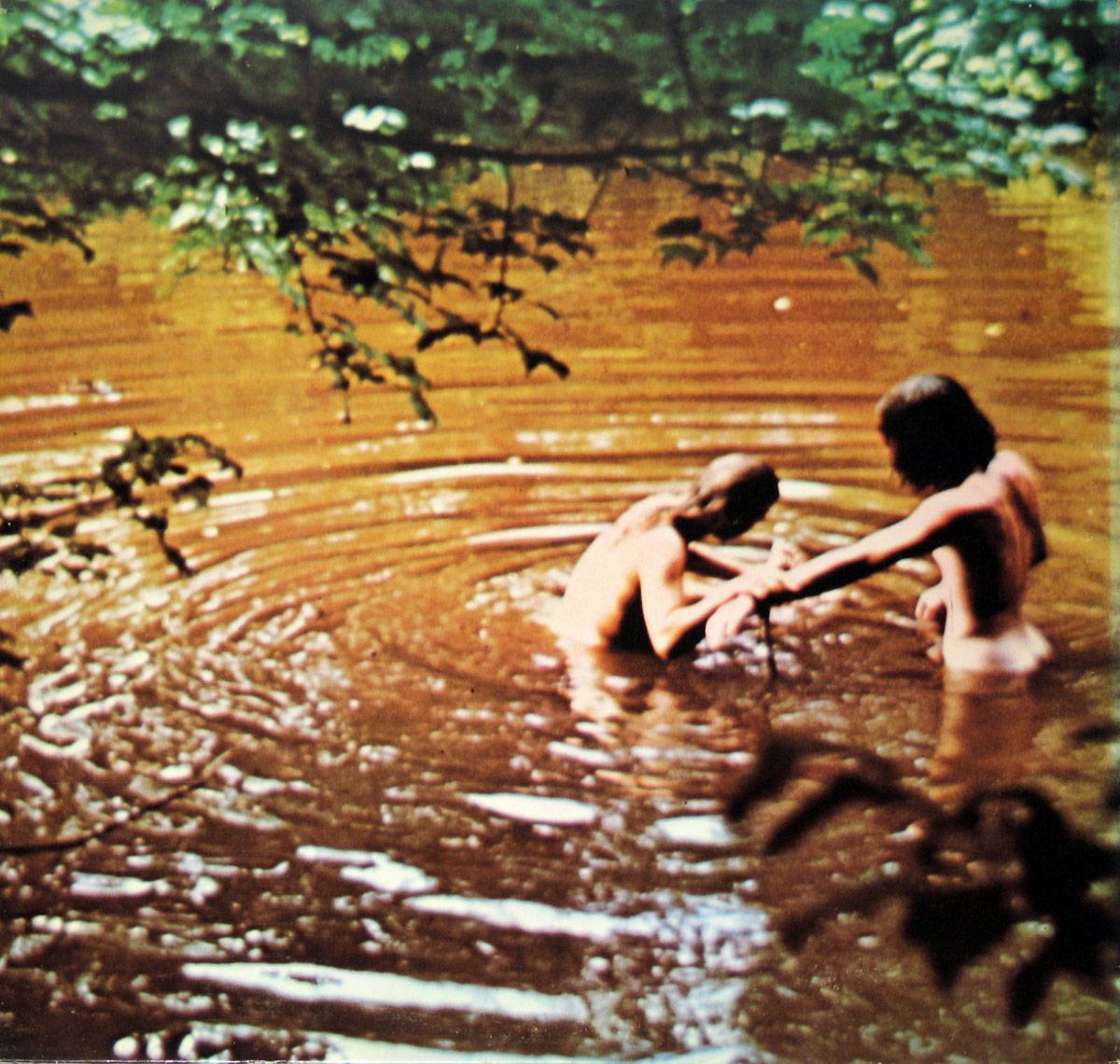
Woodstock always came with arguments attached: too big, too chaotic, too idealistic, too everything. The album leans into that “unfiltered” vibe, even visually — the inner sleeve imagery on this edition is openly nude and nature-soaked, which was very on-brand for the era and very pearl-clutchy for anyone allergic to freedom.

Musically, the set also risks honesty: it keeps the live atmosphere, the announcements, the sense that things are happening whether you’re ready or not. Some people hear that as magic; others hear it as “can we please get to the song,” and both reactions are basically the Woodstock debate in miniature.

Band dynamics and creative tensions

The “tension” here isn’t bandmates fighting over chorus harmonies — it’s the collision of styles and egos sharing one cultural stage. Folk sincerity sits next to full-blast rock theater, funk shakes hands with blues, and somehow nobody calls a meeting about “brand consistency.”

And because this is a curated document, the biggest creative choice is selection: what gets immortalized, what becomes a footnote, and how the narrative of Woodstock gets told through the tracks that made the cut.

Critical reception and legacy

The album’s staying power is the point. It became a shorthand for the festival’s “three days” mythos, and it’s still one of the most recognizable ways people experience Woodstock without needing a time machine and a tetanus shot.

Decades later, the Recording Academy put it in the Grammy Hall of Fame, which is basically the establishment admitting: fine, the kids were onto something, and yes, we’re still talking about it.

Reflective closing paragraph

When I drop the needle on this one, I don’t just hear famous songs — I hear a crowd trying to invent a better world in real time, with guitars as the argument and harmonies as the handshake. It’s imperfect, loud, and stubbornly alive, and that’s exactly why it still works.

Collector’s Note: Dad’s “Hands Off” Woodstock Rule

On the release of this album, my dad bought this album and told all of us, that this album was his and that we shouldn't abuse it.

Since then we relocated several times and don't recall what happened to it.

Music Genre:

  American Acid Psyck Rock 60s 

Album Production Information:

  The album: "Woodstock 69" was produced by: Eric Blackstead

Record Label & Catalognr:

  Cotillion SD 3-500

Media Format:

  3x 12" Vinyl Stereo Full-Length Long-Play  Gramophone Record
3x 180 grams vinyl
Album weight: 820 gram  

Year & Country:

Release date: 1970

Release country: Made in USA

Complete Track-listing of the album "Woodstock 69 Original Movie Soundtrack 3LP"

Side One

  • John B. Sebastian - I Had a Dream

    John Sebastian performed an impromptu acoustic set, including this dreamy folk song that captured the spirit of the festival.

  • Canned Heat - Going Up The Country

    Canned HeatÕs performance of this bluesy anthem became one of the defining sounds of Woodstock.

  • Richie Havens - Freedom

    Richie Havens opened Woodstock with a powerful, improvised rendition of "Freedom," setting the tone for the festival.

  • Country Joe & The Fish - Rock & Soul Music

    The band's electrifying mix of psychedelic rock and political themes energized the crowd.

  • Arlo Guthrie - Coming into Los Angeles

    Arlo GuthrieÕs performance of this folk tune, despite being slightly disoriented on stage, remains a classic Woodstock moment.

  • Sha-Na-Na - At the Hop

    The doo-wop revival group brought a nostalgic twist to Woodstock with their energetic rendition of this 1950s classic.

Side Two

  • Country Joe McDonald - The "Fish" Cheer

    Country Joe got the crowd roaring with his famous anti-war chant and song, becoming a key moment in Woodstock history.

  • Joan Baez - Drug Store Truck Drivin' Man

    Joan Baez delivered a stirring performance of this protest song, dedicated to her then-imprisoned husband.

  • Joan Baez - Joe Hill

    Her haunting rendition of this classic labor ballad captivated the audience.

  • Crosby, Stills & Nash - Suite: Judy Blue Eyes

    In only their second live performance, CSN wowed the crowd with their intricate harmonies.

  • Crosby, Stills, Nash & Young - Sea of Madness

    Neil Young joined in for this high-energy track, showcasing the band's evolving sound.

Side Three

  • Crosby, Stills, Nash & Young - Wooden Ships

    A mesmerizing performance of this countercultural anthem.

  • The Who - We're Not Gonna Take It (from "Tommy")

    The Who delivered a legendary set, including this track from their rock opera.

  • Joe Cocker - With a Little Help from My Friends

    Joe CockerÕs soulful rendition of this Beatles song became one of WoodstockÕs most iconic moments.

Side Four

Side Five

  • Jefferson Airplane - Volunteers

    The bandÕs psychedelic rock energized the crowd on Sunday morning.

  • Max Yasgur

    WoodstockÕs host and farm owner gave an inspiring speech to the massive crowd.

  • Sly & The Family Stone

    Funk legends Sly & The Family Stone had the audience dancing all night with these three groovy tracks.

    • Dance to the Music
    • Music Lover
    • I Want to Take You Higher
  • John B. Sebastian - Rainbows All Over Your Blues

    Another relaxed, soulful folk tune from Sebastian's impromptu set.

Side Six

  • Butterfield Blues Band - Love March

    A blues-fueled performance with soulful harmonica and brass.

  • Jimi Hendrix - Star Spangled Banner

    Jimi HendrixÕs groundbreaking, feedback-laden take on the national anthem remains one of rockÕs most powerful statements.

  • Jimi Hendrix - Purple Haze & Instrumental Solo

    Hendrix closed Woodstock with his signature song and an improvisational solo.

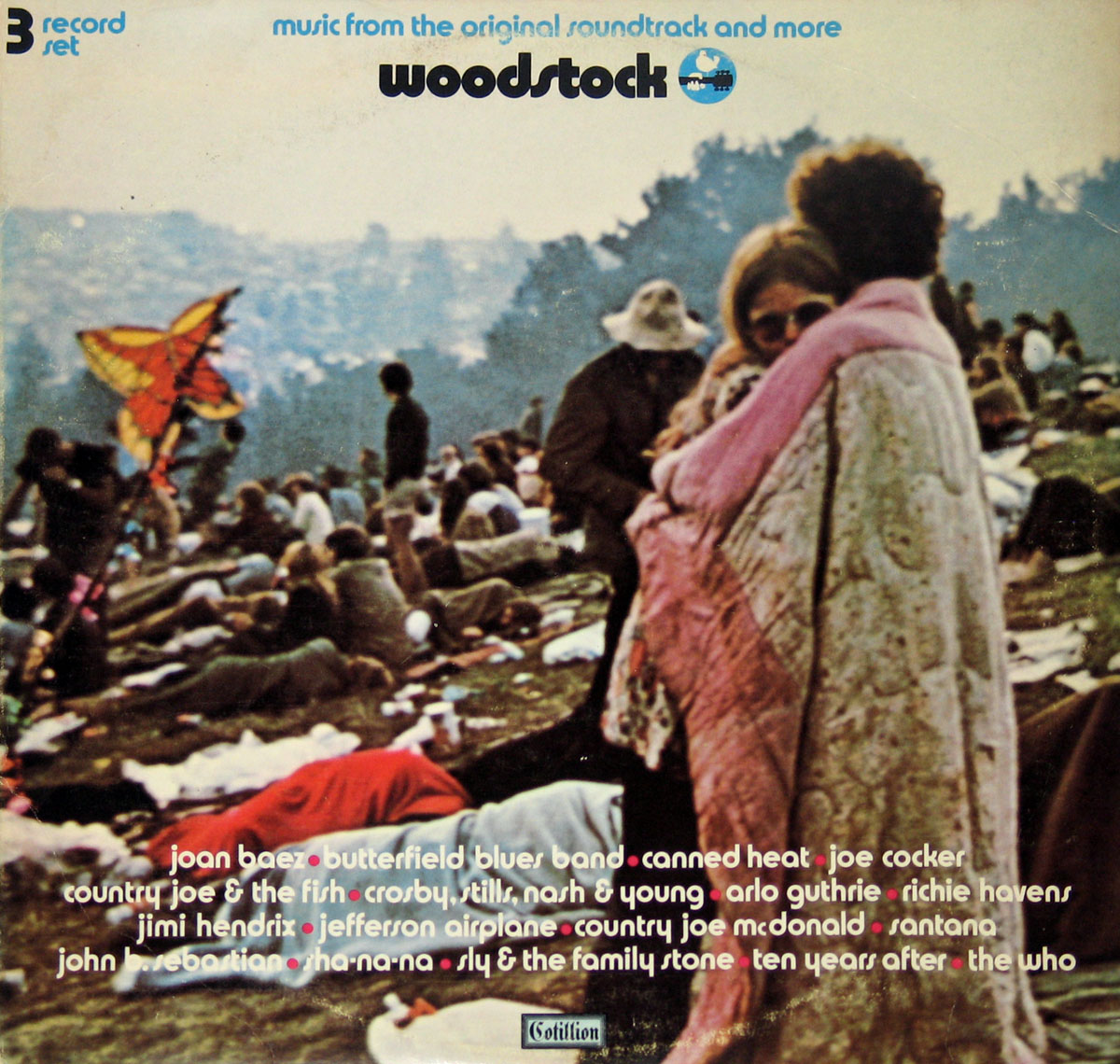
Photo of "Woodstock 69" Album's Front Cover 
Front cover of Woodstock Music from the Original Soundtrack USA, featuring a young couple wrapped in a quilt with a festival crowd in the background.

The front cover of the USA release of Woodstock: Music from the Original Soundtrack and More (3LP) captures an iconic scene from the legendary 1969 festival. A young couple stands in the foreground, wrapped together in a thick, earth-toned quilt with a pinkish floral design. The woman, wearing round sunglasses, rests her head against her partnerÕs shoulder, while her partner, with curly brown hair, faces away from the camera. Their embrace conveys warmth and intimacy, symbolizing the spirit of unity that defined the Woodstock experience.

In the background, a sprawling crowd of festival attendees covers the grassy hillside, lounging on blankets, sitting in small groups, or walking amongst one another. Some individuals wear colorful, loose-fitting clothing, characteristic of the late 1960s counterculture. A man with a wide-brimmed hat and a long coat walks through the scene, while another figure, dressed in dark clothing, stands slightly further back, gazing into the distance.

To the left, a vibrant kite with an intricate red and yellow pattern flutters in the breeze, adding an element of movement and playfulness to the composition. The hazy sky and the distant treetops in the background frame the festival setting, emphasizing the sheer scale of the event.

The album title, "Woodstock: Music from the Original Soundtrack and More," appears in bold, black and blue typography at the top, featuring the recognizable Woodstock dove-and-guitar logo. The bottom section of the cover lists the performing artists in white text, separated by small pink dots, including Joan Baez, Jimi Hendrix, The Who, Santana, Jefferson Airplane, Crosby, Stills, Nash & Young, and many more. The Cotillion Records logo is positioned in the lower center, indicating the label under which this edition was released.

This cover image encapsulates the essence of WoodstockÑmusic, love, and togethernessÑimmortalizing one of the most influential cultural moments of the 20th century.

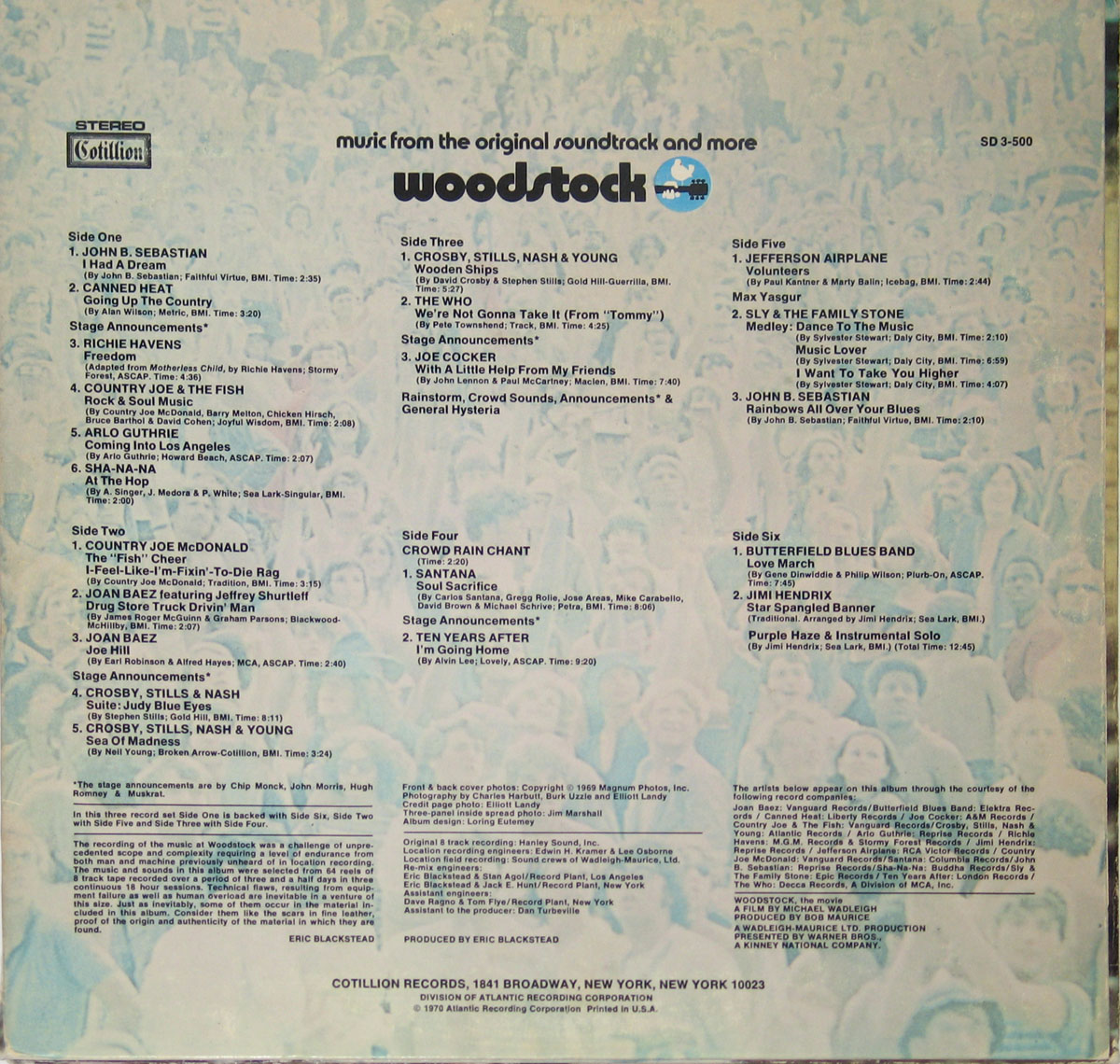
Photo of "Woodstock 69" Album's Back Cover  
Back cover of Woodstock Music from the Original Soundtrack USA, displaying track listings, credits, and production details on a blue-toned background with faded images of festival attendees.

The back cover of the USA release of Woodstock: Music from the Original Soundtrack and More (3LP) prominently presents the track listing and album details. The design features a soft, blue-tinted background with faded images of the Woodstock festival crowd, creating a subtle yet immersive representation of the event's scale and atmosphere.

The album title, "Woodstock: Music from the Original Soundtrack and More," appears in bold black and blue typography at the top center, with the recognizable Woodstock dove-and-guitar logo adjacent to it. Below, the six sides of the triple LP set are neatly organized in two columns, each detailing the song titles, artists, songwriters, and track durations.

The left column lists the songs from Sides One, Two, and Three, featuring performances by John B. Sebastian, Richie Havens, Country Joe McDonald, Crosby, Stills & Nash, The Who, and Joe Cocker. Stage announcements and ambient festival sounds are also included, enhancing the live experience captured in the recordings.

The right column covers Sides Four, Five, and Six, highlighting performances by Santana, Ten Years After, Jefferson Airplane, Sly & The Family Stone, Butterfield Blues Band, and Jimi Hendrix. HendrixÕs iconic rendition of "The Star-Spangled Banner" and "Purple Haze" conclude the album, reflecting one of the most legendary moments of the festival.

At the bottom, production credits acknowledge Eric Blackstead as the albumÕs producer, with photography credits for the front and back cover images. Additional text includes copyright details, a note on the recording process, and acknowledgments to various record labels and management teams who contributed to the albumÕs creation.

The Cotillion Records logo and the Atlantic Recording CorporationÕs address at "1841 Broadway, New York, New York 10023" are prominently displayed, reinforcing the albumÕs official release information. This back cover serves as both a comprehensive guide to the albumÕs contents and a historical artifact that captures the essence of the 1969 Woodstock festival.

Photo of "Woodstock 69" Album's Inner Cover  
Inside sleeve photo of Woodstock Music from the Original Soundtrack USA, showing two nude individuals bathing in a pond surrounded by lush green foliage, with ripples forming on the waterÕs surface.

The inside sleeve of the USA release of Woodstock: Music from the Original Soundtrack and More (3LP) features a striking and intimate photograph that captures the essence of the festivalÕs free-spirited and naturalistic atmosphere. The image depicts two nude individuals immersed in a calm pond, engaging in what appears to be a moment of shared connection. One individual extends their arms to assist the other, who is adjusting or washing something in the water.

The earthy brown hues of the water contrast with the lush green foliage that overhangs the scene, framing the image with natural branches and leaves. Sunlight filters through the canopy above, casting dappled reflections on the waterÕs surface, where gentle ripples radiate outward from the individuals' movements.

This evocative photograph aligns with the countercultural ideals of WoodstockÑfreedom, unity with nature, and communal living. Its placement within the albumÕs inner sleeve serves as a visual extension of the festivalÕs ethos, reinforcing the themes of peace, harmony, and an unfiltered connection to the natural world.

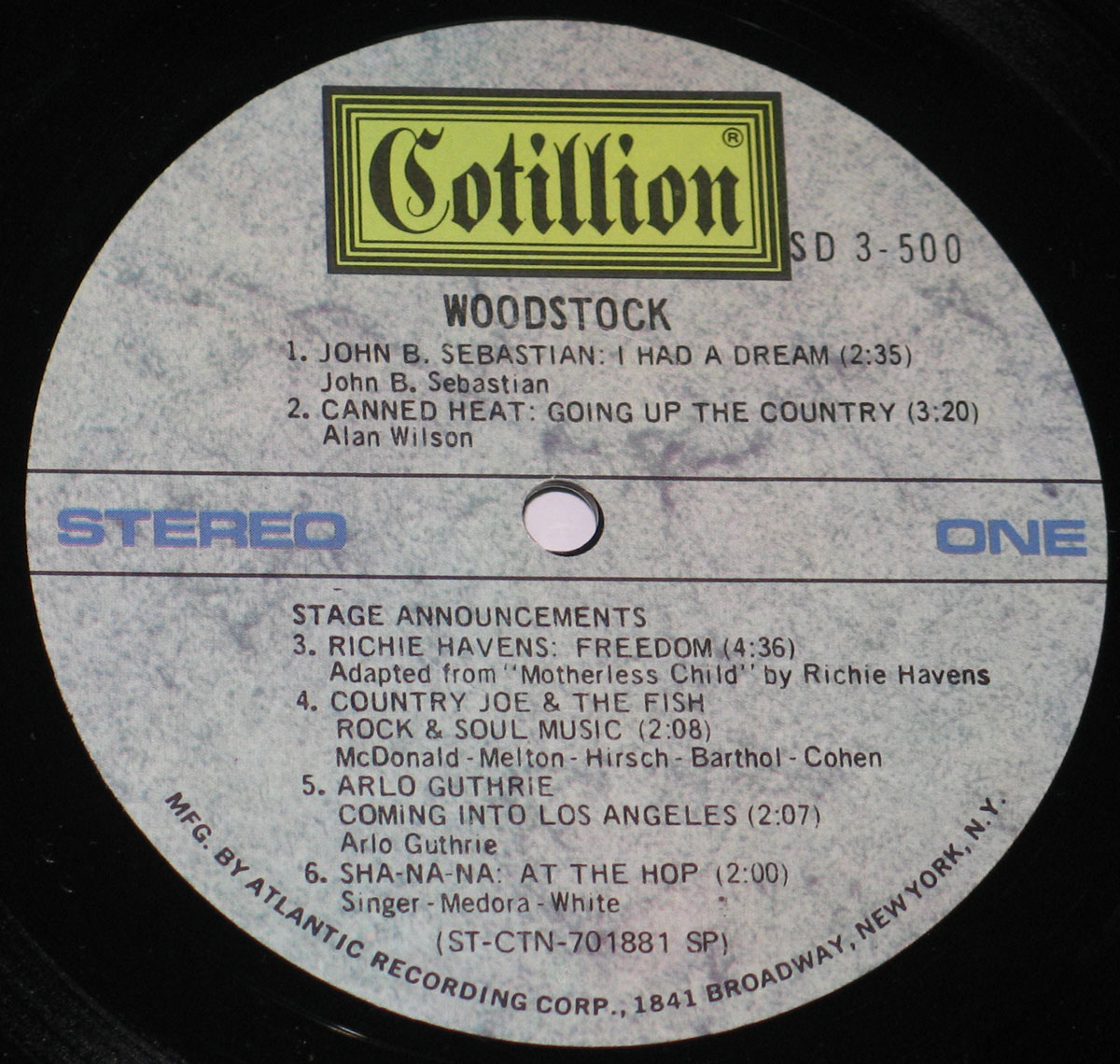
Close-up Photo of "Woodstock 69" Record Label 
Close-up of Woodstock Music from the Original Soundtrack USA, Side 1 record label, featuring the Cotillion logo, tracklist, and Atlantic Recording Corp. details.

This close-up photograph captures the record label of Side 1 from the USA release of Woodstock: Music from the Original Soundtrack and More, issued by Cotillion Records under Atlantic Recording Corporation. The label has a distinctive marbled gray background with black text, divided by a bold horizontal black line. The upper section prominently features the Cotillion logo in a lime green box with black text, placed near the top center of the label.

Below the logo, "WOODSTOCK" is printed in bold uppercase letters, followed by the tracklisting for Side 1. The songs are listed numerically, starting with John B. SebastianÕs "I Had a Dream," followed by Canned HeatÕs "Going Up the Country." Stage announcements are also included in the listing, reinforcing the albumÕs live festival atmosphere. The next tracks feature Richie HavensÕ "Freedom," Country Joe & the FishÕs "Rock & Soul Music," Arlo GuthrieÕs "Coming Into Los Angeles," and Sha-Na-NaÕs "At the Hop."

The label also contains various text elements such as songwriting credits beneath each track title. The word "STEREO" appears in blue, aligned to the left, while "ONE" is printed in the same blue color on the right side, indicating the first side of the album. Below the tracklist, a smaller text line displays the catalog number (ST-CTN-701881 SP).

The lower edge of the label features the copyright notice "MFG. BY ATLANTIC RECORDING CORP., 1841 BROADWAY, NEW YORK, N.Y.," marking the official manufacturing location. The labelÕs design reflects a classic 1970s vinyl aesthetic, with a minimal yet effective layout for easy readability.