Aphrodite's Child - 666 12" Vinyl LP Album

- A seminal 1972 double LP marking the culmination of the Greek prog rock band’s artistic journey

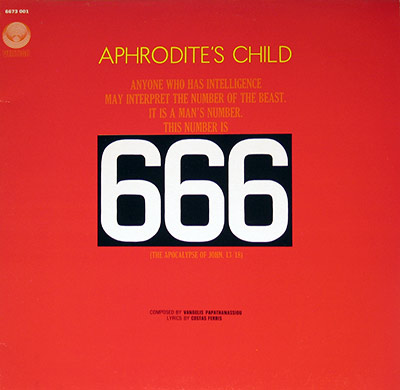
Album Front Cover Photo of Aphrodite's Child - 666 Visit: https://vinyl-records.nl/

Aphrodite's Child's "666" stands as a seminal 1972 double LP, marking the culmination of the Greek prog rock band's artistic journey. With Vangelis and Demis Roussos at the helm, this avant-garde masterpiece blends progressive rock with eclectic influences. Its release within the context of the time showcases the band's experimental spirit and enduring impact on the music scene, making "666" a production that transcends its era.

Table of Contents

"666" (1972) Album Description:

Introduction

"666" is the moment Aphrodite's Child stopped trying to be “a band with hits” and decided to stage the apocalypse on vinyl instead. It’s a 1972 double LP that sounds like progressive rock, acid-psych, and theatre panic all trying to fit through the same door at once. The wild part is: it’s not messy because they were sloppy, it’s messy because they were brave.

Historical and cultural context

Early 1970s Europe was deep in the era of big statements: concept albums, rock operas, longer songs, louder ideas, and a general belief that music could carry a whole worldview if you pressed it hard enough. Prog and psych were stretching past “cool riffs” into “full-on experiences,” and "666" lands right in that fever dream lane. It’s the kind of record that makes sense when the world feels tense and the art gets… ambitious in self-defense.

How the band came to record this album

This is their final album, and you can feel that “last chapter” energy in every groove: big swings, no safety nets, and zero interest in playing it polite. Vangelis Papathanassiou steers the whole thing as composer/arranger/producer, with lyrics credited to Costas Ferris, and it was recorded at Europasonor Studios with engineer Roger Roche. The sleeve says Vertigo, the pressing says Made in France, and the music says “we’re going to see how far this can go.”

The sound, songs, and musical direction

Sonically, "666" is a collage with a pulse: choirs, narration, sudden tempo turns, and a constant sense that something is about to break loose. Tracks like "The System" and "Babylon" kick the door open with that psych/prog bite, while "The Four Horsemen" rides in on drama, tension, and that “end-times theatre” vibe that prog did so well when it wasn’t busy polishing its own cape. Then it goes bigger: "All The Seats Were Occupied" feels like a long, strange trip through scenes and fragments, and "Break" closes like a final exhale after the storm.

Comparison to other albums in the same genre/year

If you line it up next to the big concept-wave records of the era, "666" doesn’t try to be “tidy” or “radio-friendly,” and that’s kind of the point. Where other prog albums can feel like perfectly aligned museum glass, this one feels like a ritual you accidentally walked into. It’s closer to a cinematic trip than a standard rock album: scenes, voices, mood shifts, and that constant push toward something huge and unsettling.

Controversies or public reactions

This album has always been the type to start arguments at the record shop counter: the biblical apocalypse theme alone was enough to make some people clutch their pearls. On top of that, parts of the record were considered provocative, and its uncommercial, experimental approach didn’t exactly scream “easy listen,” which helped fuel delays and confusion around it. Some called it offensive, some called it genius, and plenty of people probably just turned it louder and let the neighbors deal with it.

Band dynamics and creative tensions

You can hear the band pulling in different directions: pop instincts, prog ambition, and avant-garde weirdness all sharing the same living room. Demis Roussos brings that unmistakable vocal presence, Silver Koulouris adds bite and color on guitar, and Lucas Sideras keeps it grounded when the arrangements start levitating. It doesn’t sound like compromise; it sounds like a creative argument that accidentally became art.

Critical reception and legacy

"666" didn’t arrive as an instant crowd-pleaser, but it aged into something people keep coming back to when they want prog with real teeth and real weirdness. Over time it’s become a cult classic, praised for its ambition, atmosphere, and the way it blends rock muscle with cinematic storytelling. Decades later, it still feels like a double LP that dares you to listen all the way through without checking your phone… which is basically my favorite kind of challenge.
Album Key Details: Genre, Label, Format & Release Info

Music Genre:

Psych, Acid, Prog Rock

Label & Catalognr:

Vertigo – Cat#: 6333 500 (6333500)

Album Packaging

Gatefold/FOC (Fold Open Cover) album cover design, complete lyrics of all songs printed on the back cover.

Media Format:

Record Format: 12" Double LP

Year & Country:

1972 – Made in France

Production & Recording Information:

Producers:
  • Vangelis Papathanassiou – Composer, Keyboardist, Producer Vangelis Papathanassiou is one of those artists I never file under just “musician.” I first knew him through Aphrodite’s Child (1967–1972), where his keyboards turned psychedelic rock into something cinematic and restless. After the band years, his solo work pushed fully into electronic and orchestral worlds, always sounding like it came from five minutes in the future.
Sound & Recording Engineers:
  • Roger Roche – Recording Engineer On 666, Roger Roche had the unenviable task of keeping an extremely ambitious, sometimes chaotic production grounded enough to make it onto tape. Recording at Europasonor Studios, he captured everything from whispered passages to full-blown apocalyptic crescendos, balancing dynamics, space, and clarity without sanding off the album’s rough edges. The result feels raw but controlled, which is exactly what this record needed.
Recording Location:

Europasonor Studios

Composition & Lyrics:
  • Vangelis Papathanassiou – Music (composition & arrangements)
  • Costas Ferris – Lyrics Costas Ferris provided the lyrical backbone of 666, shaping its biblical and apocalyptic themes into something theatrical rather than preachy. His words give the album its narrative spine, moving between symbolism, provocation, and poetic abstraction, and they work hand-in-hand with the music to turn the record into a continuous dramatic experience rather than a collection of separate songs.

Band Members / Musicians:

Band Line-up:
  • Demis Roussos – Vocals Demis Roussos is the kind of vocalist who can sound tender and ominous in the same breath. On 666 he delivers the lead vocals on key tracks like “Babylon” and “The Four Horsemen”, but he’s not just “the singer” here—his bass and guitar work helps keep the album’s end-times theatre anchored to actual rock momentum.
  • Silver Koulouris – Guitars Silver Koulouris is the guy who brings the bite when the concept starts getting cosmic. On 666 his guitar is the sharp edge in the mix—big solos, wah drama, and that gritty, human “string and sweat” counterweight to all the keyboards and narration. He’s the reason the album still rocks even when it’s busy summoning Revelation.
  • Vangelis Papathanassiou – Composer, Keyboardist, Producer Vangelis Papathanassiou is one of those artists I never file under just “musician.” I first knew him through Aphrodite’s Child (1967–1972), where his keyboards turned psychedelic rock into something cinematic and restless. After the band years, his solo work pushed fully into electronic and orchestral worlds, always sounding like it came from five minutes in the future.
  • Lucas Sideras – Drums Lucas Sideras doesn’t just “play drums” on this record—he herds it. On 666 his drumming swings from tight rock drive to tom-heavy, almost tribal momentum, keeping the album’s many scenes from floating away. He also steps into the spotlight vocally on parts of the album, adding a rougher, more grounded tone when the story needs muscle.
Guests:
  • Irene Papas – Guest Vocals / Spoken Voice Irene Papas shows up with the kind of presence that makes a studio feel smaller. On 666 her vocal performance on “∞” is the infamous lightning strike: raw, provocative, and impossible to ignore, turning the album’s apocalypse concept into something physical and unsettling. Love it or panic-skip it, it’s a defining moment of the record.
  • John Forst – Guest Musician John Forst is the voice that threads the album’s “apocalypse broadcast” together. On 666 his narration appears across multiple tracks, giving the record its cinematic spine and that eerie, storybook authority that makes the concept feel like a staged event instead of a loose playlist. He’s basically the calm narrator while the music sets the sky on fire.
  • Yannis Tsarouchis – Guest Contributor Yannis Tsarouchis is better known as a major Greek painter and set designer, which makes his cameo here feel wonderfully “art-world meets prog-rock.” On 666 he delivers Greek narration on “Ofis”, adding a different texture and weight to the album’s language and drama. It’s a small part, but it deepens the ritual vibe instantly.
  • Michel Ripoche – Guest Musician Michel Ripoche is one of those guest players who quietly changes the color of the whole room. On 666 he adds brass and sax textures (notably on tracks like “Babylon” and “Hic et Nunc”), giving the arrangements that jazzy edge that prog loved when it wanted to sound dangerous. His parts make the album feel less “rock band” and more “full production.”
  • Harris Halkitis – Guest Musician Harris Halkitis is the behind-the-scenes power boost that helps 666 feel so packed and alive. On this album he contributes extra low-end and color—bass, tenor sax, congas, percussion, and backing vocals—slipping jazz and groove into the concept without breaking the spell. He’s part of why the record can jump from rock theatre to funk-ish swagger and still feel cohesive.

Complete Track-listing:

Tracklisting Side One:
  1. The System
  2. Babylon
  3. Loud, Loud, Loud
  4. The Four Horsemen
  5. The Lamb
  6. The Seventh Seal
Tracklisting Side Two:
  1. Aegian Sea
  2. Seven Bowls
  3. The Wakening Beast
  4. Lament
  5. The Marching Beast
  6. The Battle of the Locusts
  7. Do It
  8. Tribulation
  9. The Beast
  10. Ofis
Tracklisting Side Three:
  1. Seven Trumpets
  2. Altamont
  3. The Wedding of the Lamb
  4. The Capture of the Beast
  5. ∞ (Infinity)
  6. Hic et Nunc
Tracklisting Side Four:
  1. All The Seats Were Occupied
  2. Break

Irene Papas on "666": the guest voice that turns the concept into a scene

The one moment that changes the temperature of the room

On "666", Irene Papas doesn’t “guest” in the polite, backing-vocals sense. She arrives like a spotlight you didn’t ask for and suddenly the whole album feels less like a prog concept and more like a staged event. Her appearance on "∞" is short on notes, long on impact, and it’s one of the main reasons this record still gets talked about like a rumor.

What she actually does on the record

"∞" is built around Papas chanting the line “I was, I am, I am to come” over sparse percussion, pushing it further and further until it becomes physical—breath, urgency, and a kind of ecstatic frenzy. This isn’t decorative; it’s the album’s “human nerve,” the moment the Apocalypse theme stops being literature and starts being sensation. Even if you’re here for the guitars and organ, you can’t pretend this track is just background atmosphere.

Why it caused reactions instead of polite applause

The controversy wasn’t complicated: the performance sounded sexual to a lot of ears, and in the early ’70s that was enough to get people clutching their record sleeves like they’d been handed contraband. Some listeners heard art, some heard scandal, and some heard the world’s least relaxing “test track” for

The creative choice behind it

What I love (in that dry, collector way) is that this wasn’t a random stunt; it was a deliberate dramatic tool. Sources around the album describe how an earlier idea involved a more “formal” narrated contrast, but Papas’ improvisation made a stronger impression and stuck—because it sounds like real life barging into a concept record. When prog gets too clean, it becomes wallpaper; Papas is the part that tears the wallpaper off.

The archivist’s footnote: edits, versions, and why collectors care

There’s also the practical, collector-relevant wrinkle: accounts of the album’s release history mention that the "∞" performance existed in a longer form and that edits were involved before it landed on the released album. That means different editions can carry slightly different “weight” in how that moment hits—either as a quick shock or as a more drawn-out descent. If you’ve ever compared pressings with the same seriousness people reserve for wine tastings, yeah, this is one of those spots.

How I file it on my shelf

Irene Papas’ role on "666" is basically this: she turns the album from ambitious into unforgettable. You can argue about taste, you can argue about provocation, but you can’t argue it away—because once you’ve heard it, your brain remembers exactly where that track sits. And that, annoyingly, is what “legend” sounds like when it’s pressed into vinyl instead of printed in a review.

Video: Aphrodite's Child - ∞ (Infinity) (NSFW)

Disclaimer: Track durations shown are approximate and may vary slightly between different country editions or reissues. Variations can result from alternate masterings, pressing plant differences, or regional production adjustments.

Collector’s Note: When Disk Space Decided the Archive

Some of the sleeve photos for this album are missing here, and no, this is not an artistic statement or an attempt at mystery. The simple, slightly embarrassing truth is that at the time I was digitizing these covers, I ran out of storage space. Not “cloud storage is full” storage space, but actual, physical disk space — the kind that made clicking “save” feel like a moral decision.

This was the era of juggling files across hard drives, ZIP disks, and floppies that held less data than a modern toaster’s firmware update. The cloud did not exist, backups were optimistic, and deleting something meant staring at the screen for a full minute asking yourself if you would regret it in twenty years. Sometimes the answer was wrong.

So a few inner sleeves and alternate angles never made it into the archive. Not lost, just never digitized, quietly waiting in the physical world where vinyl has always lived comfortably. Consider it a reminder that even obsessive collectors are occasionally defeated — not by rarity or condition, but by a 40-megabyte hard drive and a stubborn refusal to throw anything away.

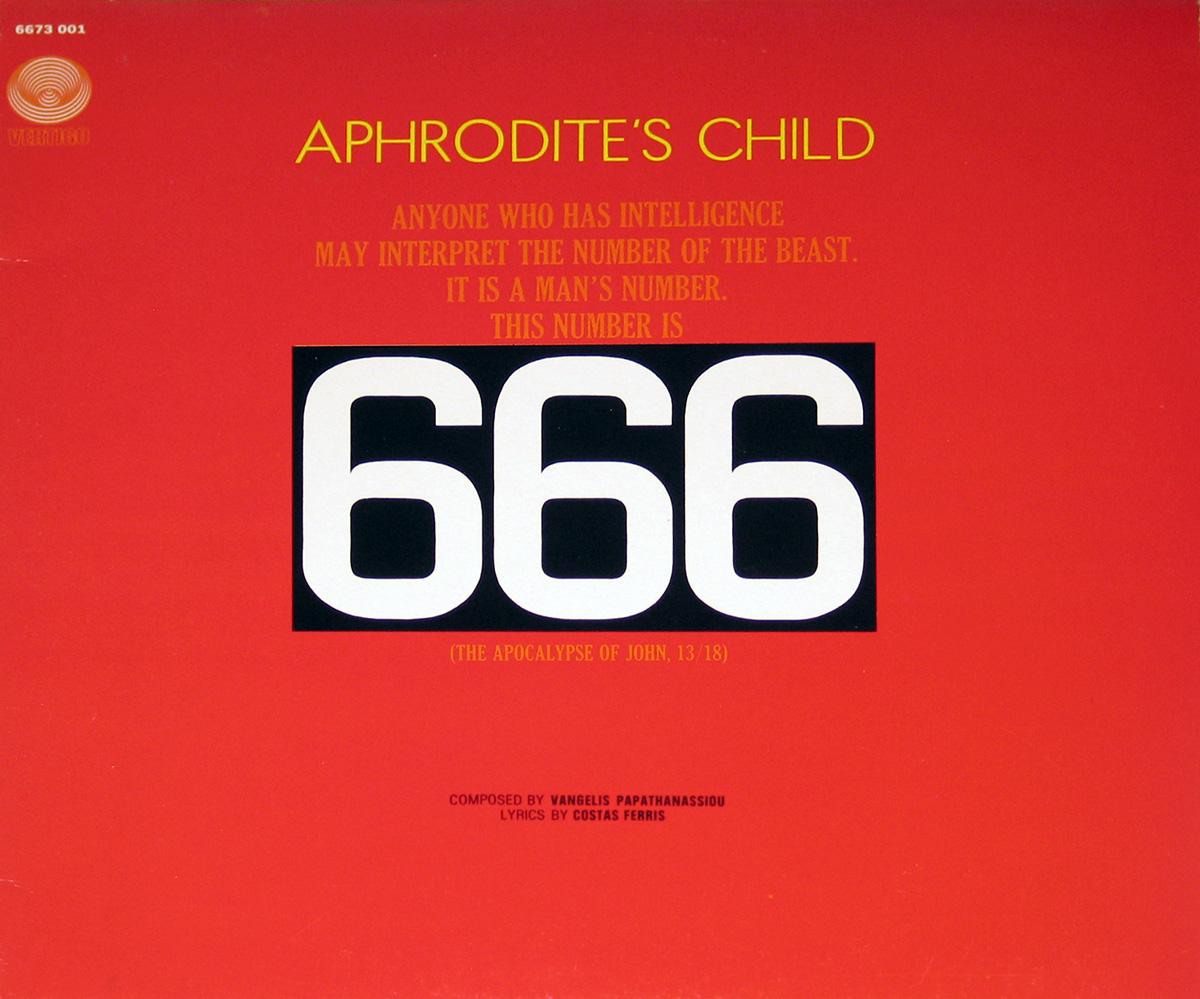
Album Front Cover Photo
Aphrodite's Child – 666 front cover with solid red background, large white 666 numerals on a black rectangle, yellow band name at top, biblical quote above the number, and small Verve logo in the upper left, emphasizing stark typography and minimal graphic design

This is the original front cover of 666 by Aphrodite’s Child, and it’s a masterclass in aggressive minimalism. The entire sleeve is dominated by a flat, saturated red background with no gradients, textures, or photographic elements. The color choice is deliberate and confrontational, designed to feel urgent and slightly unsettling rather than decorative. No borders, no framing tricks, just red right to the edges.

Centered on the sleeve is a large black rectangular block containing the number 666 in bold, rounded white numerals. The typography is heavy, geometric, and evenly spaced, filling most of the visual field. The contrast between white numbers, black block, and red background is extreme, making the title legible from across a room or a record shop bin. This is not subtle design; it’s meant to stop you cold.

Above the number, the band name Aphrodite’s Child appears in narrow, uppercase yellow lettering. The font is clean and restrained, almost understated compared to the brutal impact of the numbers below. Beneath the band name sits a biblical quotation in smaller yellow text: a reference to the Book of Revelation explaining the meaning of the number of the beast. The text is centered, evenly spaced, and clearly printed, with no distortion or decorative flourish.

In the upper-left corner, the small Vertigo swirl logo and catalog number are printed discreetly, providing label identification without competing for attention. At the bottom of the sleeve, very small black text credits Vangelis Papathanassiou for the music and Costas Ferris for the lyrics. These credits are intentionally low-profile, reinforcing the idea that the concept and the number itself are the real focus.

The copy photographed here is clean and well-preserved, with solid color coverage and no obvious ring wear, creasing, or discoloration visible in the image. Slight tonal variation may be present due to flash photography, but the red remains strong and uniform. From a collector’s perspective, this cover is all about condition, color saturation, and sharpness of print, because any wear immediately breaks the visual impact.

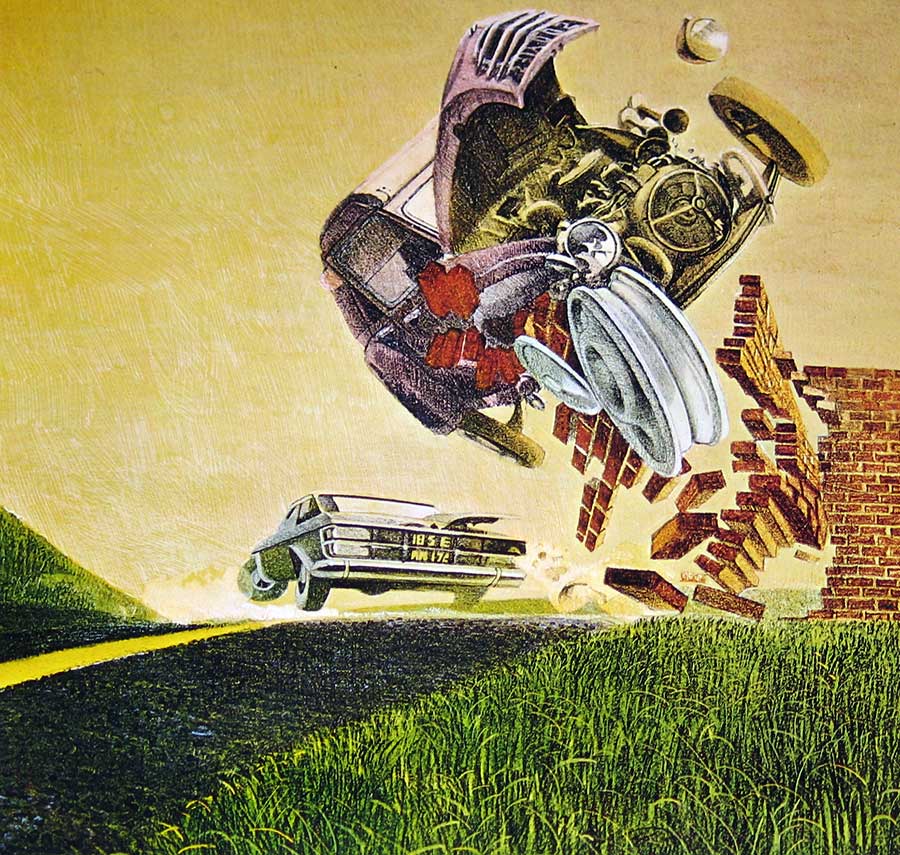
Photo of Inside Gatefold Artwork
Aphrodite's Child – 666 inner gatefold artwork showing a surreal explosion of mechanical objects bursting through a brick wall, a vintage car driving on a winding road, and green grass under a yellow sky, emphasizing collage-style apocalyptic imagery

This image comes from one of the inner gatefold panels of 666 and immediately shifts the album from stark typography into full-blown visual chaos. The background is a yellowed, parchment-like sky with visible brush texture, giving the scene an aged, almost scorched look rather than a clean illustration finish. The color palette feels deliberately dry and dusty, setting an apocalyptic tone before any details are even processed.

Dominating the upper right area is a violent explosion of everyday objects rendered in a collage-like, painterly style. Mechanical parts, circular dials, plates, metal fragments, and broken structural elements appear frozen mid-air, as if a solid wall has just been torn apart from the inside. Individual objects are clearly defined but intentionally disordered, suggesting collapse, impact, and loss of control rather than a single focal point.

To the right, a brick wall disintegrates outward, with red-brown bricks flying into space at sharp angles. The bricks are textured and uneven, emphasizing physical weight and destruction. This detail matters on a collector level because the print quality here determines how readable the individual bricks remain; muddy printing would flatten this entire section.

In the lower left, a vintage American-style car speeds along a narrow black road with a yellow center line, cutting diagonally through a field of green grass. The grass is stylized but dense, with visible blade detail that contrasts sharply against the smooth road surface. The car appears small compared to the chaos above it, reinforcing scale and vulnerability rather than motion or speed.

Overall condition in this photographed copy appears strong, with good color separation and no obvious print fading. The artwork relies heavily on fine texture, layered color, and contrast between calm landscape and violent imagery, so sharpness and saturation are critical. This inner gatefold art is essential to the album’s narrative impact and is a key inspection point when assessing completeness and sleeve condition.

Close up of record’s label
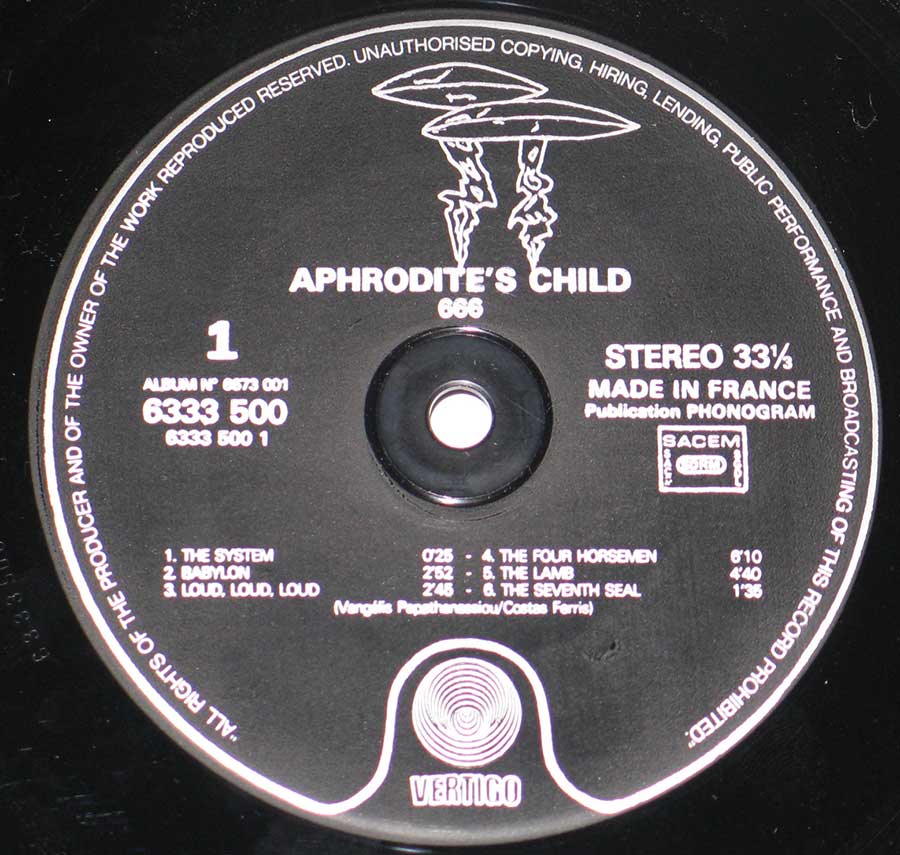
Close-up of Vertigo record label for Aphrodite's Child – 666, showing black label with white text, Vertigo swirl logo at bottom, track listing for Side 1, catalog number 6333 500, stereo 33⅓ marking, and Made in France credit

This image shows a tight, centered close-up of the original Vertigo record label for 666 by Aphrodite’s Child, photographed directly on the vinyl. The label is printed in deep black with crisp white text, creating strong contrast that makes even the smallest legal text readable. The circular layout is clean and symmetrical, with no decorative color elements beyond black and white.

At the top of the label, the band name Aphrodite’s Child is printed in bold uppercase lettering, with the album title 666 positioned just below it. Above the spindle hole sits a small surreal illustration associated with the album’s visual identity, printed sharply and without bleed. The spindle hole itself appears clean, with no excessive wear visible around the center, which is always a good sign for play history.

On the left side, the label clearly indicates Side 1, along with the album number and catalog information: 6333 500, with additional matrix-related numbering beneath. Track titles for this side are listed in compact block text, including “The System,” “Babylon,” and “Loud, Loud, Loud,” each followed by precise running times. Text alignment is tight and evenly spaced, typical of early-70s Vertigo pressings.

On the right side, technical details dominate: Stereo 33⅓, Made in France, and Publication Phonogram are all clearly printed, confirming this as a French pressing. The SACEM rights box is present and sharply defined, an important regional identifier for collectors distinguishing it from UK or other European variants.

Along the outer rim, the standard copyright and reproduction warning text runs cleanly around the edge, remaining fully legible. At the bottom, the iconic Vertigo swirl logo anchors the design, printed boldly and centered. Overall label condition appears excellent, with no obvious fading, staining, or spindle trails, making this label a strong reference point for identifying an original, well-preserved copy.

->

All images on this site are photographed directly from the original vinyl LP covers and record labels in my collection. Photo quality varies because the images were taken over several decades with different cameras. You may use these images for personal or non-commercial purposes if you include a link to this site; commercial use requires my permission. Text on covers and labels has been transcribed using a free online OCR service.

Index of Aphrodite's Child Album Cover Gallery & 12" LP Vinyl Discography Information
APHRODITE'S CHILD - 666 album front cover vinyl LP album https://vinyl-records.nl

Vertigo 6333 500 , 1972 , France

APHRODITE'S CHILD - 666

Aphrodite's Child’s 1972 double LP “666” is a landmark progressive rock concept album built around apocalyptic biblical imagery. Blending psychedelic rock, proto-synth textures, spoken passages, and avant-garde experimentation, it pushed far beyond conventional song structures. Featuring Vangelis at his most daring, the album became a cult classic and a cornerstone of early 1970s European prog.

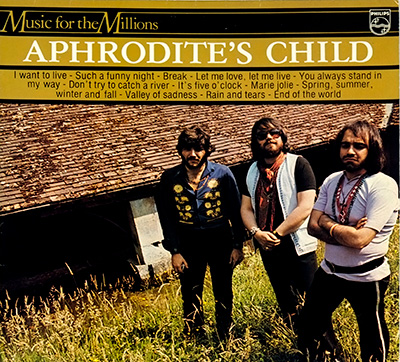
APHRODITE'S CHILD - Self-Titled 12" Vinyl LP
Thumbnail of APHRODITE'S CHILD  - Self-Titled album front cover

Music For Millions , Philips – 6484 309 , 1982 , Netherlands

One of the most notable aspects of Aphrodite's Child's music is the use of electronic instrumentation, which was relatively uncommon in rock music at the time. Vangelis's keyboard work is particularly impressive, incorporating innovative sound effects and textures that help to create the album's unique atmosphere.

Learn more
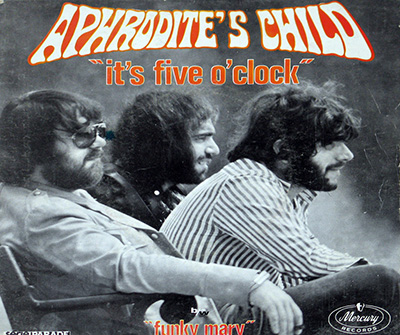
APHRODITE'S CHILD - It's Five O'Clock b/w Funky Mary 7" Vinyl Single
Thumbnail of APHRODITE'S CHILD - It's Five O'Clock b/w Funky Mary 7" Vinyl Single album front cover

Mercury / Serie Parade , ,

Aphrodite's Child's 1970 7" vinyl single, "It's Five O'Clock" b/w "Funky Mary," stands as a pivotal contribution to the eclectic musical landscape of the early 1970s. With progressive rock brilliance on the A-side and a foray into funk on the B-side, the record reflects the band's experimental spirit. The analog production techniques and captivating picture sleeve further enhance its significance in capturing the essence of a transformative musical era.

Learn more
APHRODITE'S CHILD - I Want To Live b/w Magic Mirror 7" Vinyl Single
Thumbnail of APHRODITE'S CHILD - I Want To Live b/w Magic Mirror 7" Vinyl Single album front cover

Mercury 152 505 , , France

Aphrodite's Child's 1969 French release of "I Want To Live" and "Magic Mirror" on a 7" Vinyl Single encapsulates the experimental spirit of late 1960s music. With a fusion of psychedelic rock and progressive elements, the tracks, housed in a visually striking sleeve, reflect the era's cultural shifts. Produced during the vinyl-dominated analog era on the Mercury label, the single stands as a tangible artifact, contributing to the band's international appeal and the broader evolution of the music industry.

Learn more
APHRODITE'S CHILD - Rain and Tears 12" Vinyl LP
Thumbnail of APHRODITE'S CHILD - Rain and Tears album front cover

Fontana 6420 006 , , Germany

Aphrodite's Child's 1968 debut album, "Rain and Tears," produced by Vangelis Papathanassiou, marked a pivotal moment in the late '60s music scene. Recorded at London's Morgan Studios and released under Philips Records, it showcased a fusion of psychedelic rock and progressive pop. Reflecting the era's cultural upheaval, the LP's innovative sound, underpinned by Vangelis' early electronic experimentation, continues to resonate, making it a timeless emblem of musical evolution.

Learn more