Manu Dibango – Afrijazzy Makossa 12" Vinyl LP Album

- Featuring the chart-topping single “Makasso”

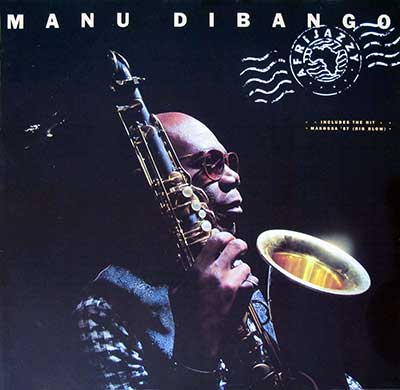
Album Front Cover Photo of Manu Dibango – Afrijazzy Makossa Visit: https://vinyl-records.nl/

Manu Dibango's “Afrijazzy Makasso” 12" LP Vinyl Album, released in 1986, is a musical masterpiece. Featuring the chart-topping single “Makasso”, this album showcases the fusion of African and jazz influences. The accompanying web page offers high-resolution album cover photos, record label details, and an in-depth description. With a lineup including Hugh Masekela, Didier Lockwood, and more, this album is a vibrant celebration of diverse musical talents.

Table of Contents

"Afrijazzy Makasso" (1986) Album Description:

Manu Dibango didn’t just drop an album in 1986 - he dropped a warm, brass-lit handshake between Africa, jazz, and the neon pulse of New York. "Afrijazzy Makasso" is groove-first music with brains, heart, and a grin, built to move bodies without switching off the mind. The page itself calls out the hit single "Makasso", and that clue matters: this record wants the dancefloor and the headspace at the same time.

Historical and cultural context

1986 was peak “genre borders are fake” energy: jazz flirting with funk, pop stealing from everywhere, and so-called “world music” finally getting a bigger Western spotlight. A German Polydor release with New York studio fingerprints says it all - the sound of cultures crossing oceans, not politely, but with a full rhythm section and no apologies. This era loved big hooks, big production, and bigger movement, and Dibango knew exactly how to aim that toward the hips.

How the band came to record this album

The credits tell a clean story without over-explaining themselves: Manu Dibango co-produced with Bill Laswell, then took the music into Quad Studios (NYC) and Masterdisk (NYC). That combination reads like a mission statement: bring the makossa pulse into a serious, modern studio environment and capture it with clarity, weight, and bite. A lineup featuring names like Hugh Masekela suggests this wasn’t a small “studio-only” idea - it was a meeting of heavy musical personalities.

The sound, songs, and musical direction

The core vibe is Afro Jazz with a saxophone in the driver’s seat, steering between danceable momentum and improvisational freedom. Tracks like "Massa Lemba" and "Gombo Sauce" feel like the band is cooking in real time - simmer first, then let the heat jump. The set also breathes: "Soir Au Village" and "Douala Serenade" carry melody like a late-night streetlight, while "Kango" keeps the groove honest and earthy.

Then there’s the spotlight moment: the page highlights "Makasso" - and now the track list does too - which makes it the album’s obvious pulse point. This is the kind of cut that makes a room change shape: bass and percussion lock in, the horn lines flash, and suddenly the air feels brighter. Guest power like Hugh Masekela adds extra brass voltage, the kind that turns a good groove into a headline.

Comparison to other albums in the same genre/year

In 1986, a few major records made “global sound” feel mainstream, but Dibango’s angle stays more street-level and band-driven - less postcard, more sweat.

  • "Graceland" - glossy and landmark-pop global; Dibango stays closer to the jam and the groove engine.
  • "Tutu" - sleek, modern, and studio-shaped; "Afrijazzy Makasso" keeps more live-band muscle in the mix.
  • "So" - art-pop with worldbeat colors; Dibango sounds like the rhythm is the point, not decoration.
Band dynamics and creative tensions

A big lineup can either sound like a committee meeting or a block party, and this record leans hard toward block party. The tight, hook-friendly single energy sits next to moments that feel looser and more conversational, like the studio left the tape running on purpose. That push-pull is the fun part: polish where it counts, freedom where it matters, and a band that never forgets the groove is the boss.

Critical reception and legacy

The page calls "Makasso" a chart-topping single, which explains why this album feels built to travel beyond jazz circles. New York recording rooms and a mastering touch associated with punch and clarity help the music hit with real presence, not fuzzy “nice vibes” softness. Decades later, this LP still plays like proof that fusion can be muscular, joyful, and smart without turning into a museum exhibit.

Reflective closing

This is the kind of record that earns its shelf space: not because it’s rare, but because it keeps paying you back every time the needle drops. The grooves carry that specific 1986 optimism - cross-cultural, high-energy, and just a little bit fearless about mixing ingredients. Decades later, the sax lines still smell faintly of city asphalt, warm vinyl, and beautifully misplaced certainty.
Album Key Details: Genre, Label, Format & Release Info

Music Genre:

Afro Jazz, Saxophone Jazz, Cameroonian Jazz

Afro Jazz blends African rhythmic traditions with jazz improvisation, often driven by polyrhythms, call-and-response phrasing, and strong melodic hooks. In this context, saxophone-led arrangements play a central role, balancing groove with expressive solos rooted in both African and Western jazz languages.

Label & Catalognr:

Polydor – Cat#: 831 720

Media Format:

Record Format: 12" LP Vinyl Stereo Gramophone Record
Total Weight: 230g

Year & Country:

1986 – Germany

Production & Recording Information:

Producers:
  • Manu Dibango – Producer

    Steering the album from the inside, keeping groove, identity, and momentum aligned.

    Manu Dibango shaped this album as both architect and navigator, ensuring the makossa pulse stayed front and center while giving the band room to breathe. The production favors movement over polish, letting rhythm sections lock in naturally and horns cut through with warmth and authority. Everything feels intentional but never stiff, a clear sign of a leader producing from lived musical instinct rather than studio theory.

  • Bill Laswell – Producer

    Adding modern edge, weight, and international studio perspective.

    Bill Laswell’s involvement tightens the low end and sharpens the album’s global reach. His production presence brings clarity and punch without sanding down the African rhythmic core, helping the record sit comfortably next to contemporary funk and jazz releases of the mid-80s. The result feels confident, urban, and forward-leaning, never trapped in nostalgia.

Sound & Recording Engineers:
  • Bob Musso – Recording Engineer

    Capturing the band with space, balance, and live energy intact.

    Bob Musso’s recording work keeps the sessions sounding human and unforced, allowing percussion and bass to breathe while preserving the snap of the horn arrangements. The sound never feels over-processed, giving the impression of musicians playing together rather than parts stitched together later. That natural flow is a big part of why the grooves feel alive.

  • Pete Sturge – Recording Engineer

    Refining clarity and separation without flattening the groove.

    Pete Sturge helped shape the album’s clean but muscular sound, making sure each instrument claims its own space in the mix. The rhythm section stays tight and grounded, while melodic lines remain clear even when arrangements grow dense. That balance keeps the album punchy without sacrificing warmth.

  • Howie Weinberg – Mastering Engineer
  • Howie Weinberg – Mastering Engineer

    Mastering legend with over 200 Gold and Platinum albums to his name.

    Howie Weinberg is a renowned mastering engineer whose work has defined the sound of countless legendary albums. With over 200 Gold and Platinum records, he has mastered classics by Metallica, Nirvana, and Slayer, shaping the sonic punch and clarity of modern rock and metal. His mastering touch became an industry benchmark that still echoes through generations.

Recording Location:
  • Quad Studios – Recording Studio

    A New York room built for groove-driven sessions.

    Quad Studios provided a controlled but flexible environment where rhythm sections could lock in tightly without losing feel. The room’s sound favors clarity and punch, helping percussion and bass sit deep while keeping horns sharp and present. Much of the album’s physical drive starts here.

  • Masterdisk – Recording & Mastering Facility

    Precision, power, and final polish in a classic NYC setting.

    Masterdisk’s involvement adds focus and authority to the finished sound. The facility’s reputation for tight low end and controlled dynamics shows through in how solid and confident the record feels on vinyl. Everything lands with weight, but nothing feels squeezed.

Album Cover Design & Artwork:
  • Jean-Félix Galletti – Cover Design

    Translating sound into color, movement, and attitude.

    Jean-Félix Galletti’s cover design reflects the album’s upbeat confidence and global identity. The visuals signal rhythm and warmth before the needle even drops, framing the record as modern, urban, and rooted in African musical energy rather than retro jazz imagery.

Photography:
  • Bernard Matussière – Photography

    Giving the album a human face and visual presence.

    Bernard Matussière’s photography supports the album’s identity by keeping the focus on personality rather than abstraction. The images feel grounded and direct, matching the music’s mix of professionalism and warmth. Nothing flashy, just confident documentation of the moment.

Band Members / Musicians:

Band Line-up:
  • Manu Dibango – Saxophone, Composer, Bandleader

    The gravitational center of the album, pulling every groove into orbit.

    Manu Dibango drives this record with absolute authority, shaping both the melodic identity and the rhythmic confidence of the sessions. His saxophone lines act as signposts, guiding the band through funk, jazz, and makossa without ever losing momentum. Leadership here is musical rather than verbal, with phrasing and timing doing the heavy lifting. The album breathes because he allows space, but it never drifts because his presence keeps everything anchored.

  • Hugh Masekela – Trumpet, Flugelhorn, Composer, Vocalist

    Injecting brass lines that feel political, joyful, and physical all at once.

    Hugh Masekela’s contribution adds a second narrative voice to the album, one that speaks through tone as much as melody. His trumpet and flugelhorn bring sharp attack and emotional weight, expanding the music beyond groove into storytelling territory. The interplay between his brass and Dibango’s sax creates moments of tension and release that elevate the arrangements. Presence alone changes the temperature of the room.

  • Didier Lockwood – Violin

    Bringing unexpected melodic color into a groove-heavy framework.

    Didier Lockwood’s violin adds a lyrical edge that cuts cleanly through the rhythm section without competing for space. His lines weave above the grooves, introducing tension and release that feels almost conversational. The result adds air and elegance, preventing the album from settling into purely percussive territory.

  • Paul Personne – Guitar

    Laying down blues-inflected guitar lines with restraint and bite.

    Paul Personne’s guitar work stays economical and expressive, filling gaps without crowding the arrangement. The phrasing leans bluesy but adapts smoothly to Afro-jazz rhythms, grounding the album when the textures grow dense. His role is subtle but structural, reinforcing groove rather than chasing spotlight.

 
  • "Chlanga" Vincent Nguini – Guitar

    Supplying rhythmic precision and African-inflected guitar textures.

    Vincent Nguini’s guitar locks directly into the rhythmic engine of the album, reinforcing groove rather than decorating it. His playing bridges traditional African phrasing with modern funk sensibility, keeping the pulse tight and dance-driven. The music leans forward because his parts refuse to drift.

  • "Bokilo" Jerry Malekani – Guitar

    Adding layered guitar lines that thicken the harmonic base.

    Jerry Malekani supports the album’s harmonic framework with understated but essential guitar work. His parts reinforce rhythm and chord movement, giving the horn-driven arrangements something solid to lean on. The sound stays full without becoming crowded.

  • Ray Lema – Keyboards

    Expanding the harmonic palette with jazz-informed keyboard textures.

    Ray Lema’s keyboards bring depth and sophistication, filling the midrange with warmth and movement. His contribution connects African rhythmic ideas with jazz harmony, smoothing transitions and enhancing melodic development throughout the album.

  • Michel Alibo – Bass

    Holding the entire album together from the low end up.

    Michel Alibo’s bass lines are elastic and deeply rhythmic, shaping the album’s physical feel. Every groove rests on his timing, allowing percussion and horns to move freely without losing focus. The record dances because the foundation never wavers.

  • Paco Sery – Drums, Percussion

    Driving the grooves with precision, swing, and power.

    Paco Sery’s drumming balances complexity with accessibility, pushing rhythms forward without overwhelming the mix. His sense of timing gives the album its forward momentum, making even intricate patterns feel effortless and danceable.

Complete Track-listing:

Tracklisting Side One:
  1. Massa Lemba
  2. Bushman Promenade
  3. Gombo Sauce
  4. Soir Au Village
Video: Massa Lemba
Video: Makossa'87 (Big Blow)
Tracklisting Side Two:
  1. Makossa '87
  2. Kango
  3. Douala Serenade
  4. ABelley Sphere

Disclaimer: Track durations are not listed for this release. Running times may vary slightly between pressings or regional editions due to mastering or production differences.

Collector’s Note: Soul Makossa vs Makossa ’87

The short, collector-grade truth first: “Soul Makossa” is the accident that became history, while “Makossa ’87” is the same idea walking back into the room fifteen years later wearing better clothes and knowing exactly how famous it already is. One crawled out of the early ’70s club circuit; the other stepped straight onto an ’80s dancefloor with confidence and a clean press kit.

“Soul Makossa” lives on repetition, looseness, and that hypnotic chant that feels half-spoken, half-spell. The groove barely changes, because it doesn’t need to. It’s raw, slightly rough around the edges, and that’s the point — the track feels discovered rather than designed, which is why DJs, samplers, and pop stars couldn’t leave it alone.

“Makossa ’87” does the opposite without betraying the source. The rhythm is tighter, the bass heavier, the mix cleaner, and the whole thing is engineered to hit hard on modern systems. This version understands radio, clubs, and global circulation, and it leans into that reality without pretending it’s still 1972.

From a vinyl-collector perspective, this isn’t a remake so much as a self-remix across decades. “Soul Makossa” is the blueprint everyone borrowed from, sometimes without asking. “Makossa ’87” is Manu Dibango calmly reclaiming his own invention, updating it, and reminding everyone who signed the original idea in the first place.

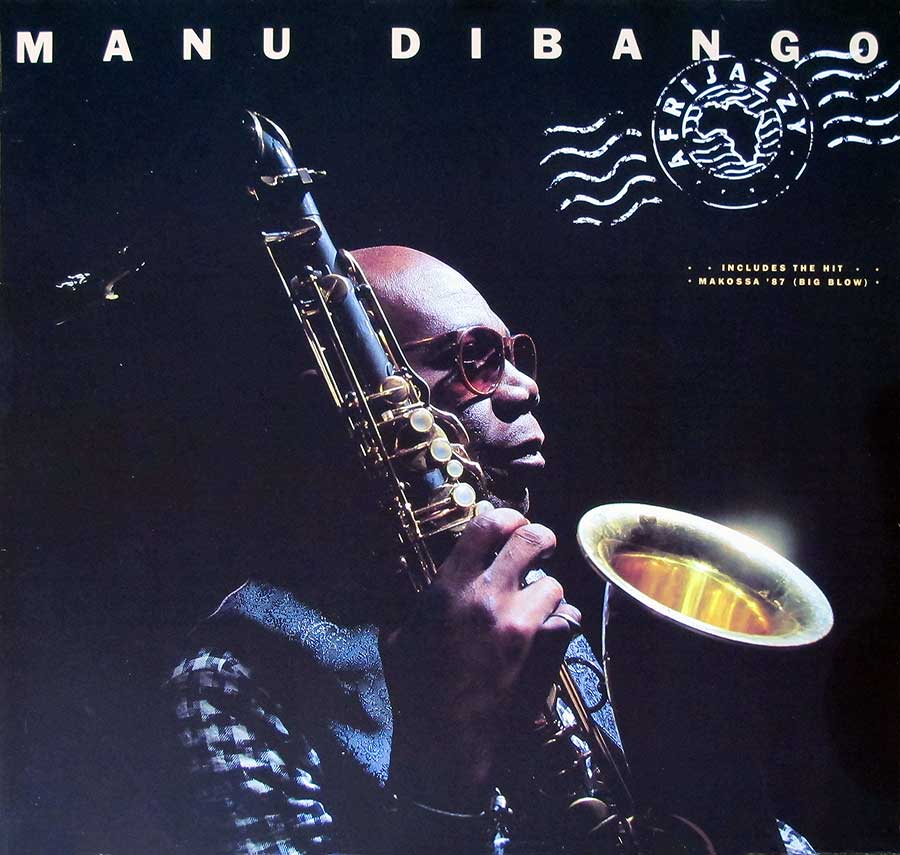
Album Front Cover Photo
Front cover of Manu Dibango’s Afrijazzy showing a close-up studio portrait of Dibango holding a saxophone at an angle, wearing glasses, against a deep black background with spaced white lettering and a stamped Afrijazzy logo highlighting the Makossa ’87 hit.

This front cover presents a tightly framed studio portrait of Manu Dibango, positioned slightly off-center against a deep, almost matte-black background that dominates most of the sleeve. The darkness is intentional and clean, creating strong contrast and pushing all attention toward the person and the instrument. The photograph focuses on Dibango from the chest up, captured in profile, facing right, with his saxophone angled diagonally across the frame.

Dibango is shown wearing lightly tinted glasses with thin frames, a textured shirt, and a darker vest layered over it. The clothing reads practical and understated, not stylized or flashy, reinforcing a serious, musician-first image rather than a pop persona. His expression is calm and concentrated, lips slightly parted near the saxophone mouthpiece, suggesting readiness rather than performance. The saxophone itself is sharply lit, with the brass keys and bell reflecting warm highlights that stand out against the black background.

Typography is minimal but deliberate. Across the top edge, the artist’s name MANU DIBANGO appears in widely spaced, uppercase white letters, clean sans-serif, evenly aligned and easy to read from a distance. On the upper right side sits a circular stamped-style graphic reading AFRIJAZZY, designed to resemble a postal or travel mark, reinforcing the album’s global identity. Just below that stamp, small yellow text notes “Includes the hit Makossa ’87 (Big Blow)”, adding commercial context without cluttering the visual balance.

From a collector’s perspective, this cover is about restraint and focus. There is no crowd, no background scene, and no excess decoration. The layout relies on contrast, spacing, and the physical presence of the instrument. The photograph reproduces cleanly on vinyl-sized format, with no visible cropping issues or edge distractions, making it a strong, intentional front cover that ages well and scans consistently across pressings.

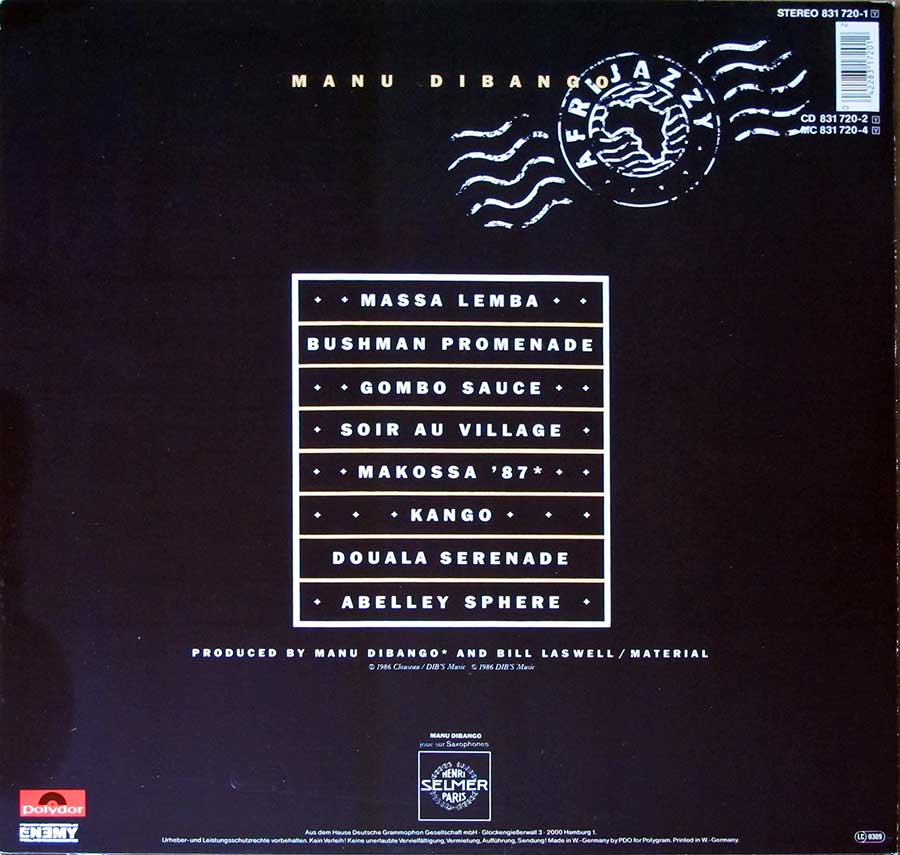
Album Back Cover Photo
Back cover of Manu Dibango’s Afrijazzy showing a black minimalist layout with centered white tracklist box, Afrijazzy stamp graphic, catalog numbers, production credits, and Polydor branding, all cleanly spaced for vinyl readability.

This back cover continues the restrained, controlled visual language of the front sleeve, built almost entirely on a deep black background with sharply defined white and pale-yellow elements. The layout is symmetrical and deliberate, leaving generous negative space around the content, which immediately signals a mid-1980s European design approach focused on clarity and longevity rather than decoration.

At the visual center sits a vertically oriented rectangular frame containing the complete track listing. Each song title is set in uppercase lettering, evenly spaced and separated by thin horizontal rules and small diamond markers. The track list reads clearly from top to bottom: Massa Lemba, Bushman Promenade, Gombo Sauce, Soir Au Village, Makossa ’87, Kango, Douala Serenade, and Abelley Sphere. The typography is clean, modern, and optimized for readability at vinyl sleeve distance.

Above the track list, the artist name MANU DIBANGO appears again in widely spaced uppercase letters, maintaining consistency with the front cover. To the upper right, the circular AFRIJAZZY stamp graphic reappears, complete with wavy postal-style lines, reinforcing the album’s global, travel-inspired identity. In the same area, small technical markings list the stereo format and catalog numbers, positioned tightly but legibly along the edge.

Below the track list, production credits are printed in small but sharp text, clearly stating that the album was produced by Manu Dibango and Bill Laswell. Near the bottom center, a prominent Henri Selmer Paris logo appears, accompanied by text noting Dibango’s use of Selmer saxophones, a detail that matters to musicians and collectors alike. Along the bottom edge, Polydor and copyright information are aligned neatly, including German manufacturing credits, confirming this as a European pressing with precise, factory-clean print quality.

From a collector’s standpoint, this back cover is about information discipline. Everything is where it should be, nothing is crowded, and the print contrast remains strong even in darker lighting. The design favors long-term legibility, making it easy to identify tracks, credits, and pressing details without handling the sleeve excessively, which is exactly what a well-designed vinyl back cover should do.

First Photo of Custom Inner Sleeve
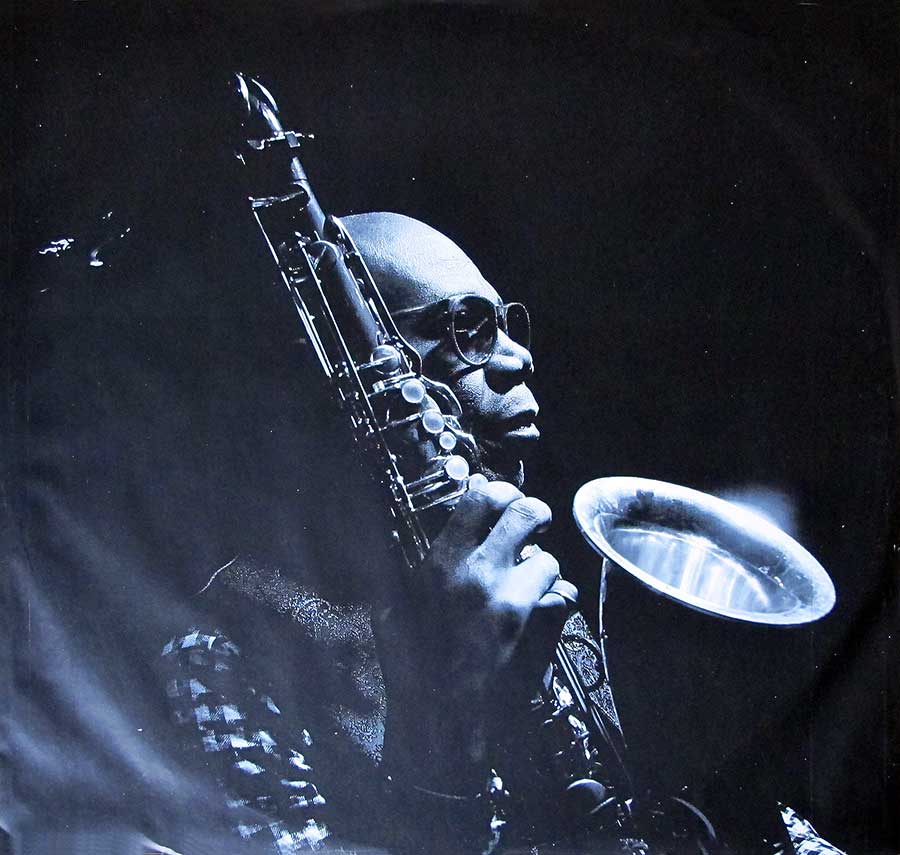
Inner sleeve photo from Manu Dibango’s Afrijazzy showing a monochrome close-up of Dibango in profile holding a saxophone, with strong contrast, visible grain, and dramatic lighting that emphasizes the instrument and facial outline.

This image is a monochrome photograph printed on the custom inner sleeve, presenting a close, tightly cropped profile view of Manu Dibango holding his saxophone. The composition is dominated by deep blacks and cool highlights, with the background falling almost completely into darkness. The lack of visible scenery or context places full emphasis on the person and the instrument, making the image feel intimate and deliberate rather than decorative.

Dibango’s head and upper torso fill most of the frame, angled slightly to the right. He appears calm and focused, wearing rounded glasses that catch a faint reflection from the light source. The lighting is directional and strong, carving out the contours of his face and hands while allowing the rest of the image to recede. The saxophone’s keys, rods, and bell edge are sharply defined, showing metallic highlights that contrast against the matte black surroundings.

The image shows noticeable film grain and soft tonal transitions, consistent with an analog photograph reproduced for print rather than a modern digital capture. This grain is not a flaw; it adds texture and reinforces the period feel of a mid-1980s inner sleeve. There are no captions, credits, or typography intruding on the image itself, which is typical for custom inner sleeves designed to function as visual breathing space between sides of the record.

From a collector’s point of view, this inner sleeve photo matters because it confirms originality and completeness. The image is clearly intended as part of the album’s visual narrative, not a generic stock photo. Its restrained use of contrast and absence of text reduce wear visibility over time, while also making any creases, seam splits, or discoloration immediately noticeable when assessing condition.

Second Photo of Custom Inner Sleeve
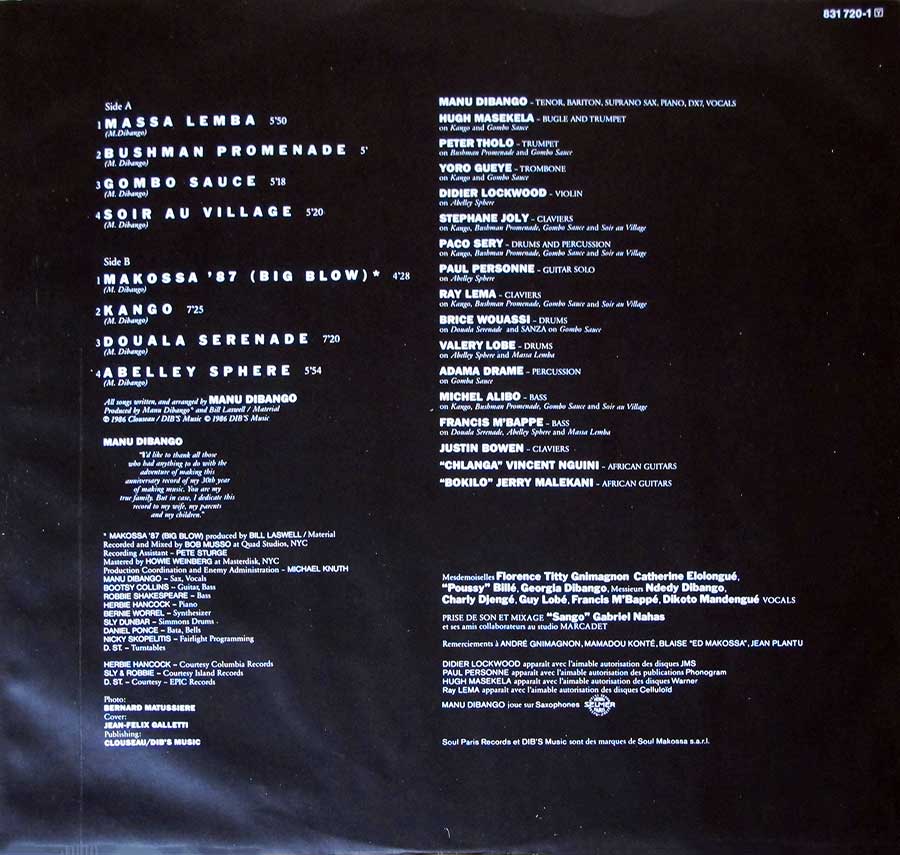
Inner sleeve layout from Manu Dibango’s Afrijazzy showing dense white text on black background with full track listings, musician credits, production details, and recording information arranged in two structured columns.

This second inner sleeve image shifts completely from portrait photography to pure information density, presenting a full credits and track information layout printed in white on a deep black background. The sleeve is structured into two vertical columns, each tightly aligned and carefully spaced, making this side the informational backbone of the album rather than a decorative element.

On the left column, the full track listing is presented with side divisions clearly labeled Side A and Side B, including track numbers, titles, composer credits, and precise running times. Each entry is cleanly typeset in uppercase for titles with smaller supporting text beneath, allowing quick identification without visual clutter. This layout is practical and functional, designed for repeated reference while handling the record.

The right column is devoted to musician credits and instrumentation, listing performers line by line with their respective roles. Instruments are spelled out in detail, covering saxophones, trumpet, trombone, keyboards, bass, drums, percussion, and African guitars. Guest musicians and session contributors are clearly separated, which is critical for collectors and researchers tracking personnel across different pressings and sessions.

Lower sections include production, recording, and mastering credits, naming Bill Laswell as producer for “Makossa ’87 (Big Blow),” with recording and mixing at Quad Studios, NYC, and mastering at Masterdisk. Additional acknowledgements, publishing credits, copyright notices, and courtesy mentions for record labels are printed in smaller text blocks, all sharply reproduced.

From a collector’s perspective, this inner sleeve side is essential for verification. It confirms originality, credit accuracy, and pressing authenticity. The high contrast print makes wear, fading, or discoloration immediately visible, which helps assess condition quickly. This is not filler content; it is a reference document disguised as an inner sleeve, exactly how serious mid-1980s releases handled documentation.

Close up of record’s label
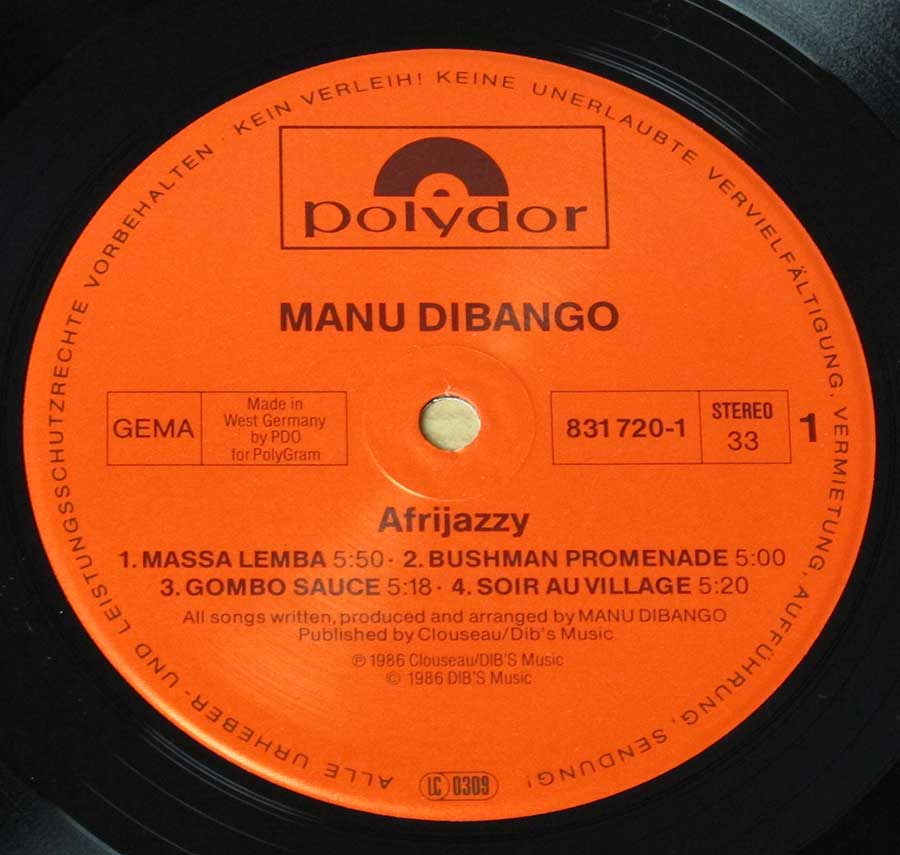
Close-up of the orange Polydor label on Manu Dibango’s Afrijazzy vinyl LP, showing catalog number 831720-1, Side 1, stereo 33 RPM marking, track list for Side A, GEMA box, and West Germany manufacturing credit.

This image shows a sharp, centered close-up of the Polydor record label used on the original vinyl pressing of Afrijazzy. The label is printed in Polydor’s distinctive solid orange color, evenly applied, with clean black text that remains highly legible. The circular layout is perfectly aligned around the spindle hole, which is cleanly punched and shows no tearing or deformation, a good indicator of careful handling.

At the top sits the classic Polydor logo inside a rectangular frame, followed directly underneath by the artist name MANU DIBANGO in bold uppercase lettering. To the right, the catalog number 831720-1 is printed clearly, paired with STEREO and 33 RPM markings, confirming playback format. The presence of the GEMA rights box on the left signals a German pressing intended for the European market.

Centered below the spindle hole, the album title Afrijazzy appears in slightly larger type, acting as a visual anchor between artist and track information. Side designation is implicit through the track listing beneath, which clearly identifies Side A titles: Massa Lemba, Bushman Promenade, Gombo Sauce, and Soir Au Village, each with precise running times printed inline. The typography is utilitarian and consistent, prioritizing clarity over decoration.

Along the lower portion of the label, publishing and copyright credits are printed in compact lines, stating that all songs were written, produced, and arranged by Manu Dibango, with publishing credited to Clouseau / Dib’s Music. Around the outer rim, fine-print German legal text circles the label edge, including restrictions on unauthorized reproduction and rental. The overall print quality is crisp, with no ink bleed, making this label an excellent reference point for identifying an authentic first pressing.

All images on this site are photographed directly from the original vinyl LP covers and record labels in my collection. Slight differences in color may exist due to camera flash and lighting conditions. You may use these images for personal or non-commercial purposes if you include a link to this site; commercial use requires my permission.