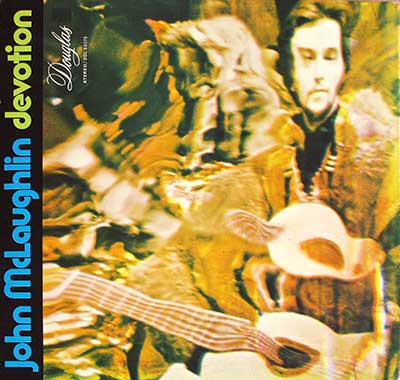
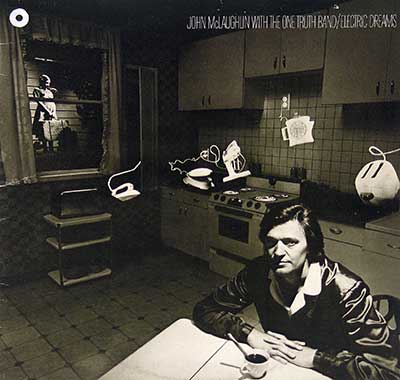
John McLaughlin in the 1970s and 1980s Band Description:
John McLaughlin never sounded like a man asking permission. By the time the early 1970s cracked open, this English guitarist had already slipped out of the British jazz-blues world and into Miles Davis's electric storm, and when Mahavishnu Orchestra hit, the sound came off the speakers like chrome sparks and incense at the same time. A lot of fusion turned clever. McLaughlin turned feral, exact, and just a little dangerous.
That is the part people still get wrong. They remember the speed, the white clothes, the double-neck guitar, the spiritual titles, all the surface static. What gets lost is how physical it felt: Billy Cobham kicking holes in the floor, Jan Hammer pushing keyboards until they seemed to smoke, Jerry Goodman sawing the violin like he meant to draw blood, Rick Laird holding the frame together while McLaughlin cut across it in hard diagonal lines. Read past the legend and the room starts moving again.
In Britain, the air he came out of was already thick with blues-rock lifers, progressive tinkerers, and jazz players being told to stay politely in their lane. Then New York blew the doors off. Around 1969 and 1970, the same current that ran through Miles Davis records like "Bitches Brew" and later "On the Corner" was turning jazz inside out, and McLaughlin fit that scene perfectly because he could think like a jazzer and attack like a rock guitarist with no interest in behaving.
That is why Mahavishnu did not land like another tasteful fusion act. Put them beside Weather Report, Return to Forever, Tony Williams Lifetime, Santana, or Soft Machine and the difference is obvious in the first minute. Weather Report often floated, Return to Forever could dance, Santana could open the spiritual window, but Mahavishnu came in like a pressure system. Even when the harmony was intricate, the band played as if every bar had to fight for oxygen.
I first really got the message through Shakti, late and hazy, the kind of listening hour when the lamp is low and the walls feel a little farther away than usual. From there I doubled back to Mahavishnu and suddenly those records stopped looking difficult and started breathing. That is often how McLaughlin works on people: the doorway is not always the one you expect.
Where the sound actually lived
The first Mahavishnu lineup mattered because each player shoved the music from a different angle. McLaughlin wrote the attack and the architecture. Cobham supplied the military-grade drive. Hammer sprayed electricity everywhere, not politely behind the guitar but right up beside it. Goodman gave the band its cutting edge in the literal sense, and Laird kept the center from floating away. When that lineup burned out, the second Mahavishnu edition shifted the colors, but the tension remained; the music just started looking toward a different horizon.
By the middle of the decade, McLaughlin's Indian musical pull was no side note anymore. That is where Shakti enters, not as some soft detour but as a re-wiring of the whole nervous system. Zakir Hussain's tabla did not decorate the music, it reorganized its heartbeat, while L. Shankar brought a singing, needling violin voice that kept everything airborne. The electric blast became acoustic tension, and that can be even wilder because there is nowhere to hide.
The lazy myth says McLaughlin moved from hot Mahavishnu to gentle Shakti, as if he traded fire for a yoga mat and some polite cross-cultural applause. Not true. Shakti was leaner, more exposed, and in some ways more radical. You hear fingers, wood, skin, breath, tiny pockets of silence, then suddenly the whole thing lifts off the floor again like the room forgot its own weight.
1970s heat, 1980s pivot
He did not spend the late 1970s and early 1980s polishing old trophies either. The Santana collaboration "Love Devotion Surrender" had already shown how naturally he could lock into a devotional blaze without sounding pious, and the acoustic guitar summit with Paco de Lucia and Al Di Meola took that restlessness somewhere else entirely. On "Friday Night in San Francisco" and then "Passion, Grace & Fire", the danger changed shape: less thunder, more knife-work. Three players, nowhere to duck, and enough right-hand attack to make your shoulders tense up from the sofa.
The 1980s records do not carry the same myth-cloud as the first Mahavishnu run, but that says as much about listeners as it does about the music. People like origin stories. They get nervous when an artist refuses to stay framed inside the one period critics already know how to praise. McLaughlin never gave them that comfort. He kept moving through "Music Spoken Here", "Mahavishnu", and "Adventures in Radioland" with the stubbornness of a man still chasing a sound that had not quite landed yet.
Misreadings, arguments, and the usual nonsense
There was no great tabloid scandal hanging over this body of work, but there were plenty of bad takes. Jazz purists heard the volume and called it rock vulgarity. Rock listeners heard the odd meters and muttered that it was too brainy. Both camps missed the point. McLaughlin's best work from this era is not a compromise between styles; it is a refusal to let those borders stay standing.
Another cheap misunderstanding is to reduce him to speed. Yes, the velocity was real. But speed was never the whole trick. What made the playing hit so hard was tension control: lines that sounded like they were rushing downhill while still landing exactly where the structure needed them. Plenty of guitarists can run. Fewer can levitate and steer.
Why this music still hums after midnight
What stays with me is not the prestige language, not the academic halo, not the word fusion used as a filing label by people who want everything in neat bins. It is the sensation of music thinking faster than ordinary speech, then suddenly sitting cross-legged and listening to its own pulse. McLaughlin did that trick better than almost anybody, and when he got it right the room did not feel decorated. It felt altered.
That is why these records still work when the house is quiet and the hour has gone a little strange. They do not sound like respectable heritage pieces. They sound like risk, discipline, mysticism, velocity, and just enough beautiful excess to make sensible people uneasy. Good. They usually need it.
References
- John McLaughlin official website - Musical Life
- John McLaughlin official website - Albums discography
- Miles Davis official site - John McLaughlin profile
- Miles Davis official site - "Bitches Brew"
- Santana official site - "Love Devotion Surrender" reference
- John McLaughlin official website - "Friday Night in San Francisco"
- John McLaughlin official website - "Passion, Grace & Fire"
- Stanley Clarke official site - "The Rite of Strings"
- Britannica - John McLaughlin biography
- Vinyl-Records.nl - high resolution album cover photos