"A Saucerful of Secrets" Album Description:
In the midst of the tumultuous late 1960s, a musical revolution was unfolding, marked by the emergence of a genre that would come to be known as Acid Psychedelic Progressive Rock. At the forefront of this sonic exploration stood Pink Floyd, a pioneering band whose avant-garde soundscapes and experimental ethos left an indelible mark on the musical landscape. A key artifact from this transformative period is the original UK pressing of "A Saucerful of Secrets," a 12" Vinyl LP Album that encapsulates the spirit of its time.
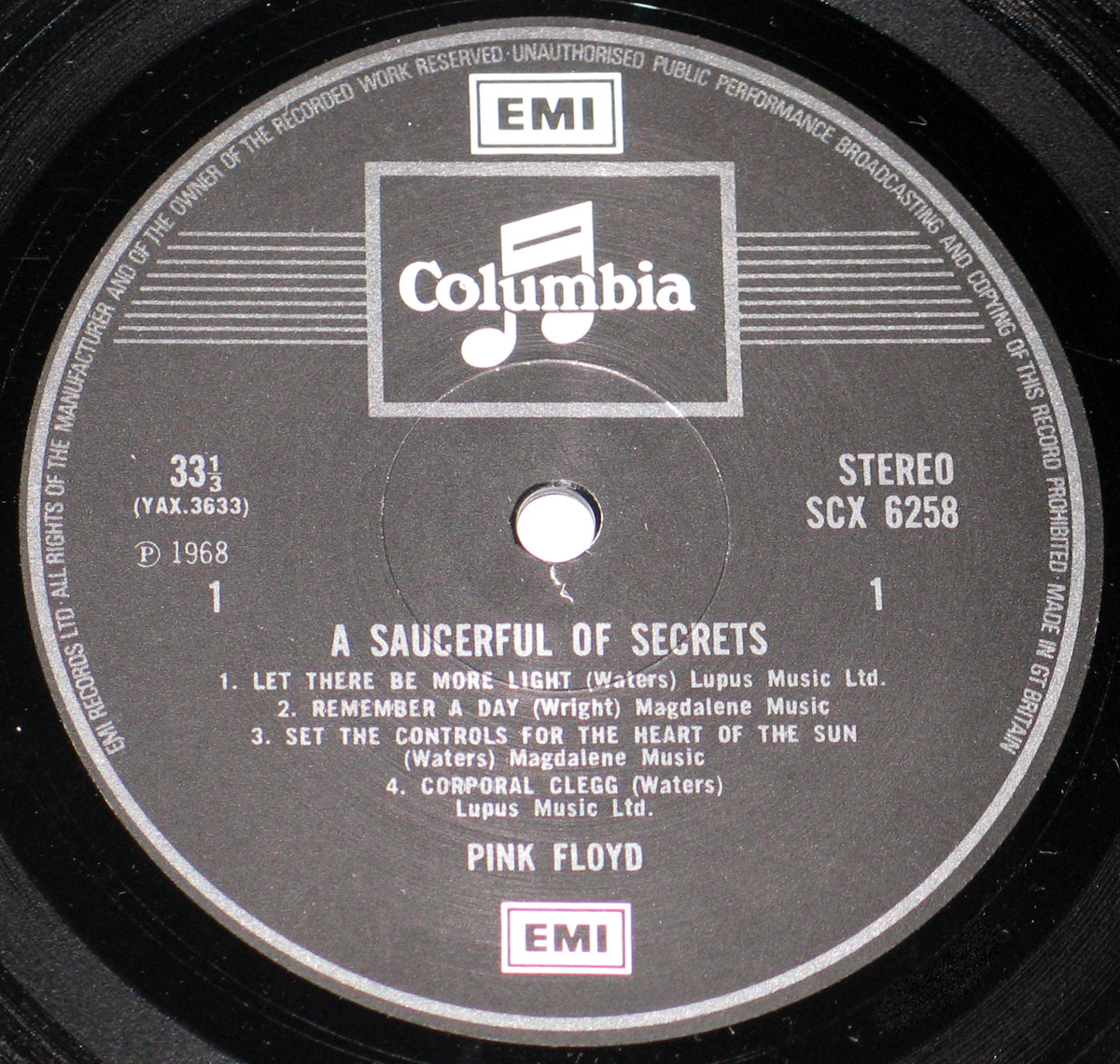
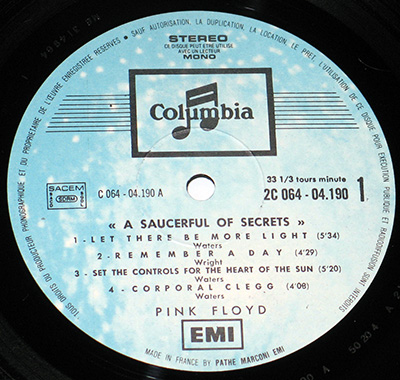
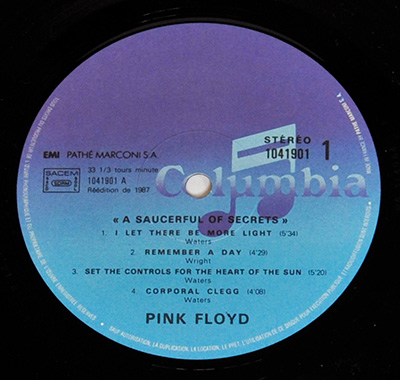
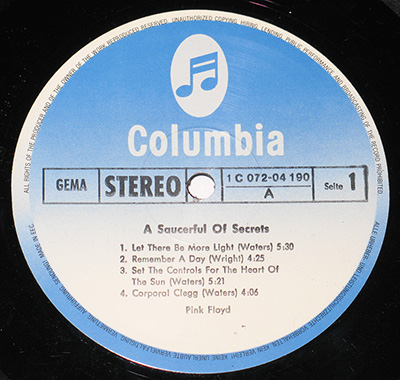
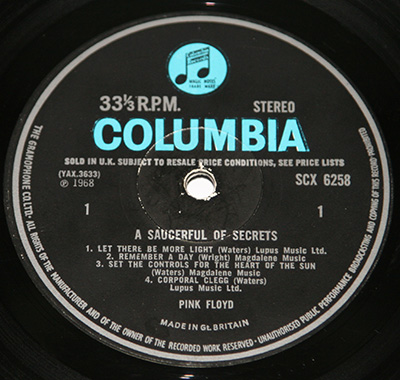
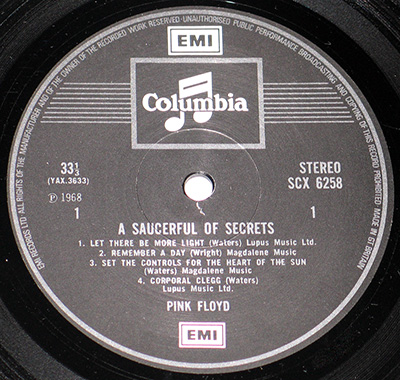
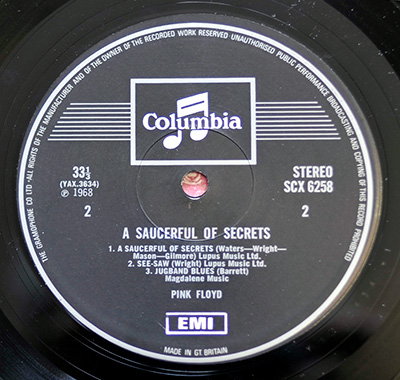
Released under the EMI Columbia label with the catalognr SCX 6258 and mastering credited to YAX 3633, this album is a testament to the band's artistic evolution. Produced by the esteemed Norman Smith, who played a crucial role in shaping Pink Floyd's early sound, "A Saucerful of Secrets" was a departure from the more straightforward approach of their debut album, "The Piper at the Gates of Dawn."
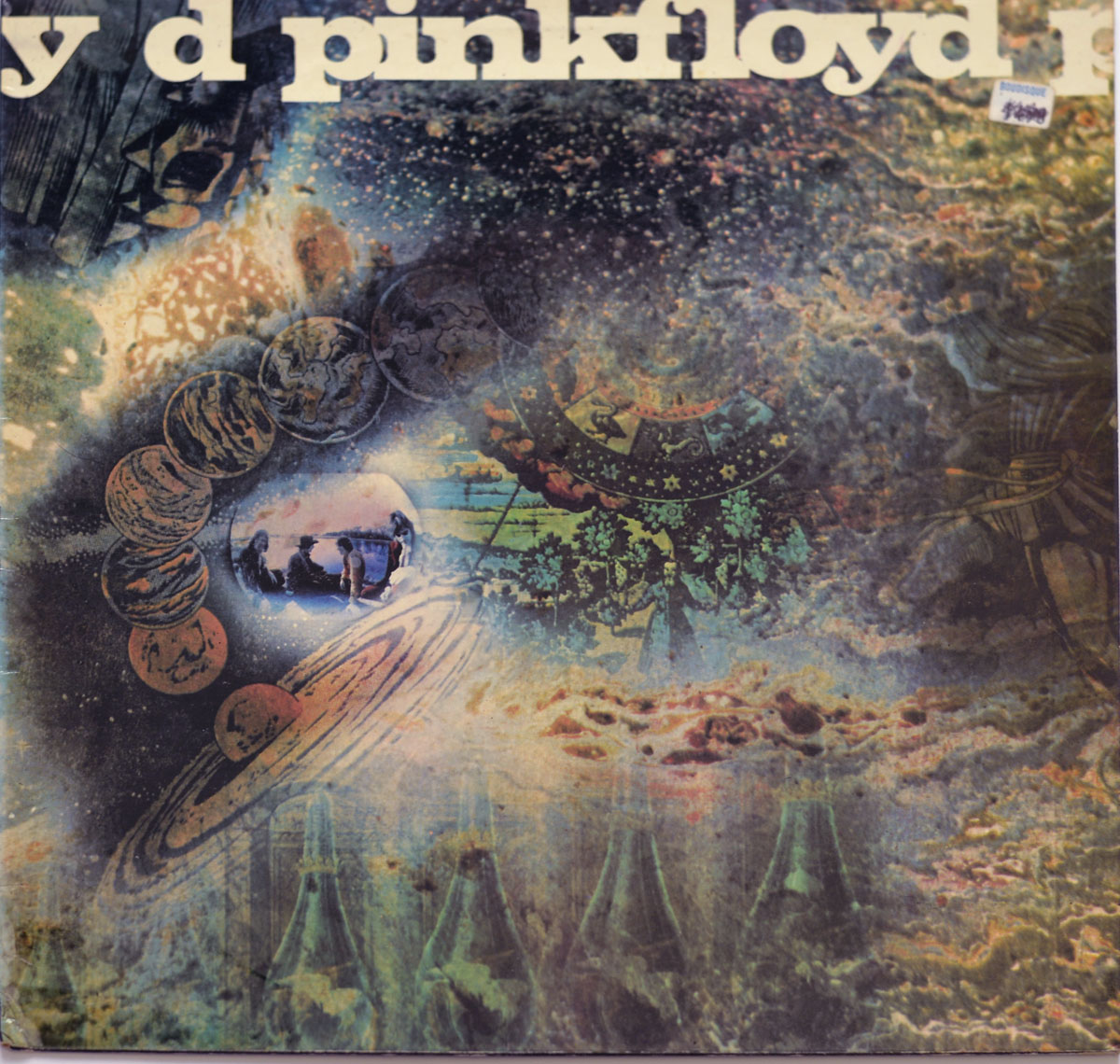
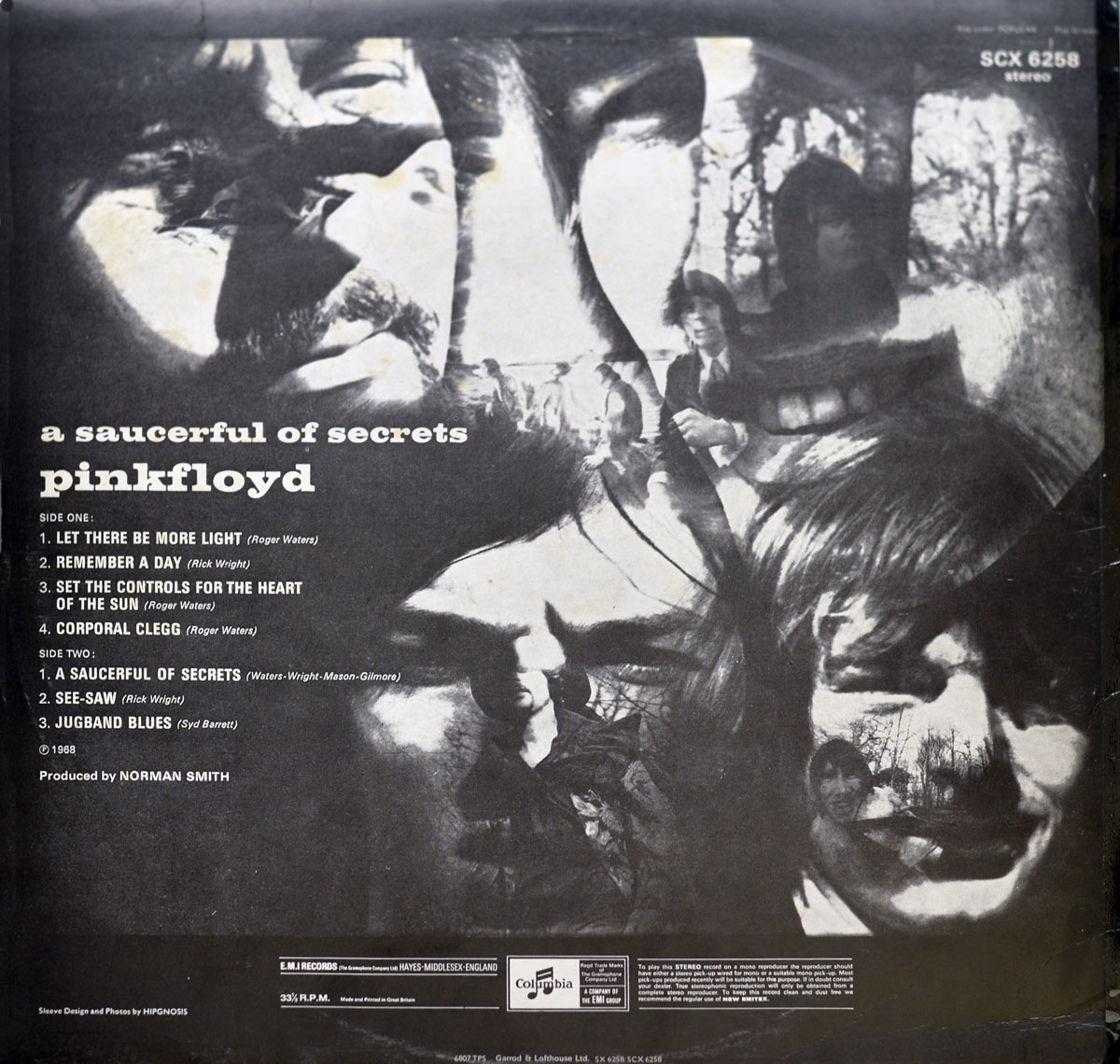
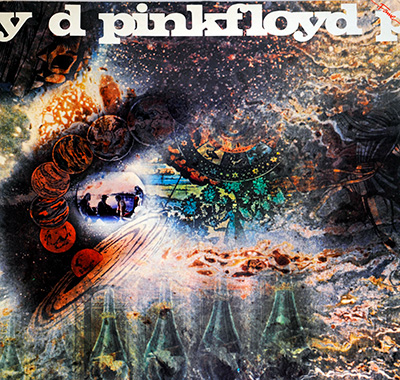
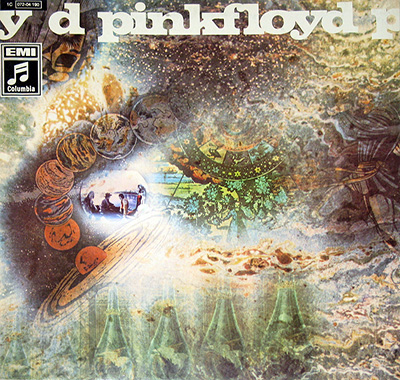
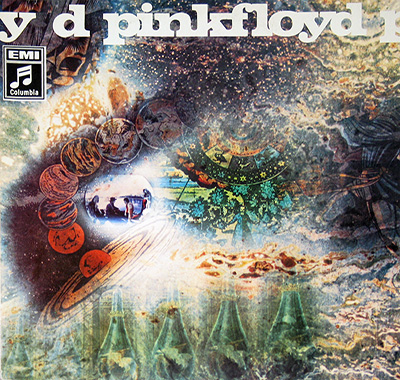
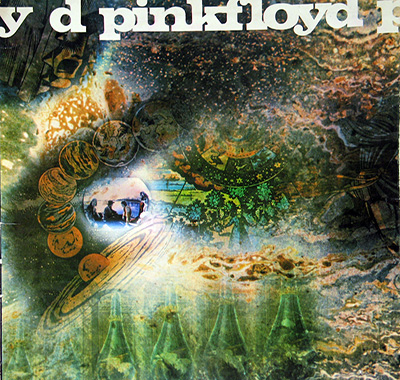
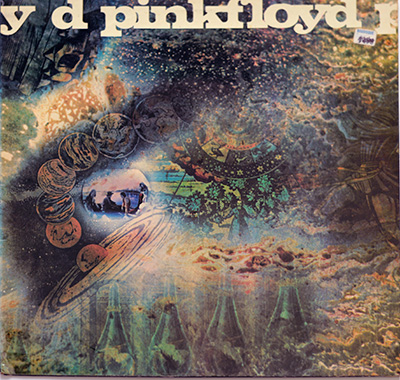
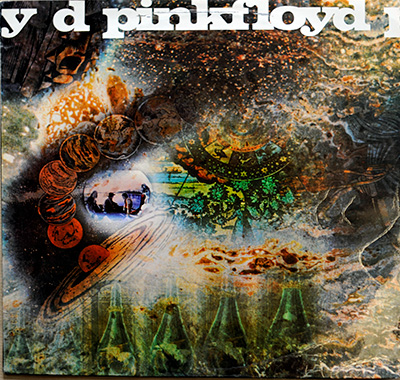
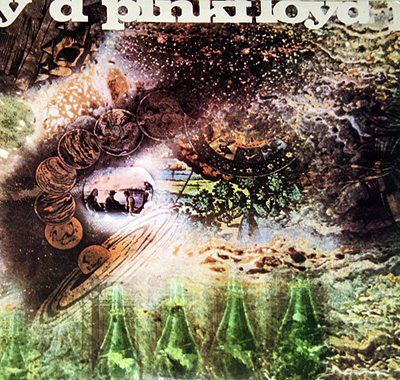
The cover of the album, adorned with black and white portrait photos arranged in a psychedelic manner, reflects the artistic experimentation prevalent during the era. The visual aesthetics, mirroring the kaleidoscopic nature of the music within, provide a captivating prelude to the auditory journey that awaits the listener.
The year of its release, 1968, is significant in understanding the contextual backdrop of "A Saucerful of Secrets." The late '60s were a time of social upheaval, political activism, and cultural transformation. The Vietnam War raged on, and movements advocating for peace, civil rights, and a countercultural ethos gained momentum. Against this backdrop, Pink Floyd's music served as both a reflection of the times and a sonic departure from the mainstream.
The album's title track, "A Saucerful of Secrets," exemplifies the band's transition into a more experimental phase. Clocking in at over 11 minutes, the composition unfolds like a sonic odyssey, incorporating elements of avant-garde, electronic effects, and improvised sections. This departure from conventional song structures marked a departure from the norms of the era, solidifying Pink Floyd's reputation as musical innovators.
The collaborative nature of the album, with each band member contributing to the songwriting process, mirrored the communal spirit of the times. Pink Floyd, comprising Syd Barrett, Roger Waters, Richard Wright, Nick Mason, and new member David Gilmour, showcased their collective prowess in crafting a cohesive yet diverse musical journey.
Norman Smith's production played a pivotal role in capturing the ethereal and experimental nature of the music. His expertise in the studio allowed Pink Floyd to push sonic boundaries, creating an immersive listening experience that transcended the confines of traditional rock.
Music Genre:
Acid Psychedelic Progressive Rock |
Album Production Information: Produced by Norman Smith Norman Smith – Producer, Sound EngineerThe Beatles called him "Normal". Pink Floyd collectors call him the guy who made the chaos sound expensive. Read more... Norman Smith - the calm EMI wizard I still hear in the grooves whenever early Floyd turns the lights weird. He cut his teeth at Abbey Road, engineering The Beatles' EMI sessions from 1962 through autumn 1965 (yes, up to "Rubber Soul"), then stepped out from behind the glass as a producer. In 1967-1969 he steered Pink Floyd through "The Piper at the Gates of Dawn", "A Saucerful of Secrets" and "Ummagumma", keeping Syd's sparkle and the chaos on tape. In 1968 he produced The Pretty Things' "S. F. Sorrow", and in the early 1970s he shaped Barclay James Harvest (including "Once Again"). Later he even popped up as Hurricane Smith, because rock history loves a plot twist.
Album cover design: Hipgnosis
Hipgnosis – British album cover art design groupHipgnosis is my favorite proof that a record sleeve can be a full-on mind game, not just a band photo with better lighting. Read more... Hipgnosis is the legendary London-based art design group that turned rock sleeves into visual myths. The core duo, Storm Thorgerson and Aubrey "Po" Powell, were childhood friends of the Pink Floyd inner circle in Cambridge—a connection that allowed them to bypass the stiff mandates of EMI’s in-house design department in 1968. Their debut, "A Saucerful of Secrets," was only the second time in EMI history (after The Beatles) that an outside firm was granted creative control. The very name "Hipgnosis" was a piece of found art; Syd Barrett, during one of his more enigmatic phases, scrawled the word in ballpoint pen on the door of the South Kensington flat he shared with the duo. Thorgerson loved the linguistic friction of it: the "Hip" for the new and groovy, and "Gnosis" for the ancient, hidden knowledge. While Peter Christopherson later joined as a third partner in 1974, that initial Barrett-endorsed moniker defined a decade of surrealist mastery for bands like Led Zeppelin, Genesis, and 10cc, before the group dissolved in 1983.
|
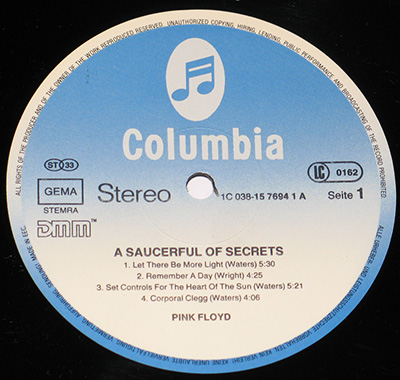
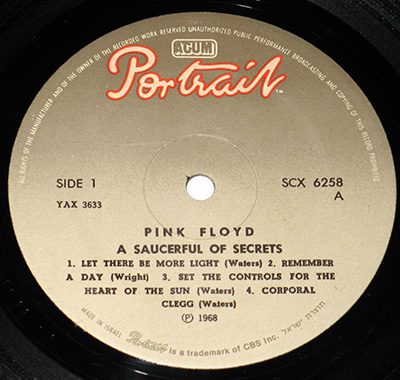
Record Label & Catalognr: EMI Columbia SCX 6258 / YAX 3633 |
| Media Format: 12" Vinyl LP Gramophone |
Year and Country:
1968 Made in Gt Britain |
Band Members and Musicians on: Pink Floyd A Saucerful of Secrets |
Pink Floyd band-members are:
- Roger Waters - bass guitar, lead vocals
- Roger Waters – Bass, vocals, songwriter
Roger Waters is the guy I blame (politely) when a Pink Floyd song stops being “spacey vibes” and starts staring straight through you with lyrics that feel like a courtroom cross-examination. Read more... Roger Waters is, to my ears, Pink Floyd’s razor-edged storyteller: bassist, singer, and the main lyric engine who pushed the band from psychedelic drift into big, human-scale themes. His key band period is Pink Floyd (1965–1985), where he became the dominant writer through the 1970s and early 1980s, before leaving and launching a long solo career (1984–present). After years of public tension, he briefly reunited with Pink Floyd for a one-off performance at Live 8 in London on 2 July 2005—basically the musical equivalent of spotting a comet: rare, bright, and gone again. Since the late 1990s he’s toured extensively under his own name, staging huge concept-driven shows that revisit Floyd classics like "The Dark Side of the Moon" (notably on the 2006–2008 tour) and "The Wall" (2010–2013), because apparently subtlety is not the point when you’ve got something to say.
- David Gilmour - lead guitar, lead vocals (incorrectly spelt Gilmore on the album)
- David Gilmour – Guitar, vocals
David Gilmour is the voice-and-fingers combo I hear whenever Pink Floyd turns from “spacey” into straight-up cinematic: he joined in 1967 and basically helped define what “guitar tone with emotions” even means. Read more... David Gilmour is, for me, the calm center of Pink Floyd’s storm: an English guitarist, singer, and songwriter whose playing can feel gentle and devastating in the same bar. His earliest band period worth name-dropping is Jokers Wild (1964–1967), before he stepped into Pink Floyd in 1967 as Syd Barrett’s situation unraveled. From there his main performing era is Pink Floyd (1967–1995), including the post-Roger Waters years where the band continued under his leadership and released "A Momentary Lapse of Reason" (1987) and "The Division Bell" (1994), with a later studio coda in "The Endless River" (2014). Outside Floyd, he’s had a long solo run (1978–present) with albums ranging from "David Gilmour" (1978) to "Luck and Strange" (2024), and he even did a sharp side-quest in 1985 with Pete Townshend’s short-lived supergroup Deep End. And for one historic night, the classic lineup reunited at Live 8 in Hyde Park, London on 2 July 2005—one of those “you had to be there (or at least press play)” moments.
- Rick Wright - piano, organ, mellotron, vibraphone, lead vocals
- Nick Mason - drums, percussion, vocals
- Nick Mason – Drums, percussion
Nick Mason is the steady heartbeat I always come back to in Pink Floyd: the only constant member since the band formed in 1965, quietly holding the whole weird universe together while the rest of the planet argues about everything else. Read more... Nick Mason is Pink Floyd’s drummer, co-founder, and the one guy who never clocked out: his main performing period with Pink Floyd runs from 1965 to the present, and he’s the only member to appear across every Pink Floyd album. Outside the mothership, he’s had a very “I’m not done yet” second act: in 2018 he formed Nick Mason’s Saucerful of Secrets (2018–present) to bring the band’s early psychedelic years back to the stage. He’s also stepped out under his own name with projects like the solo album "Nick Mason’s Fictitious Sports" (released 1981), which is basically him taking a left turn into jazz-rock just to prove he can. And yes, he was part of that blink-and-you-miss-it full-band moment at Live 8 in London in 2005, when the classic lineup briefly reunited and reminded everyone why this band still haunts people.
- Syd Barrett - rhythm guitar, lead vocals
- Syd Barrett – Guitar, vocals, songwriter
Syd Barrett is the original Pink Floyd spark plug I always think of when the music sounds like it was beamed in from a kinder, stranger universe—he co-founded the band in 1965 and shaped their early psychedelic identity before everything went sideways. Read more... Syd Barrett (born Roger Keith Barrett) is, to me, the “before” and “after” line in Pink Floyd history: the frontman, guitarist, and main songwriter in the band’s formative years, then the haunting absence everyone kept orbiting. His key band period is Pink Floyd (1965–1968), where his songs and playing defined the early sound and led to the debut album era, before his departure in 1968. After that, he had a short, intense solo period (1968–1974), highlighted by the albums "The Madcap Laughs" (released 1970) and "Barrett" (released 1970), after which he largely withdrew from the music world. It’s a brutally brief career arc for someone so influential, which is exactly why his shadow still feels weirdly present whenever early Floyd comes on.
|