- Rare Dutch import capturing The Runaways at a late-’70s crossroads between hard rock, glam, and punk
Revive the Golden Era of Heavy Metal with The Runaways' Rare Dutch Import Vinyl LP Album: A Must-Have for Female Rock Enthusiasts. This web page has photos of album covers, inner sleeves, record labels together with production details, musicians and track-listing.
And Now... The Runaways always felt like a deep breath taken in the middle of a storm. Released in 1978, it captures a band trying to steady itself while the ground under hard rock, glam, and punk was visibly cracking. This isn’t their loudest record, but it might be their most revealing one.
By 1978, the rock world was splintering fast. Punk had kicked the door in, disco ruled the charts, and traditional hard rock was suddenly accused of being old news. The Runaways were standing right in that crossfire, too heavy for pop, too melodic for punk, and too young to play the nostalgia card.
This album arrived after relentless touring, internal pressure, and shifting identities inside the band. The Runaways were no longer the shock headline of teenage rebellion; they were musicians trying to survive the industry grind. Recording this record feels less like conquest and more like consolidation.
Sonically, the album leans into gritty hard rock with glam muscle still flexing underneath. The guitars bite but don’t sprint, the rhythm section locks in tight, and the songs feel built to last a few extra spins rather than explode on first contact. Tracks like “Saturday Night Special” and “Black Leather” trade raw shock for weight and control.
Compared to the band’s own earlier releases, this record feels more grounded and less feral. In the wider 1978 landscape, it sits somewhere between the swagger of late-’70s hard rock and the stripped-down urgency punk was pushing forward. It lacks the chaos of pure punk, but gains a sense of muscle and discipline many peers didn’t bother with.
There was no single scandal attached to this album, but it quietly confused people. Some fans wanted the raw teenage blast of earlier Runaways records, while critics weren’t sure where to shelve a band that didn’t neatly fit the new rules. The loudest backlash was mostly indifference, which can sting worse than outrage.
Listening closely, you can hear a band negotiating space with itself. Individual personalities start to poke through more clearly, and the performances feel purposeful rather than reckless. This is a group aware that survival now required growth, not just volume.
At the time, And Now... The Runaways didn’t rewrite history, but it quietly aged well. Modern listeners often hear it as a transitional document, capturing a band maturing under pressure. It’s a record collectors return to when they want context, not just chaos.
Decades later, this album still sounds like determination pressed into vinyl. It smells faintly of rehearsal rooms, late-night doubt, and stubborn belief in loud guitars. I don’t play it for adrenaline—I play it for perspective.
Hard Rock / Glam Rock / Proto-Punk
Mercury – Cat#: 6304 505
Stereo 6304 505 (also playable on mono).
Record Format: 12" Vinyl LP
1978 – Made in Holland
Rusk Sound Studios – Hollywood, California
Capitol Studios – Hollywood, California
The Runaways are managed by Toby B. Mamis, American Entertainment Management Corp., 9165 Sunset Blvd., Suite 203, Los Angeles, California 90069.
A Wayward Production for Phonogram.
Disclaimer: Track durations shown are approximate and may vary slightly between different country editions or reissues. Variations can result from alternate masterings, pressing plant differences, or regional production adjustments.
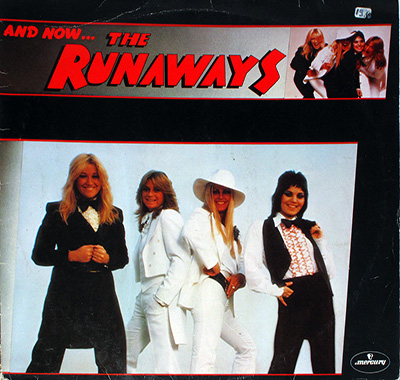
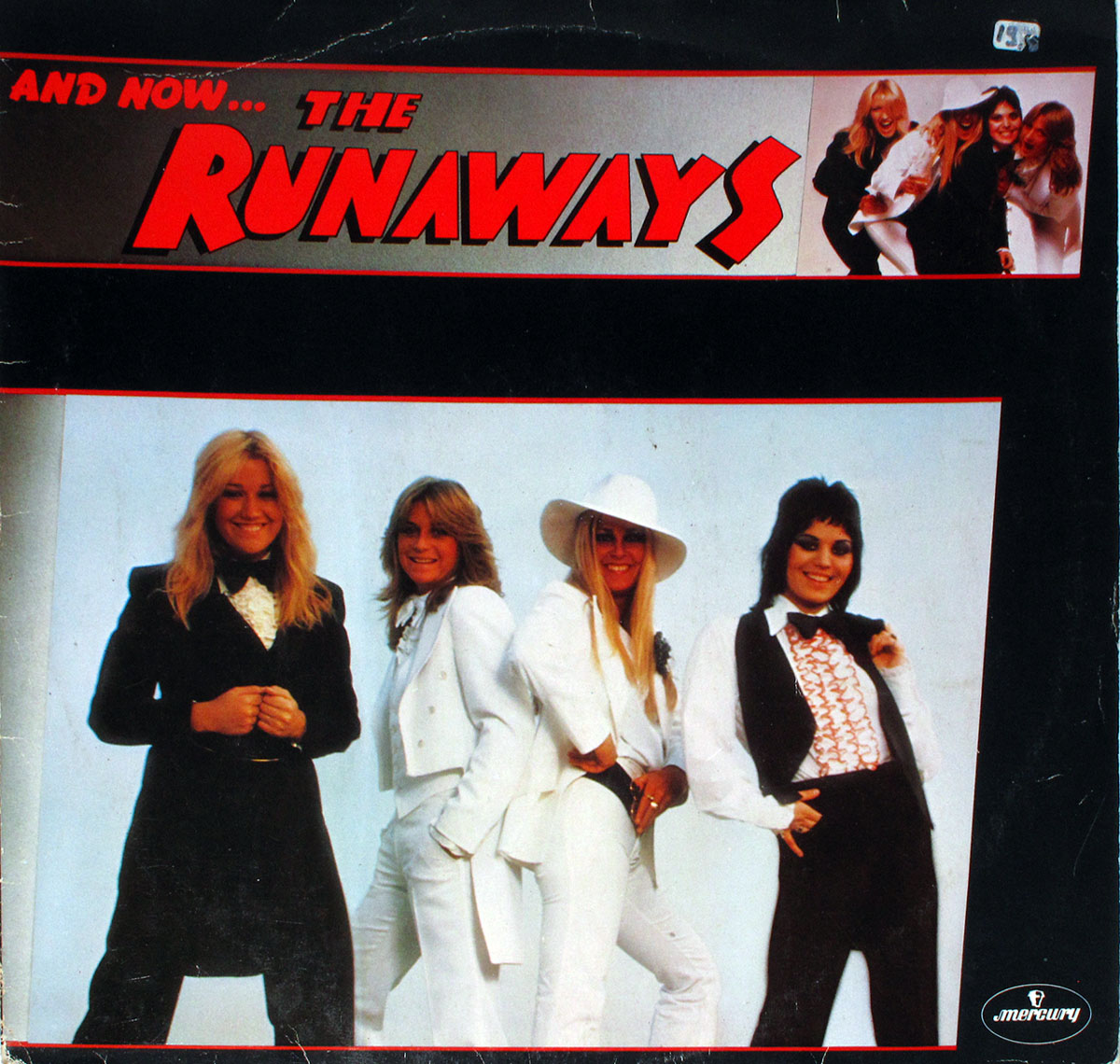
This image shows the front cover of the Dutch pressing of “And Now… The Runaways”, photographed directly from my own vinyl copy. The layout is clean and deliberate, signaling a shift away from raw shock imagery toward a more controlled, almost formal presentation. The band members are lined up across the center against a pale, neutral studio backdrop, giving the photo a sharp, uncluttered look that emphasizes posture, clothing, and attitude rather than chaos.
The four members are dressed in sharply contrasting outfits: black suits on the outer figures and white suits in the middle, creating a strong visual rhythm across the sleeve. This black-and-white styling feels intentional and symbolic, reinforcing the idea of balance and maturity rather than teenage rebellion. The tailoring, wide lapels, and staged poses firmly place the image in the late 1970s, but without the glitter excess often associated with glam.
At the top, the album title “And Now… The Runaways” is printed in bold red lettering on a gray banner, using a thick, angular typeface that immediately grabs attention. The red-on-gray contrast is strong and readable, even from a distance, which matters when flipping through crates. The typography feels confident and assertive, clearly meant to reintroduce the band rather than shock the viewer.
In the lower corner, the Mercury logo is printed cleanly, confirming the label identity without cluttering the design. The sleeve shows light edge wear and minor surface marks consistent with age, but the print remains crisp and the colors stable, making this a solid archival example of a late-’70s Dutch pressing. Overall, the cover communicates control, professionalism, and a band repositioning itself within the hard rock landscape.
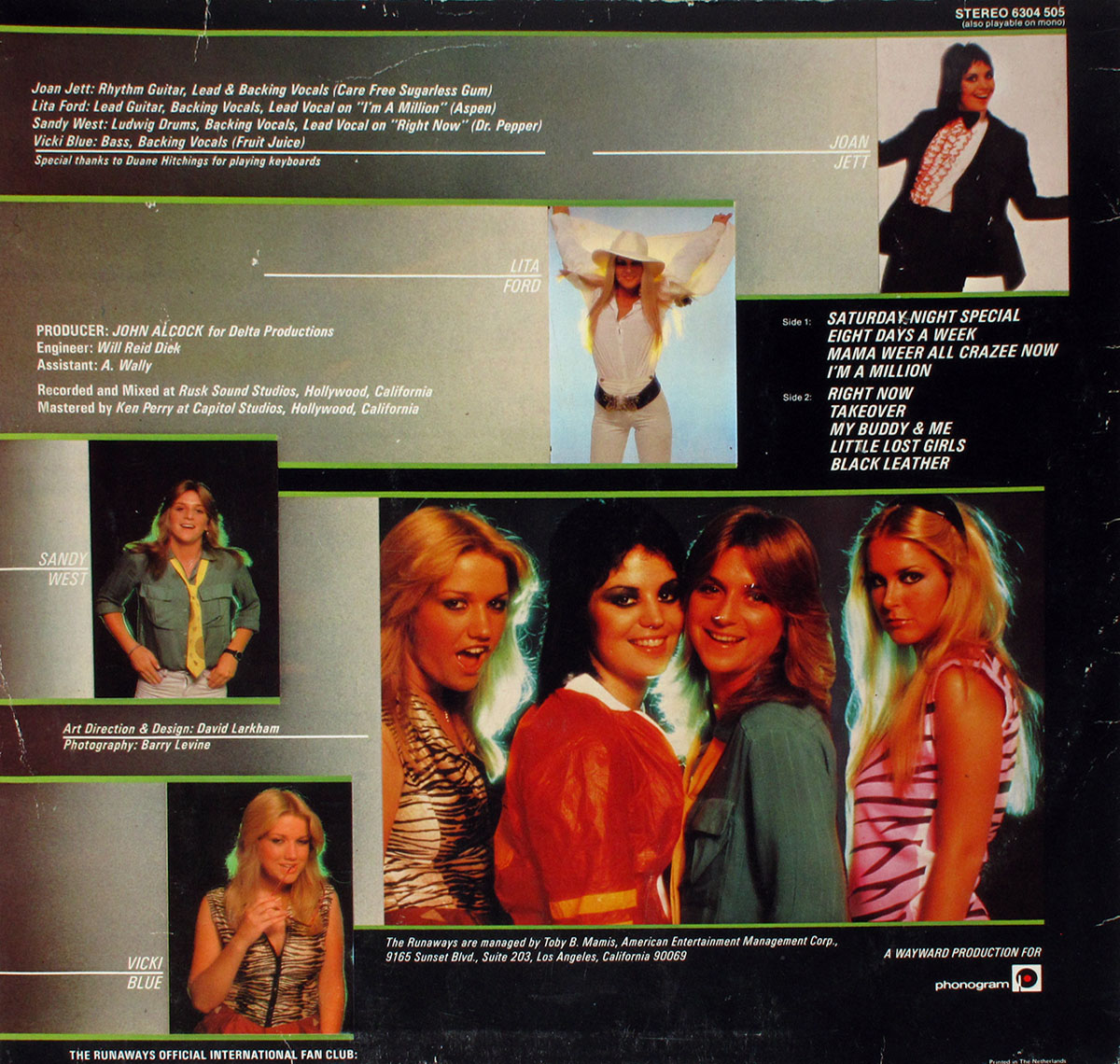
This image shows the back cover of the Dutch pressing of “And Now… The Runaways”, and it is packed with information in a very late-1970s, no-nonsense layout. The background is predominantly dark, broken up by thin green horizontal lines that separate text blocks from photographs. This grid-like structure immediately tells me the sleeve was designed to be read as much as it was meant to be looked at.
Along the top left, the band member credits are printed in clear white text, listing instruments and vocal roles in a straightforward manner. These credits are practical and legible, clearly intended for listeners who actually care who did what. Just beneath that, production details are grouped together: producer, engineer, assistant engineer, recording and mixing location, and mastering studio. From a collector’s point of view, this is prime documentation territory, confirming studio lineage and personnel without embellishment.
To the right side, the complete tracklisting is presented in two neat columns labeled Side One and Side Two, printed in bold white lettering against the dark background. The song titles are easy to scan and visually balanced, making it simple to confirm whether a copy matches the correct pressing configuration. The catalog number and stereo designation appear near the top edge, another small but important detail for identifying the exact issue.
The lower half of the sleeve is dominated by a large group photograph of the band, flanked by smaller individual portraits. These images show the members in colorful late-’70s outfits, contrasting sharply with the darker design elements above. The photographs humanize the record, shifting the focus from credits and data back to personality and presence. Minor edge wear and light surface scuffing are visible, consistent with an original sleeve that has been handled but not abused, making this a solid and honest archival example.
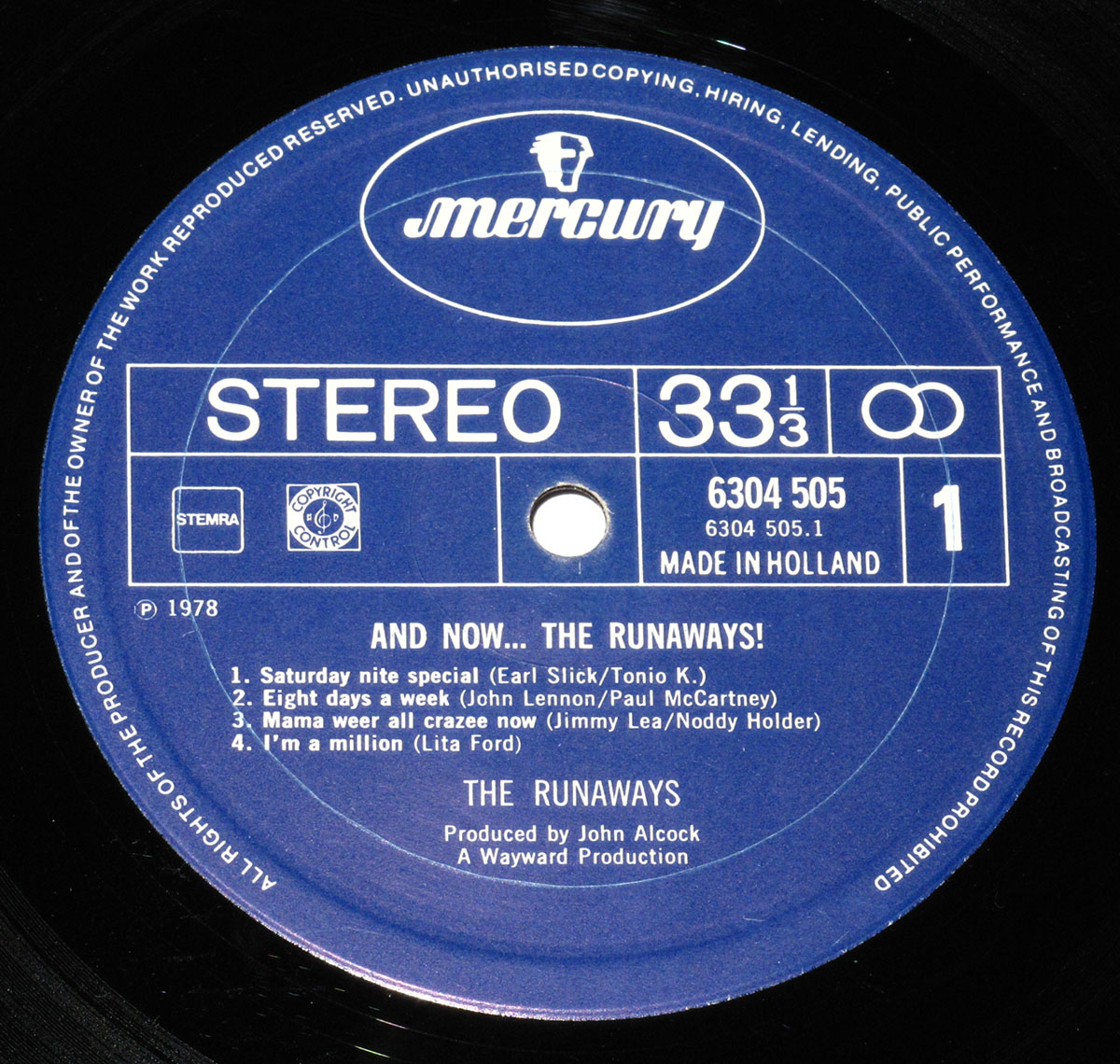
This is a close-up of the Side One record label from the Dutch pressing of “And Now… The Runaways”. The label uses Mercury’s deep blue background with crisp white print, a design chosen for clarity and durability rather than decoration. At the very top sits the classic Mercury logo inside an oval: a stylized classical head profile, derived from the Roman god Mercury, traditionally used by the label to signal authority, distribution reach, and brand recognition across Europe.
Dominating the upper half are bold boxed fields reading STEREO and 33⅓, making playback format unmistakable even in low light. To the right, the catalog number 6304 505 is printed clearly, with a side indicator “1” confirming this is Side One. Below that, MADE IN HOLLAND is stated plainly, an essential marker for collectors tracking pressing origin and manufacturing quality.
The track list is laid out in a neat, left-aligned column, numbered and easy to read, including songwriter credits in parentheses. This practical layout reflects late-1970s European Mercury standards, prioritizing legibility over visual flair. Around the outer rim runs dense copyright text in English, warning against unauthorized copying, lending, and broadcasting, a common but important legal detail of the era.
Minor spindle marks are visible around the center hole, consistent with careful use rather than abuse. The print remains sharp, the ink even, and the blue tone stable, indicating a well-preserved original pressing rather than a later reissue.
This Mercury label reflects the late-1970s European house style: clean, functional, and instantly recognizable. The design emphasizes format, cataloging, and legal clarity, reinforcing Mercury’s role as a major international record company rather than a niche or boutique label. This particular label design was used by Mercury during the late 1970s.
All images on this site are photographed directly from the original vinyl LP covers and record labels in my collection. Earlier blank sleeves were not archived due to past storage limits. Photo quality varies because the images were taken over several decades with different cameras. You may use these images for personal or non-commercial purposes if you include a link to this site; commercial use requires my permission. Text on covers and labels has been transcribed using a free online OCR service.
This album hits like a band slamming the brakes without killing the engine. In 1978, The Runaways tightened their sound, swapping pure teenage shock for harder riffs and more control. Joan Jett’s rhythm guitar keeps things tough and grounded, while Lita Ford adds extra bite up front. It’s glam-leaning hard rock with proto-punk nerve—less chaos, more muscle, still plenty of attitude.
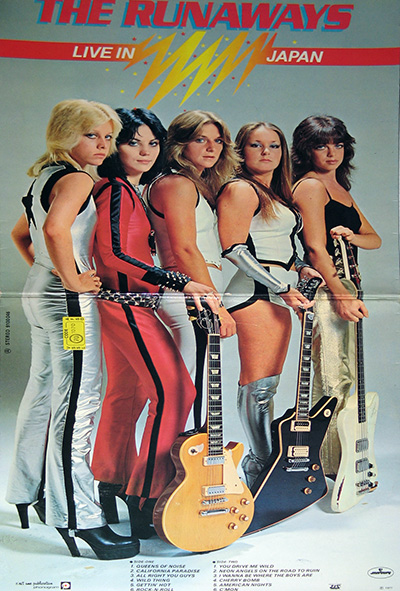
The album "Live in Japan" was originally released only in Japan, and some other regions including; Canada, Australia, New Zealand and the Netherlands. It was not intended for release in the United States or the United Kingdom.
RUNAWAYS - Live in Japan (1977, France) RUNAWAYS - Live in Japan (1977, Holland)
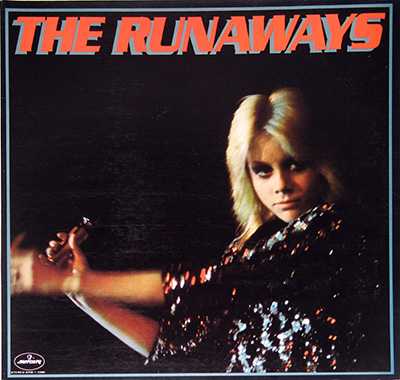
The Runaways' 1976 self-titled debut on 12" vinyl is a high-energy blast of punk-infused rock. Fronted by Joan Jett and Cherie Currie, anthems like "Cherry Bomb" made them one of the first successful all-female rock bands.
RUNAWAYS - S/T Self-Titled 12" Vinyl LP
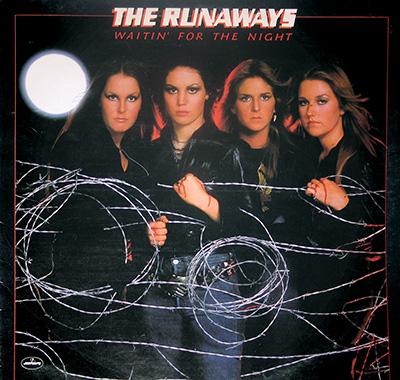
Released in 1977, "Waitin' For The Night" is a vinyl record featuring The Runaways' raw hard-rock sound. It showcases early contributions from Joan Jett and Lita Ford, who became rock icons.
Waitin' For The Night 12" Vinyl LP