- 1969 Danish Acid/Psych Prog Rock – German Polydor Release
"Savage Rose: In The Plain" blooms into existence on the 12" Vinyl LP Album, a 1968 masterpiece by the Danish Acid/Psych Prog Rock band. This album represents the second official studio endeavor by Savage Rose, capturing the essence of a transformative era. With a fusion of acid, psych, and prog rock elements, the band creates a sonic landscape that transcends conventional boundaries. "In The Plain" stands as a timeless testament to Savage Rose's innovation and musical exploration.
Every time I listen to “In The Plain” on my stereo, it hits me how fearless Savage Rose were in this moment. The album feels like a band refusing gravity, pulling 1969 into its own swirling orbit. There’s a raw confidence here — a mix of innocence and ambition — that still feels startlingly alive.
The late sixties had Denmark humming with counterculture energy, even if it wasn’t as loud or chaotic as London or San Francisco. Young artists were chasing new freedoms, and Savage Rose plugged directly into that current. While British bands stretched rock into cosmic epics, these Danes carved their own path: short, emotional bursts carried by Annisette’s volcanic voice and Thomas Koppel’s classical backbone.
By the time they recorded this album, the Koppels were already operating like their own creative weather system. Thomas and Anders shaped the musical skeleton; Annisette brought the fire; and “Maria,” credited only by her first name, added the harpsichord and piano textures that softened the sharper edges. The human story behind the scenes wasn’t smooth — more like a quietly smoldering triangle — but that tension helped define the record’s atmosphere.
The album blends acid-psych haze with something almost ancient — folk moods, hymnal harmonies, and delicate classical touches. One moment the guitars drift like fog; the next moment Annisette tears straight through with a voice that feels too unrestrained for the studio walls. Songs like “I’m Walking Through the Door” and “Ride My Mountain” hit with emotional urgency, while “Evening’s Child” floats in with a fragile softness that lingers long after the last note.
In 1969, the world was busy with giants like “In the Court of the Crimson King” and “Volunteers,” but Savage Rose didn’t try to imitate any of that. Their sound carried a European soulfulness — psychedelic, yes, but grounded in melody and emotion instead of jammed-out cosmic spirals. It felt intimate in a way few psych records dared to be.
Collectors eventually run into the quiet drama behind this era: Thomas was still married to Ilse Maria while gradually moving closer to Annisette. It never became tabloid chaos, but you can sense it in the arrangements. Maria’s harpsichord has a steady, almost composed presence, while Annisette sings with a kind of unleashed conviction. The studio must have been intense — charged but incredibly focused.
Critics weren’t sure where to place the band back then. Too emotional for pure psych, too unconventional for pop, too compact for the prog crowd. But listeners who understood what the band were reaching for held onto this album tightly. Over the years, it became one of those records people talk about quietly at fairs — not obscure, but appreciated by those who listen beyond surface impressions.
Rare Danish Acid/Psych Prog Rock
A distinctly European blend of psychedelic rock, folk-inspired melodies, and classical flourishes. Unlike the heavier UK/US psych of the same era, Savage Rose built their sound around emotional vocals, harpsichord textures, and dramatic organ lines — a style that set them apart in the late-60s psych landscape.
Polydor – Cat#: 2459 326
Standard 12" Vinyl LP Album Cover
12" Vinyl Stereo Full-Length Long-Play Gramophone Record
Total Weight: 230g
Recorded in 1968 – Released in Germany during 1969
Every time I pull out an original Polydor pressing of In the Plain, my eyes land on that tiny credit: “Maria – harpsichord, piano.” No surname, no clue, just a single name dropped into the lineup like everyone automatically knew who she was. That tiny mystery used to drive me nuts, so I dug into it properly. “Maria” is actually Ilse Maria Lanser, later known as Ilse Maria Koppel, Thomas Koppel’s first wife and one of the quiet engines of Savage Rose’s early sound.
Back then the band loved this loose, almost communal style of crediting. First names only, no fuss, no hierarchy. It fits the vibe of those years: young, experimental, and too wrapped up in the music to worry about formalities. But once you know who Maria really is, the harpsichord lines and piano touches suddenly click into place. They add a kind of fragile warmth you only notice after spinning the album a few dozen times.
For a detail-obsessed collector like me, this is the kind of thing that makes early Savage Rose pressings irresistible. Most people flip past the name without a second thought, but the story behind it says everything about how interconnected that early circle was. One word on the sleeve, and suddenly you’re staring at a whole piece of the band’s history hiding in plain sight. That’s exactly why I keep chasing these original copies — every tiny detail rewards another listen.
Disclaimer: Track durations are not listed on this German 1969 Polydor pressing. Variations may exist between original Danish issues, German releases, and later reissues due to differing masterings and regional production adjustments.
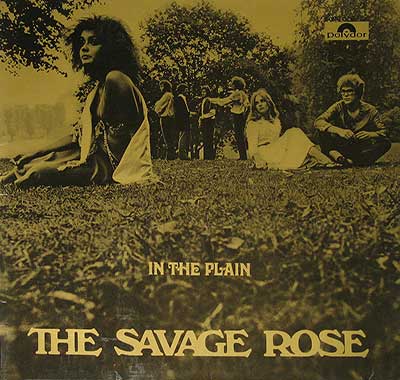
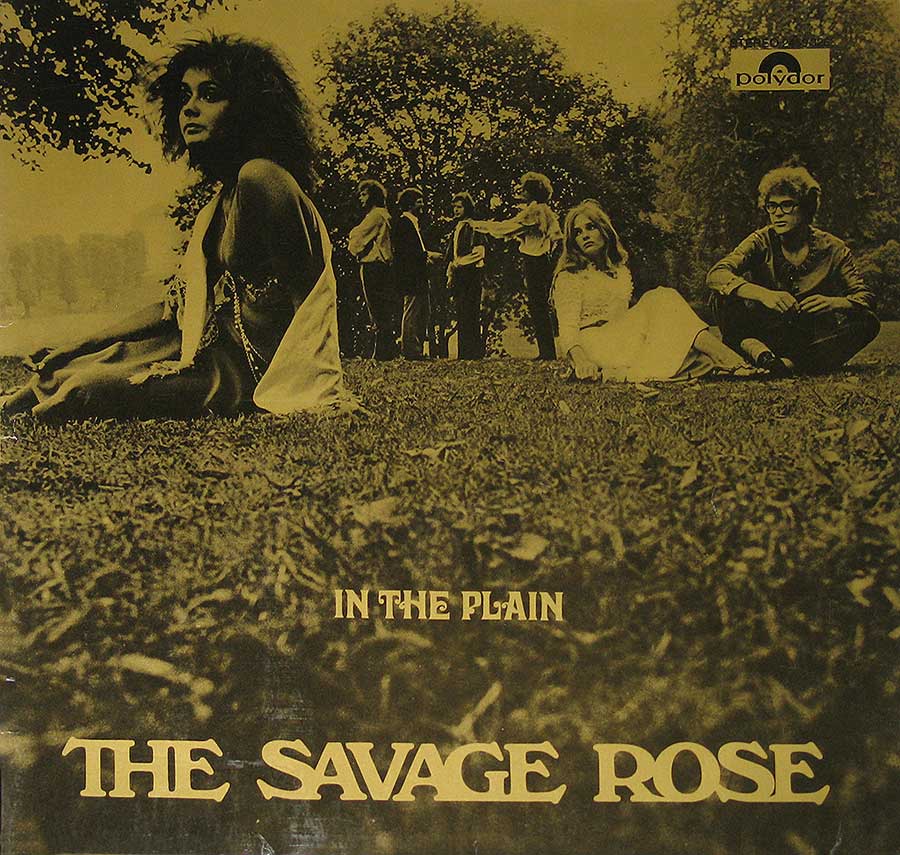
The front cover of the German 1969 Polydor pressing sets a very specific mood: an earthy, sepia-toned photograph taken outdoors, with the band arranged across varying depths of field. Annisette sits in the left foreground, dominating the composition with her posture angled slightly away from the camera and her loose dress catching the scattered daylight. The texture of the grass is sharply defined, giving the lower third of the sleeve a gritty, tactile quality that collectors immediately recognize on well-preserved copies.
A second focal point sits to the right: a woman in white apparel seated on the ground, positioned beside a male band member wearing round glasses. Their placement creates a balanced triangular structure that keeps the viewer’s eye moving across the frame. In the background, the remaining musicians stand in a loose line near a tree, their forms slightly softened by distance and the matte printing characteristic of late-60s Polydor covers. The band name appears in bold cream-colored serif type at the bottom, while the album title In The Plain floats just above it in a condensed ornate font.
The Polydor logo in the upper right corner confirms this as the German 1969 issue, with its crisp black-on-yellow contrast aligning with other Polydor layouts from that period. Every visual cue — from the monochrome palette to the outdoor staging — reflects the band’s early aesthetic: raw, communal, and slightly unconventional. This cover remains a key reference point when identifying original European variants, especially for collectors who track printing differences between German and Danish releases.
Step into the most intimate Savage Rose moment ever caught on film. This deep-dive into the “In The Plain” album cover unpacks hidden chemistry, late-60s visual storytelling, and the emotional layers behind Annisette and Thomas’s quiet gravity. Discover why this photo reveals more than the music alone ever could.
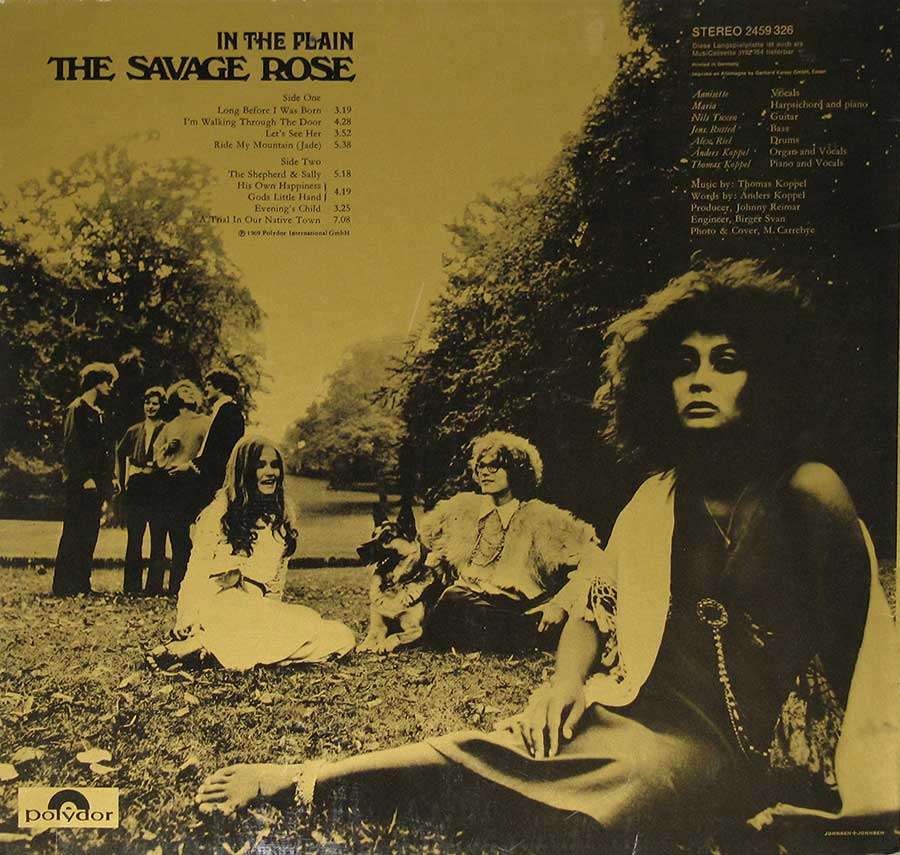
The back cover of the German 1969 Polydor pressing presents a dense combination of sepia-toned photography and essential album data, laid out in the restrained but unmistakable Polydor house style of the late sixties. The band is again posed outdoors, sitting and standing across a wide stretch of park grass. A man in a fur-like vest sits beside a dog near the center-right, while Annisette dominates the far right foreground with her intense expression and dramatic hair, anchoring the composition with a stronger sense of presence than the rest of the group.
The full tracklisting for Side One and Side Two appears in the upper left quadrant, set in a condensed serif font with clean spacing between song titles and durations. Above it, the album title In The Plain and the band name appear in bold cream lettering. On the right side sits a complete musician roster, listing vocals, guitar, bass, drums, organ, piano, and harpsichord exactly as performed on the album, including the early single-name credit “Maria,” a detail of real interest for collectors tracking variations of Ilse Maria Koppel-Lanser’s early appearances.
The Polydor catalog number 2459 326 and the STEREO designation occupy the top-right corner, printed with the crispness typical of German Polydor production during this era. The bottom-left corner includes the Polydor logo, confirming the pressing’s origin. The photograph stretches across the entire sleeve without framing borders, adding to the raw, naturalistic feel that defines the first run of European editions. This layout, combined with the matte finish, remains a reliable reference when authenticating original copies and distinguishing them from later reprints.
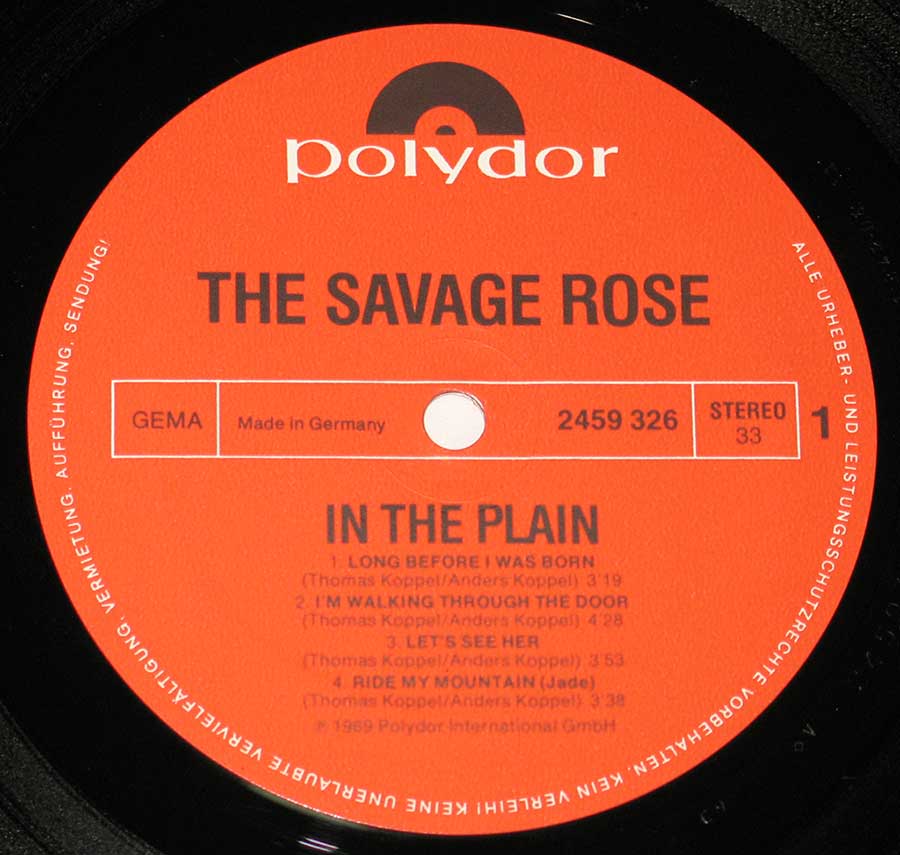
The Side One label of the German 1969 Polydor pressing features the classic deep-red Polydor design that collectors instantly recognize. The logo sits at the top in bold white lettering with the familiar black semi-circle emblem above it. Directly beneath that, the band name THE SAVAGE ROSE appears in large uppercase type, sharply printed and centered. The layout is clean and symmetrical, typical of late-60s Polydor production.
The GEMA rights designation appears in a white-lined box on the left, paired with the “Made in Germany” marking. On the right side, the catalog number 2459 326 and the STEREO 33 speed designation are printed inside matching white boxes, both elements confirming this as the original 1969 German issue. The precision of these boxes, including the thickness of the border lines, is often used by collectors to distinguish authentic pressings from later reprints.
The tracklist for Side One is printed in the lower half, starting with “Long Before I Was Born” and followed by three additional titles, each credited to Thomas and Anders Koppel. The text remains crisp and evenly spaced, with no ink bleed — a detail that speaks to Polydor’s consistent print standards of the era. Around the outer rim, the German copyright warning circles the label in fine white text, adding another reliable authenticity marker for collectors comparing regional variations.
All images on this site are photographed directly from the original vinyl LP covers and labels in my collection. Earlier generic sleeves were not archived due to storage limitations, and Side Two labels are omitted when they contain no collector-relevant details. Photos vary in lighting quality because they were taken over multiple decades with different camera equipment. You may use these images for non-commercial purposes with credit to this site; commercial use requires permission.
Savage Rose has always been one of those bands where the music tells the story faster than any biography. The group formed in 1967, and the creative pulse came straight from Thomas and Anders Koppel. Their combination of classical training, raw experimentation, and absolute conviction is what shaped the band’s entire identity.
Thomas was the main architect of that early sound. His piano work and compositions gave the band its emotional core, while Anders handled organ, percussion, and the unusual textures that helped Savage Rose stand out in the late-60s psychedelic scene. They didn’t do it alone, though — the original lineup included several other musicians whose playing gave those first albums their depth.
Before things shifted, Thomas was married to Ilse Maria Lanser (later known as Ilse Maria Koppel). She contributed to the band’s early recordings, adding subtle but important colors like harpsichord and vocal layers. These details are exactly what pull me back into the vinyl sleeves again and again, especially when comparing early Polydor pressings.
From the very beginning, the unmistakable voice at the front was Annisette Hansen. She didn’t arrive later — she was part of the initial formation, and her voice was the emotional spearhead of everything Savage Rose recorded. That mix of vulnerability and attack gave the band its identity long before any personal relationships developed behind the scenes.
Over time, the creative bond between Thomas and Annisette grew into a personal partnership, and they eventually married. That connection kept the heart of Savage Rose remarkably stable across decades, even as lineups shifted and the musical landscape changed. Their shared artistic drive is a big part of why the band’s early catalog still feels so focused and fearless.
Albums like “In the Plain” (1968, their second studio record) and “Refugee” (1971, their fifth) show exactly how quickly the band evolved. The blend of psychedelic rock, folk, classical influences, and gospel energy makes these records a joy to handle as a collector. Every pressing variation — Polydor layouts, RCA Victor label fonts, dead-wax etchings — adds another layer to the story.
Whenever I study those sleeves and spin those records, it becomes clear how tightly the band’s personal history is woven into its sound. The family connections, the lineup changes, the push toward new musical territory — it all reinforces why Savage Rose remains one of Denmark’s most distinctive contributions to late-60s and early-70s rock.
Co-founder, pianist, composer. Married first to Ilse Maria, later to Annisette.
Early contributor (harpsichord, vocals). First wife of Thomas.
Ilse Maria Koppel → Ilse Maria Lanser
Lead vocalist and founding member. Later married Thomas.
"Anisette always sparks the same memory for me: a tiny bar in Marseille where the bartender swore it was “sunshine in a glass.” The drink was so sweet and perfumed it felt like liquefied licorice candy, and the locals tossed it back effortlessly. Every sip came with a lecture about tradition, pride, and how people like me never fully understand it."
Annisette Koppel → Annisette Hansen
Polydor 2459 326 , 1969 , Germany
"In The Plain" drops into that dreamy zone where acid-psych meets chamber-like drama, with Annisette driving the whole thing using vocals that feel one breath away from combustion. The Koppel brothers lock in those haunting melodic lines that make the album feel both raw and strangely elegant. A standout Polydor issue that still hits harder than most late-60s psych releases.
Gregar Records / RCA Victor LSP-10353 / ATRS-5847 , Germany
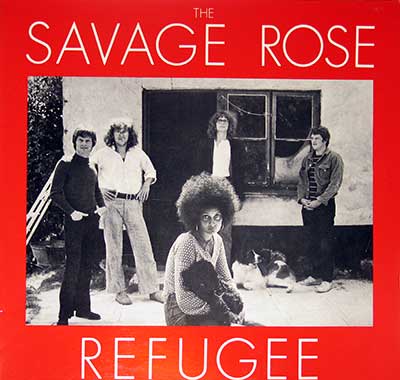
"Refugee" is the fifth studio album by Danish Acid/Psych Prog Rock band Savage Rose, released in 1971. The record expands their dramatic sound with more elaborate arrangements and intense vocal work, marking a pivotal moment in their early catalogue.