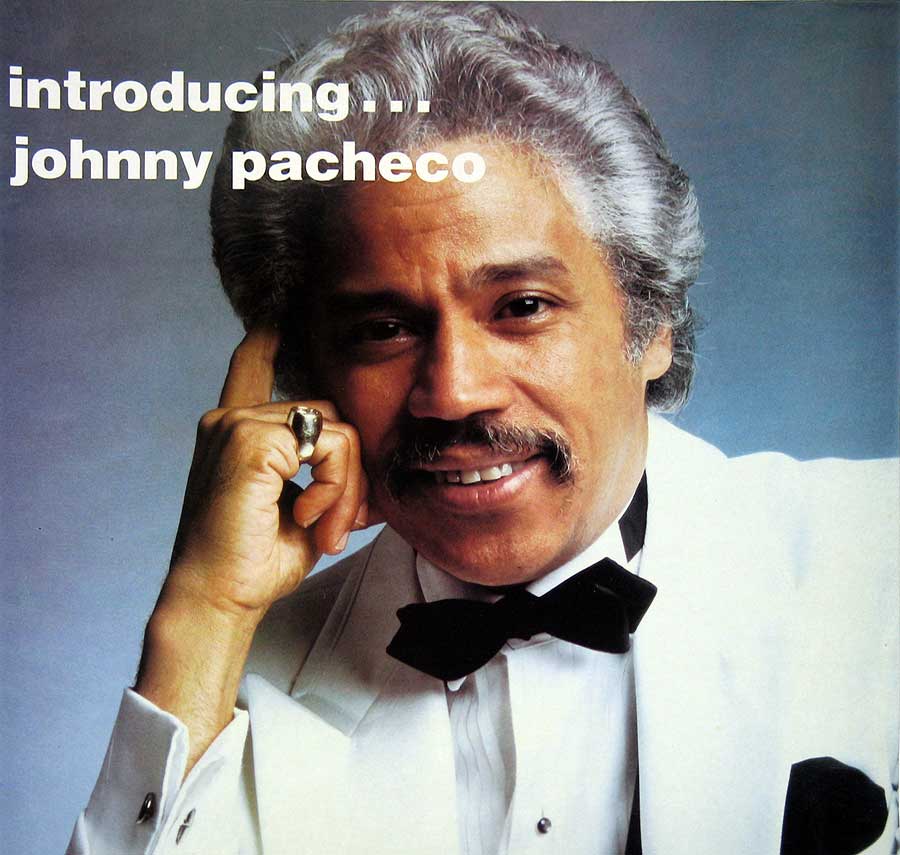
Johnny Pacheco - Introducing Johnny Pacheco Caliente Records 12" Vinyl LP Album

- The tuxedoed salsa boss: one compilation, ten tracks, zero chill—flute waiting.

Album Front cover Photo of Johnny Pacheco - Introducing Johnny Pacheco Caliente Records 12" Vinyl LP Album https://vinyl-records.nl/

Front cover is a close studio portrait: Johnny Pacheco in a white tuxedo and black bow tie, salt-and-pepper hair and moustache, smiling with his cheek resting on his ringed hand. Bold white text reads “introducing… johnny pacheco” on a blue-gray backdrop.

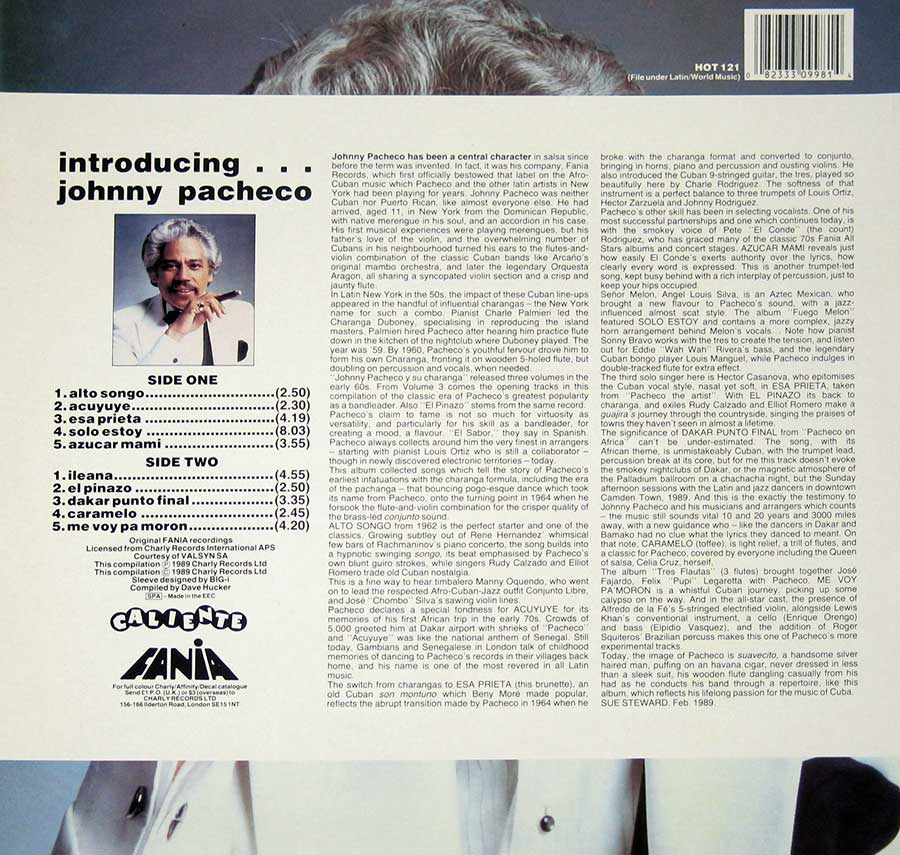
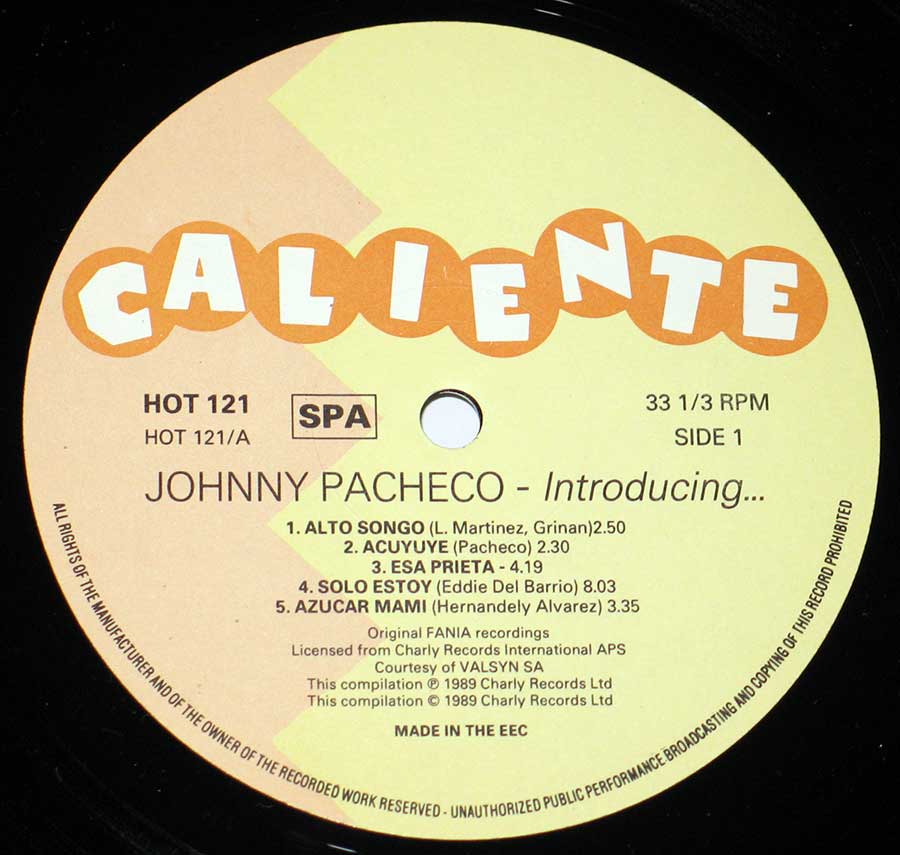
This page is the practical stuff collectors actually use: clear photos of the covers, sleeves, and labels, plus the production credit, catalog number (Caliente HOT 121), country/year (1989 Made in EEC), and a full track list split by side. No mysticism, no “legacy” sermon—just everything you need to pin down this release and move on to the next record.

"Introducing Johnny Pacheco" (1989) Album Description:

I’ve got a soft spot for compilations that don’t act polite and call it “curation.” "Introducing Johnny Pacheco" hits like someone shoved the doors open and let the whole room spill out: flute riding high, percussion snapping underneath, and not a second wasted trying to charm you into listening. It’s 1989, it’s Caliente HOT 121, and the record doesn’t ask permission before it starts moving.

1989 in the air: shine on the surface, sweat underneath

Late ’80s Latin releases could come dressed up—clean fonts, cleaner edges, romance drifting into places that used to be all elbows and percussion. Fine. People fall in love, the radio wants hooks, the world keeps turning. But a Pacheco set like this still feels built for rooms with bodies in them, not for polite listening at half volume while someone explains “cultural importance” over cheese cubes.

This particular issue—UK, Caliente imprint, Charly sound copyright floating around the label copy—smells like that Charly-world approach: grab the right material, line it up so it plays like a proper night, and get it out where people can actually buy it. Not glamorous. Effective. Sometimes that’s the whole job.

Genre context: where this sits when the salsa aisle gets crowded

Put this next to the heavy talkers and the architects and you hear what Pacheco does differently. Willie Colón and Rubén Blades could turn a tune into a street argument. Eddie Palmieri builds rhythm like scaffolding. Tito Puente comes in with that brass-and-timbales authority. Celia Cruz can light a whole block with one shout.

Pacheco? He drives. The flute isn’t decoration—it’s a steering wheel. He keeps the band pointed forward, even when the rhythm section is trying to drag the car sideways.

  • Against late-’80s smoothness: this stays sharper, more bandstand than bedroom.
  • Against the grand statement makers: less speech, more motion.
  • Against the jazz-leaning experiments: the brain stays employed, but the hips get the paycheck.
The sound: flute that cuts, percussion that argues back

The flute tone here isn’t the polite conservatory thing. It’s bright, quick, a little cocky—like it knows it can slice through horns and still land on its feet. Under it, the groove doesn’t “support” anything. It pushes. It shoves. It keeps poking you in the ribs until you stop standing there like a statue.

The tempos feel dancer-first: not rushed, not lazy—just that relentless forward roll where the pocket keeps tightening, then loosening, then tightening again. You can hear the band breathe together, the way good rhythm sections do when they’re watching the floor instead of worshipping the click track.

Track-listing, but as nightlife

Side One comes out swinging: "Alto Songo" opens the door, "Acuyuye" slips through the crowd, "Esa Prieta" keeps the room honest. Then "Solo Estoy" stretches out—longer, moodier, the kind of track that lets the band lean back and still keep the tension humming. "Azucar Mami" sweet-talks for about half a second, then gets right back to work.

Side Two doesn’t drift. "Ileana" brings a broader breath, then "El Pinazo" snaps you back into the tighter frame. "Dakar Punto Final" and "Caramelo" feel like the moment the band realizes the room’s still with them and decides to press harder. "Me Voy Pa Moron" closes like a last grin on the way out—no bow, no thanks-for-coming speech.

Key people: what they practically contributed

Johnny Pacheco—Dominican-born, New York-shaped, the kind of bandleader who doesn’t need to shout to make the band obey—runs this thing with arranger instincts and a performer’s timing. His playing isn’t floating above the rhythm; it’s leaning into it, pulling it, daring it to keep up.

The only named credit you’ve got on the page is Dave Hucker tied to Charly Records, and the safest, most honest way to frame that is this: he’s the hands-on “put it together” guy. Selection. Ordering. Notes. The unsexy work that makes a compilation feel like a set instead of a random bag of tracks dumped on your lap.

Band events, minus the boring timeline

Trying to talk about Pacheco like he’s a fixed rock lineup misses the point. His world is charanga and salsa culture—players rotate, singers rotate, the scene shifts, the rooms change. Cause and effect isn’t “so-and-so quit.” It’s “the dance changed, so the band changed,” and the leader who survives is the one who can keep the music tight without freezing it in place.

Controversy: nothing dramatic, just the usual bad assumptions

No big public scandal hangs off this release—no famous ban, no tabloid fight worth framing on the wall. The real problem is smaller and more annoying: people treat compilations like they’re biographies. Ten tracks do not explain a life. They open a door. Whether you walk through it is your problem.

Another dumb assumption: flute-led salsa must be “lighter.” Put this on loud. Listen to the percussion argue with your heartbeat. Then tell me it’s light with a straight face.

One quiet personal anchor

I can see this record in a scuffed “LATIN” bin with a hand-written price tag, filed under “P” because somebody couldn’t be bothered with first names. You take it home, drop the needle, and your living room immediately starts acting like it paid a cover charge.
References

Album Description & Collectors information: 

Music Genre:

Salsa

Album Production Information:

The album: "Introducing JOHNNY PACHECO" was produced by:
Dave Hucker - Charly Records

Record Label & Catalognr:

Caliente HOT 121

Media Format:

12" LP Vinyl Stereo Gramophone Record

Total Album (Cover+Record) weight: 230 gram

Year & Country:

1989 Made in EEC

Transcript of the Liner Notes

Johnny Pacheco has been a central character in salsa since before the term was invented. In fact, it was his company, Fania Records, which first officially bestowed that label on the Afro-Cuban music which Pacheco and the other latin artists in New York had been playing for years. Johnny Pacheco was neither Cuban nor Puerto Rican, like almost everyone else. He had arrived, aged 11, in New York from the Dominican Republic, with native merengue in his soul, and an accordion in his case. His first musical experiences were playing merengues, but his father's love of the violin, and the overwhelming number of Cubans in his neighbourhood turned his ears to the flutes-and-violin combination of the classic Cuban bands like Arcaño's original mambo orchestra, and later the legendary Orquesta Aragon, all sharing a syncopated violin section and a crisp and jaunty flute.

In Latin New York in the 50s, the impact of these Cuban line-ups appeared in the handful of influential charangas — the New York name for such a combo. Pianist Charlie Palmieri led the Charanga Duboney, specialising in reproducing the island masters. Palmieri hired Pacheco after hearing him practise flute down in the kitchen of the nightclub where Duboney played. The year was '59. By 1960, Pacheco's youthful fervour drove him to form his own Charanga, fronting it on wooden 5-holed flute, but doubling on percussion and vocals, when needed. "Johnny Pacheco y su charanga" released three volumes in the early 60s. From Volume 3 comes the opening tracks in this compilation of the classic era of Pacheco's greatest popularity as a bandleader. Also "El Pinazo" stems from the same record.

Pacheco's claim to fame is not so much for virtuosity as versatility, and particularly for his skill as a bandleader, creating a mood, a flavour. "El Sabor", they say in Spanish. Pacheco always collects around him the very finest arrangers — starting with pianist Louis Ortiz who is still a collaborator — though in newly discovered electronic territories — today. This album collects songs which tell the story of Pacheco's earliest infatuations with the charanga formula, including the era of the pachanga — that bouncy pogo-esque dance which took its name from Pacheco, onto the turning point in 1964 when he forsook the flute-and-violin combination for the crisper quality of the brass-led conjunto sound.

ALTO SONGO from 1962 is the perfect starter and one of the classics. Growing subtly out of Rene Hernandez' whimsical few bars of Rachmaninov's piano concerto, the song builds into a hypnotic swinging songo, its beat emphasised by Pacheco's own blunt guiro strokes, while singers Rudy Calzado and Elliot Romero trade old Cuban nostalgia. This is a fine way to hear timbalero Manny Oquendo, who went on to lead the respected Afro-Cuban-Jazz outfit Conjunto Libre, and José "Chombo" Silva's sawing violin lines.

Pacheco declares a special fondness for ACUYUYE for its memories of his first African trip in the early 70s. Crowds of 5,000 greeted him at Dakar airport with shrieks of "Pacheco" and "Acuyuye" was like the national anthem of Senegal. Still today, Gambians and Senegalese in London talk of childhood memories of dancing to Pacheco's records in their villages back home, and his name is one of the most revered in all Latin music.

The switch from charangas to ESA PRIETA (this brunette), an old Cuban son montuno which Beny More made popular, reflects the abrupt transition made by Pacheco in 1964 when he broke with the charanga format and converted to conjunto, bringing in horns, piano and percussion and ousting violins. He also introduced the Cuban 9-stringed guitar, the tres, played so beautifully here by Charle Rodriguez. The softness of that instrument is a perfect balance to three trumpets of Louis Ortiz, Hector Zarzuela and Johnny Rodriguez.

Pacheco's other skill has been in selecting vocalists. One of his most successful partnerships and one which continues today, is with the smokey voice of Pete "El Conde" (the count) Rodriguez, who has graced many of the classic 70s Fania All Stars albums and concert stages. AZUCAR MAMI reveals just how easily El Conde's exerts authority over the lyrics, how clearly every word is expressed. This is another trumpet-led song, kept busy behind with a rich interplay of percussion, just to keep your hips occupied.

Señor Melon, Angel Louis Silva, is an Aztec Mexican, who brought a new flavour to Pacheco's sound, with a jazz-influenced almost scat style. The album "Fuego Melon" featured SOLO ESTOY and contains a more complex, jazzy horn arrangement behind Melon's vocals. Note how pianist Sonny Bravo works with the tres to create the tension, and listen out for Eddie "Wah Wah" Rivera's bass, and the legendary Cuban bongo player Louis MangueI, while Pacheco indulges in double-tracked flute for extra effect.

The third solo singer here is Hector Casanova, who epitomises the Cuban vocal style, nasal yet soft, in ESA PRIETA, taken from "Pacheco the artist". With EL PINAZO it's back to charanga, and exiles Rudy Calzado and Elliot Romero make a guajira's journey through the countryside, singing the praises of towns they haven't seen in almost a lifetime.

The significance of DAKAR PUNTO FINAL from "Pacheco en Africa" can't be underestimated. The song, with its African theme, is unmistakeably Cuban, with the trumpet lead, percussion break at its core, but for me this track doesn't evoke the smokey nightclubs of Dakar, or the magnetic atmosphere of the Palladium ballroom on a chachacha night, but the Sunday afternoon sessions with the Latin and jazz dancers in downtown Camden Town, 1989. And this is exactly the testimony to Johnny Pacheco and his musicians and arrangers which counts — the music still sounds vital 10 and 20 years and 3000 miles away, with a new guidance who — like the dancers in Dakar and Bamako had no clue what the lyrics they danced to meant.

On that note, CARAMELO (toffee) is light relief, a trill of flutes, and a classic for Pacheco, covered by everyone including the Queen of salsa, Celia Cruz, herself.

The album "Tres Flautas" (3 flutes) brought together José Fajardo, Felix "Pupi" Legarreta with Pacheco. ME VOY PA MORON is a wistful Cuban journey, picking up some calypso on the way. And in the all-star cast, the presence of Alfredo de la Fé's 5-string electrified violin, alongside Lewis Khan's conventional instrument, a cello (Enrique Orengo) and bass (Elpidio Vasquez), and the addition of Roger Squieros' Brazilian percus makes this one of Pacheco's more experimental tracks.

Today, the image of Pacheco is suavecito, a handsome silver haired man, puffing on an havana cigar, never dressed in less than a sleek suit, his wooden flute dangling casually from his hand as he conducts his band through a repertoire, like this album, which reflects his lifelong passion for the music of Cuba.

SUE STEWARD. Feb. 1989.

Complete Track Listing of: "Introducing JOHNNY PACHECO"

The Songs/tracks on "Introducing JOHNNY PACHECO" are

    Side One:
  1. Alto Songo
  2. Acuyuye
  3. Esa Prieta
  4. Solo Estoy
  5. Azucar Mami
    Side Two:
  1. Ileana
  2. El Pinazo
  3. Dakar Punto Final
  4. Caramelo
  5. Me Voy Pa Moron