- ORIGINAL Colombian Pressing
"Mi Carrito" is a 12" Vinyl LP album by Lisandro Meza, showcasing his Colombian musical talent. Produced by Julio Segundo Villa, the album encapsulates the vibrant rhythms and melodies of Colombian music. Lisandro Meza's distinctive style shines through in this collection, making it a cherished addition to the world of Latin music
Lisandro Meza y su Conjunto didn’t make "Mi Carrito" to be “background music” - this one is built to move bodies and reset moods. It’s a 1985 Colombian cumbia LP that feels like sunlight hitting a dusty street, right when the party finally starts. Put it on and the room immediately develops hips.
Mid-’80s Colombia is where dance music wasn’t a luxury - it was survival, community, and a little bit of rebellion without needing a manifesto. In Medellin, Colombia, labels like Sonolux were documenting the everyday heartbeat: regional styles, bandstand energy, and songs meant to live outside the studio. This record belongs to that real-world tradition - the kind that gets worn down by love, not by collectors wearing gloves.
Meza had already earned his stripes as a key voice in cumbia’s evolution, with roots in accordion-driven styles and the kind of band experience you don’t get from sitting politely in a rehearsal room. The page notes his early profile as a founding member of Los Corraleros de Majagual, that legendary breeding ground that also connects to names like Fruko. By the time "Mi Carrito" rolls in, you’re hearing an artist who knows exactly how to aim joy like a dart.
The production side keeps it grounded: Julio Segundo Villa as producer, and Gabriel Alzate C. handling mezcla y corte - mixing and cutting that turns a band’s sweat into something a needle can translate. It’s the classic “get in, capture the spark, don’t overthink it” energy, the opposite of modern music’s obsession with polishing the life out of everything.
The album description calls Meza’s style a cross between rural Dominican merengue, Louisiana zydeco, and Tex-Mex norteño - and yeah, that’s weirdly accurate, like a passport full of stamps that still somehow matches your face. The accordion leads, but it doesn’t hog the spotlight; it steers the groove like a confident driver who doesn’t need to slam the horn. Everything feels designed for motion: dance-floor momentum, smiles you can hear, and melodies that stick like warm humidity.
The title track "Mi Carrito" is the obvious flag planted in the ground - catchy, proud, and built for repeat plays until your neighbors start accidentally learning the chorus. Tracks like "La Kakunanga" and "El Pasado Ya Paso" (even the title screams “keep moving”) sell the album’s emotional range: playful on the surface, quietly lived-in underneath. Flip to Side Two and you get that sweet ache in "Esperando Una Llamada" and "Corazon Herido" - proof this isn’t just party fuel, it’s real life wearing dancing shoes.
In the mid-’80s cumbia world, plenty of records chased polish or leaned hard into formula - clean, safe, instantly forgettable. "Mi Carrito" lands closer to the lived-in side: human timing, band chemistry, and that accordion tone that feels like it’s grinning at you. The page doesn’t list peer albums from 1985, so I’m not going to name-drop “comparisons” like I’m bluffing my way through a record fair.
No dramatic soap-opera notes are spelled out on the page, but the record itself sounds like a unit that understands the job: lock the rhythm, let the melody flirt, never lose the dance-floor thread. This is ensemble thinking - the kind where everyone leaves space, because the groove is the boss. If there were tensions, they got converted into forward motion, which is honestly the healthiest possible outcome for musicians.
The page frames Lisandro Meza as a major figure in cumbia’s evolution, and "Mi Carrito" reads like evidence rather than a claim. It’s the sort of LP that survives because it works: on a good system, on a cheap system, at a family party, or alone at night when you want the room to feel less quiet. As an original Colombian pressing, it also has that collector magic - not because it’s “rare” for internet points, but because it’s a real artifact of place and time.
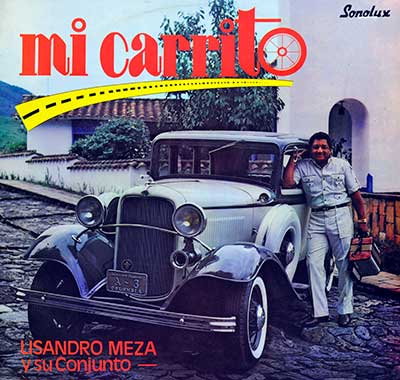
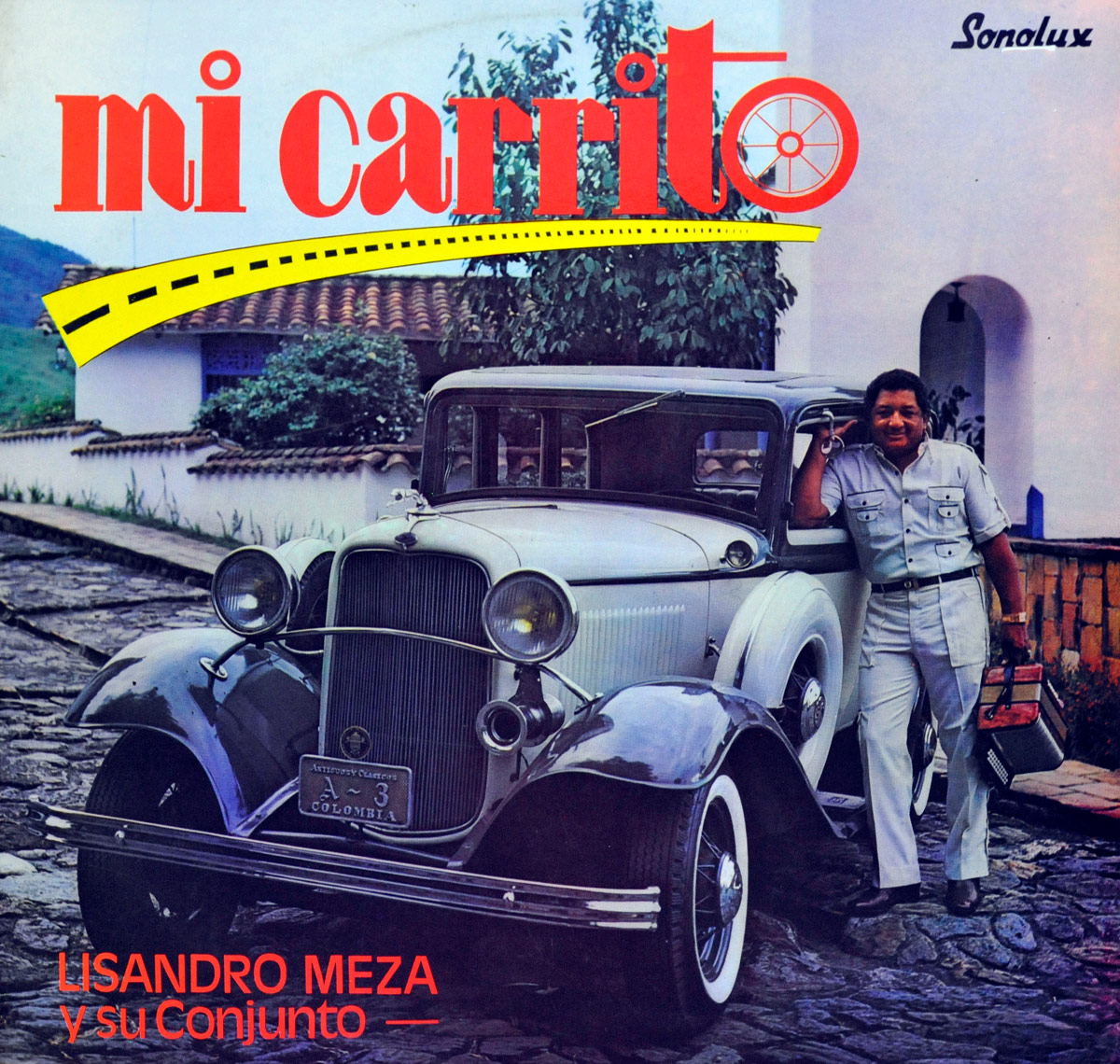
The cover says it all: Meza leaning on that classic car, key in hand, accordion ready - like he’s about to drive the whole neighborhood straight into a better mood. With photography credited to Camilo Moreno and even the “classic car” shout-out to Herman Gutierrez Maya, this sleeve feels proudly everyday, not manufactured mystique. Decades later, these grooves still smell faintly of warm pavement, crowded rooms, and the kind of optimism you only get when the rhythm refuses to let you sit still.
Cumbia
Sonolux – Cat#: 01(0131)01398
Record Format: 12" Vinyl Stereo Gramophone Record
Total Weight: 230g
1985 – Made in Medellin Colombia
The steady hand that keeps this whole LP dancing in a straight line. Read more...
Julio Segundo Villa shapes "Mi Carrito" by keeping the music focused on momentum rather than studio gloss. The performances stay tight but never stiff, allowing Lisandro Meza’s accordion to lead naturally without overpowering the ensemble. The album flows with purpose from track to track, balancing festive energy with emotional warmth. This kind of production discipline turns a collection of songs into a full night of dancing.
The mix-and-cut work that lets the groove hit hard without turning muddy. Read more...
Gabriel Alzate C. delivers a mezcla y corte that translates cumbia’s physical movement directly to vinyl. The accordion sits forward and lively, the rhythm section snaps without crowding the mix, and the low end stays clean and controlled. Choruses remain energetic but readable, even at volume. This careful balance ensures the record stays punchy on turntables without sacrificing warmth or clarity.
The sleeve image that sets the mood long before the needle drops. Read more...
Camilo Moreno’s photography frames "Mi Carrito" as everyday Colombian life with confidence and pride. The image communicates movement, personality, and accessibility rather than staged glamour. That visual tone mirrors the music’s openness and celebratory spirit. The cover works as an invitation, signaling that this album belongs on turntables, not behind glass.
A visual detail that quietly anchors the album’s identity. Read more...
Herman Gutierrez Maya’s classic car contributes more than surface flair to "Mi Carrito". The vehicle reinforces themes of pride, movement, and street-level confidence, turning the cover into a lived-in scene rather than a posed portrait. That visual cue strengthens the album’s sense of place and time. It becomes part of how the music is remembered, not just how it is seen.
Disclaimer: Track durations are not listed on the original source and are therefore omitted. Titles are presented exactly as credited on the album.
This is the front cover of the album "Mi Carrito" by Lisandro Meza. The image captures Meza dressed in a white short-sleeved button-up shirt with matching white pants and a black belt. He is leaning casually against a vintage silver car with black trim, large round headlights, a classic grille, and white-wall tires. In his left hand, he holds an accordion, a signature of his musical style, while in his right hand, he lifts a key, reinforcing the albumÕs theme.
The setting is a cobblestone street in front of a colonial-style house with white stucco walls, a red-tiled roof, and an arched entrance. Lush green foliage surrounds the home, adding a natural touch to the background. The atmosphere is calm, with an overcast sky casting soft, diffused lighting over the scene.
The album title, "Mi Carrito", is prominently displayed at the top in bold red and yellow stylized letters. A small illustration of a road and a wheel is incorporated into the typography, emphasizing the car theme. The Sonolux logo appears in the upper right corner. At the bottom, "Lisandro Meza y su Conjunto" is written in bold red text, standing out against the darker tones of the car.
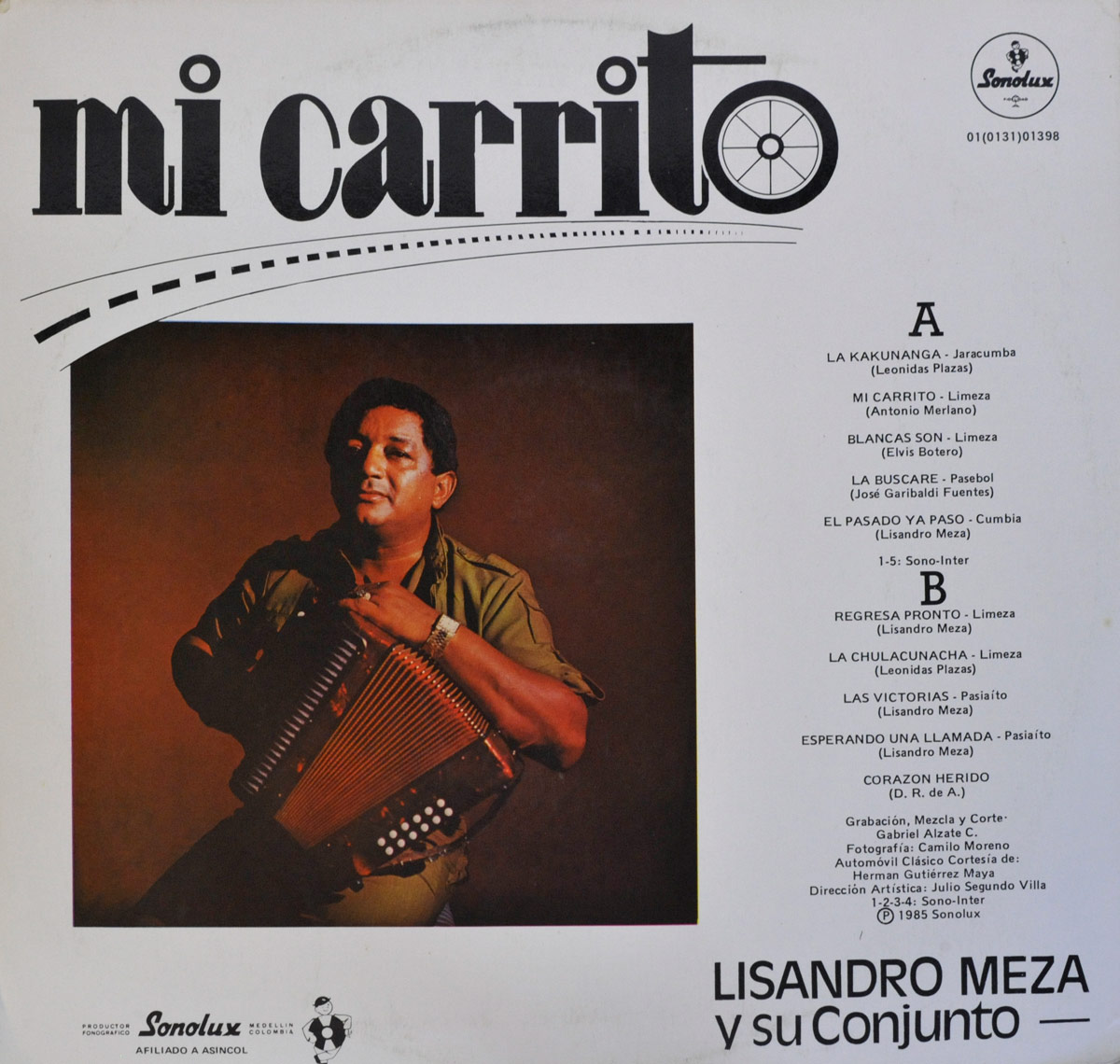
This is the back cover of the album "Mi Carrito" by Lisandro Meza. The layout is clean and structured, with a white background and black typography. A centered photograph features Meza playing an accordion against a dark reddish-brown background. He is wearing an olive-green short-sleeved shirt and a gold wristwatch. His facial expression is contemplative as he looks off to the side.
Above the photograph, the album title "Mi Carrito" appears in bold black stylized typography, incorporating a road and wheel illustration within the lettering. The Sonolux logo is positioned in the top right corner, along with a catalog number.
To the right of the image, the tracklist is printed in black text and divided into two sections: Side A and Side B. Each song is listed alongside its composer. Titles include "La Kakunanga," "Mi Carrito," "Blancas Son," "El Pasado Ya Pas—," "Regresa Pronto," and "Coraz—n Herido."
At the bottom, production credits are detailed, including recording, mixing, and cutting by Gabriel Atilio C., photography by Camilo Moreno, and artistic direction by Julio Segundo Villa. The Sonolux logo appears again, along with an emblem of an affiliated organization.
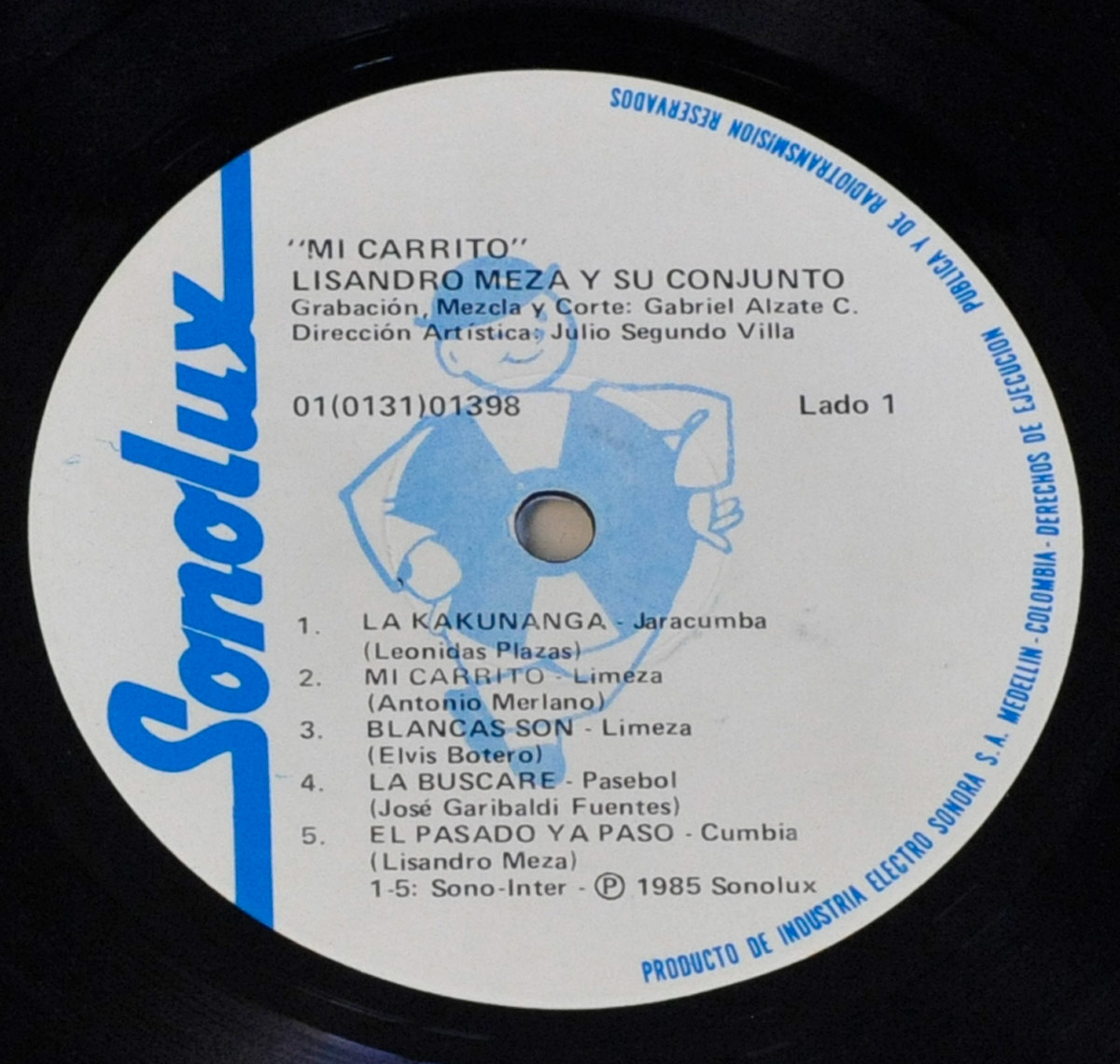
"Mi Carrito" Record Label Details: Sonolux 01(0131)01398 ? 1985 Sonolux
This is a close-up of the Side 1 label of the album "Mi Carrito" by Lisandro Meza. The label is predominantly white with blue text and features the Sonolux logo in bold blue on the left side. In the background, there is a light blue illustration of a cartoon character playing an instrument.
At the top, the album title "Mi Carrito" and the artist name "Lisandro Meza y su Conjunto" are printed in black uppercase letters. Below, production credits mention Gabriel Alzate C. for recording, mixing, and cutting, while Julio Segundo Villa is credited for artistic direction.
The catalog number 01(0131)01398 is printed beneath the credits, followed by the tracklist for Side 1. This includes five songs: "La Kakunanga" (Leonidas Plazas), "Mi Carrito" (Limeza, Antonio Merlano), "Blancas Son" (Limeza, Elvis Botero), "La Buscare" (JosŽ Garibaldi Fuentes), and "El Pasado Ya Pas—" (Cumbia, Lisandro Meza).
A small blue text around the outer rim provides copyright information, stating that the record is a 1985 Sonolux production and includes rights management details. The black vinyl edge frames the label, contrasting with the white and blue design.
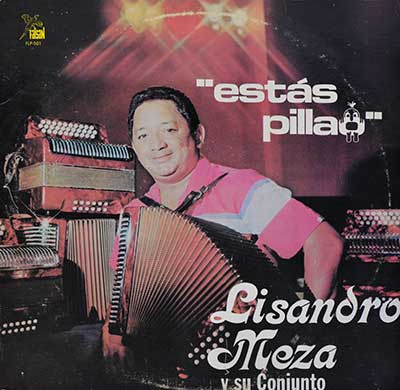
ÒEst‡s PillaoÓ by Lisandro Meza is a dynamic Cumbia album that showcases the artistÕs mastery of the accordion and his signature vallenato sabanero style. Released under Faisan Records, this LP blends infectious rhythms, heartfelt lyrics, and vibrant instrumentation, making it a must-have for Latin music collectors. From danceable beats to soulful melodies, this album is a true gem.
See full details
Mi Carrito by Lisandro Meza is a classic Cumbia album that captures the vibrant energy of Colombian music. Released in 1985 under Sonolux Records, this LP showcases MezaÕs masterful accordion skills and infectious rhythms. Featuring hits like La Kakunanga and El Pasado Ya Pas—, it remains a treasure for vinyl collectors and Latin music fans.
View full details and photos here.