- Original France Release
Tom Novembre's 1985 album L'Insecte is a French pop oddity that looks playful on the surface but quietly digs into loneliness, identity, and social awkwardness. Built around sharp melodies, theatrical vocals, and slightly off-kilter arrangements, the record balances wit and unease with confidence. Songs like the title track "L'Insecte" and "Les Nains De 1,80m" turn everyday discomfort into catchy, character-driven pop. Issued as an original French Philips pressing, this album captures a very specific mid-80s moment where chanson tradition and modern pop collided without sanding off the strange edges.
"L'Insecte" is the kind of 1985 French pop record that sneaks up on you: bright on the surface, quietly anxious underneath, and somehow both charming and a little unsettling. It feels like Tom Novembre is smiling while holding a tiny existential crisis behind his back. And yeah, I love that energy.
Tom Novembre isn't trying to win a volume war here — he's doing something trickier: making you lean in. This is chanson francaise with pop polish, where the hooks can be playful, but the mood keeps side-eyeing you like it knows something you don't. It's catchy, human, and just odd enough to be memorable.
Release date: 1985. Release country: Made in France. Put that on the sleeve and you basically get the vibe: Paris-adjacent wit, slightly theatrical delivery, and a bunch of tunes that feel like little scenes rather than just “songs”.
In mid-80s France, pop was stretching in multiple directions at once — shiny modern sounds on one side, and the older chanson tradition still refusing to die (because of course it won't). "L'Insecte" sits right in that overlap: modern enough to feel of its time, but still built around personality, language, and character.
This is also the era where studio craft mattered a lot: records sounded intentional, arranged, staged — like the producer and the room were part of the band. "L'Insecte" carries that vibe hard, but without sanding off the weird edges that make Novembre feel like… well, Novembre.
The story you can hear in the grooves is collaboration: Tom Novembre working with Charlélie Couture as producer, shaping the songs into something tight but still quirky. It was recorded in France at Studio Venus (Longueville) across June–July 1985, which is peak “lock the doors, chase the idea” season.
And I have to respect the confidence here: commit to your little universe, press it to vinyl, and let the world decide whether it's brilliant or “what even is this?” That's the fun part.
Sonically, this album moves like a quick-witted conversation: upbeat melodies that bounce, then lyrics that quietly pivot into loneliness, identity, and that awkward feeling of not fitting anywhere. It's pop with a brain, but it never forgets to entertain.
The title track "L'Insecte" has that perfect “quirky but serious” tension, while "Les Nains De 1,80m" is the kind of catchy idea you'll hum and then suddenly realize you're thinking about it way too hard. That's Novembre's trick: he makes the odd feel normal, then pulls the rug.
Even when the arrangements feel playful, there's an introspective pulse running underneath — like the lights are bright, but the room is emotionally cold. It's not depressing; it's honest. Big difference.
1985 in France could be big and anthemic, sleek and new wave, or full-on rock posture — and "L'Insecte" pretty much refuses to pick just one lane. Compared to the era's more “crowd-sized” records, Novembre feels like he's performing for a small table, making eye contact, and daring you to laugh at the wrong moment.
Where some 1985 pop aimed for the stadium or the dancefloor, "L'Insecte" aims for the human scale: awkward, funny, lonely, sweet, and occasionally sharp. It's the sound of a personality first, a “genre” second.
This one doesn't scream “scandal record” from the sleeve. The drama here is quieter: the risk of being too eccentric for casual listeners, and too pop for the purists — the classic middle-ground danger zone where interesting albums go to either become cult favorites or get misunderstood.
The creative engine feels like a push-and-pull between discipline and weirdness: clean enough production to let the melodies land, but enough left-field character to keep it from turning generic. That balance is hard, and it's exactly why this album works.
You can hear a team behind it — musicians and voices supporting the central character without sanding him down. It's not a “look how tight we are” band flex; it's a “serve the song, serve the story” kind of record.
The most vinyl-collector proof of life is simple: decades later, this original Philips release still matters enough to be hunted, photographed, and obsessed over — including that original custom inner sleeve with lyrics and artwork that turns the album into a little self-contained world.
To me, that's the legacy: "L'Insecte" isn't just a stack of tracks, it's a mood capsule from 1985 France — a record you don't outgrow, you just understand differently as the years pile up.
Spinning "L'Insecte" as a metal-head collector is honestly hilarious in the best way — no riffs, no thunder, and yet it still hits the same addiction button: personality, atmosphere, and that intoxicating sense of a real human being trapped inside a record. Decades later, it still smells faintly of studio lights, inked lyrics, and that uniquely French mix of charm and melancholy.
Chanson Française, Pop
A blend of French chanson traditions with mid-1980s pop sensibilities, balancing poetic, conversational lyrics with restrained electronic textures and song-driven arrangements.
Philips – Cat#: 826 192-1
This album "TOM NOVEMBRE - L'Insecte" includes the original custom inner sleeve with album details, complete lyrics of all songs, and artwork/photos.
Record Format: 12" LP Vinyl, Stereo, Gramophone Record
Total Weight: 230g
Release Date: 1985
Release Country: Made in France
Producer credit and co-mix credit on the sleeve, meaning the sound wasn’t just captured — it was deliberately shaped. Read more...
Charlélie Couture, credited as producer (and also one of the two names on the mix), sits right in the album’s decision seat: what gets pushed forward, what stays shadowy, and how the whole thing breathes. The record leans on that “arranged, not overcooked” feeling — songs dressed with just enough texture to feel cinematic without losing their human edges. Co-mixing in the same stretch of sessions (June–July 1985) locks in the final balances and space, so the album keeps a consistent atmosphere instead of sounding like it was assembled in a dozen different rooms.
Credited for “prise de son” and also appears in the mix credit — basically the person who made the performances land on tape, then helped decide how they would sit together. Read more...
Patrick Drouet, credited for “prise de son,” is the reason these songs exist as a physical, hearable thing instead of just a rehearsal-room memory. “Prise de son” is where the real alchemy happens: mic choices, placement, levels, and the thousand tiny calls that decide whether a vocal feels intimate or distant, whether drums are crisp or foggy, whether keys sit like velvet or glass. The sleeve also credits him as co-mixer with Charlélie Couture, which means the job didn’t stop at recording — the final soundstage and balance decisions were part of his hands-on contribution to this specific album.
Credited as assistant — the behind-the-console backbone work that keeps sessions moving and mistakes from becoming permanent history. Read more...
Ludovic Lanen, listed as the assisting engineer, handles the unglamorous essentials that make a studio run feel effortless: setting up, troubleshooting, managing takes, notes, and all the little technical guardrails that let the artist stay in the song instead of getting dragged into gear drama. On a record tracked and mixed in a tight June–July 1985 window, that kind of steady support matters — it’s the difference between capturing momentum and losing it to friction.
Studio Venus – Longueville, France
Both recording and mixing happened here in the same June–July 1985 stretch — one place, one continuous workflow, fewer “different-room” surprises. Read more...
Studio Venus, credited for both recording and mixing, is the album’s fixed point on the map: Longueville, France, June–July 1985. That single-location credit is more than trivia — it tells a story of continuity, where tracking and mixing decisions could stay grounded in the same acoustics, the same monitoring chain, and the same working rhythm. The result (on paper and in the ear) is a record that feels coherent, like it was lived-in rather than stitched together.
The credited artwork hand — setting the album’s visual mood before the needle even gets a chance to speak. Read more...
Mah Duboy, credited for the artwork, builds the frame that these songs live inside. Album art isn’t wallpaper on a record like this — it’s the first chapter of the story, hinting at tone, tension, and personality before a single lyric lands. That visual identity becomes part of how the album is remembered: the image and the sound getting stuck together in the brain like they were always meant to be one object.
The credited lens on the package — turning the album into something you can recognize across a room, not just hear. Read more...
B. Scott, credited for photography, supplies the album’s photographic memory — the images that make the package feel like a real artifact instead of a generic sleeve. Those photos do quiet heavy lifting: they anchor the vibe, support the lyrics’ character-driven feel, and help the whole presentation read as intentional rather than accidental. On vinyl, that matters, because the cover and inner sleeve are part of the listening ritual, not an afterthought.
The central voice and narrator of the album, half-singer, half-actor, treating vocals, spoken parts, and noise as equal storytelling tools. Read more...
Tom Novembre, the credited lead vocal presence on "L'Insecte", makes the album feel like a character study rather than just a set of songs. The sleeve credit is unusually specific — “chant, choeurs, PF 15, bruits” — and that’s the whole vibe in a nutshell: voice up front, extra voices when the chorus needs width, and those “bruits” details that turn the performances into scenes. Vocals don’t simply sit on top of the arrangements here; they steer the mood and the pacing, pulling everything else into the same theatrical orbit. Even the credited “PF 15” reads like part of the toolbox, another texture used to keep the record slightly off-balance in the best way.
A constant creative presence, weaving backing vocals and textures into the songs while shaping their atmosphere from the inside. Read more...
Charlélie Couture, credited on this album for backing vocals, synthesizers, and harmonica, works like the record’s built-in atmosphere generator. The choeurs widen the hooks without turning them into glossy pop wallpaper, and the synths provide that mid-80s sheen in a way that still feels human and slightly haunted. Harmonica credits are always a little mischievous on a pop-leaning record — a small, sharp color that can cut through a mix or give a line a bittersweet edge. Everything about these credits screams “supporting cast with real power,” the kind of contribution that changes how the songs land without constantly waving for attention.
Providing understated but essential guitar lines, favoring mood and restraint over flash. Read more...
Laurent Prado, credited simply for guitars, is the kind of player whose value shows up in the spaces between the loud moments. On an album that leans on character and nuance, guitars don’t need to be the main event — they need to be the architecture: rhythm that keeps the story moving, accents that underline a lyric, and textures that keep the arrangements from feeling flat. The credit suggests a steady, consistent guitar presence across the record, doing the practical work of glueing songs together while leaving room for vocals, keys, and those oddball “bruits” to stay in focus.
Guest guitarist, adding a specific color to a single track rather than dominating the canvas. Read more...
Alice Botté shows up as a guest guitar credit — “guitares sur ◯” — which is basically the musical equivalent of a well-timed cameo. That kind of credit usually means one song needed a different guitar personality: a particular tone, attack, or feel that the core setup didn’t deliver quite the same way. The result is a track that gets its own fingerprint without breaking the album’s continuity, like a subtle change of lighting in the middle of a film. Guest contributions like this are small on paper but often memorable on the needle-drop.
Anchoring the album with bass while slipping saxophone and backing vocals into the margins, blurring rhythm and melody. Read more...
Phil Gonnan carries three credits that tell you exactly how a record like this stays interesting: bass, saxophone, and backing vocals. Bass is the foundation — the part that makes the songs feel like they have a body — while saxophone adds a melodic edge that can swing from warm to sly depending on the moment. Then the choeurs layer the human texture on top, reinforcing choruses or adding shadow harmonies behind the lead. It’s a multi-role contribution that quietly shapes both the groove and the color palette of the album.
Handling keys and synths, supplying the subtle electronic framework typical of mid-80s French pop experiments. Read more...
Jerry Lipkins, credited for piano and synthesizers, is where the album’s emotional lighting comes from. Piano can pin a song to something intimate and direct, while synths can blur the edges, add air, or build tension without shouting. That two-part credit suggests a constant job of balancing the organic and the electronic — keeping the songs grounded when they need warmth, then letting them drift into texture when they need atmosphere. It’s the kind of contribution that makes arrangements feel “designed” without feeling overdesigned.
Driving the songs with controlled, economical drumming that supports the narrative rather than pushing it forward. Read more...
Abraham Causse holds down drums and percussion — the engine room that keeps the whole record from drifting into pure mood-piece territory. Batterie gives the songs their spine and forward motion, while percussion adds detail: little rhythmic sparks that can make an arrangement feel busier, sharper, or more playful without changing the tempo. On a record built around storytelling and tone, that combination matters, because the groove has to support the voice without stealing the scene.
Adding feminine vocal textures that soften and contrast the album’s introspective tone. Read more...
Guida Chalonges is credited for backing vocals and female voices, which is a fancy way of saying “contrast and character.” A different vocal color changes how a lyric reads, how a chorus opens up, and how intimate (or dramatic) a moment feels. The credit suggests targeted appearances rather than constant presence — coming in where the songs need softening, lift, or a second emotional angle. Those voix féminines are often the secret ingredient on albums like this: not loud, not central, but instantly felt.
Disclaimer: Track durations shown are approximate and may vary slightly between different country editions or reissues. Variations can result from alternate masterings, pressing plant differences, or regional production adjustments.
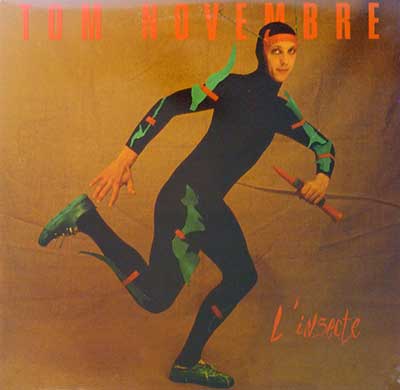
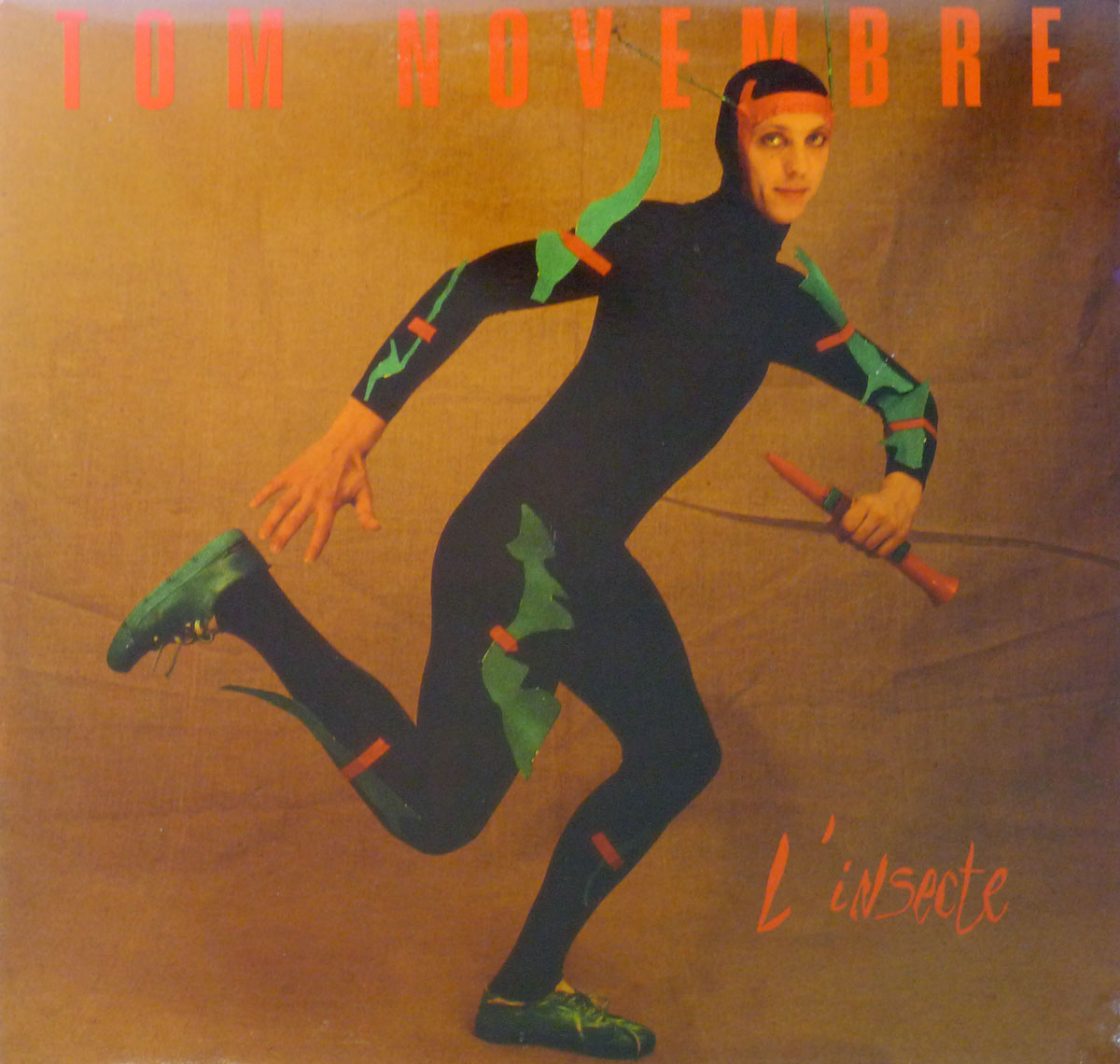
My photo shows the original front cover of TOM NOVEMBRE – “L’Insecte”, framed straight-on like a collector would document it: full sleeve visible, edges included, no fancy cropping that hides condition. The background is a warm tan-brown field with soft gradients, almost like a stage floor or studio sweep, and it gives the cover a very “set design” feel rather than a natural scene.
The typography is doing heavy work. Across the very top, “TOM NOVEMBRE” is printed in tall, widely spaced uppercase letters in a hot red-orange tone; each letter sits clean and separate, making the artist name read fast from across the room. At the bottom right, the album title “L’insecte” switches style completely: a loose, handwritten script in the same red-orange family, angled slightly and looking deliberately informal, like a quick marker signature. That contrast—rigid headline text versus scribbled title—signals the album’s “odd but controlled” personality before a needle even drops.
The central image is a single person in a tight black bodysuit, caught in a dynamic sideways running pose, leaning back with one knee lifted and one foot planted. The face is uncovered, turned toward the viewer, with a focused expression that reads half-performer, half-character. The costume is the key visual hook: bright green, irregular cutout shapes are attached along the arms and legs, held in place by small orange bands, creating an insect-like or armored look without using literal wings. Matching green shoes reinforce the costume palette, and the black suit keeps the body shape graphic and clean against the brown background.
From a sleeve-design and “spot the real thing” perspective, this cover is all about simple, memorable elements: one strong figure, two loud colors (green and red-orange), and huge readable artist text. The photo also reveals practical physical details: faint surface creases and handling marks are visible in the image, especially near the top area, the kind of light wear that shows up on real-life copies that have been pulled from shelves and played. No hype stickers or extra label blocks appear on the front—just the core design—so the visual identity stays uncluttered and instantly recognizable.
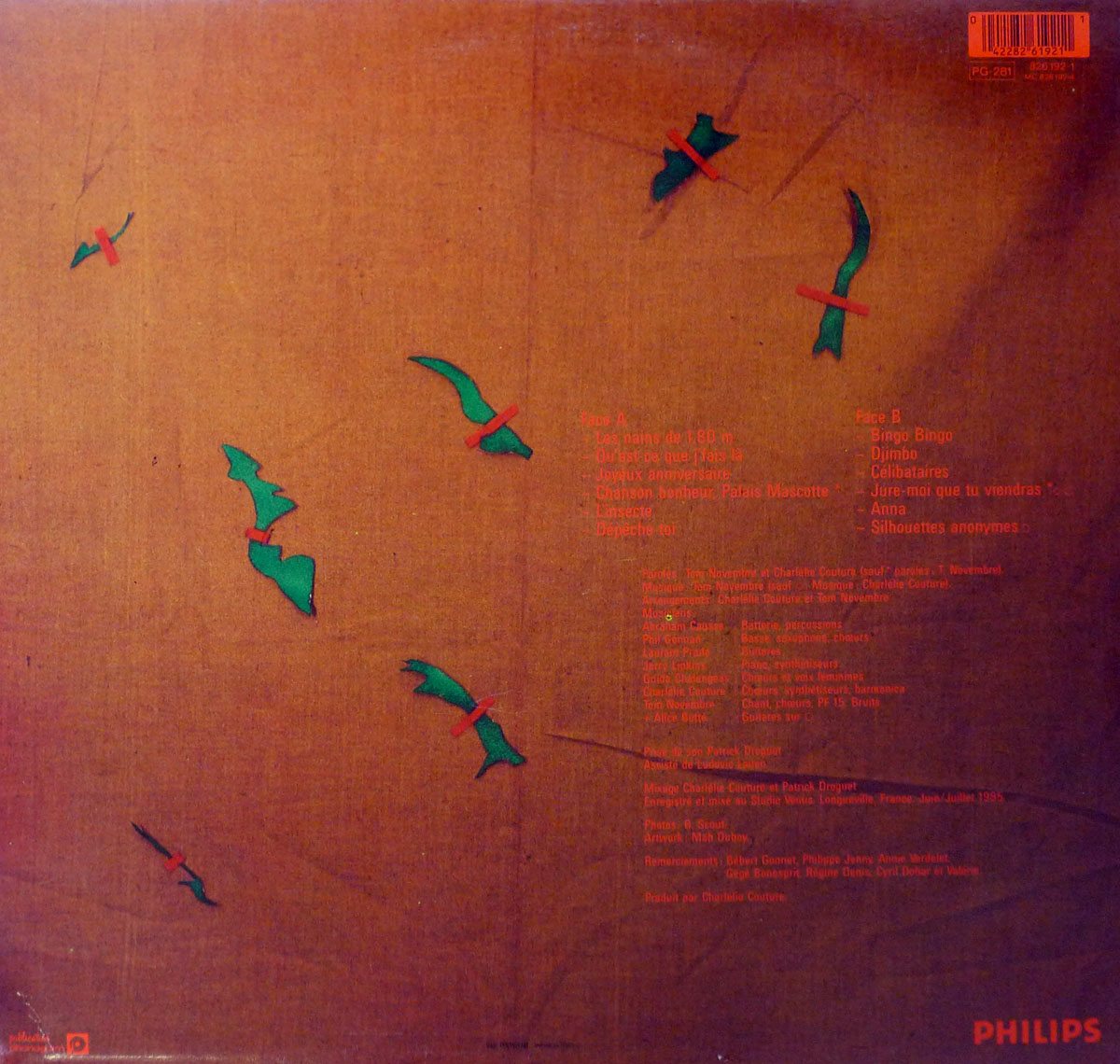
This is the full back cover of TOM NOVEMBRE – “L’Insecte”, photographed straight-on so the entire sleeve surface and condition clues are visible. The base color is a warm brown/tan field with subtle texture and uneven shading, like a studio backdrop or cardboard surface under soft light. Several long crease lines and scuff marks run diagonally and vertically across the sleeve, the kind of honest wear that shows up on copies that have actually lived in a shelf and been handled.
The main graphic motif is repeated here without the front-cover character: scattered green, irregular shapes that look like insect limbs or costume fragments. Each green piece is strapped down with a small red band, like a quick wrap of tape, which makes the shapes feel “pinned” to the background. The pieces are spread across the sleeve—one large cluster on the left, a few smaller ones floating near the top and center, and one near the bottom—keeping the design airy and slightly off-balance.
All text is printed in a red-orange ink that matches the front cover’s color family, and it’s placed mostly on the right half. Two headings stand out: Face A and Face B, each followed by a neat list of track titles. Under Face A, the visible list includes “Les nains de 1,80 m”, “Qu’est-ce que j’fais la”, “Joyeux anniversaire”, “Chanson bonheur, Palais Mascotte”, “L’insecte”, and “Depeche-toi”. Under Face B, the list shows “Bingo Bingo”, “Djimbo”, “Celibataires”, “Jure-moi que tu viendras”, “Anna”, and “Silhouettes anonymes”. For a collector, this layout matters: quick scan track list, no clutter, and both sides clearly separated.
Beneath the track lists sits a dense block of production and musician credits in the same red-orange print, with multiple short lines and names stacked in a practical, “all the info is here” way. A separate label/ID area is impossible to miss: the top-right corner has a red barcode box with the barcode and small-print identifiers including PG-281, catalog 826 192-1, and MCPS BIEM. The branding lands hard at the bottom-right with a large PHILIPS logo in red-orange, while the bottom-left also carries smaller Philips markings/logos. Everything about this back cover is classic functional design: track lists, credits, catalog/rights box, and label branding—cleanly placed so the sleeve stays recognizable even with mild wear.
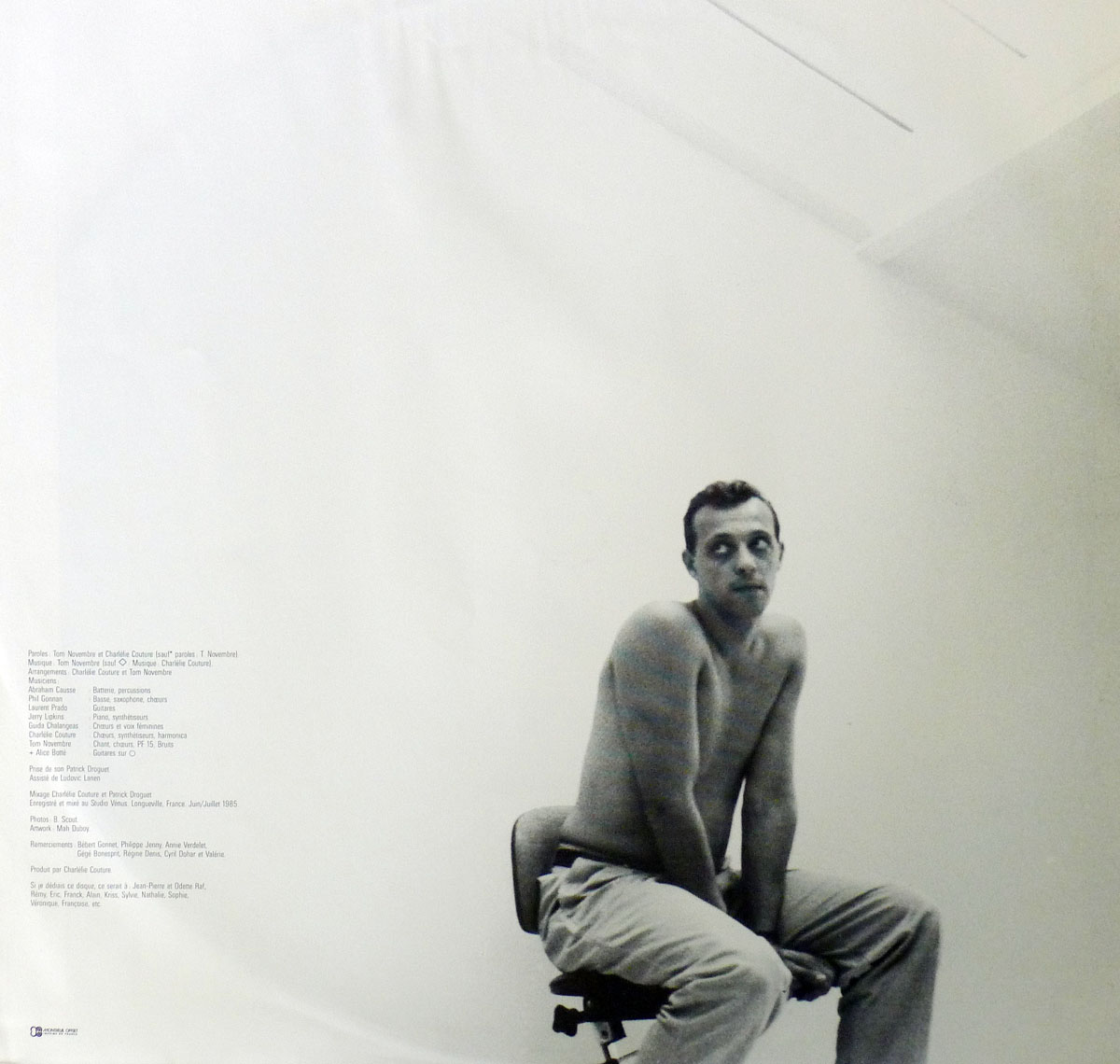
This is the original custom inner sleeve for TOM NOVEMBRE – “L'Insecte”, and it’s the total opposite of a busy lyric-sheet collage. The design is aggressively minimal: a huge white field dominates the sleeve, with almost everything pushed down into the lower third. That negative space is not “empty” from a collector point of view; it’s a deliberate layout choice that makes every printed element feel intentional and easy to verify when comparing copies.
On the lower left sits a tight block of French credits printed in small, dark text, left-aligned and stacked like a studio log. Paroles (lyrics) credit Tom Novembre and Charlélie Couture, musique (music) credits are listed, and arrangements are credited to Charlélie Couture and Tom Novembre. The musician list is right there in plain sight, with instruments and roles spelled out: batterie/percussions, basse/saxophone/choeurs, guitares, piano/synthetiseurs, choeurs et voix feminines, plus the specific vocal/noise-style credit line for Tom Novembre. This is the kind of inner sleeve that makes documentation painless: names and roles are readable and centralized.
The same block also nails down recording details: prise de son is credited to Patrick Drouet, assistance to Ludovic Lanen, and mixage to Charlélie Couture and Patrick Drouet. Recording and mixing are stated as done at Studio Venus in Longueville, France, with the date window printed as Juin/Juillet 1985. Photo and artwork credits are included too: photos credited to B. Scott and artwork to Mah Duboy. A short thanks/dedication section follows, still kept compact and practical, not spread all over the sleeve.
The photograph itself sits at the lower right: a black-and-white portrait of a shirtless person seated sideways on an office chair, wearing light-colored trousers. The posture is tense and posed, knees bent, torso angled slightly forward, with the head turned and eyes looking up to the left, as if reacting to something off-frame. The background is a stark, high-key room; faint ceiling lines and hard angles are visible near the top right, reinforcing a studio/interior setting rather than an outdoor scene. Slight glare and subtle paper texture show this is a photographed sleeve, not a cleaned-up scan, which is exactly what a condition-aware archive wants.
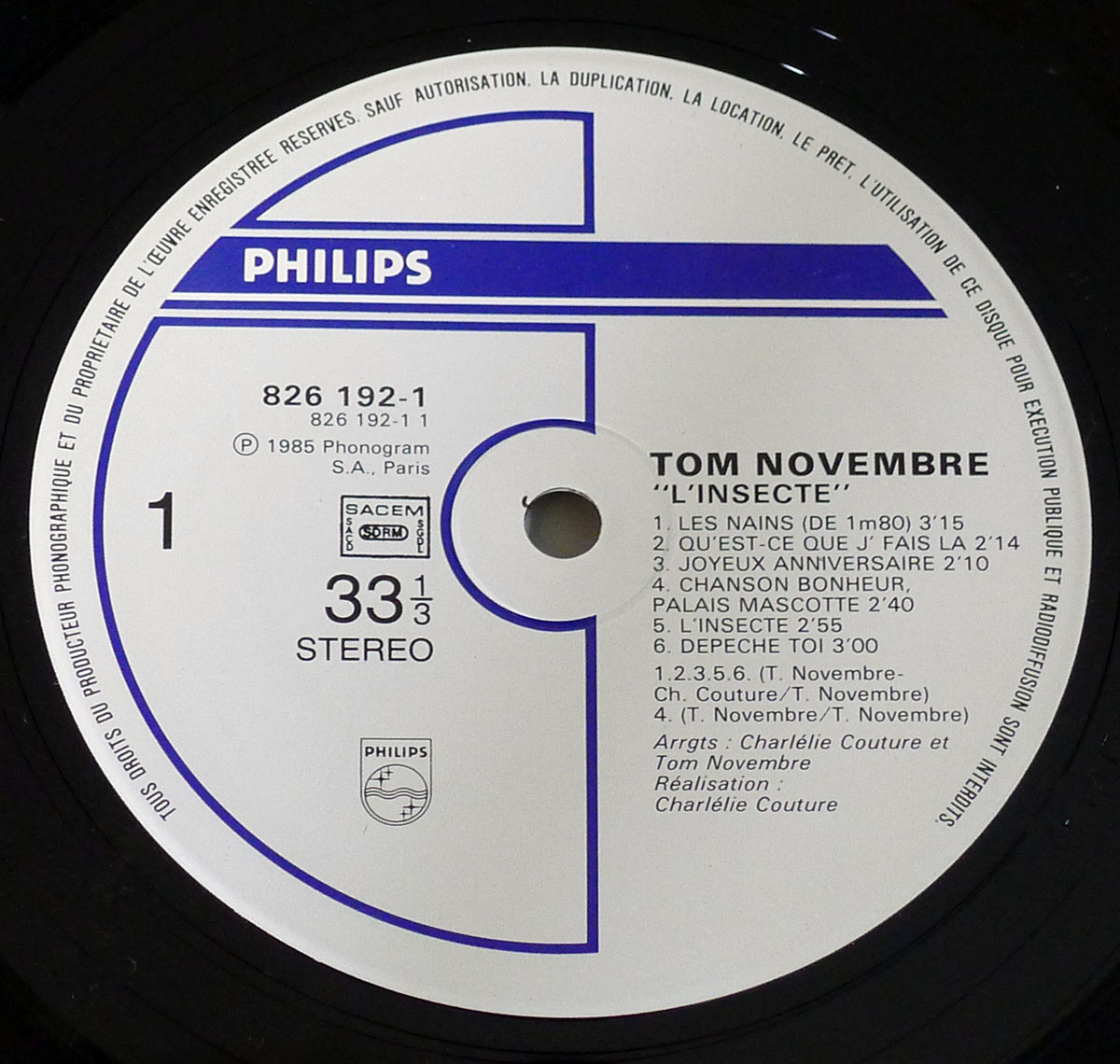
This close-up locks onto the actual Philips center label on the vinyl, and it’s the kind of shot that settles “which pressing is this?” arguments fast. The label background is a pale grey/white, surrounded by the black vinyl playing surface, where the circular grooves and light reflections are clearly visible around the edge of the frame. The center hole sits in a slightly darker grey ring, with the blue label graphics wrapping around it in a crisp, geometric layout.
The top-left carries the bold PHILIPS name in white letters inside a thick blue banner, with a thin blue stripe underneath, all printed clean and sharp. A strong blue line forms a squared-off, almost architectural border that curves tightly around the center hole, giving the label that classic “engineered” Philips look: straight lines, hard corners, and one precise curve where it matters.
The left information block is pure collector gold. The catalog number 826 192-1 is printed large, with a smaller line beneath reading 826 192-1 1 (the side-specific marking). Below that sits (P) 1985 Phonogram S.A., Paris, which pins the date and the company text right on the label. A boxed rights/society stamp shows SACEM with SDRM and SGDL in the same block, and the speed is spelled out in big type as 33 1/3 with STEREO underneath. A large numeral 1 at left confirms this is Side 1, and a small Philips shield logo sits lower-left as a final authenticity marker.
The right block is the track and credit area, printed in black text that’s easy to read. The heading line shouts the artist name TOM NOVEMBRE, followed by the album title in quotes: "L'INSECTE". Side 1 tracks are listed with timings: LES NAINS (DE 1m80) 3'15, QU'EST-CE QUE J' FAIS LA 2'14, JOYEUX ANNIVERSAIRE 2'10, CHANSON BONHEUR, PALAIS MASCOTTE 2'40, L'INSECTE 2'55, and DEPECHE TOI 3'00. Under the tracks, the credits go straight to the point: song-by-song author lines using initials, then Arrgts : Charlelie Couture et Tom Novembre and Realisation Charlelie Couture. Everything here is functional, verifiable, and exactly what a label photo should capture: catalog, year, rights marks, speed, side, and the complete Side 1 program.
All images on this site are photographed directly from the original vinyl LP covers and record labels in my collection. Slight differences in color may exist due to lighting and flash use. Images can be zoomed in on touch devices. You may use these images for personal or non-commercial purposes if you include a link to this site; commercial use requires permission. Text on covers and labels has been transcribed using a free online OCR service.
French pop for people who like their earworms with a side of existential side-eye.
“L’insecte” is exactly my kind of French pop: smart, stubbornly catchy, and too idiosyncratic to ever go bland. Tom Novembre is the exceptional force here—actor energy, comedian timing, and real emotion hiding in plain sight. The title track pokes straight through your defenses, “Les Nains De 1,80m” is instant cult, and the rest stays nicely quirky with chanson attitude and a pop-rock push. Nothing runs on autopilot.
1983 chanson-pop drama: intimate vocals, sharp writing, and tracks that stick for days.
Tom Novembre’s 1983 “Toile Cirée” blends chanson francaise with pop-rock edges, driven by intimate vocals and lyrics focused on love, loss, and everyday complications. The record balances quiet confession with punchier moments, showing real range across the set. Standouts include “Bavards” and “Parcours Santé,” making this one a smart, mood-rich French LP worth revisiting.
1982 French pop satire: quirky hooks, sharp jokes, and weird ideas that actually work.
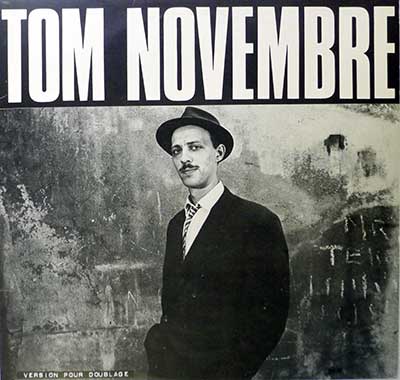
Tom Novembre’s “Version Pour Doublage” (1982) is a playful, eclectic French pop LP rooted in chanson francaise but loaded with quirky humor and satirical lyrics. The songs poke at social norms and the absurdity of conformity, while keeping the melodies catchy and off-kilter. Highlights like “André,” “Le Fléau,” and “Les Casseroles” deliver eccentric hooks with a sharp, character-driven tone.