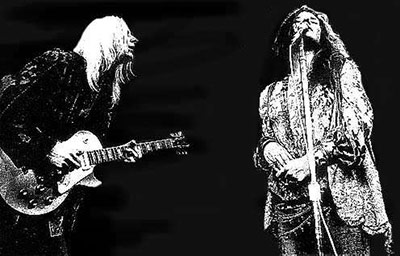
The promotion man for Fillmore East chose Johnny Winter knowing that critics would turn out for Winter and believing that of the two blues guitarists, Lonnie Mack was better than Johnny Winter, and would be compared and discovered
By Mary Campbell Lonnie Mack is, back. He's happy to be back and yet he's nostalgic for where he's been. Blues guitarist Mack in 1963, at age 22 (born in a log cabin near Harrison, Ind.,) and influenced by a blind gospel guitarist (Ralph Trotto in Aurora, Ind.), cut his first rec-ord, "Memphis", for Fraternity Records in Cincinnati. It became a big hit and Mack thought, "This is easy". He was wrong, More recording produced no more hits. He got a group together and they started playing one-night stands, wearing out two cars a year driving themselves around, pulling their equipment in a trailer. After three years of that, they stepped up to playing one and two-week engagements in obscure locations for a couple of years.
They were playing in a converted airplane hangar in Fort Walton Beach, Fla., last summer, when Elektra Records sent a producer down to hear them. Somebody at Elektra had read a belated rave review of the LP, "Wham of that Memphis Man,', which Fraternity had brought out after the single. ELEKTRA immediately signed Mack, and he has two LPs out for the company, "Glad I'm in the Band", teamed with his drummer Ron Grayson and organist David Byrd, and "Whatever 's Right". Also, a promotion man played some tapes for Bill Graham, who said he'd book him at Fillmore West with anybody. The promotion man chose Johnny Winter mowing that critics would turn out for Winter and believing that of the two blues guitarists, Mack was better thar Winter, and would be compared and "discovered".
Tin reviews fulfilled his hopes Mack, Incidentally, had never heard of Johnny Winter. Now, Graham 's booking agency, Millard, is booking Mack in the major rock palaces across the country. "Now I'm a success, I wear workshirt", says Mack in his calm voice. "All I need now Is a laundromat. It's a lot easier this way than having to worry about getting suits cleaned and pressed, and getting razor cuts and all that hair spray. Now, I haven't really combed my hair in eight months, I think". MACK USED to play one-'lighters in buildings left from the era of the touring big dance and jazz bands. "It seems like every little town in the Midwest has got a big ballroom, beautiful places.
Nowadays a trio, with amplifiers, can make more noise than a 30-piece orchestra could. We could drown out Glen Miller, "One time we were booked in Hatfield, Minn., and the booking agent said, 'It's not on the map, so just get close to there and ask somebody.' We got to the town supposed to be next to it and couldn't n find anybody who knew it. There were only four or five a streets going out of town, so t we'd go down each one for 10 miles, looking at the signs. Finally we got to a handpainted sign saying Hatfield was one mile. It was a gravel road; there wasn't any blacktop, not even in the town. The only thing there was a bar, a church and a big ballroom, and the place was jammed.
"I would really love to go back and play Hatfield. "Everything was so non-organized those days. So in many towns I went into, I'd drive up to a filling station gand say, 'Where is Lonnie s. Mack playing tonight?' and 1- they'd tell me. We just knew the town it was in; didn't 'a know the name of the place". it Mack says, "That driving gets tiresome. You think you'd id like to settle down, but I get in one spot and I've got to get out of again. se "As far as success goes,I really like where I'm at now, but really the other place is me. We were making pretly good money and getting to see a lot of the country. You go in because you like to play, and you play, and people enjoy it, and you feel good about your-self.
"Maybe 10 years from now, my attitude will change, but I don't think so. I think those will still be the best. Memories".
Source: 69-11-01 Corpus Christi Times