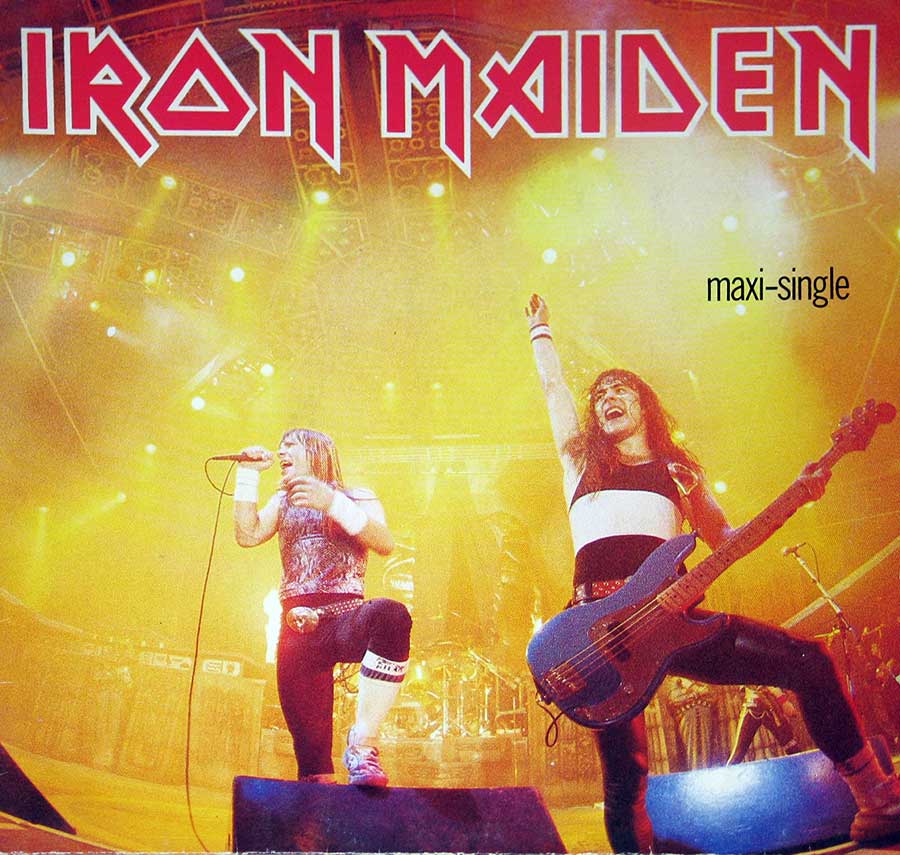
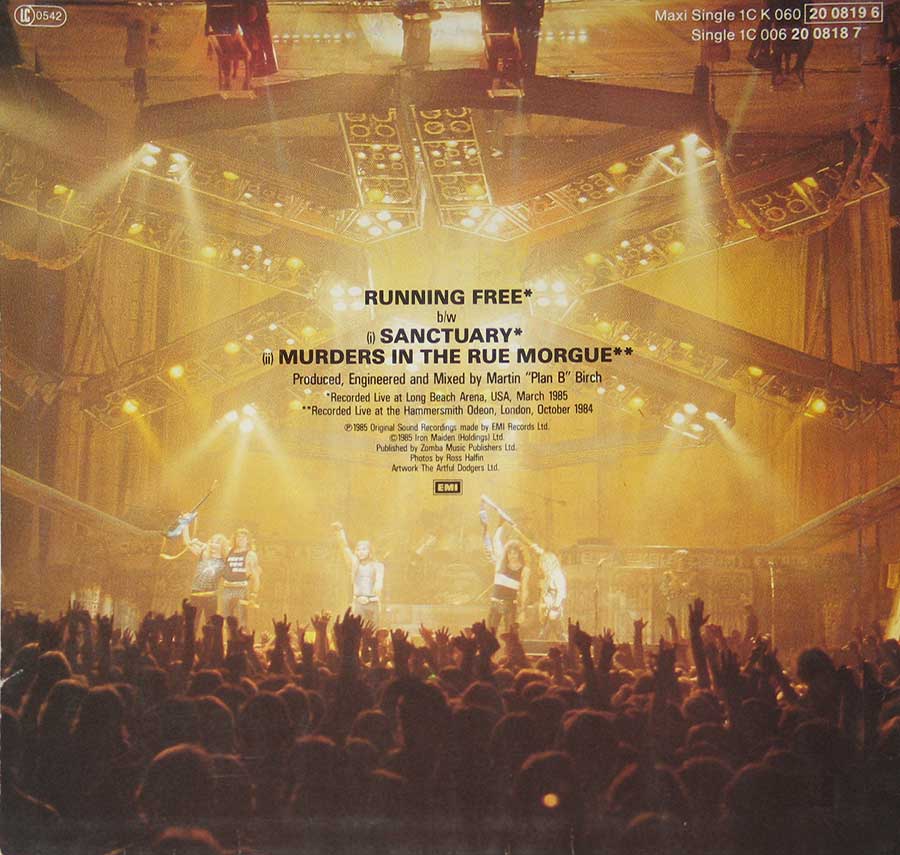
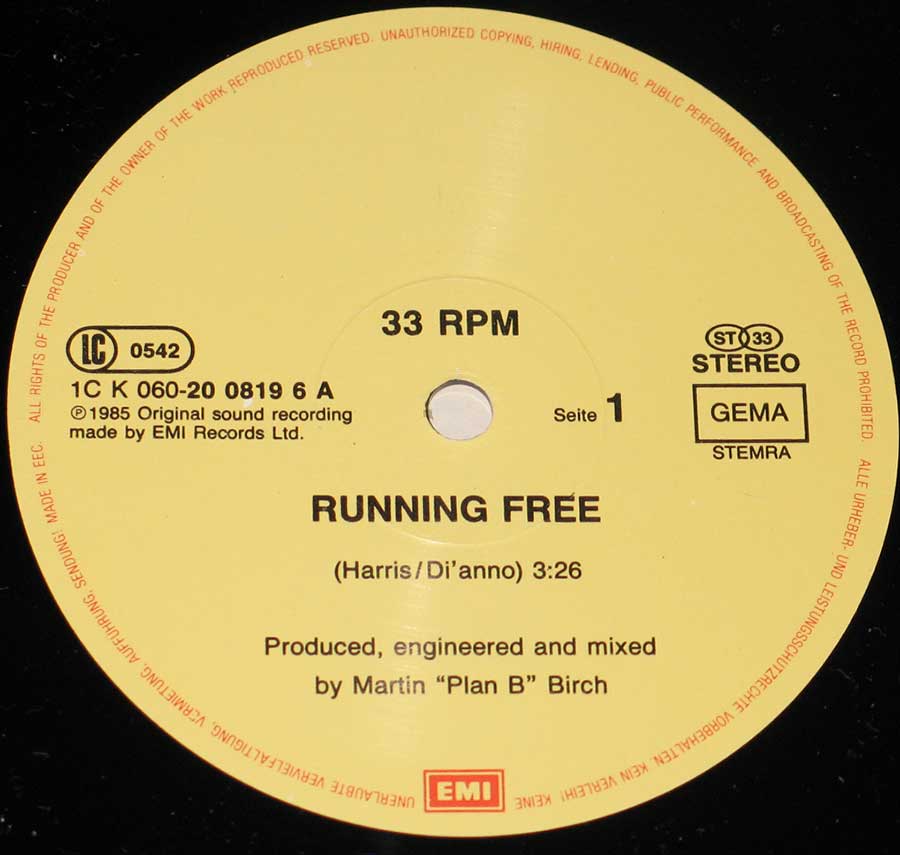
"Running Free Live" 12" Maxi Single Description:
I don’t keep this 12" around because it’s rare, holy, or “essential.” I keep it because it still sounds like a room full of people about to topple the barriers. Sleeve out. Vinyl out. Quick brush. Needle down. And suddenly my living room is somebody else’s bad decision in 1985.
It’s the live "Running Free" maxi tied to "Live After Death"—not the tidy 1980 single you file under “early days,” but the grown-up, road-hardened version that shows up wearing sweat and a grin.
The bit where it stops being polite
Side one hits with "Running Free" from Long Beach Arena, March 1985. You can hear the place pushing back at the band, like the crowd is part of the rhythm section. It’s not “clean.” Good. Live records shouldn’t sound like they were ironed.
Flip it and you get the real reason I like this pressing: no filler, no excuses. "Sanctuary" comes from the same Long Beach run, still hot. Then they sneak in "Murders in the Rue Morgue" from Hammersmith Odeon, October 1984—different night air, tighter bite, a little more London in the corners.
About the words (without the poetry lecture)
"Running Free" started life as a younger, scrappier story—Steve Harris and Paul Di’Anno writing teenage motion into a few minutes. By 1985 it’s Bruce driving it like he owns the road, stretching the attitude until it feels less like “kid on the run” and more like “band that can’t sit still.” Subtle? No. Effective? Absolutely.
Some people want the “definitive” version of everything. I just want the version that makes me reach for side two again before the kettle’s even boiled.
References / citations
Music Genre:
New Wave Of British Heavy Metal, NWOBHM |
Album Production Information:
Produced and engineered by Martin "Plan B" Birch
Martin Birch – Producer, Sound Engineer
I first noticed Martin Birch on those early Iron Maiden sleeves—the ones with the typography that felt like a threat. At twelve, I didn’t care about "production value"; I just liked that the guitars didn't sound like mud. He was the man behind the sound mixer, the one who made the snare snap like a dry branch in a cold forest. He was "The Headmaster," and we were all just students of his high-voltage curriculum.
Read more...
Birch didn’t just record noise; he organized aggression. By 1972, he was already wrangling the messy brilliance of Deep Purple’s Machine Head, turning Ian Gillan’s banshee wails into something that didn't just clip the tape but lived inside it. In 1980, he pulled off the ultimate renovation, giving Black Sabbath a much-needed shower and a new spine. Heaven and Hell shouldn't have worked, but Martin polished that Birmingham sludge into something operatic and gleaming. It was a pivot that felt like fate, mostly because he refused to let the mid-range get lazy.
Then came the long, obsessive stretch with Iron Maiden from 1981 to 1992. It was a twelve-year marriage to the fader. From the moment Killers (EMC 3357, for those who care) hit the shelves, the sound was physical. He knew how to let Steve Harris’s bass clatter like a machine gun without drowning out the melody—a sonic miracle that still feels fresh. You can almost smell the ozone and the dust on the Marshall stacks when the needle drops on The Number of the Beast. He stayed until Fear of the Dark, then simply walked away. No victory lap, no bloated memoir. He preferred the hum of the desk to the noise of the crowd, leaving us with nothing but the records and a slight sense of abandonment. But then, when you’ve already captured lightning on tape for twenty years, why bother hanging around for the rain?
|
Record Label & Catalognr:
EMI 1C 060-20 0819 6 |
Media Format:
33rpm 12" Vinyl Maxi-single Gramophone Record
Album weight: 200 gram |
Year & Country:
1985 Made in Germany |