Heading for Tomorrow lands with that bright early-90s German spark, even though I’d already blasted enough British Heavy Metal to last several lifetimes. And let’s be clear: this isn’t the trench-warfare Teutonic stuff served by the Big Three — Kreator, Sodom and Destruction. This album is cleaner, flashier, practically begging to be used as wallpaper when you want metal vibes without the artillery fire. With standout tracks like “Lust for Life,” “Space Eater,” and that oversized title epic, it stays prime collector fuel and a must-spin for anyone who remembers when Noise Records meant business.
Whenever I play it on my 1980s Thorens turntable, “Heading for Tomorrow” gives me that same electric jolt it did decades ago — the kind you only get from a debut album built on nerves, adrenaline, and a bit of glorious chaos. This record doesn’t politely introduce itself; it kicks the door open with that early-90s German metal urgency and sprints head-first into its own identity. Even now, it still sounds like a band catching fire right in front of me.
1990 Germany was buzzing — walls falling, scenes shifting, and everyone arguing about what the next decade should sound like. Metal fans were spoiled, and the power-speed crowd was sharpening their riffs to a razor point. Right in the middle of that upheaval, this album dropped like a flare. It wasn’t just another release; it became part of the soundtrack of a country reinventing itself with the amps still humming.
After stepping away from Helloween, Kai Hansen didn’t drift — he redirected all that pent-up creative energy into forming Gamma Ray. You can feel the mix of frustration, freedom, and “let’s just build this ourselves” running through every inch of the album. It’s the sound of a musician refusing to idle, shaping a new identity while the studio lights were still warm.
This album moves. The guitars slice forward, the vocals grip the melodies, and the rhythm section keeps the whole thing humming with a kind of eager tension. “Heaven Can Wait” and “Space Eater” still burst out of the speakers like caffeinated uppercuts, while the 14-minute title track reads like Hansen’s whole mission statement scribbled into one long metal diary entry. Nothing feels static; everything pushes.
Compared to the metal output of 1990, this record takes its own path. While American thrash tightened its jaw and Scandinavian metal drifted into darker moods, Gamma Ray leaned into melody, momentum, and bright, sharp conviction. Sure, there’s Helloween DNA in there — how could there not be — but here it’s reshaped into something more personal and a bit more defiant.
This wasn’t a settled lineup yet, and the tension shows in the best possible way. Scheepers sings like he’s trying to outrun gravity, the rhythm section anchors the chaos, and Hansen plays with that restless energy of someone trying to build a whole new world overnight. That urgency gives the album its edge — nothing feels phoned in or over-refined.
Fans warmed to it fast because it felt hungry and sincere. Critics were mixed — some praised the direction, while others grumbled about Helloween shadows — but time has done its job. Today it stands as one of those debuts that carved a new future, even if not everyone got the message at first listen. It’s earned its place through sheer personality and persistence.

German/Teutonic Power Speed Metal
German/Teutonic Power Speed Metal blends razor-sharp riffing, high-velocity drumming, and an aggressive, martial edge that became a defining sound for late-80s German metal. Intensely technical and relentlessly fast, it pushed traditional speed metal into a harder, darker, more disciplined direction.
Noise N 151-1
Record Format: 12" Vinyl Full-Length Stereo Long-Play Gramophone Record
Total Weight: 300g
1989–1990 – Germany
The intro hits with such an Iron Maiden vibe that I half-expected Bruce Dickinson to burst in demanding air-raid sirens and a fencing match. Whether it’s homage or accidental Maiden cosplay, that NWOBHM gallop is worn louder than a battle jacket at a 1984 tour stop.
Sure, it’s officially a Uriah Heep cover — but let’s be honest: this thing screams Ritchie Blackmore’s Rainbow so loudly that I half-expect Ronnie James Dio to kick down the door and claim royalties. Original? Not exactly. Entertaining? Absolutely.
Disclaimer: Track durations shown are approximate and may vary slightly between different country editions or reissues. Variations can result from alternate masterings, pressing plant differences, or regional production adjustments.
Minimalist front cover dominated by a flat, light-grey background that shows the usual subtle wear of an early-90s matte sleeve: tiny surface scuffs, slight corner rub, and a faint vertical handling mark on the left edge. Nothing distracting, just the kind of honest shelf patina that comes with decades of storage.
The centerpiece is the large, bold KAI HANSEN logo positioned slightly above the vertical midpoint. Letters are thick, angular, and outlined in yellow with a red fill and a metallic-style shading effect that gives them the classic late-80s metal aesthetic. Edges are sharp, color saturation is consistent, and no print misalignment is visible.
Directly beneath the logo sits the album title HEADING FOR TOMORROW, printed in compact black uppercase type. The spacing is tight, the baseline crisp, and the alignment perfectly centered. No artwork, photos, or additional design elements appear anywhere on the sleeve, which makes this variant stand out among collectors for its stark simplicity and clean layout.
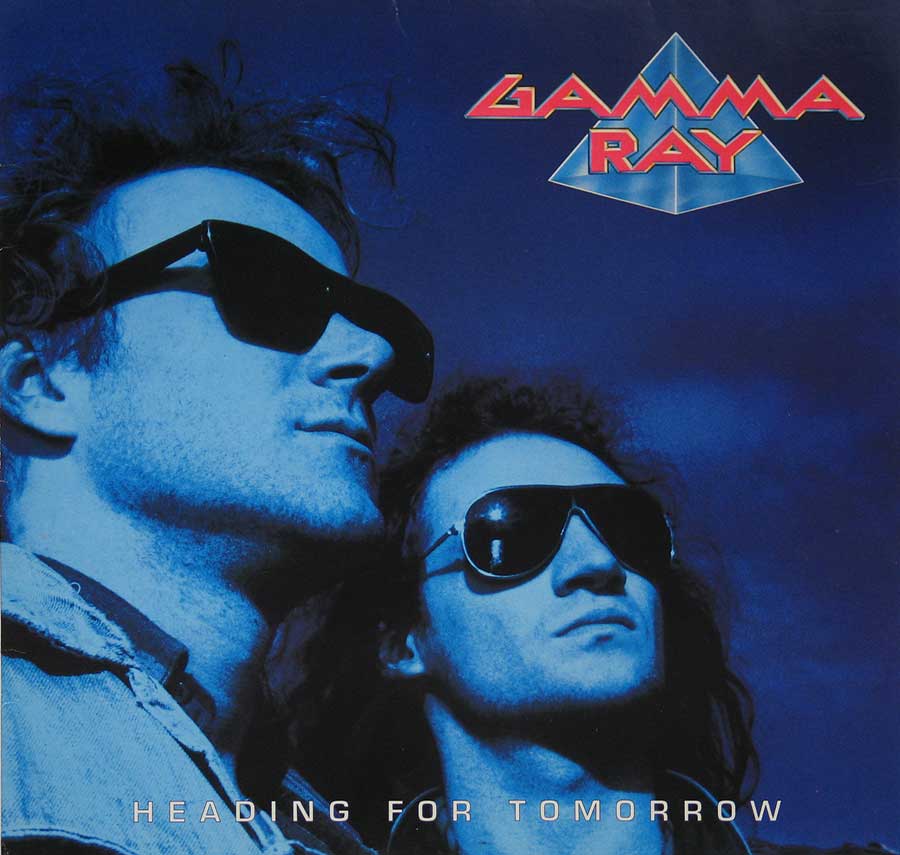
Custom inner sleeve printed in a bold, monochrome blue color treatment. Two band members fill most of the composition, photographed from a low angle that pushes both faces upward toward the right side of the frame. The lighting is hard and cool, carving out strong shadows under the cheekbones, chin, and oversized sunglasses.
Sunglasses dominate the midsection of the image; their glossy, black lenses reflect no detail, giving the photo a clean, graphic look. Hair texture remains visible despite the aggressive blue filter, especially the wind-pushed strands on the left man and the denser curls on the right. Denim collar edges and stitching still read clearly, showing that the print retains enough contrast for garment details.
The Gamma Ray logo sits in the upper-right area, with sharp red lettering mounted over a metallic triangular emblem. Print alignment is tight, color borders clean, and no misregistration is visible. Along the bottom edge, the title HEADING FOR TOMORROW appears in evenly spaced white uppercase type, a typical OIS design choice for Noise Records during this era.
As a custom inner sleeve, this piece serves both as artwork and packaging — no track lyrics, no credits, just a full-bleed promotional photo. Condition appears strong: no visible seam splits, no tearing, and no warping across the printed surface. A clean example of early-90s metal sleeve design meant to extend the album’s visual identity beyond the cover.
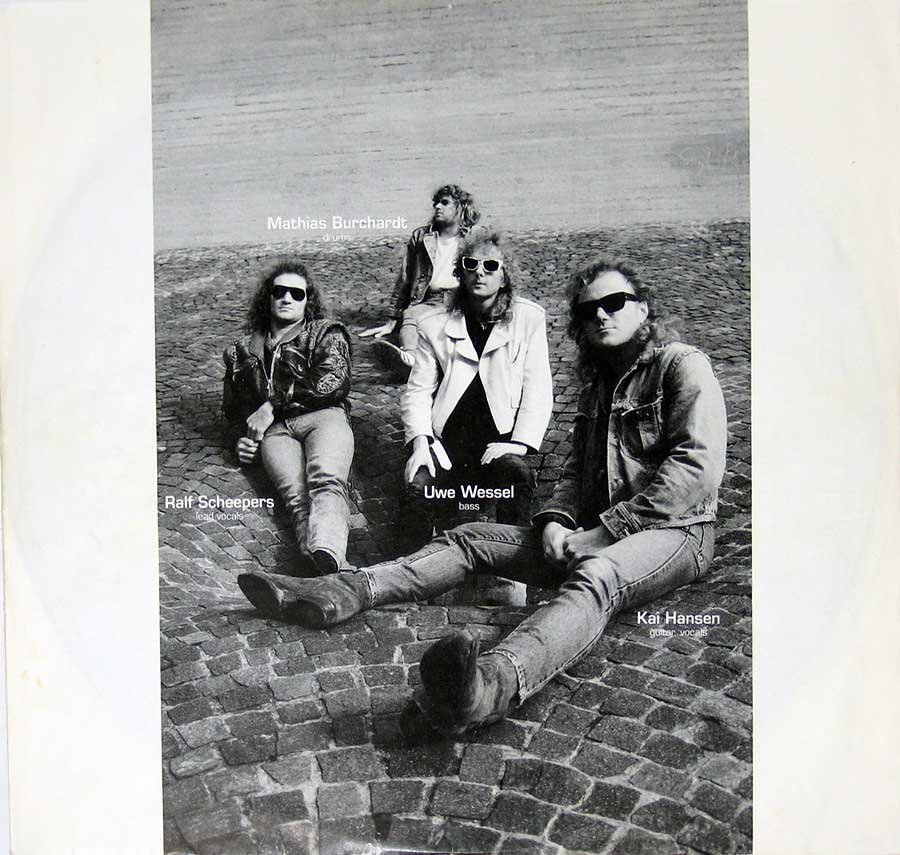
Custom inner sleeve printed in black and white on matte stock, showing the full band seated on a sloped cobblestone surface. The composition uses a shallow upward angle, which pulls the eye from foreground to background as each member occupies a different distance point. Lighting is even and natural, creating clear texture on both the pavement and the denim, leather, and fabric surfaces.
In the foreground left sits Ralf Scheepers, leaning back with legs extended forward, wearing a dark leather jacket and sunglasses. His name and “lead vocals” credit are printed in small white text beside him. Just behind him in the center is Uwe Wessel, also wearing sunglasses, dressed in a light-colored jacket, and sitting upright with hands resting forward; his “bass” credit appears directly beneath his name.
Further back on the slope, Mathias Burchardt sits slightly elevated, positioned near the top edge of the cobblestone incline. His drums credit is printed above him, making him easy to identify even at a distance. To the right foreground sits Kai Hansen, wearing a denim jacket and sunglasses, leaning slightly to one side with one knee raised; his “guitars, vocals” credit sits neatly beside him.
The layout is clean and uncluttered, with no lyrics or production notes on this side of the sleeve—only the photograph and printed member identifications. The white margin around the image shows mild age toning and light handling discoloration, consistent with a 1990 Noise International inner sleeve. The print quality remains sharp, with good tonal range and no visible ink bleed.
A tiny confession from the archives: the back cover and inner sleeve photos for Heading for Tomorrow by Kai Hansen / Gamma Ray (1990) never made it into my digital vault. Back in the pre-cloud era — when web hosting was priced like luxury goods — I had to decide whether to upload full artwork or avoid blowing my hosting budget. Guess which one won.
So here we are, decades later, and I’m still occasionally haunted by those classic collector regrets: “Why didn’t I scan that?” “Why did I think disk space was more important than album art?” If your copy still has all the trimmings, treat it kindly — it survived both time and my questionable 1990s storage priorities.
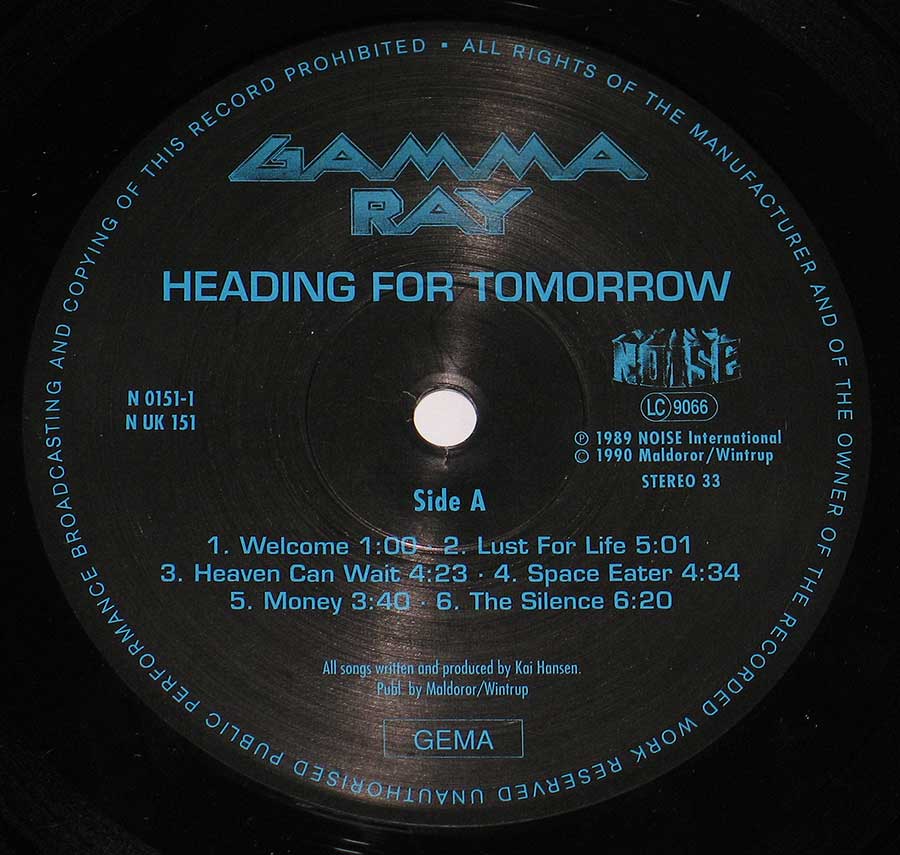
Side A label printed on a deep black background with bright blue text that stands out sharply — classic early Noise International styling. Center hole alignment is clean, no label tear, no spindle scratches visible in the surrounding area.
Across the top sits the angular Gamma Ray band logo, rendered in metallic blue-grey with hard geometric edges. It mimics the look of a beveled steel plate — a deliberate stylistic cue used across early Gamma Ray branding to give the logo a futuristic, engineered feel.
Below the logo, the album title Heading For Tomorrow is printed in the same blue ink. The Noise Records logo sits to the right — a rough, distorted stencil-style drawing resembling cracked stone or graffiti, typical of Noise’s late-80s visual identity. Its only job is branding but ends up contributing a gritty, underground aesthetic.
Two catalog numbers appear on the left: N 0151-1 (German LP) and N UK 151 (UK market number), confirming a pressing intended for broad European distribution. The LC code LC 9066 appears beside the Noise logo, a marketing identifier used across German releases.
Pressing information includes: © 1989 Noise International and © 1990 Maldoror / Wintrup, followed by “STEREO 33,” printed cleanly without decorative framing. Tracklist is centered, numbered 1–6, with accurate timing. The GEMA rights society box sits near the bottom, printed in a light blue rectangle.
Rim text is fully in English, running along the outer edge in clear uppercase type: a standard legal warning used by Noise International at the time. No manufacturing country is printed, but the label’s design, fonts, and LC code firmly place this as a German-pressed Noise International LP.
Early-1990 Noise International label style printed with bright blue text over a matte black base. This particular label design was used by Noise International between 1988 and 1991.
All images on this site are photographed directly from the original vinyl LP covers and record labels in my collection. Earlier blank sleeves were not archived due to past storage limits, and Side Two labels are often omitted when they contain no collector-relevant details. Photo quality varies because the images were taken over several decades with different cameras. You may use these images for personal or non-commercial purposes if you include a link to this site; commercial use requires my permission. Text on covers and labels has been transcribed with a free OCR service.