- Parallel Lines Records Release
CALDERONE is a power/speed metal band from Berlin, Germany. The band was originally founded as "CRYPT" which was founded in 1986. Crypt was soon renamed into "Calderone" and has been active since. They released one official recording, an Extended Play (EP) record , called "Calderone".
Calderone’s self-titled 1988 EP is a hidden gem from the twilight of the heavy metal underground. It’s a raw, five-track blast of German power/speed metal, pressed on 12-inch vinyl and crackling with youthful energy. From the first needle drop, you feel the era’s passion pouring out of the grooves.
Back in 1988, heavy metal was at a crossroads. Glam metal ruled MTV while thrash peaked in adrenaline, and European power metal was just beginning to flex. Yet in West Berlin, a divided city sitting in the Cold War’s shadow, Calderone was carving out something uniquely theirs.
The band originally began as Crypt in 1986, hammering out riffs in underground rehearsal rooms. Berlin’s gritty isolation gave them a stubborn DIY streak, and you can sense that determination in their sound.
Calderone’s road to vinyl is the kind of underground tale collectors cherish. Their early Crypt demo earned small buzz in tape-trading circles, giving them the confidence to rename themselves Calderone and chase a proper recording.
By June 1988, the lineup — Zlatko Relic, Marc Papanastasiou, Jörg Franke and Chris Mosch — hit Vielklang Studio in West Berlin. They recorded the EP in just a handful of intense days driven by energy, stubbornness and probably caffeine and beer.
Working with producer Marcel Fery and releasing through the tiny Parallel Lines Records label, they created a record with no studio trickery — just four determined guys capturing lightning in a bottle.
Drop the needle and Calderone unleashes a fast, razor-edged blend of Power and Speed Metal. Quick melodic riffing, double-time drums and high-range theatrical vocals (clearly inspired by King Diamond) define the sound.
Zlatko Relic’s vocals don’t just sing; they soar and scream with dramatic flair. The guitars duel and harmonize over a pounding, uptempo rhythm section.
The production is raw and unpolished, and that’s part of the charm. It feels real, urgent and unmistakably part of the Berlin underground.
The EP holds five fiery tracks. “Wanna Make You Scream” opens with an adrenalized rush, followed by the aggressive pulse of “Burning Eyes.”
“God Forgive Us” closes Side One with dramatic flair, atmospheric touches and an extended solo. Flip it over and “Calderone” brings a fist-pumping anthem proudly bearing the band’s name.
The EP ends with “Quick One”, a two-minute burst of pure speed that leaves you exhilarated and slightly breathless.
In 1988, giants like Iron Maiden, Metallica and Helloween defined the global metal landscape. Calderone didn’t have their budget or reach, but they shared the same electric spirit.
Their mix of high-pitched drama and speed-driven riffing draws comparisons to King Diamond, early Blind Guardian and American speed metal bands like Agent Steel. It’s raw, hungry and sits proudly among the cult releases of the era.
No real controversy surrounded the EP — Calderone flew too far under the radar for that. What debate existed happened among the few who actually heard them.
Some teased them for wearing their influences openly, especially in the vocals. Others shrugged and turned it louder because, honestly, the energy was undeniable.
Calderone’s internal dynamic was the classic struggle of hungry musicians chasing a dream. Zlatko’s dual role as vocalist and guitarist alone shows how much weight he carried.
Guitar slot changes and lineup tweaks hinted at typical band life tensions. But by the time they recorded the EP, the chemistry was locked in and strong.
They poured everything into those five songs, even if real life and shifting trends later pulled them apart.
The EP was a local obscurity when it came out, but those who heard it recognized its charm. It quickly became a cult item among vinyl hunters and tape-traders.
Over the years, reviewers have revisited it with respect and nostalgia. Many agree the band had the potential for a full career if timing had been kinder.
Today, Calderone – Self-Titled is a prized collectible not because it’s expensive, but because it captures a moment lost to time. A spark that burned bright and fast.
Playing this EP now feels like opening a time capsule. The cover, the label, the faint scent of old cardboard — it all pulls you back to the era when metal felt urgent and new.
The record may be short, but the emotion inside it isn’t. For collectors and die-hards, it remains a reminder of why we fell in love with heavy metal in the first place.
Power/Speed Metal
A fast, razor-edged blend of late-80s Power and Speed Metal, built on quick melodic riffing, sharp double-time rhythms and high-range, theatrical vocals clearly inspired by King Diamond’s falsetto-driven drama. The sound feels raw, driven, and unmistakably underground — the kind of adrenaline-loaded metal that only small German presses managed to bottle in that era.
Parallel Lines Records – Cat#: PMLP 3330
Standard sleeve.
No custom inner sleeve included.
Record Format: 12" EP Vinyl Stereo Gramophone Record
Total Weight: 230g
1988 – Germany
Vielklang Studio – Berlin West, Germany
C.C. Promotions – 030 / 624 48 57
Personal Manager: Oliver C. Thons
Janus Music
Andernacher Straße 23
8500 Nürnberg 10
Germany
Disclaimer: Track durations shown are approximate and may vary slightly between different country editions or reissues. Variations can result from alternate masterings, pressing plant differences, or regional production adjustments.
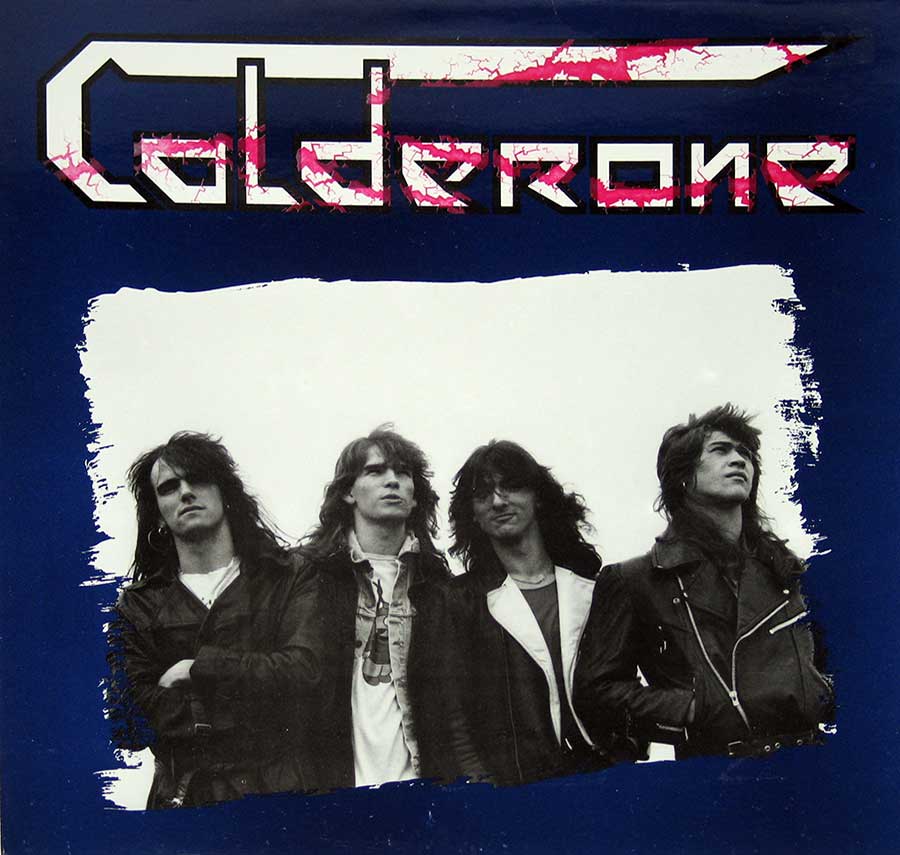
Front cover of the self-titled CALDERONE 12-inch vinyl EP, captured directly from the original Parallel Lines Records album cover. The design hits that classic late-80s hard rock look: a heavy blue background, a rough-edged white photo block, and a sharply angular band logo at the top with a cracked red-and-white pattern that instantly reveals its era. The logo alone tells a collector exactly what shelf this belongs on.
The black-and-white band photo shows four members lined up shoulder-to-shoulder, all with long hair, layered jackets, and that unbreakable “we’re ready to take over” stance. Each face carries a different kind of attitude: the first member with crossed arms and an earring, the second staring ahead with a denim-over-leather combo, the third with a slight smirk and open jacket, and the fourth angled to the side in a zipped-up biker jacket. These visual cues help confirm authenticity when comparing different print runs.
Every detail here matters to collectors: the grain of the photo, the exact shade of the blue border, the thickness of the white brush-stroke frame, and the precise wear patterns on the logo’s cracked effect. These elements help verify that this is an original and not a later reproduction. Photographed in high resolution straight from the personal archive for accurate documentation.
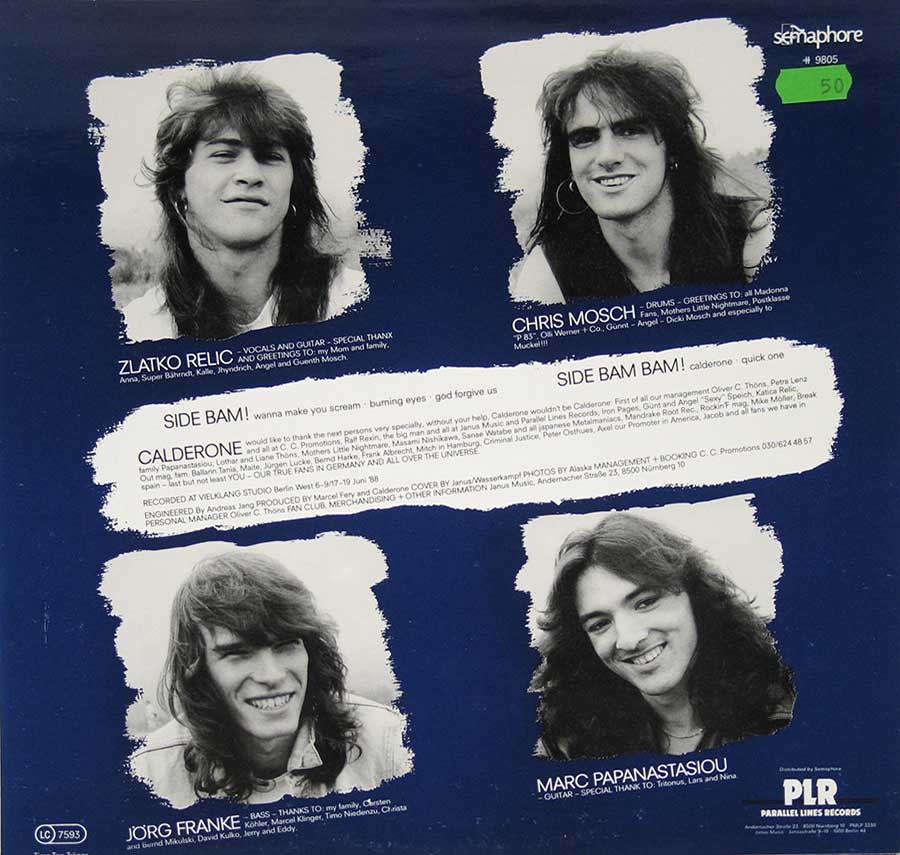
Back cover of the self-titled CALDERONE 12-inch EP, photographed directly from the original Parallel Lines Records Album Cover. The layout is pure late-80s German hard rock packaging: deep blue background, four individual black-and-white portraits arranged in a tight grid, each framed by a rough white brush-stroke border that instantly identifies the visual style used on this release.
The top row features Zlatko Relic and Chris Mosch, each accompanied by their role and special thanks. The portraits are crisp, lightly contrasted, and printed in a matte monochrome style typical of small-label European metal releases of the era. Beneath them, a long horizontal white block contains full tracklists, detailed acknowledgements, credits, management, booking info, and studio notes. Every line is part of what collectors check when authenticating early-run copies.
The lower row shows Jörg Franke and Marc Papanastasiou, again with individual credits beneath their portraits. A small LC 7593 code sits near the bottom left, while the familiar PLR (Parallel Lines Records) logo anchors the lower right. A bright green price sticker marked “50” remains stuck near the top right corner — the kind of real-world detail that helps date a copy and confirm its retail history. All elements photographed cleanly for accurate archival reference.
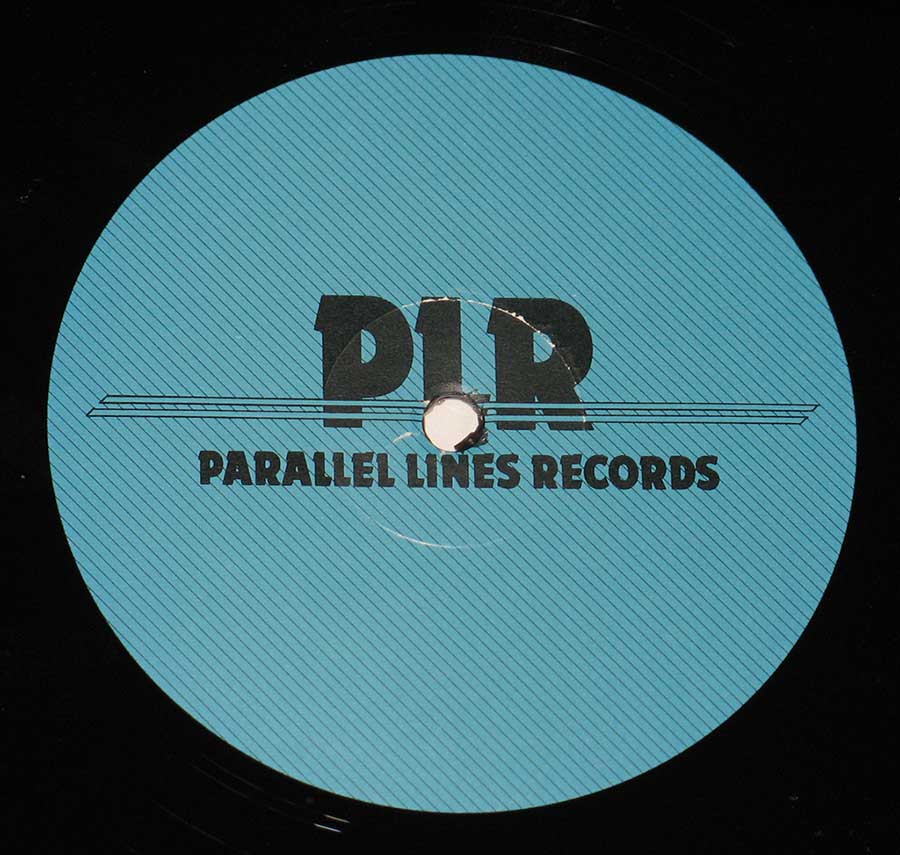
Close-up of the record label from the self-titled CALDERONE EP, photographed directly from the original record label. The entire label face is sky-blue with extremely fine diagonal black pinstripes running from the upper left to the lower right, giving it that distinct Parallel Lines Records aesthetic that collectors immediately recognize. The spindle hole sits dead center, with a small amount of wear around the edge — normal for a used but well-handled copy.
The label artwork is built around the large, bold PLR logo printed in solid black near the top-middle. The letters sit on a pair of double horizontal lines that stretch across the width of the logo, a detail used by collectors to confirm this exact label variation. Beneath the logo, the label reads “PARALLEL LINES RECORDS” in heavy block lettering, perfectly centered. No track titles or catalog data appear on this side, which is typical for small-label European metal releases of the late 1980s.
The surrounding vinyl surface is clean, dark, and reflective, with light circular groove rings visible toward the outer edge of the image. These visual patterns confirm the lacquer-cut style and help identify whether the disc is an early or later pressing. All details photographed at high resolution for accurate documentation and comparison against other runs. No year, country, or side designation is printed on this label — these values are therefore noted as unknown.
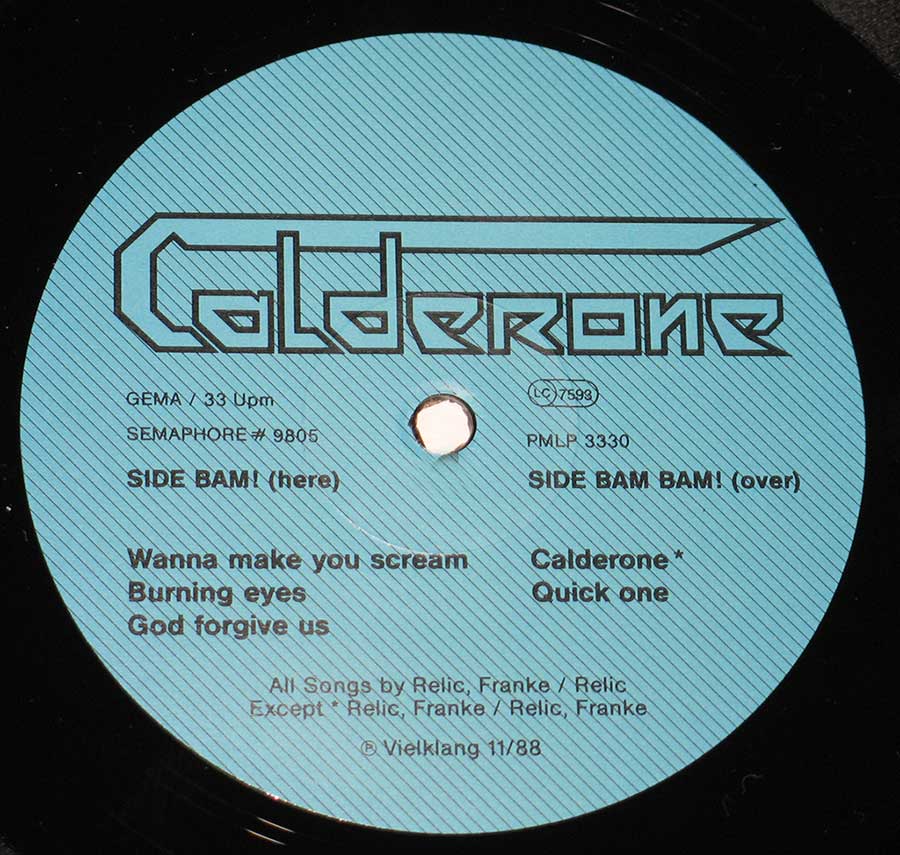
Close-up of the Side Two label from the self-titled CALDERONE EP, photographed directly from an original Parallel Lines Records record label. The label is printed in a bright sky-blue tone with extremely fine diagonal black pinstripes, a design element typical for PLR during the late 1980s. The spindle hole sits perfectly centered with light natural wear around the edges.
The band’s angular Calderone logo dominates the upper half. The logo resembles a sharpened metal blade running across the top, with stylized geometric lettering beneath it — clearly designed to project a harder, almost weaponized visual identity that fits late-80s German melodic metal aesthetics. This distinctive logo shape helps confirm authenticity since counterfeit runs often simplify the outline.
Text is arranged in a tight, efficient layout: GEMA and the 33 Upm speed appear at left, the LC 7593 code and catalogue number RMLP 3330 at right, with “Semaphore # 9805” printed in the upper-left block. The tracklists for both sides are printed in two columns: “Side Bam!” on the left and “Side Bam Bam!” on the right. Below the titles sits a songwriting credit line and the production timestamp “Vielklang 11/88,” marking the manufacturing date but not the country — which remains unknown.
No rim text is printed on this label, and no country-of-manufacture marker is present. These omissions are typical for PLR pressings from this distribution era. All details shown here are important reference points for collectors verifying label variations and authenticating original 1988 runs.
Sky-blue label with diagonal pinstripe background, bold PLR logo, and the full Calderone band logo printed prominently across the top. This particular label design was used by Parallel Lines Records between UNKNOWN and UNKNOWN.
All images on this site are photographed directly from the original vinyl LP covers and record labels in my collection. Earlier blank sleeves were not archived due to past storage limits, and Side Two labels are often omitted when they contain no collector-relevant details. Photo quality varies because the images were taken over several decades with different cameras. You may use these images for personal or non-commercial purposes if you include a link to this site; commercial use requires my permission. Text on covers and labels has been transcribed using a free online OCR service.