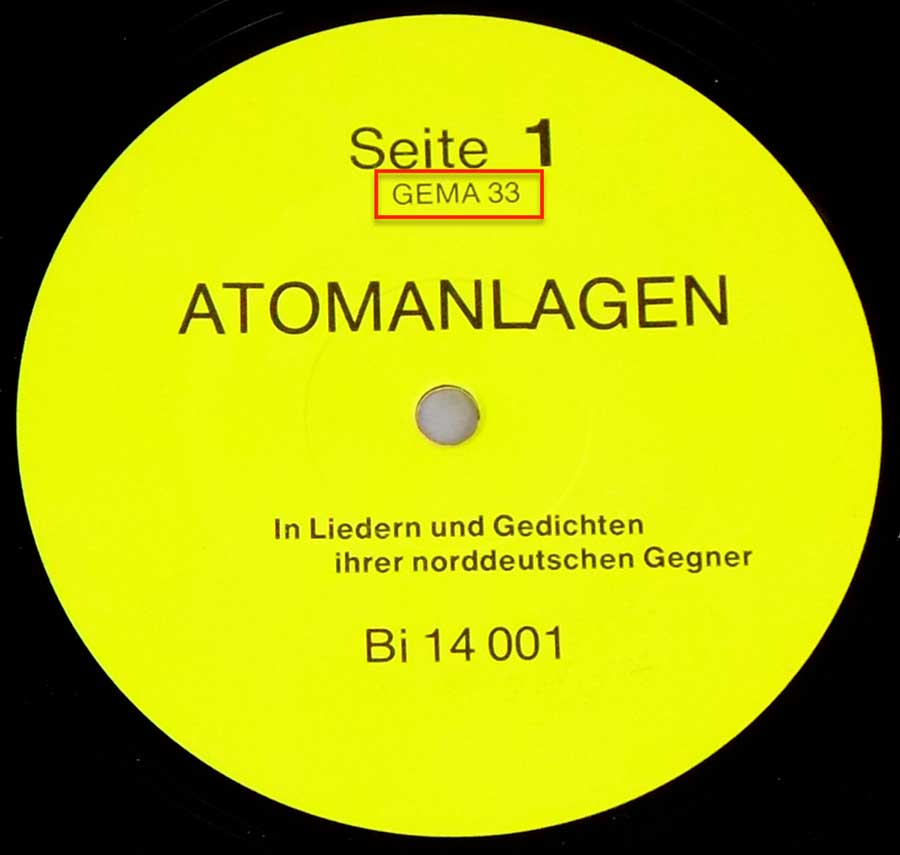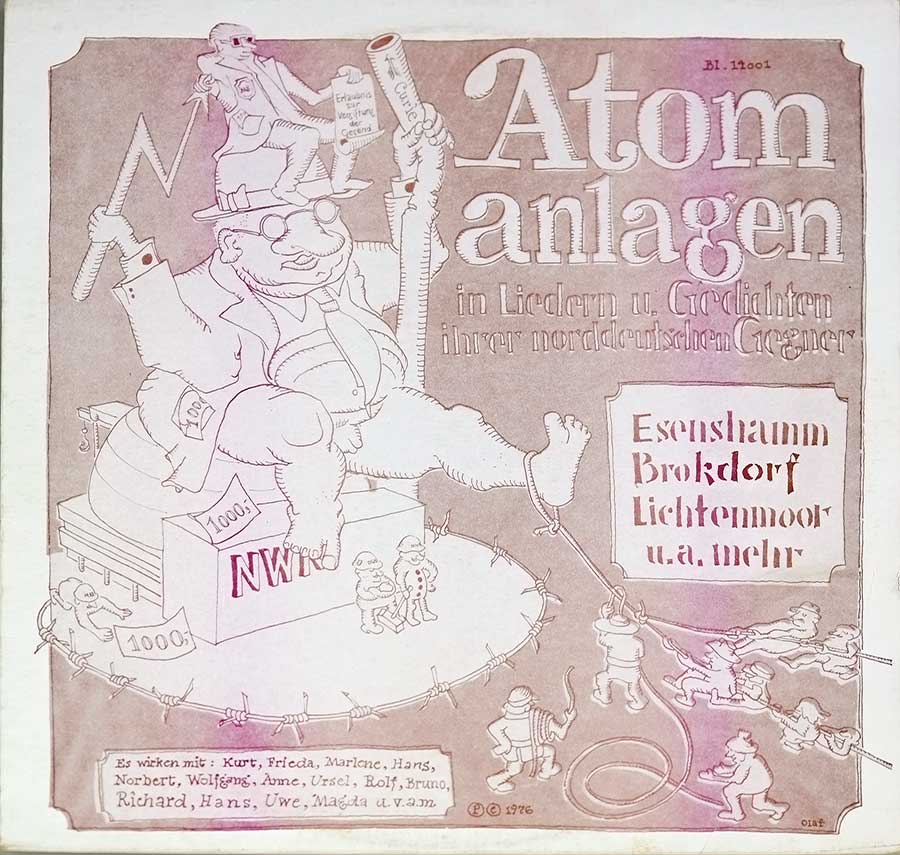
"AtomAnlagen in Liedern und Gedichten ihrer Norddeutscher Gegner" (1976) Album Description:
This 1976 West German protest LP is basically a field recording of a political pressure cooker: anti-nuclear activism in the North, turned into songs, poems, and blunt local testimony. It is not trying to be polite, timeless, or “artistic” in a gallery-friendly way; it is trying to be heard right now, by the people living near planned and operating nuclear sites. The result is agit-folk with teeth, where humor, anger, and rural realism sit in the same barstool.
West Germany, 1976: when “progress” showed up with riot police
By 1976, nuclear power in West Germany was not just an energy policy; it was a cultural fault line running through villages, unions, churches, newspapers, and party politics. Local citizens’ initiatives had already proven they could stall or derail projects, and northern sites were becoming flashpoints where permits, fences, and public anger arrived in the same week. In that climate, this record lands less like entertainment and more like a pamphlet that happens to be cut at 33 1/3.
The geography here matters: northern river and marsh landscapes, fishing and farming communities, and the feeling that decisions were being made somewhere far away and delivered locally like bad weather. Several song titles point straight at that lived map, including references to Brokdorf and the Elbe. The album’s “we” voice is the sound of neighbors trying to stop a machine they did not order.

Genre: protest folk with a Northern accent
The record sits in the protest-song ecosystem that West Germany had been building all through the 1960s and 1970s: the Liedermacher tradition, political cabaret, and community-choir realism. But it is not the polished singer-songwriter posture of a concert hall; it is closer to the hand-painted banner vibe. The mood swings from grim warning to deadpan satire, because that is how movements survive long winters.
If you want a family resemblance, think of the broader German political-song current that included artists like Hannes Wader and Franz Josef Degenhardt, plus the rawer street-level edge of bands like Ton Steine Scherben. Across Europe and the UK, the same decade saw folk and rock artists pulling politics into everyday language, but this album stays stubbornly local. It speaks like a leaflet written by someone who has to live with the outcome.
What the tracklist tells you before you even press play
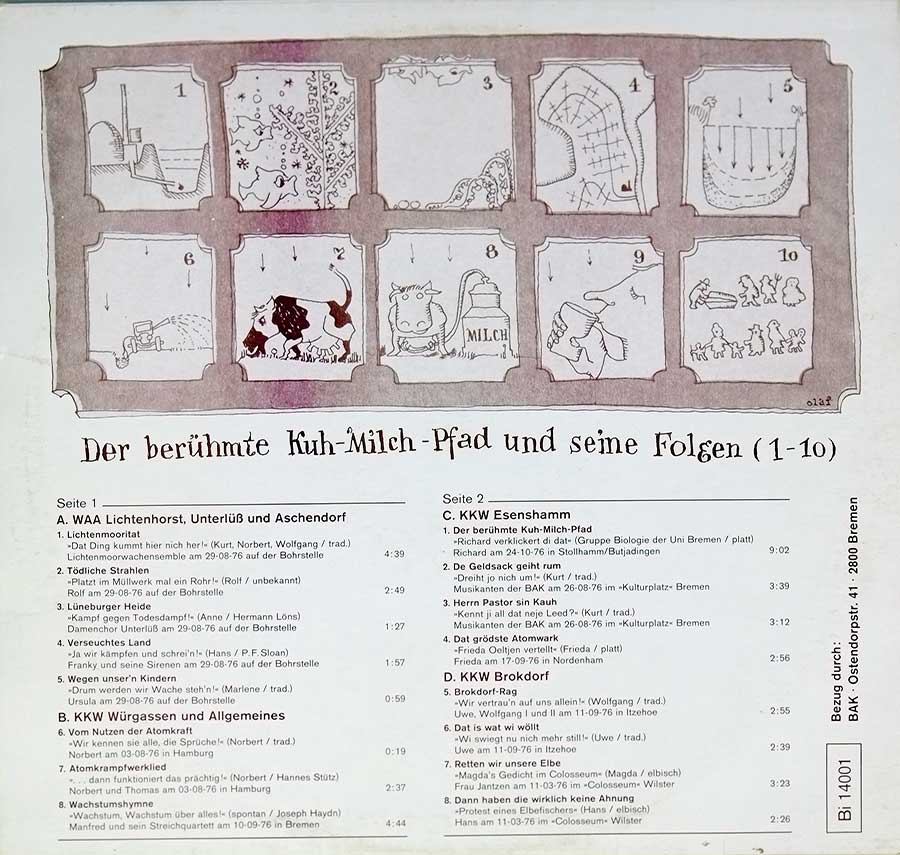
The titles read like headlines from a regional paper that’s stopped pretending everything is fine. They move between threat (“Tödliche Strahlen”), poisoned landscape (“Verseuchtes Land”), and a fierce, almost parental moral argument (“Wegen unser’n Kindern”). Then there is satire aimed at the sales pitch of “growth” and “benefit,” because propaganda always has slogans and this record wants to break them in half.
- Warning songs that treat radiation and contamination as immediate, not theoretical.
- Place-based pieces that anchor the conflict in named regions rather than abstract policy.
- Satirical numbers that mock the “jobs and progress” script without sounding like a lecture.
- Movement anthems designed to be remembered, repeated, and sung with other people.
Musical exploration: simple forms, sharp delivery
Musically, the record leans on folk basics: sturdy rhythms, singable melodies, and structures that work in a room full of non-professional singers. That is not a limitation; it is the point. The songs are built to travel, so a chorus can jump from a kitchen table to a demonstration without needing a rehearsal studio.
The palette includes spoken-word and poem-like pacing, where meaning and emphasis matter more than virtuosity. Humor shows up as a weapon, not a break from seriousness, and dialect phrasing adds an extra layer of identity and defiance. Even when the arrangements are minimal, the intent is maximal: clarity, memorability, and group energy.
“This is what protest music sounds like when it’s written by people who can’t drive away from the problem.”
The collective approach also explains the album’s blend of songs and spoken material: different kinds of communication aimed at different kinds of listeners. Some tracks persuade with narrative, some with ridicule, some with straight-up warning. The mix is strategy: reach the cautious neighbor, the angry friend, and the undecided uncle in one spin.
Movement history on wax: Brokdorf and the northern flashpoints
The Brokdorf reference is not decorative; it points at one of the most heated West German nuclear battlegrounds, where demonstrations and police confrontations became part of the public story starting in 1976. In other words, the record arrives at the exact moment the conflict stops being “a local dispute” and becomes a national mirror. You can hear that escalation in the tone: urgency, sarcasm, and the sense that normal democratic channels are being ignored.
The song “Brokdorf Rag” is especially revealing because it uses the bounce of a familiar protest-song trick: make the tune catchy enough to carry the message past defenses. That move puts this LP in the same international protest-music toolbox that had already been refined in the US and UK during the previous decade. The point is not originality; it is transmission.
Controversies: why this album was never going to be “just music”
First controversy: the subject itself. In 1976, openly anti-nuclear material was not a neutral consumer preference; it was a political statement that could collide with local authorities, employers, and the pro-nuclear messaging machine. Even when the songs are funny, the target is serious power.
Second controversy: the record refuses the polite distance of commentary and speaks from the affected communities, naming places and consequences. That can read as “inflammatory” if you are invested in keeping the conversation abstract. The album’s bluntness is exactly what makes it useful, and exactly what would have made it unwelcome in certain official rooms.
Third controversy: the movement tone invites group identity, and group identity invites backlash. Protest music can become a rallying flag, and flags make opponents nervous, especially when protests are already filling roads and headlines. This LP does not calm the temperature; it documents it and nudges it higher.
Quick guide: how to listen so it makes sense
This record rewards listening like it is a documentary. Focus on how the material shifts between warning, satire, and solidarity, because that three-part rhythm is how communities process big threats. The “genre” is not just folk or protest; it is community communication under pressure.
- Start with the titles and notice how often place names and environmental language show up.
- Listen for repeated phrases and choruses designed for group singing, not solo performance.
- Pay attention to humor: it is not decoration, it is a coping mechanism and a persuasion tactic.