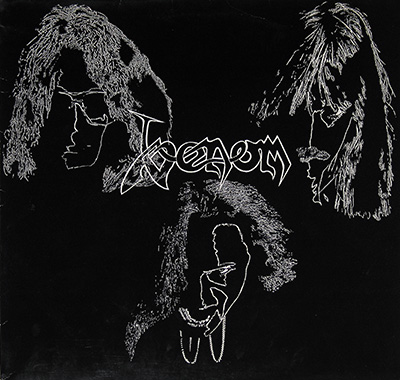
Album Description:
Historical & Cultural Context (Early 1980s)
By 1984 the New Wave of British Heavy Metal (NWOBHM) movement—born in the late 1970s—had already reshaped British and global metal culture. Bands began blending punk energy with metallic aggression, creating faster tempos, rawer sound, and darker lyrical themes. The early 1980s in Britain were marked by political tension, economic hardship, and a restless youth culture seeking intensity and release through music.
Globally, the Cold War, social unrest, and youth rebellion gave heavy metal a potent sense of urgency. Within that environment, Venom emerged as one of the loudest, most extreme voices—a band willing to push boundaries both musically and thematically.
The Genre & Its Contemporaries
Venom occupied a unique space within the NWOBHM era. While peers like Iron Maiden, Saxon, and Def Leppard refined the classic metal formula, Venom stripped it down, sped it up, and drenched it in distortion and chaos. Their influence was immediate: groups such as Bathory, Hellhammer, Slayer, and Metallica drew heavily from their intensity and theatricality.
The band’s second album, Black Metal (1982), would later give a name to an entire genre of extreme music. By the time Warhead was released, Venom were already recognized as godfathers of both thrash and black metal—a bridge between NWOBHM’s melodic roots and the more brutal styles that would dominate underground scenes in the decades to follow.
About the Warhead EP
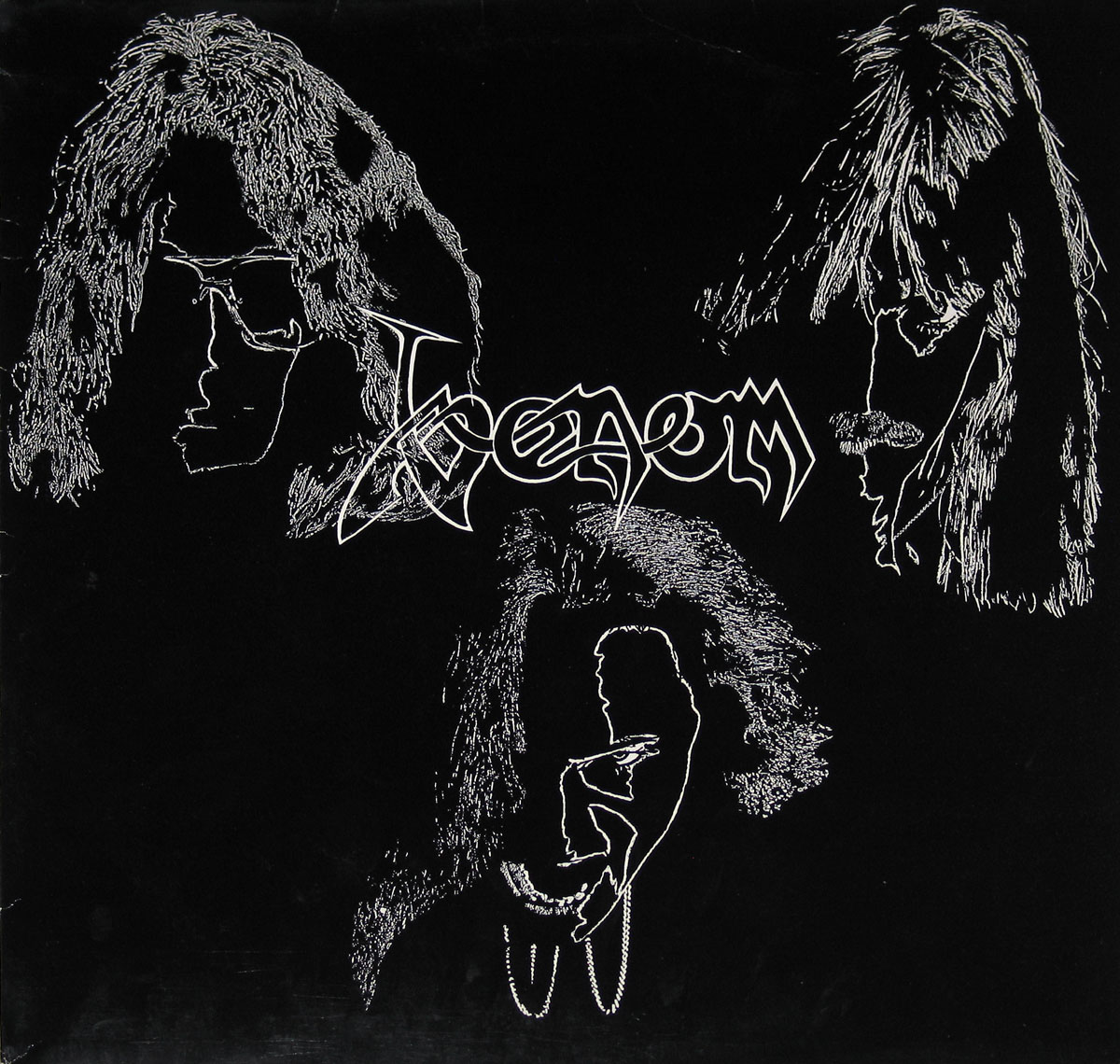
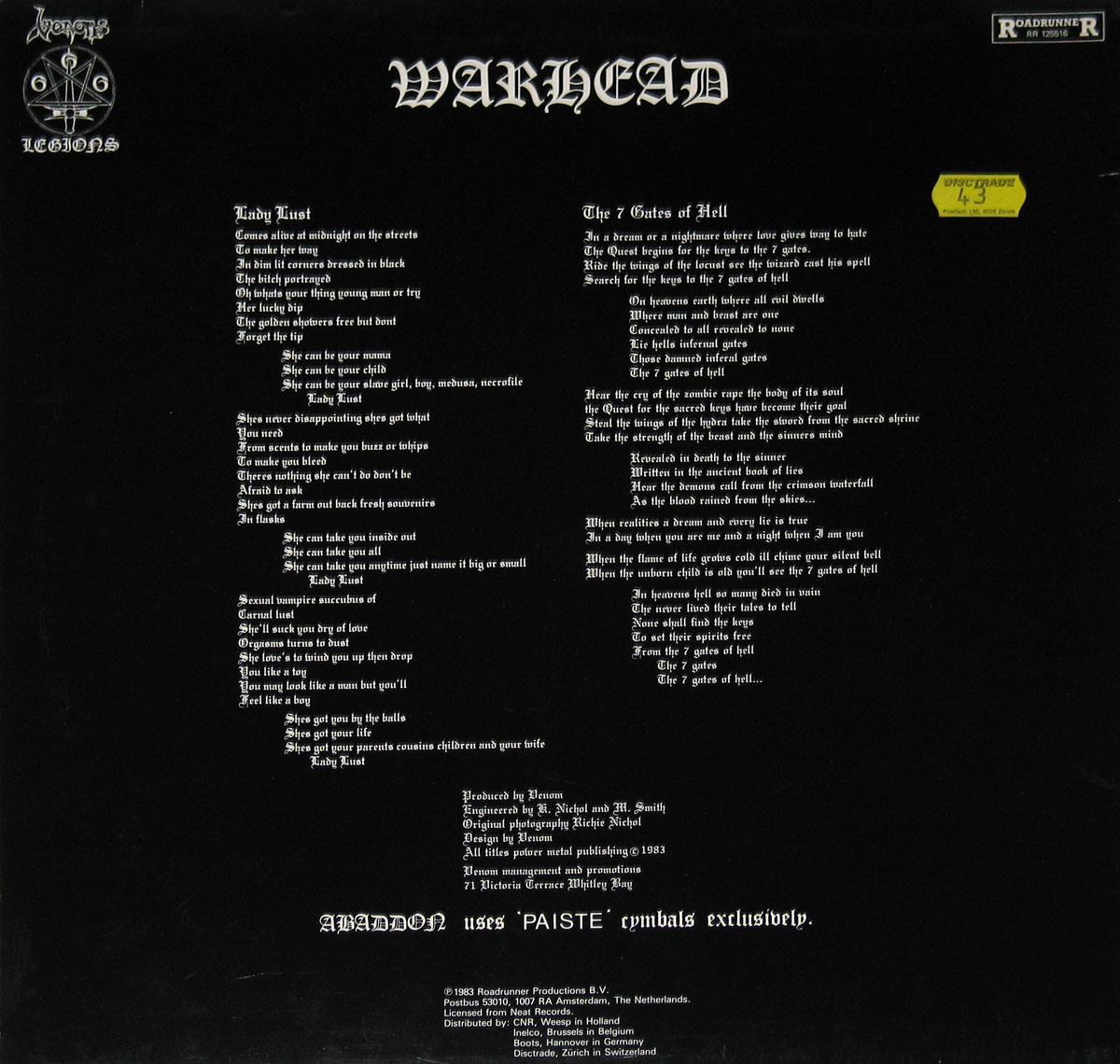
Released on 20 January 1984 by Neat Records, the Warhead 12-inch single arrived shortly before Venom’s full-length album At War with Satan. It captured the band at their creative peak, fusing relentless rhythm with dark theatricality. The EP typically included the tracks “Warhead,” “Lady Lust,” and “The 7 Gates of Hell.”
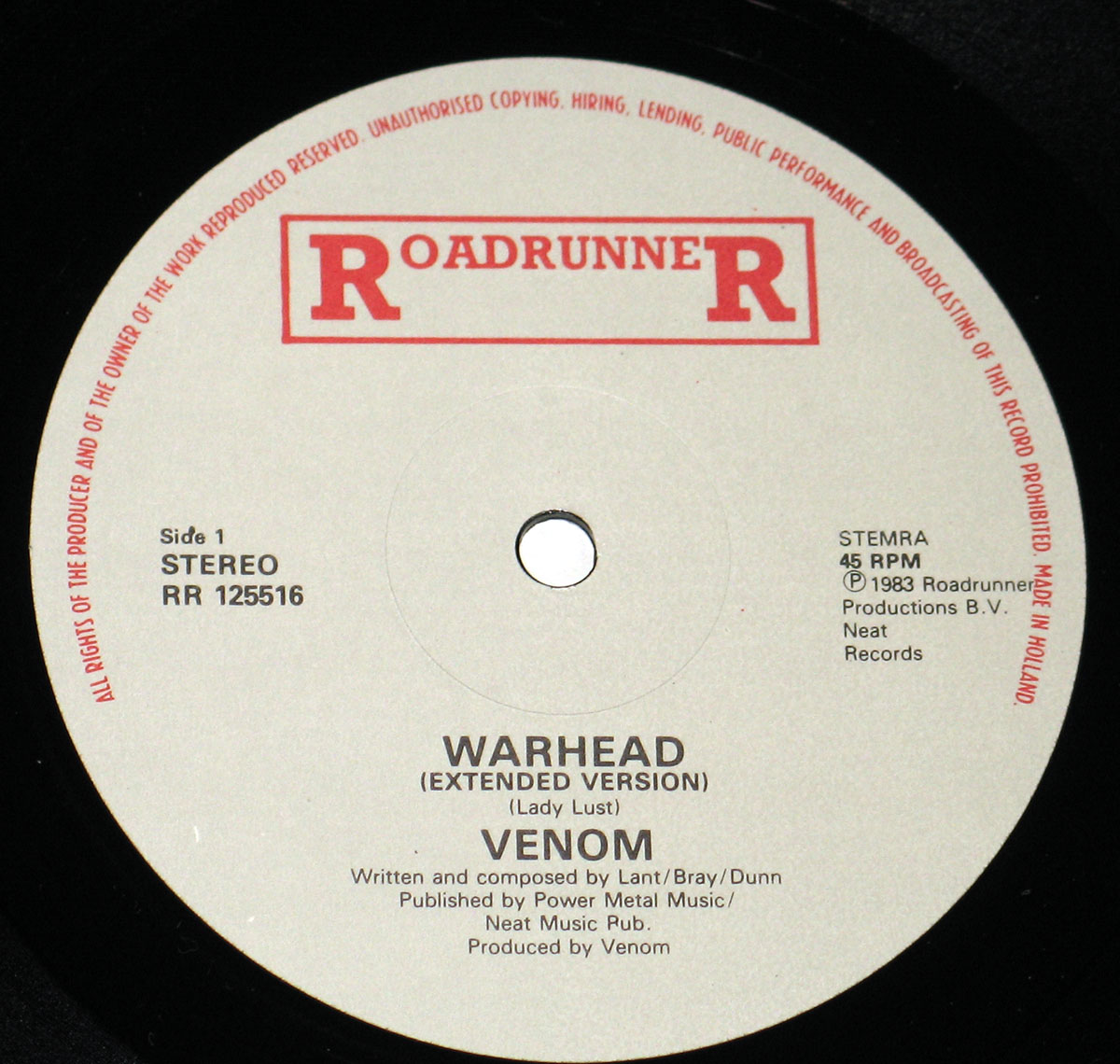
This web-page documents the European release issued by the Dutch label RoadrunneR Productions B.V., which licensed the recording from Neat Records for continental distribution. This version was widely circulated across the Netherlands, Germany, Belgium, and Switzerland, representing one of the earliest collaborations between Neat’s British underground roster and RoadrunneR’s expanding European metal network.
Musically, it served as both a preview of their evolving direction and a reaffirmation of their uncompromising sound—dense, noisy, and unapologetically aggressive. The recording showcased the trio’s raw chemistry and DIY approach to heavy metal production.
Musically, it served as both a preview of their evolving direction and a reaffirmation of their uncompromising sound—dense, noisy, and unapologetically aggressive. The recording showcased the trio’s raw chemistry and DIY approach to heavy metal production.
Musical & Thematic Exploration
The title track “Warhead” opens with a pounding rhythm section and abrasive guitar tone that symbolize the violence of war itself. Cronos’s snarling vocals and Abaddon’s thunderous drumming reinforce the apocalyptic atmosphere. “Lady Lust” delivers straightforward riff-driven energy, while “The 7 Gates of Hell” dives deep into occult imagery, pairing doom-laden riffs with ceremonial undertones.
Venom’s themes of war, destruction, and infernal power mirrored the fears of a generation living under the shadow of nuclear conflict. The band’s fascination with Satanic and anti-religious symbolism was not necessarily literal—it functioned as rebellion, theater, and social provocation. Their visual and lyrical choices helped define the shock-aesthetic that became a hallmark of extreme metal.
Band & Key Contributors
At the time of Warhead, Venom consisted of:
- Conrad “Cronos” Lant – bass & vocals
- Jeffrey “Mantas” Dunn – guitars
- Tony “Abaddon” Bray – drums
Production was handled by Venom themselves, engineered by K. Nichol and M. Smith, with original photography by Richie Nichol. The credits highlight the band’s self-contained creative control—unusual for heavy acts of the era, who often relied on major-label producers. Venom’s hands-on approach gave their recordings a raw authenticity that would influence countless underground artists.
Band Formation & Evolution
Venom originated in Newcastle upon Tyne around 1978–79. Various early line-ups experimented under names like Guillotine before consolidating into the trio of Cronos, Mantas, and Abaddon. Their debut album Welcome to Hell (1981) was recorded on a shoestring budget but became a cornerstone of underground metal. Follow-ups Black Metal (1982) and At War with Satan (1984) solidified their reputation.
Although the “classic” lineup remained intact through the mid-1980s, internal tensions and creative differences eventually led to departures. Nevertheless, the chemistry of the three members during this era remains one of heavy metal’s most influential combinations.
Controversy & Reaction
As with much of Venom’s work, Warhead provoked both fascination and outrage. Critics accused the band of glorifying Satanism and war, while fans embraced their defiant spirit. The controversy only amplified their mystique, ensuring the single’s underground success despite limited radio play or mainstream exposure.
Venom’s combination of speed, darkness, and rebellious attitude positioned them as one of the most feared and admired acts of the 1980s metal scene. Warhead stands as a key recording in the transition from NWOBHM to the dawn of extreme metal—a fierce statement from a band determined to push every boundary.