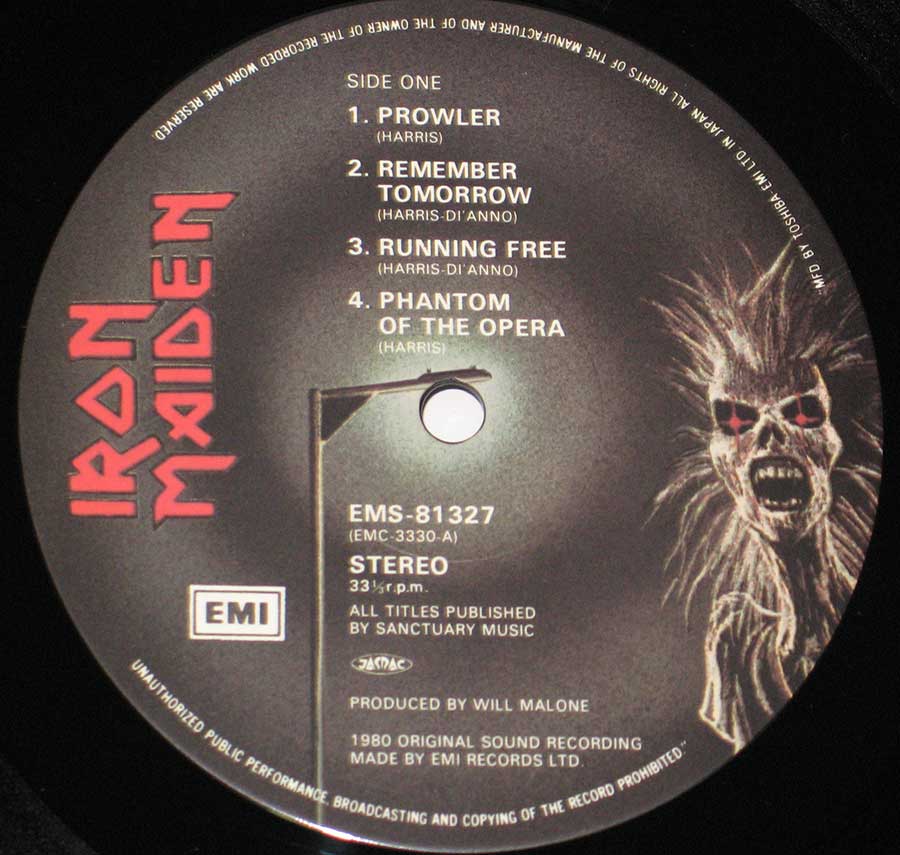
IRON MAIDEN S/T SELF-TITLED 12" Vinyl LP Album

- Japanese Release on Toshiba Records

In 1980, the rising sun bore witness to a British invasion of a different kind. Iron Maiden's self-titled debut, a raw and unyielding metal assault, landed on Japanese shores via Toshiba Records. This wasn't just an album; it was a cultural exchange, a sonic samurai charge against the musical establishment. Eddie's menacing grin, gracing the cover, became a symbol of rebellion for Japanese youth hungry for a new sound. This album marked the dawn of a new era, a testament to the universal power of heavy metal that transcended borders and language barriers.


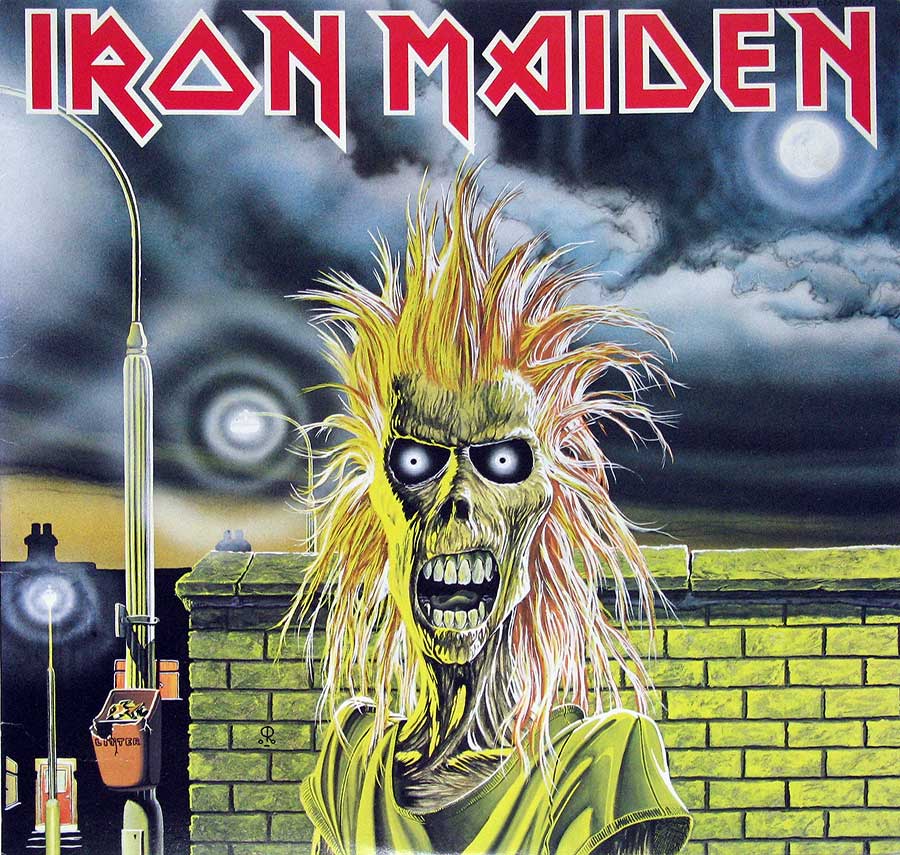
IRON MAIDEN - Self-Titled Toshiba Japan 12" Vinyl LP Album front cover

Rising Sun, Rising Steel: Iron Maiden's Sonic Onslaught Reaches Japan
Album Description:

In the Land of the Rising Sun, a new dawn broke in 1980. Not of gentle light, but a sonic thunder unleashed by a British quintet, their name echoing across continents: Iron Maiden. Their self-titled debut, a raw diamond forged in London's fiery underground, found a new home under Toshiba Records, destined to ignite a heavy metal wildfire across Japan.

This wasn't just any record; it was a cultural exchange, a collision of East and West, a testament to the universal language of raw power and unbridled passion. Japan, steeped in its own rich musical heritage, was about to be conquered by a sound as fierce and uncompromising as a samurai's blade.

Produced by Will Malone, forged in the sonic furnaces of Kingsway and Morgan Studios, this album was no mere collection of songs, but a manifesto of rebellion against the stale status quo. While disco shimmered and prog rock meandered, Maiden resurrected the raw energy of rock and roll, infusing it with a metallic edge that resonated with the rebellious spirit of Japanese youth.

Steve Harris's galloping basslines laid the foundation for a sonic assault, a relentless rhythm that propelled the music forward. Dave Murray and Dennis Stratton, twin guitar virtuosos, unleashed a maelstrom of riffs, harmonizing and dueling with the ferocity of legendary warriors. Paul Di'Anno, a streetwise frontman with a voice like gravel and whiskey, snarled lyrics of darkness, history, and fantasy, his words striking a chord with those who felt marginalized and misunderstood.

The Japanese release, while mirroring the UK tracklist, took on a life of its own. The album's iconic cover art, depicting Eddie the Head emerging from the shadows, became a symbol of defiance and rebellion, embraced by a generation eager to forge its own path. The vinyl grooves weren't just carrying music, they were carrying a message of empowerment and self-expression.
Collectors information / Album Description: 

Music Genre:

NWOBHM New Wave of British Heavy Metal 

Album Production Information:

The album: "IRON MAIDEN S/T Self-Titled Toshiba Japan" was produced by: Will Malone, Sanctuary Music.

Sound/Recording Engineer(s): Martin Levan at Morgan Studios, London.

This album was recorded in 1980 at: Kingsway Studios, London.

Record Label & Catalognr:

Toshiba EMI EMS-81327  

Media Format:

12" Vinyl Stereo Gramophone Record
Total Album (Cover+Record) weight: xxx gram  

Year & Country:

1980 Made in Japan  
Band Members and Musicians on: IRON MAIDEN S/T Self-Titled Toshiba Japan
    Band-members, Musicians and Performers IRON MAIDEN Band: members/musicians
  • Paul Di'Anno
  • Paul Di'Anno – Vocals

    The OG Iron Maiden throat: street-level grit, punk heat, and zero “polite” in the delivery.

    Paul Di'Anno, (17 May 1958 – 21 October 2024) locked himself into metal history by fronting Iron Maiden from 1978–1981, putting that snarling, rough-cut voice on the band’s early landmark releases. After Maiden, the timeline turns into a proper tour-bus saga: Di’Anno (1983–1985, then revived in the 1998–2001 era), the short, star-stacked Gogmagog detour (1985), Battlezone (1985–1989, back again 1997–1998), a notable studio cameo with Praying Mantis around 1990, and Killers (1990–1997, returning 2001–2003, plus a 2013 regroup). Later chapters include the Brazil-based Rockfellas run (2008–2010) and Architects of Chaoz (2014–2016). The common thread never really changed: that unmistakable, no-varnish vocal attitude that made early NWOBHM feel dangerous in the first place.

  • Steve Harris
  • Steve Harris – Bass Guitar, Songwriter

    Iron Maiden’s engine room: galloping bass lines, history-nerd lyrics, and “captain of the ship” energy baked into every riff.

    Steve Harris (born 12 March 1956, Leytonstone, England) is the rare bassist who doesn’t just hold the floor—he draws the whole blueprint. In my book, he’s the founder and primary songwriter who’s kept Iron Maiden on its rails from 1975–present, with that instantly recognizable “gallop” driving huge chunks of the catalogue. The pre-Maiden grind matters too: first band days in Influence/Gypsy’s Kiss (1973–1974, including a documented gig run in 1974), then the older, blues-leaning Smiler period (1974–1975) where his more ambitious writing basically forced the next step: forming Maiden. Outside the mothership, he’s fronted his own hard-rock outlet British Lion (2012–present), a project that grew out of connections going back to the early 1990s and finally hit the world as his solo debut in 2012.

  • Dennis Stratton
  • Dennis Stratton – Guitar

    Maiden’s short-lived “melody guy” in the earliest days: twin-guitar shine, tighter harmony instincts, and a very un-satanic love of proper hooks.

    Dennis Stratton (born 9 October 1952, Canning Town, London) is a classic example of “brief stint, permanent fingerprints.” He joined Iron Maiden in December 1979 and was out by October 1980, but in that tight window he played on the debut album Iron Maiden (released April 1980) and the non-album single "Women in Uniform", right as the band went from club-level chaos to real-deal momentum. He even helped shape the lineup by recommending drummer Clive Burr, which is the kind of butterfly-effect detail collectors love to remember. Before Maiden, he’d cut his teeth in local bands like Harvest/Wedgewood (early 1970s) and Remus Down Boulevard (mid-1970s). After leaving, he kept moving through the UK hard rock ecosystem, notably with Lionheart (1980s onward) and as lead guitarist (and occasional lead vocalist) for Praying Mantis from 1990–2006, plus a mid-1990s collaboration run with former Maiden singer Paul Di'Anno under The Original Iron Men. Dennis Stratton Wiki

  • Dave Murray
  • Dave Murray – Guitar

    Maiden’s calm killer: smooth leads, twin-guitar harmony for days, and that melodic bite that makes the “gallop” feel cinematic instead of chaotic.

    Dave Murray (born 23 December 1956, Edmonton, Middlesex, England) is one of the defining lead guitar voices of heavy metal, and in my book he’s the melodic “second spine” of Iron Maiden. His timeline with the band starts early: joining in 1976, getting briefly pushed out in 1977, then returning in 1978 and staying locked in ever since—making him one of the longest-serving members in the whole Maiden saga. During that 1977 gap he spent around six months with Urchin (Adrian Smith’s band), which is a fun little historical glitch in the matrix if you like your Maiden lore messy and human. Beyond the main band, his most notable “outside the mothership” credit is the all-star charity metal project Hear ’n Aid (1985), because apparently even guitar lifers sometimes leave the bunker to do side quests. Dave Murray Wiki

  • Clive Burr
  • Clive Burr – Drums

    The early Maiden groove machine: big feel, sharp fills, and that “Beast-era” punch that still rattles the walls.

    Clive Burr (8 March 1957 – 12 March 2013) is one of those drummers who didn’t just keep time—he gave a band its early backbone. I mainly hear him as Iron Maiden’s rocket fuel from 1979–1982, laying down that urgent, swinging drive on their first run of classic records and helping make the whole NWOBHM thing feel dangerous instead of polite. Before that, he did the London grind with Samson (1977–1978). After Maiden, the timeline gets gloriously nomadic: Trust (1983–1984), a blink-and-you-miss-it week with Alcatrazz (1983), his own Clive Burr’s Escape (1983–1984) evolving into Stratus (1984–1985), the supergroup cameo in Gogmagog (1985), Desperado (1988–1990), and later work with Praying Mantis (1995–1996). His later years were brutally shaped by multiple sclerosis, but the playing legacy stays loud, human, and unmistakably his own—Clive Burr Wiki

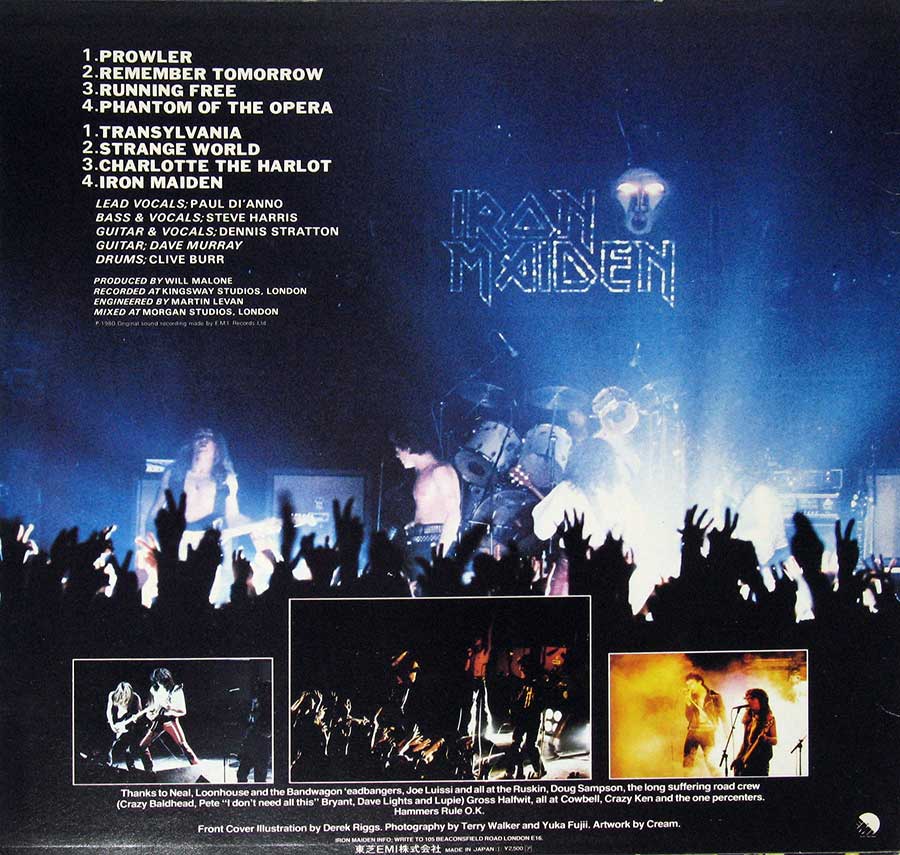
Complete Track Listing of: IRON MAIDEN S/T Self-Titled Toshiba Japan

The Song/tracks on "IRON MAIDEN S/T Self-Titled Debut" are

    Side One:
  1. Prowler
  2. Remember Tomorrow
  3. Running Free
  4. Phantom of the Opera
    Side Two:
  1. Transylvania
  2. Strange World
  3. Charlotte the Harlot
  4. IRON MAIDEN

IRON MAIDEN - Vinyl Records Discography Home Page