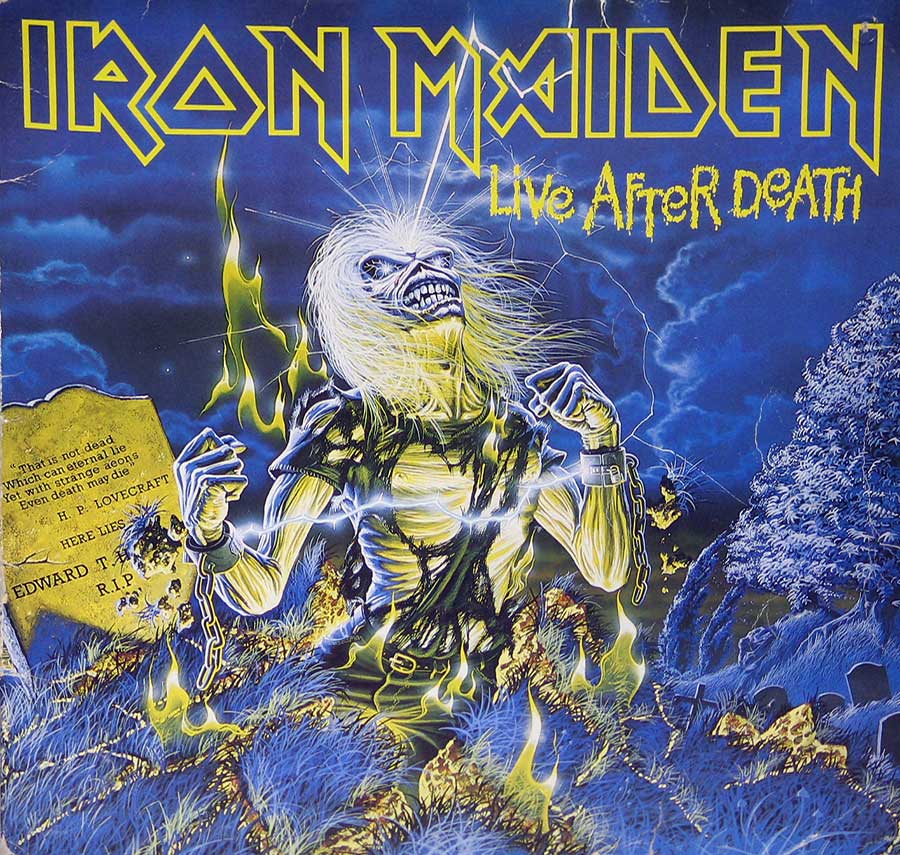
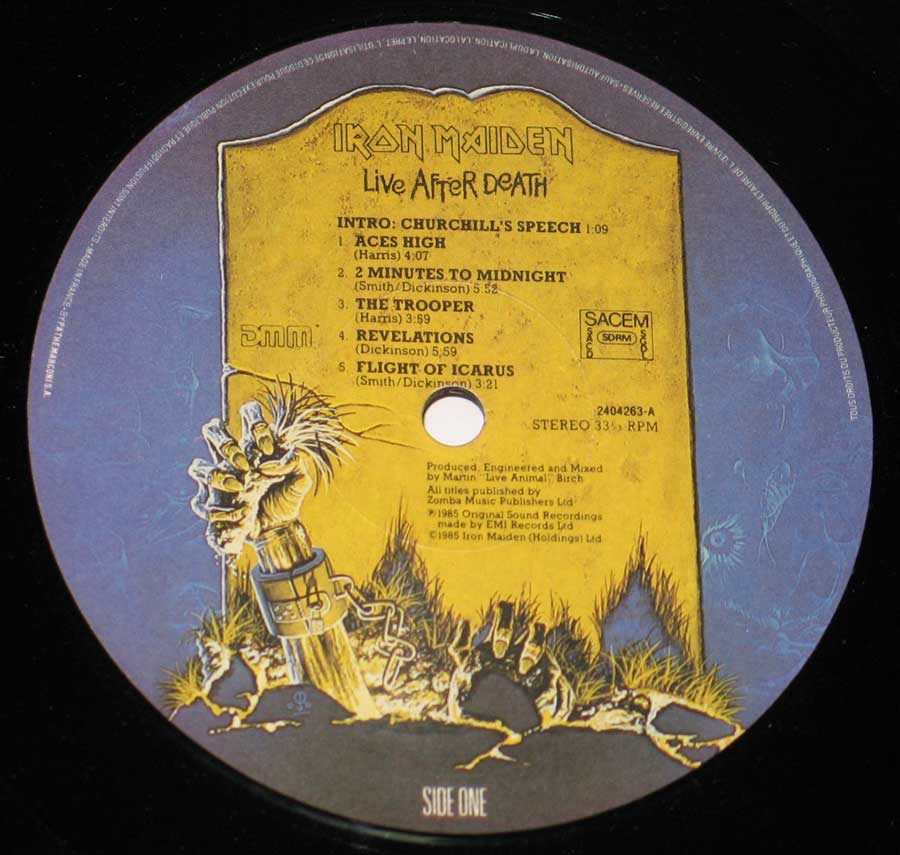
"Live After Death" Album Description:
In the world of heavy metal history, there exists a landmark recording that has withstood the test of time, resonating with fans and critics alike. IRON MAIDEN's "Live After Death," a 12" 2LP Vinyl Album released in France on October 14, 1985, stands as a testament to the band's unparalleled prowess on stage and their indelible impact on the genre.
Time Period and Historical Context
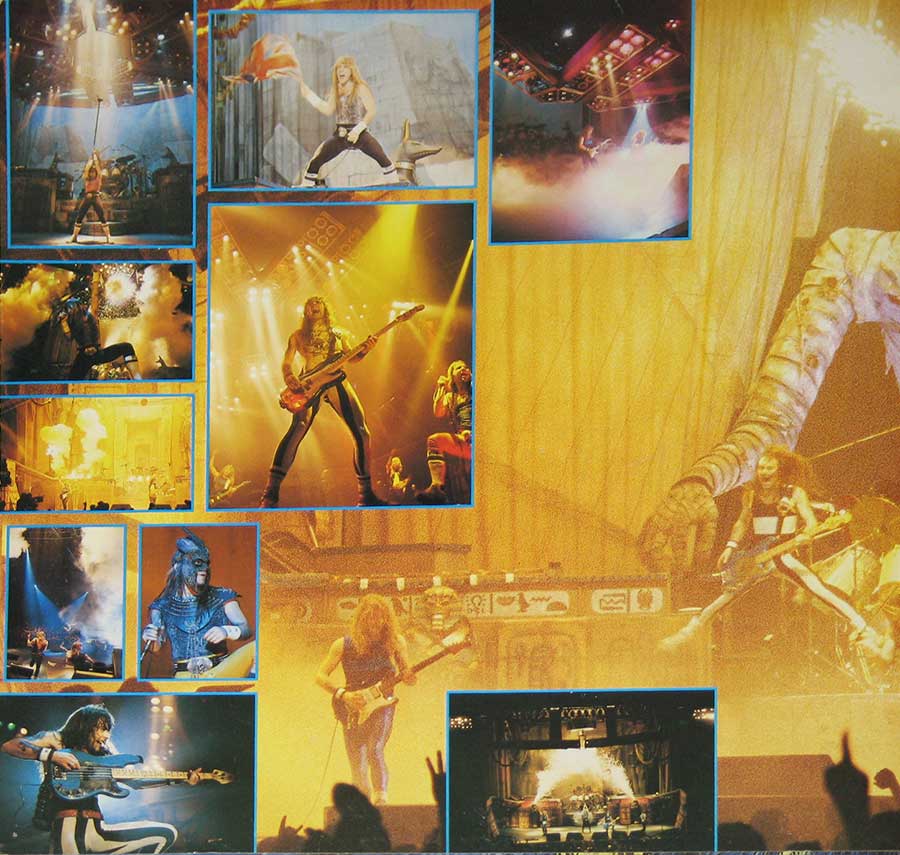
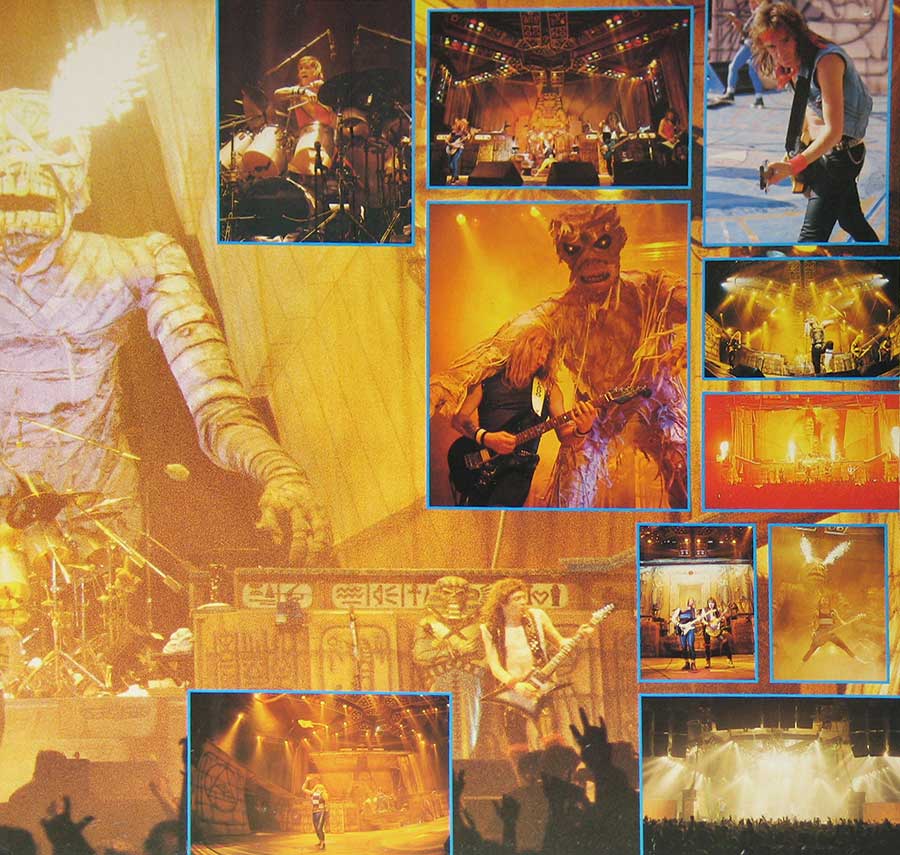
The release of "Live After Death" places us squarely in the heart of the mid-1980s, a period marked by the ascendancy of heavy metal as a global phenomenon. The New Wave of British Heavy Metal (NWOBHM) had already made its mark, and bands like IRON MAIDEN were at the forefront of the movement. The live album, recorded during the World Slavery Tour, captures the essence of a time when metal was reaching new heights of popularity and cultural significance.
As the world grappled with political tensions and societal shifts, the music scene provided an outlet for expression and rebellion. IRON MAIDEN's energetic and theatrical performances during this era resonated with a generation seeking an escape through the raw power of heavy metal.
Production Excellence: Capturing the Thunderous Energy
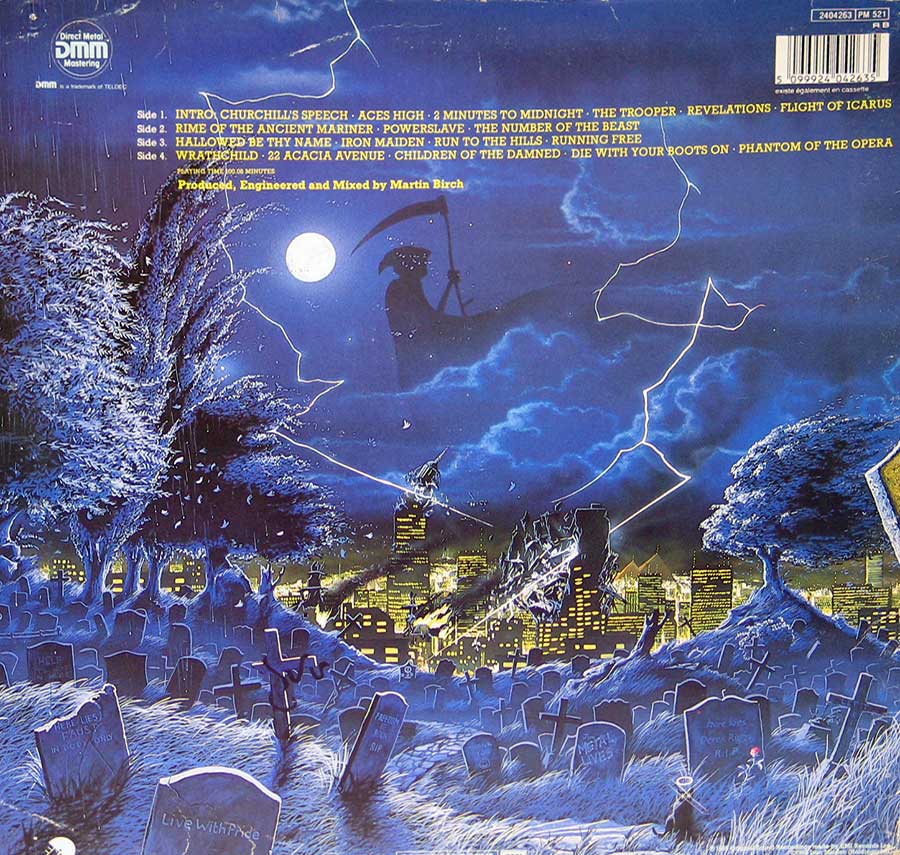
"Live After Death" is more than just a documentation of concerts; it is a sonic journey that transports listeners to the heart of the live experience. The production, spearheaded by Martin Birch, a legendary figure in the world of rock and metal production, captures the thunderous energy of IRON MAIDEN's performances.
Birch's meticulous attention to detail ensures that every guitar riff, every drum beat, and every soaring vocal is rendered with clarity and impact. The result is a sonic tapestry that not only pays homage to the band's studio prowess but also elevates the live experience to new heights.
The decision to release the album as a 12" 2LP Vinyl in France adds an extra layer of nostalgia and collectibility to this iconic record. The tactile nature of vinyl, coupled with the immersive artwork and packaging, enhances the overall listening experience, making it a cherished possession for fans and collectors alike.
Enduring Legacy: Greatest Live Album Ever?
"Live After Death" continues to be heralded as one of the greatest live albums ever recorded. Its enduring legacy is evident in the fact that, decades after its release, it still commands a prominent place in discussions about the best live performances in the history of heavy metal.
The album not only showcases the musical prowess of each band member but also captures the symbiotic relationship between IRON MAIDEN and their fervent audience. From the anthemic "Aces High" to the epic "Rime of the Ancient Mariner," each track on the album is a testament to the band's ability to create a transcendent live experience.
Band Members and Musicians on: IRON MAIDEN Live After Death 2LP
|
Band-members, Musicians and Performers
- Bruce Dickinson
- Bruce Dickinson – Singer
Samson forged the roar; Iron Maiden turned it into a global alarm system. Read more... Bruce Dickinson, Bruce Dickinson is the rare frontman who can sound like a human air-raid siren and still tell a story. Before the arenas, I track him in
Samson (1979–1981)
, where the voice sharpened into steel. He joined Iron Maiden in 1981 and powered their classic run through 1993, then returned in 1999 and has stayed ever since. Between the big chapters he kept moving: a solo career from 1990 onward, plus the short, sharp Skunkworks detour in 1996. On stage he’s theatrical without slipping into pantomime—commanding, precise, and oddly disciplined for heavy metal. Timeline: Samson ’79–’81; Maiden ’81–’93 and ’99–now; solo from ’90; Skunkworks ’96. And yeah, never boring.
- Dave Murray
- Dave Murray – Guitar
Maiden’s calm killer: smooth leads, twin-guitar harmony for days, and that melodic bite that makes the “gallop” feel cinematic instead of chaotic. Read more... Dave Murray (born 23 December 1956, Edmonton, Middlesex, England) is one of the defining lead guitar voices of heavy metal, and in my book he’s the melodic “second spine” of Iron Maiden. His timeline with the band starts early: joining in 1976, getting briefly pushed out in 1977, then returning in 1978 and staying locked in ever since—making him one of the longest-serving members in the whole Maiden saga. During that 1977 gap he spent around six months with Urchin (Adrian Smith’s band), which is a fun little historical glitch in the matrix if you like your Maiden lore messy and human. Beyond the main band, his most notable “outside the mothership” credit is the all-star charity metal project Hear ’n Aid (1985), because apparently even guitar lifers sometimes leave the bunker to do side quests. Dave Murray Wiki
- Adrian Smith
- Adrian Smith – Guitarist, Songwriter
The melodic blade behind Maiden’s heaviest hooks. Read more... Adrian Smith, Adrian Smith, he writes riffs the way old street poets throw punches: clean, sharp, and memorable. Before the Maiden machine, I hear him in Urchin (1973–1980), already mixing melody with bite. He joined Iron Maiden in November 1980, helped define their twin-guitar gold through 1990, then stepped away as the band’s direction shifted. In the wilderness years he tried A.S.A.P (1989–1990) and led Psycho Motel (1993–1999), plus a stint in Bruce Dickinson’s solo band (1997–1999). Since his return to Iron Maiden in 1999 he’s stayed a key songwriter, while still stretching out with projects like Smith/Kotzen (2020–present). He’s the guy who makes speed feel singable, not just fast for fast’s sake.
- Steve Harris
- Steve Harris – Bass Guitar, Songwriter
Iron Maiden’s engine room: galloping bass lines, history-nerd lyrics, and “captain of the ship” energy baked into every riff. Read more... Steve Harris (born 12 March 1956, Leytonstone, England) is the rare bassist who doesn’t just hold the floor—he draws the whole blueprint. In my book, he’s the founder and primary songwriter who’s kept Iron Maiden on its rails from 1975–present, with that instantly recognizable “gallop” driving huge chunks of the catalogue. The pre-Maiden grind matters too: first band days in Influence/Gypsy’s Kiss (1973–1974, including a documented gig run in 1974), then the older, blues-leaning Smiler period (1974–1975) where his more ambitious writing basically forced the next step: forming Maiden. Outside the mothership, he’s fronted his own hard-rock outlet British Lion (2012–present), a project that grew out of connections going back to the early 1990s and finally hit the world as his solo debut in 2012.
- Nicko McBrain
-
Nicko McBrain – Drums
Nicko McBrain, born 1952, is the powerhouse drummer who has driven Iron Maiden’s thunderous engine since joining in 1982. His playing combines brute force with swing and pinpoint timing, giving albums like The Number of the Beast and Powerslave their unstoppable momentum. Before Maiden, his work with Trust and the Pat Travers Band sharpened his style, culminating in a career that redefined metal drumming.
|