- The Dutch Pressing That Captured Maiden’s Most Dangerous Era
This Dutch pressing of “Killers” feels like stumbling onto Iron Maiden right as they’re leveling up — a snapshot of 1981 when the band still had street grit under their nails but were already gearing up for world domination. The combo of Adrian Smith’s fresh fire and Paul Di’Anno’s last stand gives the album this wild, transitional energy, like a machine mid-transformation. The Netherlands edition captures that moment perfectly: raw, hungry, and swaggering with the kind of attitude you only get once in a band’s lifetime — before polish, before stadiums, just pure, accelerating momentum.
Iron Maiden’s 1981 album “Killers” catches the band at a defining crossroads, sharpening their sound while accelerating their rise across Europe. This period saw the arrival of guitarist Adrian Smith, whose melodic precision strengthened the twin-guitar identity, and marked the final chapter of Paul Di’Anno, whose raw edge still fuels the album’s intensity.
“Killers” shows a band transforming fast, moving from rough, street-level NWOBHM toward the more structured, dramatic style that would define their later albums. Tracks like “Wrathchild” and the title track carry the ferocity of early Maiden, while pieces such as “Prodigal Son” introduce a more melodic, reflective side.
The Netherlands edition reflects the band’s growing international presence at the time, capturing a key moment as Iron Maiden expanded beyond the UK and built momentum across Europe.
For collectors, this pressing represents a snapshot of Maiden refining their identity—part farewell, part launchpad—before entering the landmark years with Bruce Dickinson. It remains an essential document of a band pushing forward with confidence and creative fire.
The original custom inner sleeve is black WITHOUT any text
There is NO barcode on this album
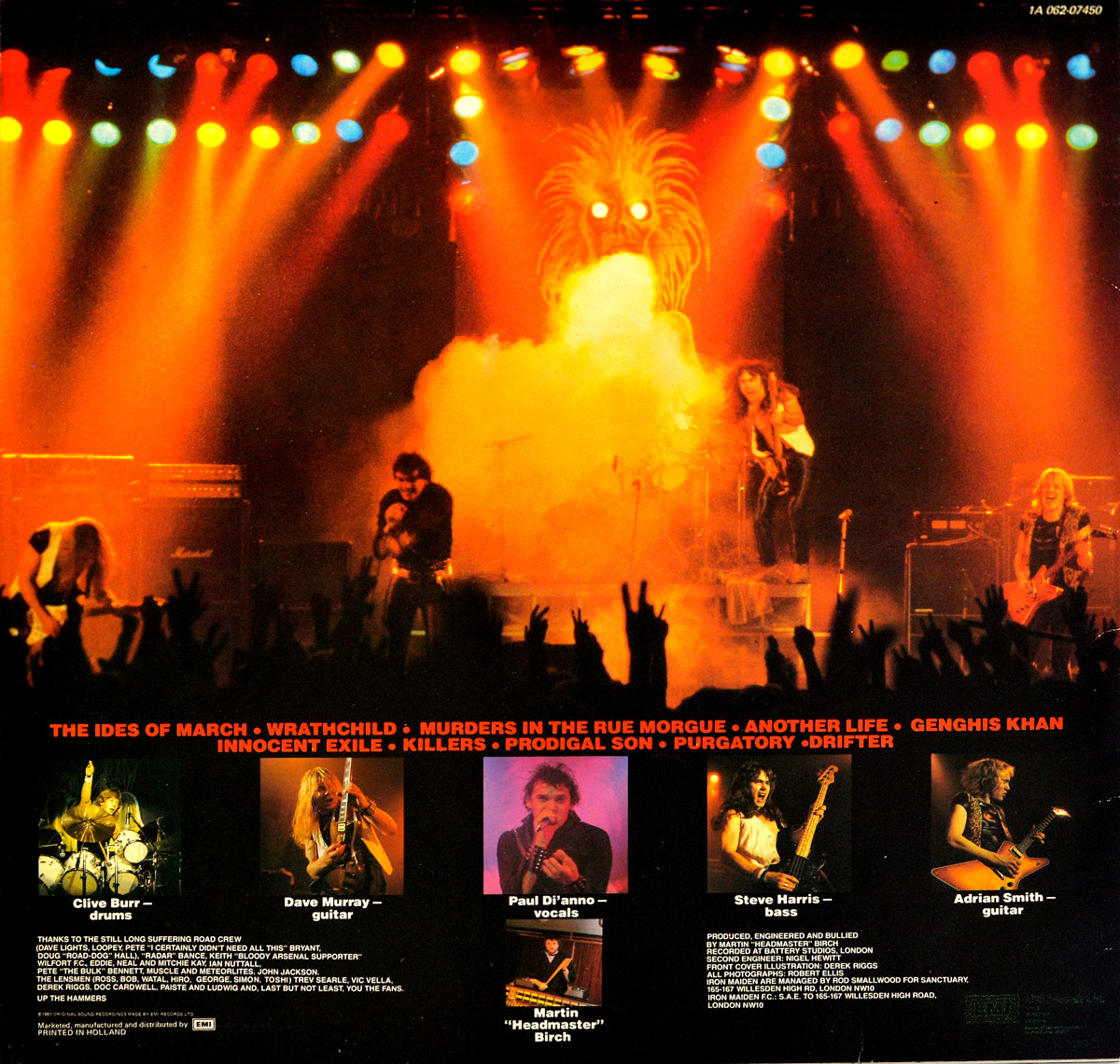
1) Notice that the top right corner has a single catalognr. Other versions may have multiple catalognrs in this position.
2) The bottom left corner has "PRINTED IN HOLLAND" this does NOT always appear in other releases
Top right corner:
1A 062.07450
Bottom Left Corner:
1981 ORIGINAL SOUND RECORDINGS MADE BY EMI RECORDS LTD
Marketed, Manufactured and distributed by EMI-logo
PRINTED IN HOLLAND
Bottom Right Corner:
PRODUCED, ENGINEERED AND BULLIED BY MARTIN "HEADMASTER" BIRCH RECORDED AT BATTERY STUDIOS, LONDON SECOND ENGINEER: NIGEL HEWITT FRONT COVER ILLUSTRATION: DEREK RIGGS ALL PHOTOGRAPHS: ROBERT ELLIS IRON MAIDEN ARE MANAGED BY ROD SMALLWOOD FOR SANCTUARY. 165-167 WILLESDEN HIGH RD. LONDON NW10 IRON MAIDEN FC.: S.A.E. TO 165-167 WILLESDEN HIGH ROAD. LONDON NW1O
This album comes with custom inner sleeves which contain production details, tracklisting, musician information, photos, artwork
Side One: 062-07450-A //47197-1-Y
Side Two: 062-07450-B //47198-1-Y
Record Label Information:
Label Side One:
Remark: Labels on this version have NO Label Code
Above center-hole:
1A 062-07450
STEREO
STEMRA
Side 1
Below center-hole:
(062-07450 A)
(p) 1981 Original Recording
Sound Recording
Made by EMI
Records Ltd
Label Side Two:
Above center-hole:
1A 062-07450
STEREO
STEMRA
Side 2
Below center-hole:
(062-07450 B)
(p) 1981 Original Recording
Sound Recording
Made by EMI
Records Ltd
NWOBHM, British Heavy Metal
EMI 1A 062-07450
Standard sleeve.
No custom inner sleeve included.
12" Vinyl Stereo Gramophone Record
Total Weight: 230g
1981 – Netherlands
Battery Studios – London, UK
The OG Iron Maiden throat: street-level grit, punk heat, and zero “polite” in the delivery. Read more...
Paul Di'Anno, (17 May 1958 – 21 October 2024) locked himself into metal history by fronting Iron Maiden from 1978–1981, putting that snarling, rough-cut voice on the band’s early landmark releases. After Maiden, the timeline turns into a proper tour-bus saga: Di’Anno (1983–1985, then revived in the 1998–2001 era), the short, star-stacked Gogmagog detour (1985), Battlezone (1985–1989, back again 1997–1998), a notable studio cameo with Praying Mantis around 1990, and Killers (1990–1997, returning 2001–2003, plus a 2013 regroup). Later chapters include the Brazil-based Rockfellas run (2008–2010) and Architects of Chaoz (2014–2016). The common thread never really changed: that unmistakable, no-varnish vocal attitude that made early NWOBHM feel dangerous in the first place.
Maiden’s calm killer: smooth leads, twin-guitar harmony for days, and that melodic bite that makes the “gallop” feel cinematic instead of chaotic. Read more...
Dave Murray (born 23 December 1956, Edmonton, Middlesex, England) is one of the defining lead guitar voices of heavy metal, and in my book he’s the melodic “second spine” of Iron Maiden. His timeline with the band starts early: joining in 1976, getting briefly pushed out in 1977, then returning in 1978 and staying locked in ever since—making him one of the longest-serving members in the whole Maiden saga. During that 1977 gap he spent around six months with Urchin (Adrian Smith’s band), which is a fun little historical glitch in the matrix if you like your Maiden lore messy and human. Beyond the main band, his most notable “outside the mothership” credit is the all-star charity metal project Hear ’n Aid (1985), because apparently even guitar lifers sometimes leave the bunker to do side quests. Dave Murray Wiki
Iron Maiden’s engine room: galloping bass lines, history-nerd lyrics, and “captain of the ship” energy baked into every riff. Read more...
Steve Harris (born 12 March 1956, Leytonstone, England) is the rare bassist who doesn’t just hold the floor—he draws the whole blueprint. In my book, he’s the founder and primary songwriter who’s kept Iron Maiden on its rails from 1975–present, with that instantly recognizable “gallop” driving huge chunks of the catalogue. The pre-Maiden grind matters too: first band days in Influence/Gypsy’s Kiss (1973–1974, including a documented gig run in 1974), then the older, blues-leaning Smiler period (1974–1975) where his more ambitious writing basically forced the next step: forming Maiden. Outside the mothership, he’s fronted his own hard-rock outlet British Lion (2012–present), a project that grew out of connections going back to the early 1990s and finally hit the world as his solo debut in 2012.
The early Maiden groove machine: big feel, sharp fills, and that “Beast-era” punch that still rattles the walls. Read more...
Clive Burr (8 March 1957 – 12 March 2013) is one of those drummers who didn’t just keep time—he gave a band its early backbone. I mainly hear him as Iron Maiden’s rocket fuel from 1979–1982, laying down that urgent, swinging drive on their first run of classic records and helping make the whole NWOBHM thing feel dangerous instead of polite. Before that, he did the London grind with Samson (1977–1978). After Maiden, the timeline gets gloriously nomadic: Trust (1983–1984), a blink-and-you-miss-it week with Alcatrazz (1983), his own Clive Burr’s Escape (1983–1984) evolving into Stratus (1984–1985), the supergroup cameo in Gogmagog (1985), Desperado (1988–1990), and later work with Praying Mantis (1995–1996). His later years were brutally shaped by multiple sclerosis, but the playing legacy stays loud, human, and unmistakably his own—Clive Burr Wiki
Disclaimer: Track durations shown are approximate and may vary slightly between different country editions or reissues. Variations can result from alternate masterings, pressing plant differences, or regional production adjustments.
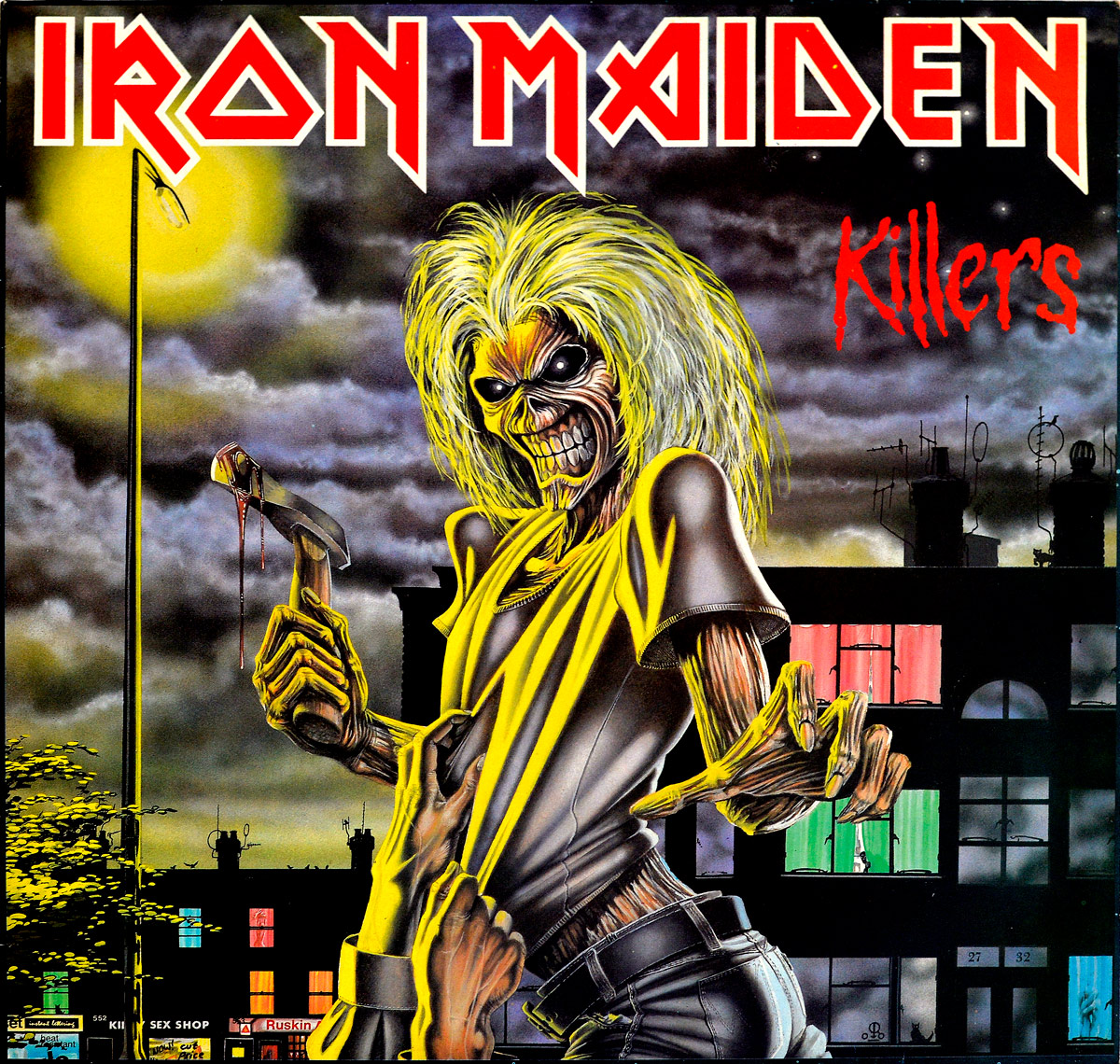
The cover art features Iron Maiden’s iconic mascot Eddie standing beneath a harsh yellow streetlamp on a storm-clouded urban night. His hair is wild and electric blond, fanning outward as though caught in a sudden wind. His skin is stretched tight over a skeletal frame, his eyes nothing but dark, predatory pits, and his mouth fixed in a twisted, triumphant grin.
Eddie grips a blood-soaked axe in his right hand, the weapon still dripping with bright red streaks. His left hand pulls up the shirt of an unseen victim whose arm emerges from the bottom edge of the frame, conveying a violent struggle frozen mid-moment. His black T-shirt clings to his sharp, angular torso, emphasizing the sinewy, undead energy characteristic of Derek Riggs’ artwork.
Behind him stretches a row of dark city buildings, their windows glowing in reds, greens, and blues—each window hinting at silhouettes and shadowy figures inside. Rooftops are studded with antennas and chimneys, adding to the gritty, nocturnal atmosphere. The sky is heavy with dark storm clouds, contrasting the bright yellow moon and lamp that cast dramatic highlights across Eddie’s figure.
The band’s bold red-and-white logo dominates the top left corner, while the album title Killers appears in jagged blood-red lettering to the right. The entire composition blends horror, comic-book intensity, and raw heavy-metal energy, creating one of the most recognizable and menacing album covers in rock history.
The most striking collector-specific markers of this Dutch pressing appear immediately: the catalog number 1A 062-07450 printed in the upper-right corner, and the unmistakable “PRINTED IN HOLLAND” manufacturing line paired with EMI’s marketing statement in the lower-left. These two identifiers make this Netherlands edition instantly distinguishable from UK, German, Japanese, and other international releases.
The main artwork above these details shows Iron Maiden captured mid-performance in a blazing wall of red, yellow, and green stage lights. A cloud of thick smoke rises from behind the drum kit, glowing as it diffuses the lights into fiery halos. The giant illuminated Eddie stage backdrop peers through the fog, its glowing eyes adding a haunting presence to the scene.
At the center of the stage stands Paul Di’Anno, gripping the microphone with a hunched, aggressive stance. To his sides, Dave Murray and Adrian Smith push forward with their guitars, limbs caught in motion by the intense lighting. On the right, Steve Harris strikes a commanding pose with his bass, while drummer Clive Burr remains partially obscured in a haze of light and smoke. The foreground is a sea of raised hands in silhouette, forming a jagged, energetic border that grounds the live atmosphere.
Beneath the main photo, five portrait shots present the band members individually, each identified by name and role. A block of production credits follows, highlighting producer and engineer Martin “Headmaster” Birch, along with a bold red track list stretching across the middle. The overall layout blends documentary clarity with the raw excitement of a heavy metal performance, making this back cover an essential part of the album’s visual identity.
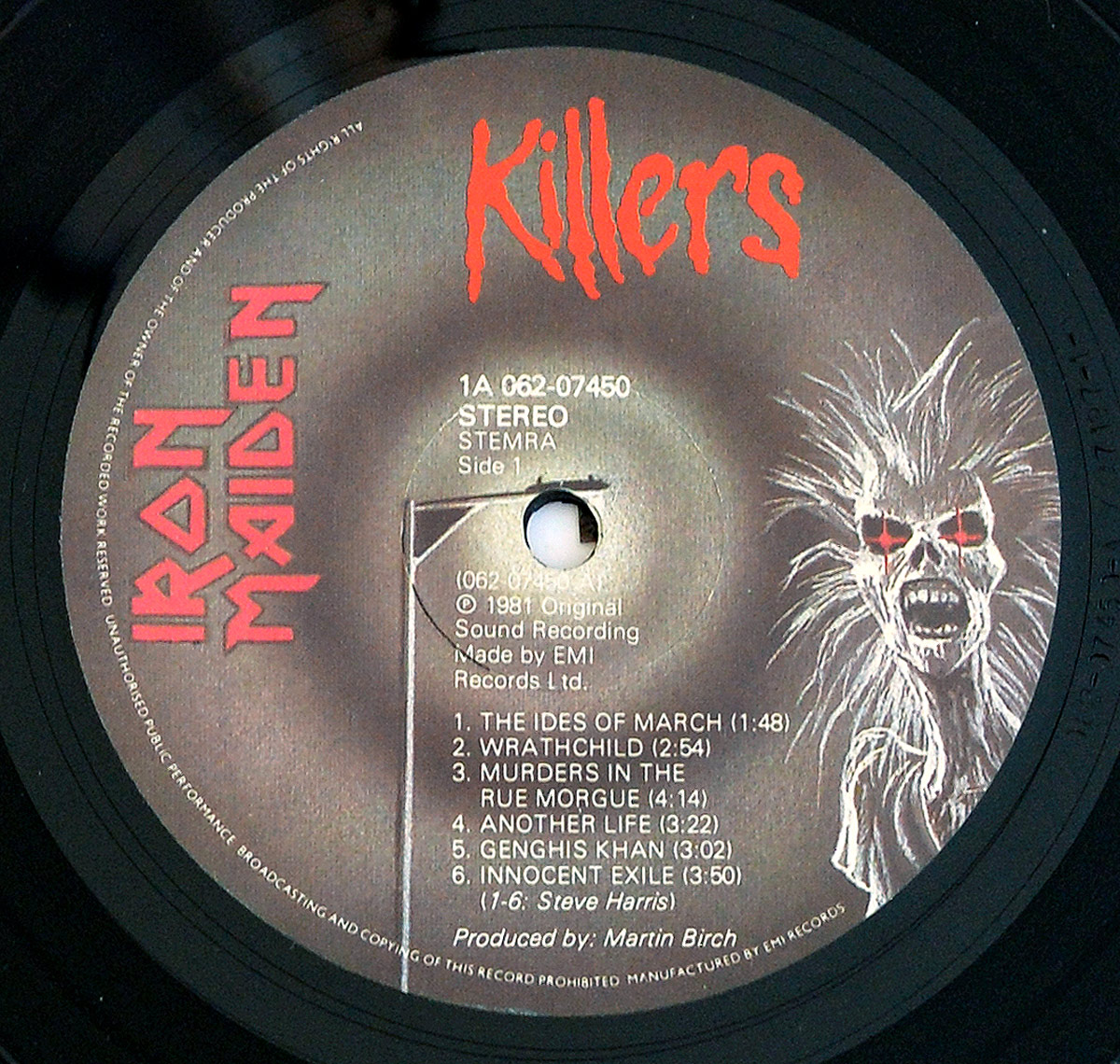
This close-up reveals the Side One label of the Dutch pressing of Iron Maiden’s Killers, distinguished by its gritty grey-brown background texture and stark, high-contrast artwork. The label is printed with the catalog number 1A 062-07450 at the top center, followed by the format designation STEREO and the rights society STEMRA, identifying the pressing as a Netherlands edition.
The left side features the classic vertical Iron Maiden logo in bold red lettering, printed along the rim. On the right, an intense illustration of Eddie is integrated directly into the label background: wide-mouthed, skeletal, with violently spiked white hair and glowing red eyes that stare directly outward. This artwork is a direct miniature version of the album’s cover iconography, serving as both branding and thematic reinforcement.
Beneath the spindle hole, the track listing for Side One is printed in clean white text, each title followed by its duration. A short copyright block appears above it, reading “℗ 1981 Original Sound Recording Made by EMI Records Ltd.” At the very bottom, the production credit explicitly names Produced by: Martin Birch, mirroring the heavy-metal production identity of early Maiden.
The circular rim text, printed in fine white lettering, contains standard EMI restrictions on copying, public performance, and broadcasting. The combination of STEMRA, the specific Dutch catalog number, and the metallic brown/grey background makes this label unique to the Netherlands release and instantly identifiable to collectors. The artwork, typography, and text arrangement form an iconic early-’80s EMI label design used specifically for Iron Maiden releases of the period.
This EMI label variant was used on Dutch Iron Maiden vinyl releases in the early 1980s and is distinguished by its aggressive artwork integration, metallic brown/grey background tone, and large red vertical Maiden logo. It is specific to Netherlands STEMRA-regulated editions.
This close-up of the Side One label from the Netherlands pressing of Iron Maiden’s Killers reveals a striking design that blends textual information with bold, integrated artwork. The label features a rough grey-brown textured background, consistent with early-80s Dutch EMI heavy-metal issues. At the very top sits the catalog number 1A 062-07450, identifying this pressing as the Netherlands variant, followed by the format indication STEREO, the rights society STEMRA, and the side marking “Side 1”.
Along the left rim, the classic Iron Maiden logo appears vertically in bold red lettering, instantly recognizable and used consistently on Maiden vinyl releases of the era. On the right-hand side, a fierce illustration of Eddie — screaming, hollow-eyed, with violently spiked hair — is printed directly into the label background. His glowing red eyes and sharp, skeletal expression reinforce the dark, aggressive theme of the album and serve as a form of artistic branding that ties the label visually to the album cover.
Beneath the spindle hole, the full Side One track list is presented in white print, each entry including its duration. The copyright block above it reads “℗ 1981 Original Sound Recording Made by EMI Records Ltd.,” confirming its UK-based production origin despite the Dutch pressing. At the bottom of the label, “Produced by: Martin Birch” is printed, anchoring the recording in the sonic legacy of one of metal’s most influential producers.
Encircling the outer black rim is the standard EMI legal text, printed in fine white lettering, warning against unauthorized broadcasting, copying, and performance. The combination of the STEMRA rights society, unique 1A catalog number, heavy-metal-themed Eddie artwork, and Dutch market identifiers makes this label a distinctive and easily authenticated Netherlands pressing from 1981.
This EMI label variant was issued on Dutch Iron Maiden vinyl releases in the early 1980s and is identifiable by its textured grey-brown background, integrated Eddie artwork, and vertical red Iron Maiden logo. It reflects EMI’s heavier visual branding strategy for metal releases during this period.