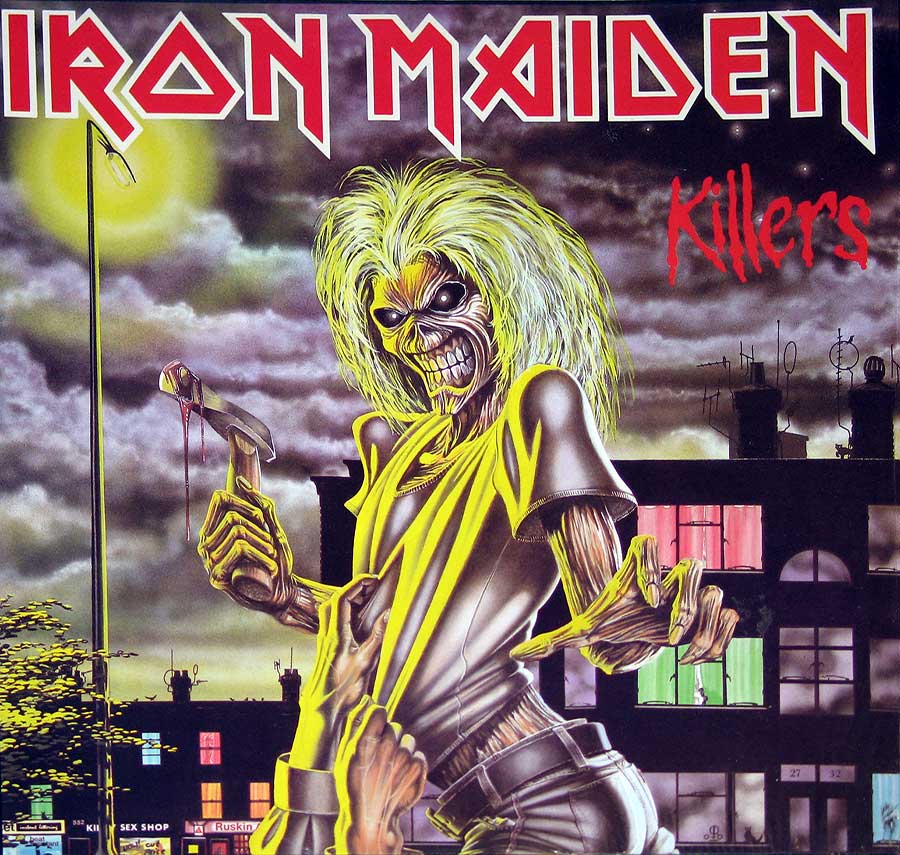
- Germany 2nd Pressing
Iron Maiden's sophomore album, "Killers," explodes with raw energy and showcases the band's evolution towards a more melodic, powerful sound. Brace yourself for classics like "Wrathchild" and the title track, along with the driving instrumentals that perfectly set the album's thrillingly dark tone. This is Iron Maiden solidifying their place as heavy metal masters.
Iron Maiden's sophomore release, "Killers," stormed the world in 1981, showcasing the band's evolution towards a tighter, more melodic heavy metal sound. While the initial UK release is iconic, the German 2nd release holds a special place in Maiden's discography due to its sonic refinements and an intriguing track change.
Sonic Evolution
Produced by the legendary Martin "Headmaster" Birch, "Killers" on the German 2nd release demonstrates a noticeable improvement in sound quality compared to the initial UK release. This enhanced production allows instruments to cut through the mix with greater clarity. Paul Di'Anno's vocals feel more dynamic, while Steve Harris's signature basslines punch through with more definition. Adrian Smith's guitar work, now a vital component of Iron Maiden's dual guitar attack, soars with melodic leads and propulsive rhythms.
The Track Shift
A key difference in the German 2nd release is replacing the original instrumental opener, "The Ides of March," with the powerhouse track "Twilight Zone." This swap adds a strong, vocal-driven song to the album's start, kicking off the experience with greater melodic weight. "The Ides of March" still holds a place in Iron Maiden history as a showcase of the band's early instrumental prowess, but "Twilight Zone" delivers a more instant punch that's suited to the album's overall feel.
Seminal Heavy Metal
Beyond production and track listing tweaks, the core of "Killers" remains a testament to Iron Maiden's raw energy and expanding songwriting chops. Songs like "Wrathchild," "Murders in the Rue Morgue," and the title track are high-octane classics, filled with pummeling rhythms and singalong choruses. The album also unveils Iron Maiden's more nuanced side with tracks like "Prodigal Son," showcasing their ability to meld intricate musicianship with epic storytelling.
Iron Maiden's "Wrathchild" is a high-octane anthem that captures the raw energy and frustration of teenage rebellion.
The song explodes with galloping drums and Steve Harris's signature bassline, creating a sense of urgency that perfectly complements vocalist Paul Di'Anno's aggressive snarl. Di'Anno embodies the character of a restless youth, railing against societal constraints and yearning for freedom. Lyrics like "Gonna break all the rules" and "Got a hunger, gotta rage" resonate with anyone who's ever felt stifled by authority.
"Wrathchild" isn't just about teenage angst, though. It hints at a darker side, with lines like "Maybe destruction's what I need." This ambiguity adds depth to the song, suggesting the potential for the protagonist's anger to turn destructive.
Musically, "Wrathchild" is a masterclass in early Iron Maiden. Twin guitar harmonies soar over the rhythm section, creating a powerful and memorable soundscape. The song's breakneck pace and catchy chorus make it a live favorite, ensuring its place as a cornerstone of Iron Maiden's legacy.
|
Band Members and Musicianson: IRON MAIDEN - Killers |
The early Maiden groove machine: big feel, sharp fills, and that “Beast-era” punch that still rattles the walls. Read more...
Clive Burr (8 March 1957 – 12 March 2013) is one of those drummers who didn’t just keep time—he gave a band its early backbone. I mainly hear him as Iron Maiden’s rocket fuel from 1979–1982, laying down that urgent, swinging drive on their first run of classic records and helping make the whole NWOBHM thing feel dangerous instead of polite. Before that, he did the London grind with Samson (1977–1978). After Maiden, the timeline gets gloriously nomadic: Trust (1983–1984), a blink-and-you-miss-it week with Alcatrazz (1983), his own Clive Burr’s Escape (1983–1984) evolving into Stratus (1984–1985), the supergroup cameo in Gogmagog (1985), Desperado (1988–1990), and later work with Praying Mantis (1995–1996). His later years were brutally shaped by multiple sclerosis, but the playing legacy stays loud, human, and unmistakably his own—Clive Burr Wiki
Maiden’s calm killer: smooth leads, twin-guitar harmony for days, and that melodic bite that makes the “gallop” feel cinematic instead of chaotic. Read more...
Dave Murray (born 23 December 1956, Edmonton, Middlesex, England) is one of the defining lead guitar voices of heavy metal, and in my book he’s the melodic “second spine” of Iron Maiden. His timeline with the band starts early: joining in 1976, getting briefly pushed out in 1977, then returning in 1978 and staying locked in ever since—making him one of the longest-serving members in the whole Maiden saga. During that 1977 gap he spent around six months with Urchin (Adrian Smith’s band), which is a fun little historical glitch in the matrix if you like your Maiden lore messy and human. Beyond the main band, his most notable “outside the mothership” credit is the all-star charity metal project Hear ’n Aid (1985), because apparently even guitar lifers sometimes leave the bunker to do side quests. Dave Murray Wiki
The OG Iron Maiden throat: street-level grit, punk heat, and zero “polite” in the delivery. Read more...
Paul Di'Anno, (17 May 1958 – 21 October 2024) locked himself into metal history by fronting Iron Maiden from 1978–1981, putting that snarling, rough-cut voice on the band’s early landmark releases. After Maiden, the timeline turns into a proper tour-bus saga: Di’Anno (1983–1985, then revived in the 1998–2001 era), the short, star-stacked Gogmagog detour (1985), Battlezone (1985–1989, back again 1997–1998), a notable studio cameo with Praying Mantis around 1990, and Killers (1990–1997, returning 2001–2003, plus a 2013 regroup). Later chapters include the Brazil-based Rockfellas run (2008–2010) and Architects of Chaoz (2014–2016). The common thread never really changed: that unmistakable, no-varnish vocal attitude that made early NWOBHM feel dangerous in the first place.
Iron Maiden’s engine room: galloping bass lines, history-nerd lyrics, and “captain of the ship” energy baked into every riff. Read more...
Steve Harris (born 12 March 1956, Leytonstone, England) is the rare bassist who doesn’t just hold the floor—he draws the whole blueprint. In my book, he’s the founder and primary songwriter who’s kept Iron Maiden on its rails from 1975–present, with that instantly recognizable “gallop” driving huge chunks of the catalogue. The pre-Maiden grind matters too: first band days in Influence/Gypsy’s Kiss (1973–1974, including a documented gig run in 1974), then the older, blues-leaning Smiler period (1974–1975) where his more ambitious writing basically forced the next step: forming Maiden. Outside the mothership, he’s fronted his own hard-rock outlet British Lion (2012–present), a project that grew out of connections going back to the early 1990s and finally hit the world as his solo debut in 2012.
Complete Track Listing of: IRON MAIDEN - Killers |
Note: The photos on this page are taken from albums in my personal collection. Slight differences in color may exist due to the use of the camera's flash. Images can be zoomed in/out ( eg pinch with your fingers on a tablet or smartphone ).
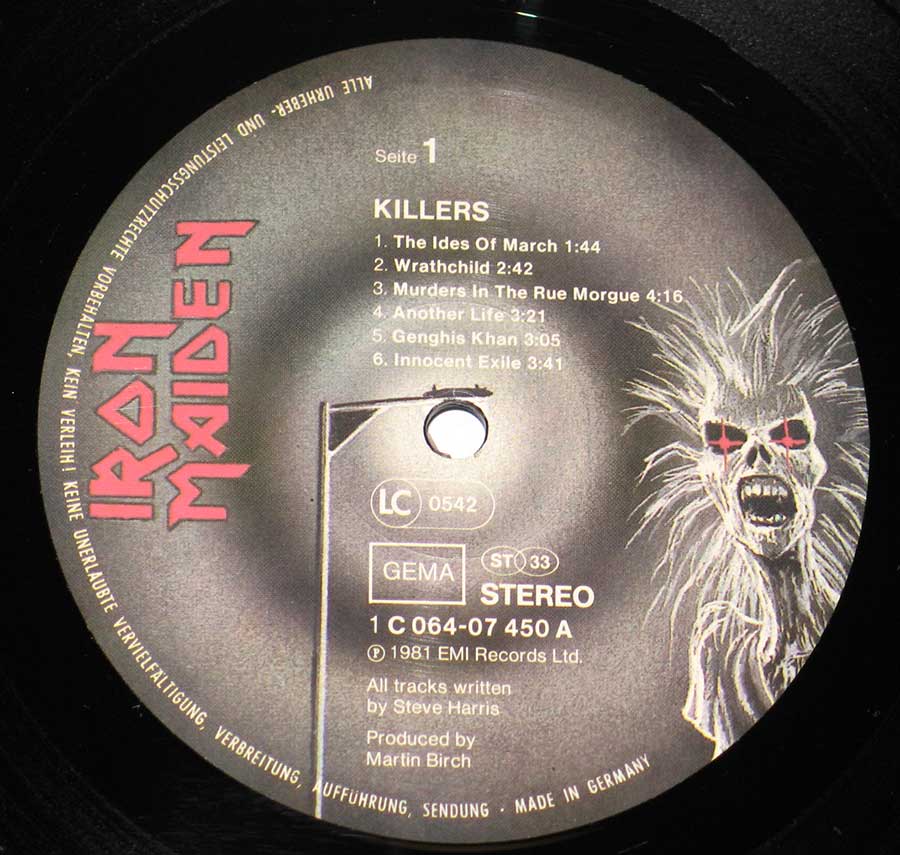
"Killers" Record Label Details: EMI Records Ltd 1C 064-07 450 (064-07450) LC 0542 ℗ 1981 EMI Records Sound Copyright