IRON MAIDEN - KILLERS 12" Vinyl LP Album

- Canadian Release

Killers is the second album by IRON MAIDEN. It was the first of their albums to feature guitarist Adrian Smith, and the last to feature vocalist Paul Di'Anno, who left the band mid-tour due to problems with alcohol and cocaine. This was also the first album produced by veteran producer Martin Birch who went on to produce their next eight albums before retiring after Fear of the Dark in 1992


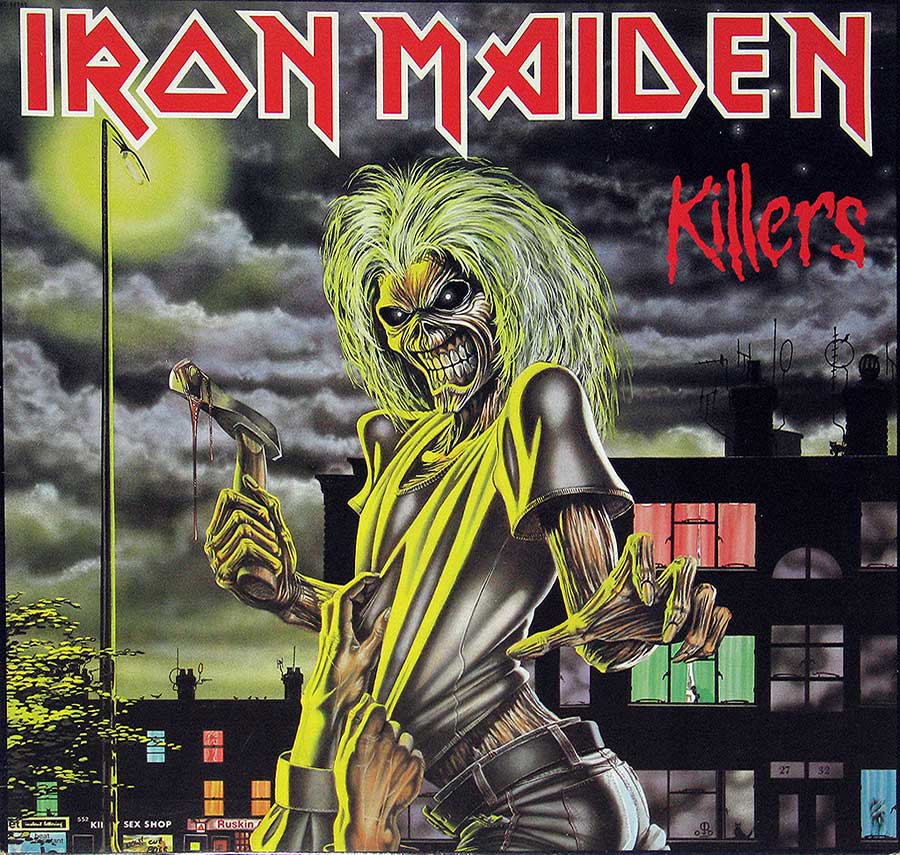
IRON MAIDEN - Killers Canada 12" Vinyl LP Album front cover

In the Heart of Darkness, a Killer's Tale Unfolds: Iron Maiden's Canadian Onslaught
Album Description:

From the depths of London's historic Battery Studios in 1981 emerged a sonic maelstrom destined to carve its name into the annals of heavy metal. Iron Maiden, the New Wave of British Heavy Metal's rising stars, unleashed their sophomore album, "Killers," upon the Canadian masses, a sonic testament to their growing prowess and unyielding spirit.

Produced by the legendary Martin Birch, who had previously helmed iconic works by Deep Purple and Black Sabbath, "Killers" showcased a band on the precipice of greatness. Birch's deft touch, along with the engineering expertise of Nigel Hewitt, captured the raw energy and intricate musicianship that would become Iron Maiden's signature.

The album's cover art, a chilling masterpiece by Derek Riggs, featured the band's iconic mascot, Eddie, lurking in the shadows, a menacing figure ready to strike. The imagery perfectly encapsulated the album's dark themes of murder, revenge, and the macabre.

Musically, "Killers" was a relentless assault of galloping rhythms, soaring vocals, and intricate guitar harmonies. Tracks like "Wrathchild," "Murders in the Rue Morgue," and the title track itself became instant anthems, their infectious energy resonating with metalheads across the nation. The album's historical context is significant, as it marked a pivotal moment in Iron Maiden's career. It solidified their position as one of the leading forces in the burgeoning heavy metal scene, setting the stage for their subsequent rise to global stardom.

The Canadian release of "Killers" on the Capitol Harvest label was a landmark event, introducing a new audience to the band's unique brand of metal. The album's raw power and uncompromising spirit struck a chord with Canadian fans, who embraced Iron Maiden with open arms.

While "Killers" was not without its controversies, with some critics deeming the lyrics too violent or graphic, the album's impact was undeniable. It cemented Iron Maiden's reputation as a force to be reckoned with, paving the way for a string of classic albums that would define the genre for decades to come.

Music Genre: 

NWOBHM New Wave of British Heavy Metal 

Album Production Information:

The album: "IRON MAIDEN - Killers Netherlands" was produced by: Martin Birch

  • Martin Birch – Producer, Sound Engineer

    I first noticed Martin Birch on those early Iron Maiden sleeves—the ones with the typography that felt like a threat. At twelve, I didn’t care about "production value"; I just liked that the guitars didn't sound like mud. He was the man behind the sound mixer, the one who made the snare snap like a dry branch in a cold forest. He was "The Headmaster," and we were all just students of his high-voltage curriculum.

    Birch didn’t just record noise; he organized aggression. By 1972, he was already wrangling the messy brilliance of Deep Purple’s Machine Head, turning Ian Gillan’s banshee wails into something that didn't just clip the tape but lived inside it. In 1980, he pulled off the ultimate renovation, giving Black Sabbath a much-needed shower and a new spine. Heaven and Hell shouldn't have worked, but Martin polished that Birmingham sludge into something operatic and gleaming. It was a pivot that felt like fate, mostly because he refused to let the mid-range get lazy.

    Then came the long, obsessive stretch with Iron Maiden from 1981 to 1992. It was a twelve-year marriage to the fader. From the moment Killers (EMC 3357, for those who care) hit the shelves, the sound was physical. He knew how to let Steve Harris’s bass clatter like a machine gun without drowning out the melody—a sonic miracle that still feels fresh. You can almost smell the ozone and the dust on the Marshall stacks when the needle drops on The Number of the Beast. He stayed until Fear of the Dark, then simply walked away. No victory lap, no bloated memoir. He preferred the hum of the desk to the noise of the crowd, leaving us with nothing but the records and a slight sense of abandonment. But then, when you’ve already captured lightning on tape for twenty years, why bother hanging around for the rain?
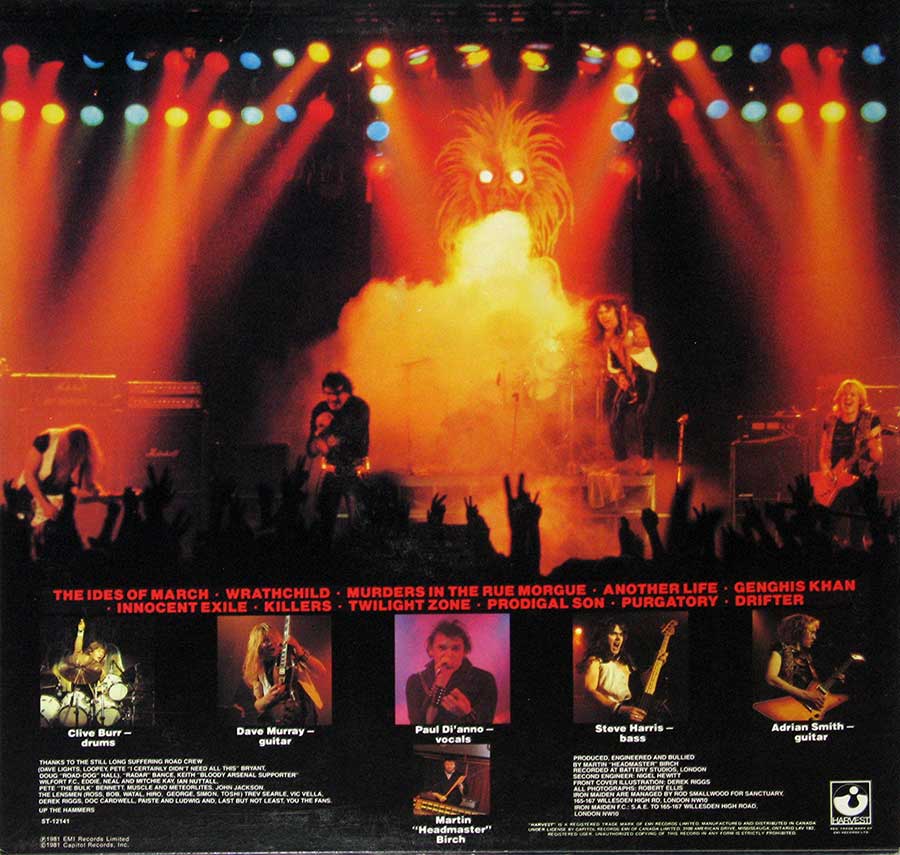
  • Sound/Recording Engineer(s): Martin Birch, Nigel Hewitt

    Nigel Hewitt a British Sound Engineer who has (during the 1980s) engineered vinyl albums for heavy metal bands like: Def Leppard, Iron Maiden, Dio, Mammoth and others.

    This album was recorded at: Battery Studios, London

    Battery Studios London has been a key recording centre since the 1970s, known for its high-end equipment and sessions spanning rock, pop, and metal. Countless artists shaped their sound here, leaving a production legacy that still influences modern studio work. Read more.

    Album cover design: Derek Riggs

  • Derek Riggs – Illustrator, Cover Artist Derek Riggs is the artist who gave Iron Maiden its visual soul by creating Eddie, one of the most recognizable mascots in heavy metal history. Since the band’s 1980 debut, his artwork fused sci-fi, horror, and dark fantasy into covers that were as confrontational and imaginative as the music itself. Riggs’ paintings didn’t just decorate records, they built a world that became inseparable from Maiden’s identity.
  • Album cover photography: Robert Ellis

  • Robert Ellis – Photographer

    The guy with the press pass (and the nerve) who lived on rock tours from 1971 to 1993, catching the moments bands never planned to share.

    Robert Ellis is the kind of rock photographer I trust because the shots don’t pose, they confess. Seeing his work, the noise comes back in full color: sweat in the stage lights, backstage grins that last ten seconds, and that split-second where a band looks immortal before the van ride ruins everyone’s posture. Credits tell the timeline clean: he starts out in 1968, then lands at New Musical Express (1971–1975), moves through Melody Maker (1975–1976), and keeps rolling as a freelance gun-for-hire for titles like Sounds and Kerrang! (plus the occasional mainstream giant like Time). The real “band periods” here aren’t membership cards, they’re tour years: Ellis is on the road photographing bands across the rock and metal circuit from 1971–1993, then turns the archive into a home base by founding Repfoto in 1982 and later pushing his own book imprint, The Rock Library, in the 2010s. That’s the job done right: stay invisible, keep the shutter honest, and let the music leave fingerprints on the film.

  • Record Label: 

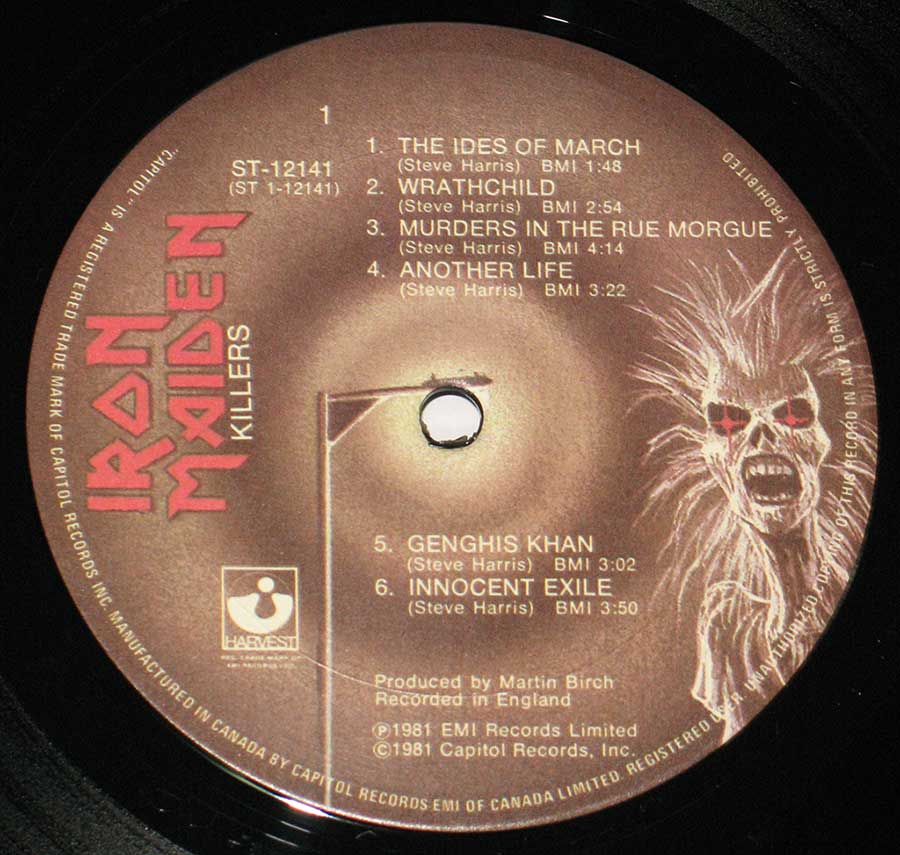
    Capitol Harvest ST-12141 

    Record Format

    12" Vinyl Stereo Gramophone Record
    Total Album (Cover+Record) weight: xxx gram  

    Year & Country 

    1981 Made in Canada  
    Band Members and Musicians on: IRON MAIDEN Killers
      Band-members, Musicians and Performers
    • Clive Burr - Drums
    • Clive Burr – Drums

      The early Maiden groove machine: big feel, sharp fills, and that “Beast-era” punch that still rattles the walls.

      Clive Burr (8 March 1957 – 12 March 2013) is one of those drummers who didn’t just keep time—he gave a band its early backbone. I mainly hear him as Iron Maiden’s rocket fuel from 1979–1982, laying down that urgent, swinging drive on their first run of classic records and helping make the whole NWOBHM thing feel dangerous instead of polite. Before that, he did the London grind with Samson (1977–1978). After Maiden, the timeline gets gloriously nomadic: Trust (1983–1984), a blink-and-you-miss-it week with Alcatrazz (1983), his own Clive Burr’s Escape (1983–1984) evolving into Stratus (1984–1985), the supergroup cameo in Gogmagog (1985), Desperado (1988–1990), and later work with Praying Mantis (1995–1996). His later years were brutally shaped by multiple sclerosis, but the playing legacy stays loud, human, and unmistakably his own—Clive Burr Wiki

    • Dave Murray - Guitars
    • Dave Murray – Guitar

      Maiden’s calm killer: smooth leads, twin-guitar harmony for days, and that melodic bite that makes the “gallop” feel cinematic instead of chaotic.

      Dave Murray (born 23 December 1956, Edmonton, Middlesex, England) is one of the defining lead guitar voices of heavy metal, and in my book he’s the melodic “second spine” of Iron Maiden. His timeline with the band starts early: joining in 1976, getting briefly pushed out in 1977, then returning in 1978 and staying locked in ever since—making him one of the longest-serving members in the whole Maiden saga. During that 1977 gap he spent around six months with Urchin (Adrian Smith’s band), which is a fun little historical glitch in the matrix if you like your Maiden lore messy and human. Beyond the main band, his most notable “outside the mothership” credit is the all-star charity metal project Hear ’n Aid (1985), because apparently even guitar lifers sometimes leave the bunker to do side quests. Dave Murray Wiki

    • Paul Di'Anno - Lead Vocals
    • Paul Di'Anno – Vocals

      The OG Iron Maiden throat: street-level grit, punk heat, and zero “polite” in the delivery.

      Paul Di'Anno, (17 May 1958 – 21 October 2024) locked himself into metal history by fronting Iron Maiden from 1978–1981, putting that snarling, rough-cut voice on the band’s early landmark releases. After Maiden, the timeline turns into a proper tour-bus saga: Di’Anno (1983–1985, then revived in the 1998–2001 era), the short, star-stacked Gogmagog detour (1985), Battlezone (1985–1989, back again 1997–1998), a notable studio cameo with Praying Mantis around 1990, and Killers (1990–1997, returning 2001–2003, plus a 2013 regroup). Later chapters include the Brazil-based Rockfellas run (2008–2010) and Architects of Chaoz (2014–2016). The common thread never really changed: that unmistakable, no-varnish vocal attitude that made early NWOBHM feel dangerous in the first place.

    • Steve Harris
    • Steve Harris – Bass Guitar, Songwriter

      Iron Maiden’s engine room: galloping bass lines, history-nerd lyrics, and “captain of the ship” energy baked into every riff.

      Steve Harris (born 12 March 1956, Leytonstone, England) is the rare bassist who doesn’t just hold the floor—he draws the whole blueprint. In my book, he’s the founder and primary songwriter who’s kept Iron Maiden on its rails from 1975–present, with that instantly recognizable “gallop” driving huge chunks of the catalogue. The pre-Maiden grind matters too: first band days in Influence/Gypsy’s Kiss (1973–1974, including a documented gig run in 1974), then the older, blues-leaning Smiler period (1974–1975) where his more ambitious writing basically forced the next step: forming Maiden. Outside the mothership, he’s fronted his own hard-rock outlet British Lion (2012–present), a project that grew out of connections going back to the early 1990s and finally hit the world as his solo debut in 2012.

    • Adrian Smith
    • Adrian Smith – Guitarist, Songwriter Adrian Smith is one of those players I always associate with Iron Maiden’s classic sound and its later revival. Joining in 1980, leaving in 1990, and returning in 1999, his melodic solos and sharp songwriting helped define albums from The Number of the Beast to Brave New World and beyond.
    Complete Track Listing of: IRON MAIDEN Killers
      Tracks:
    1. The Ides of March
    2. Wrathchild
    3. Murders in the Rue Morgue
    4. Another Life
    5. Genghis Khan
    6. Innocent Exile
    7. Killers
    8. Prodigal Son
    9. Purgatory
    10. Drifter

    IRON MAIDEN - Vinyl Records Discography Home Page