- Female Fronted Heavy Metal · 1984 · Roadrunner Records
Wendy Orlean Williams (May 28, 1949 – April 6, 1998), better known as Wendy O. Williams, was the lead singer for the punk band the Plasmatics, whose stage theatrics included blowing up equipment, near nudity and chain-sawing guitars. Dubbed “The Queen of Shock Rock,” Williams was widely considered the most controversial and radical woman singer of her day. She often sported a trademark Mohawk haircut. Williams was nominated in 1985 for a Grammy in the Best Female Rock Vocal category during the height of her band’s popularity.
WOW is the moment Wendy O’Williams takes her shock-rock mythology and bolts it onto a real-deal Female Fronted Heavy Metal engine, then dares you to look away. It’s loud, brazen, and unapologetically physical—like a stage dive frozen into vinyl and shipped out as Roadrunner RR 9852 (and yes, my copy’s a 1984 Made in Holland pressing). If you want polite rock, this record kindly suggests you try another planet.
1984 was an era where heavy music kept getting bigger, tougher, and more theatrical—perfect weather for someone already famous for turning concerts into controlled demolition. Wendy didn’t arrive as a “new singer”; she arrived as the notorious frontperson from the Plasmatics, with the kind of stage reputation that made people clutch pearls and buy tickets in the same motion. In that climate, a metal record with her name on it wasn’t “just another release”—it was a provocation pressed into 12 inches of black plastic.
The behind-the-scenes headline is right there: Produced by Gene Simmons, recorded at Right Track Studios in New York, then finished off with mastering by George Marino at Sterling Sound. That combination screams “let’s make this hit hard and look expensive while it’s doing it,” which is hilarious when your star is known for chainsaw-level chaos. It’s a proper studio build, but it’s still Wendy at the center—smirking at the idea of behaving.
Sonically, WOW rides the line between metal muscle and punk attitude—tight enough to feel intentional, rough enough to feel dangerous. The track titles alone give you the temperature: “I Love Sex (and Rock and Roll)” kicks the door in, “It’s My Life” doubles down, and “Thief in the Night” keeps the mood nocturnal and a little feral. The record doesn’t ask for your approval; it assumes you’ll catch up eventually.
Then there’s “Bump and Grind,” which gets extra spice thanks to Ace Frehley showing up on lead guitar like a cameo in a grindhouse movie. It’s the kind of guest spot that feels perfectly on-brand: glam/metal celebrity energy dropped into a record that already lives for spectacle. If you listen with headphones, you can practically hear the grin behind the amp hiss.
In the wider 1984 heavy universe, big metal records were chasing sharper riffs, bigger choruses, and cleaner punch—while the underground kept the attitude jagged. WOW belongs to that same year’s obsession with impact, but it brings something most records didn’t: a frontperson whose entire career was already a public argument. If you line it up next to a few 1984 staples, the contrast is the point.
Wendy didn’t need “controversial lyrics” to cause a stir—her whole persona did that job for her. The page itself spells it out: she was known for near nudity, blowing up equipment, and chain-sawing guitars, and she was widely seen as one of the most radical women in rock. So when a record like WOW lands, the reaction isn’t subtle—some people call it outrageous, others call it honest, and plenty just turn it up and stop pretending they’re above it.
Even without a diary of studio arguments, you can hear a creative tug-of-war that makes the album fun: the polished, “let’s-capture-it-right” studio framework versus Wendy’s instinct to kick over the furniture. Add Gene Simmons in the producer chair and you get a record that feels simultaneously built for impact and built to shock. It’s not messy—just gloriously unwilling to be one thing.
The page drops one big receipt: Wendy O’Williams was nominated in 1985 for a Grammy in Best Female Rock Vocal, right at the height of that cultural moment. That’s the kind of detail that reminds me this wasn’t just chaos for chaos’ sake—she was genuinely seen, loudly, by the mainstream whether it liked it or not. Decades later, WOW still reads like a postcard from a time when rock could be dangerous and theatrical in the same breath.
I like this record because it doesn’t try to sand down Wendy’s edges—it frames them, spotlights them, and dares you to blink first. Between the Roadrunner Dutch pressing vibe, the New York studio pedigree, and that “Bump and Grind” guitar cameo, it’s a collector’s kind of chaos: specific, loud, and weirdly timeless. Decades later, the grooves still smell faintly of sweat, stage smoke, and that stubborn little spark that refuses to behave.
Female Fronted Heavy Metal
Roadrunner – Cat#: RR 9852
Record Format: 12" Vinyl LP
Total Weight: 150g
1984 – Made in Holland
Right Track Studios – New York, USA
Sterling Sound – New York City, USA
Ace Frehley is the reason KISS sounded like it came from another planet—those space-age riffs didn’t happen by accident. Read more...
Ace Frehley (1951–2025) was the electrifying guitarist, singer, and songwriter who co-founded KISS in 1973, defining its space-age sound and image. After leaving the band in 1982, he led Frehley’s Comet through the late 1980s, before returning for multiple KISS reunions and continuing a solo career that spanned more than five decades of hard rock history.
Gene Simmons didn’t just randomly wake up one day and think, “You know what my life needs? A Wendy O. Williams solo album.” This started the old-fashioned way: on the road. After The Plasmatics dropped Coup d’État and then opened for KISS on the Creatures of the Night tour in early 1983, the band’s label situation got messy fast. Capitol didn’t renew the deal, and right in that limbo Gene stepped in and approached Wendy and her manager Rod Swenson about producing a new record.
The key move was strategic (and honestly, very Gene): to dodge legal quicksand with Capitol, they decided not to use “The Plasmatics” name at all and make it a Wendy O. Williams record—WOW—so they could move without lawyers playing whack-a-mole. And Gene liked the setup because it let him pick and choose musicians without being chained to a fixed band lineup. That’s basically the “producer’s cut” version of creative control.
Now, Ace Frehley showing up as a guest? That’s Gene using his own address book like a weapon. Multiple sources agree Gene “pulled in” Ace for the sessions (even though Ace hadn’t played with KISS since leaving), and Ace’s specific job on the album is clear: lead guitar on “Bump and Grind.” In other words: Gene was producing, Gene was curating the cast, and Ace was one of the star cameos Gene convinced to drop in.
If you want the vibe in one sentence: WOW happened because the Plasmatics-to-major-label pipeline snapped, and Gene offered Wendy a lifeline that also happened to be a very Gene Simmons-shaped opportunity to build a record like a crossover event—Wendy up front, and a few KISS-adjacent fireworks in the margins.
Disclaimer: Track durations shown are approximate and may vary slightly between different country editions or reissues. Variations can result from alternate masterings, pressing plant differences, or regional production adjustments.
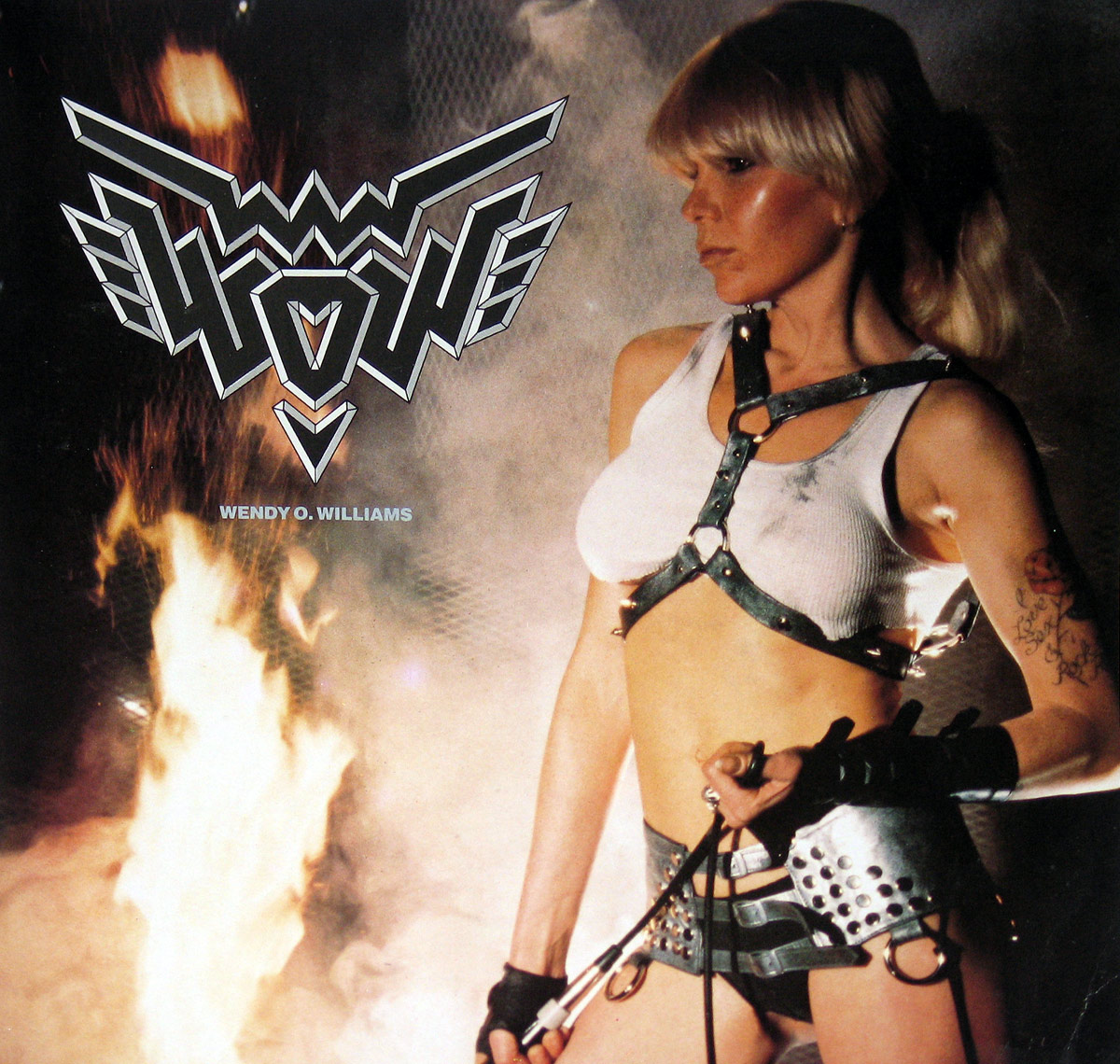
This image shows the original front cover of WOW by Wendy O. Williams, photographed directly from the vinyl sleeve in my collection. The composition is aggressive and deliberately confrontational, designed to reflect her on-stage persona rather than traditional glamor. Wendy is positioned on the right side of the frame in a strong side profile, her body angled slightly toward the center while her gaze is directed downward and away from the viewer. The lighting highlights the contours of her arms and shoulders, emphasizing physical strength rather than softness.
She wears a white sleeveless shirt combined with a black leather harness strapped across her chest, secured with metal rings and rivets. Around her waist is a wide, studded leather belt with industrial detailing, reinforcing the punk-metal aesthetic. Her short blonde hair is cut in a blunt, functional style with no attempt at stylization. A visible tattoo on her upper arm adds to the raw, unfiltered presentation. There is no decorative background; instead, the scene feels like a stage or industrial set.
On the left side of the cover, real flames rise vertically, captured mid-motion. The fire creates a harsh contrast against the dark background and serves as both a visual divider and a symbolic element, suggesting destruction, rebellion, and danger. The fire is not decorative; it looks uncontrolled and practical, consistent with her reputation for using real pyrotechnics during live performances.
The WOW logo is large, metallic, and sharply angular, placed prominently near the upper left. Its symmetrical, wing-like extensions give it a militaristic and mechanical feel, almost like an emblem rather than a band logo. Beneath it, her name appears in smaller, clean lettering, secondary to the visual impact of the image itself. From a collector’s perspective, this sleeve design is tightly integrated with the album’s identity: minimal text, strong contrast, and no wasted space. Any color shifts visible in this photograph come from flash reflection on the printed sleeve, not from the original artwork.
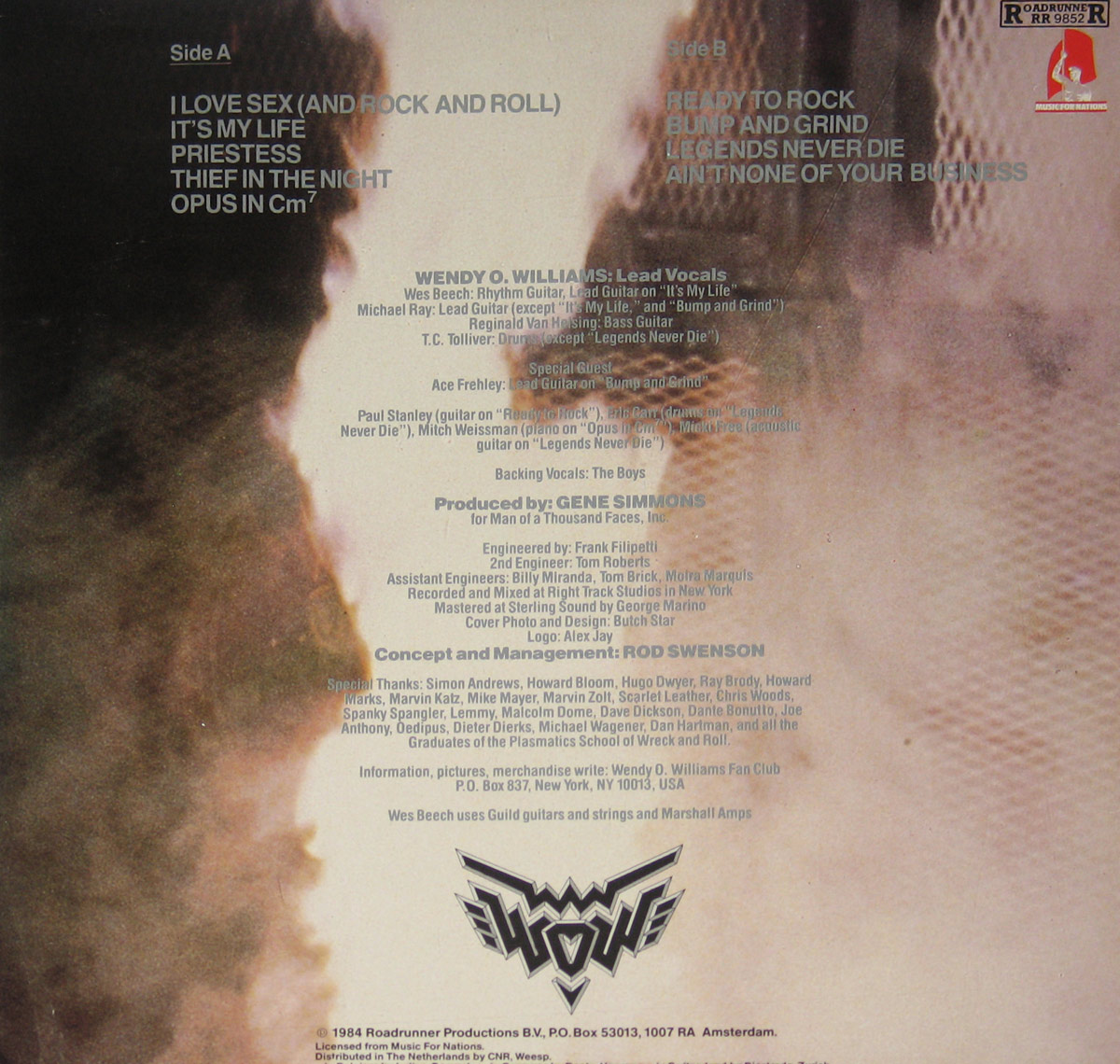
This image shows the original back cover of WOW by Wendy O. Williams, photographed directly from the Roadrunner Records vinyl sleeve in my collection. The design mirrors the confrontational tone of the front cover but shifts the focus to information density and contrast. The background is vertically divided: the left half is dominated by dark, smoky textures that feel scorched or burned, while the right half shows a rigid, industrial metal grid pattern. The split is not symmetrical and feels intentionally abrasive.
At the top left, the Side A heading appears in small, clean type, followed by the track list starting with “I Love Sex (And Rock And Roll)” and ending with “Opus in Cm7.” On the top right, Side B is laid out in the same restrained style, listing songs such as “Ready to Rock,” “Bump and Grind,” and “Legends Never Die.” The typography is functional rather than decorative, prioritizing legibility over flair, which was typical for early-1980s hard rock and metal sleeves.
The center section contains a dense block of credits. Wendy O. Williams is clearly identified as lead vocalist, followed by detailed guitar, bass, and drum credits. Special guest appearances are spelled out, including named contributions rather than vague mentions. Production is credited prominently to Gene Simmons, reinforcing the album’s lineage and crossover appeal. Engineering, recording studios, mastering, and cover design credits are all present and readable, which matters when documenting first pressings accurately.
Near the bottom, the WOW logo reappears, smaller than on the front but still visually sharp and metallic. Below it, copyright and licensing information confirms Roadrunner Productions B.V. in Amsterdam, with Dutch distribution details. From a collector’s standpoint, this back cover is essential for identifying European pressings, confirming original credit layouts, and checking print clarity. Any slight discoloration visible here comes from age and flash reflection, not from damage to the sleeve itself.
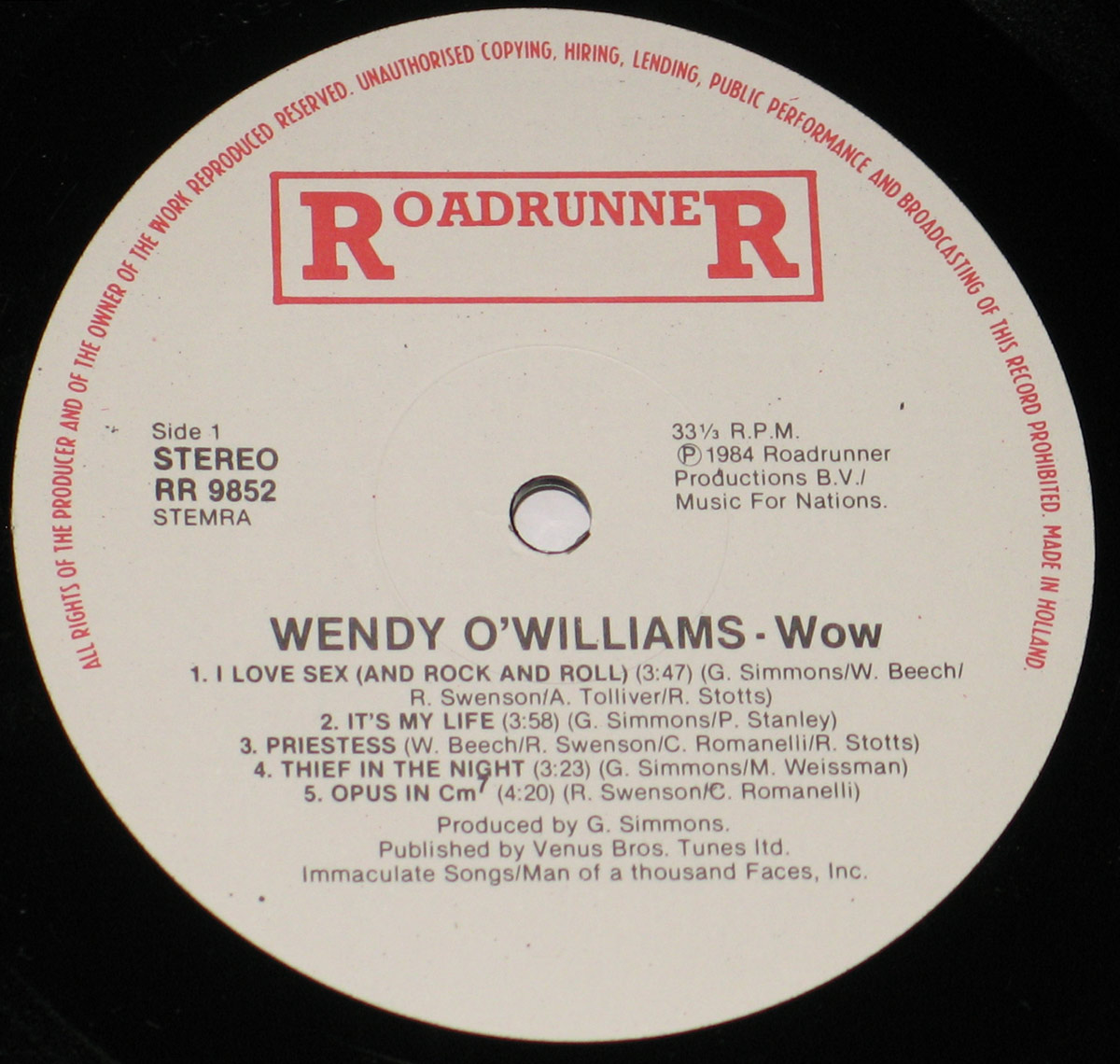
This image is a close-up of the Side 1 record label from the original Roadrunner Records pressing of WOW by Wendy O. Williams, photographed directly from the vinyl in my collection. The label uses the classic Roadrunner layout of the mid-1980s, with a white background and strong red and black typography that prioritizes clarity and durability over decoration. At the very top, the bold red Roadrunner logo sits inside a rectangular frame, immediately identifying the label without ambiguity.
On the left side of the label, the technical information is clearly printed: Side 1, Stereo, catalog number RR 9852, and the rights organization STEMRA. On the right side, the playback speed is marked as 33 1/3 R.P.M., followed by the copyright line crediting Roadrunner Productions B.V. and Music For Nations. The outer rim text forms a full circular copyright warning, confirming this as a European pressing manufactured in Holland.
Centered on the label is the artist and album title printed in a no-nonsense font: WENDY O’WILLIAMS – Wow. Below this, the complete Side 1 track listing is laid out in numbered order, including running times and detailed songwriting credits. Tracks such as “I Love Sex (And Rock And Roll)” and “Priestess” are clearly legible, which is essential when verifying first pressings or checking credit variations across releases.
At the bottom of the label, production and publishing credits are printed in smaller text, including the clear producer credit to G. Simmons. Light surface scuffs and faint hairlines are visible in the vinyl around the label area, typical for a well-kept but played record from this era. Slight color shifts are caused by flash reflection on the label’s coated paper, not by wear or fading.
All images on this site are photographed directly from the original vinyl LP covers and record labels in my collection. Image quality varies as photos were taken over many years with different cameras. You may use these images for personal or non-commercial purposes if you include a link to this site; commercial use requires my permission.