- AXE ATTACK's 1985 album 'Nightmare', released on the French Axe Killer label, fronted by guitarist Pete Brasino with vocals by Armand van der Stigchel.
AXE ATTACK's 1985 album "Nightmare" marks one of those curious moments in metal history where an American underground band found itself reborn through a French label. With Guitar Pete Brasino at the helm and vocals delivered by Armand van der Stigchel, this LP bridges raw New York energy with Axe Killer’s fierce aesthetic. Originally released in the USA as "Nitemare" with different artwork, this pressing captures the album’s grittiest identity.
Released in 1986 on the French label Axe Killer Records, Axe Attack’s “Nightmare” — often known as Guitar Pete’s Nightmare — is a loud, street-born blast of American speed metal that somehow ended up with a European passport. The band never broke into the mainstream, but the LP carries that raw, rough-edged bite that defined the untamed mid-’80s metal underground.
“Nightmare” emerged in an era when speed metal was spreading like wildfire worldwide: the U.S. pushing things faster and meaner, the U.K. shaping its post-NWOBHM direction, and Europe refining its own flavor. Axe Attack wasn’t part of the French metal movement, but releasing the album through a French label gave it a curious, cross-continental identity. Musically, the record rides the line between heavy metal and speed metal — fast riffs, barked vocals, and that straight-to-the-gut, unpolished production that fans instantly recognize.
Tracks such as “Axe Attack”, “Leather, Lace and Studs”, and “Pushing Your Luck” deliver pure adrenaline, while “Klimaxx” and the vivid “Nitemare (in Queens)” slide into a more melodic, almost cinematic build. Nothing experimental here — just a band hammering out songs like New York bar-circuit metal bands did best: loud, fast, and refreshingly unconcerned with subtlety.
The recording took place in New York, engineered by Rick Bieder, who captured exactly what the band brought into the room: raw amp fire, live-wire vocals, and a rhythm section that feels one take away from flying apart — in the best possible way. It’s unpolished, unpretentious, and unapologetically real. A time capsule of how countless metal bands truly sounded in 1986, before glossy, high-budget productions reshaped the genre.
If you’re after polished, commercial metal from the era, this isn’t it. But if what you crave is an underground relic that practically smells like cigarette burns on a studio carpet, “Nightmare” hits that sweet spot with absolute precision.
Speed Metal, Heavy Metal
A fast, aggressive style built on rapid riffing, double-kick drumming, and soaring vocals, with the melodic edge of classic heavy metal still intact.
Axe Killer Records – Cat#: 7024
Standard sleeve.
Record Format: 12" LP Vinyl Stereo Gramophone Record
Total Weight: 230 gram
1986 – France
Rick Bieder Studios – N.Y., USA
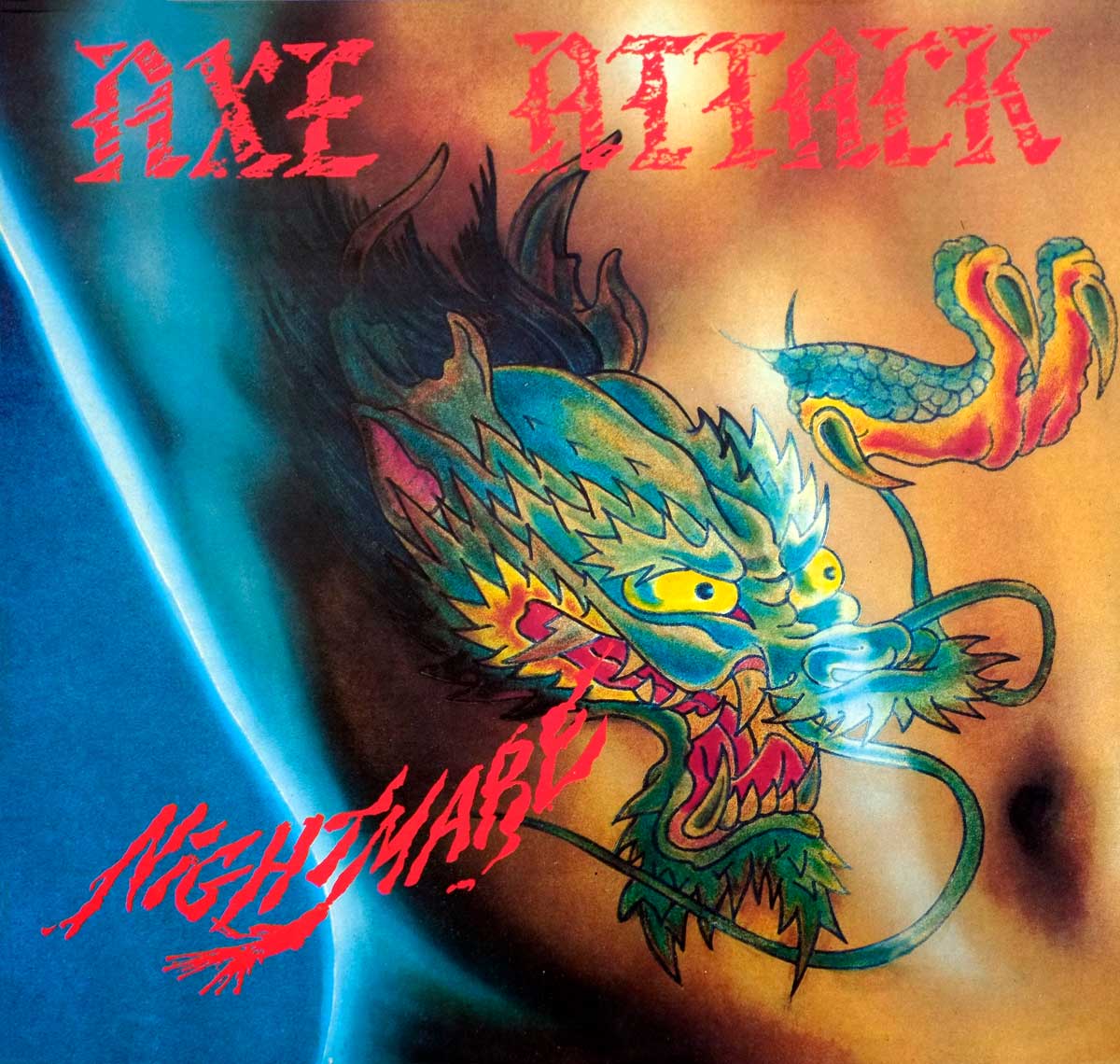
Front cover built entirely around an extreme close-up of a tattooed torso. The tattoo dominates the frame: a snarling dragon head inked across the hip line, rendered in saturated greens, yellows, and reds, with heavy black outlines that push the illustration forward. The scales, fangs, whiskers, and flame-like edging all show the bold style associated with classic American tattoo flash, but pushed harder for album art impact.
The lighting leans warm on the skin tones and cooler along the left edge, giving the composition a gradient that shifts from deep turquoise into a warm beige. The navel sits clearly on the right side of the frame, grounding this as a literal body close-up rather than an abstract layout. This matters for collectors because it confirms the identity of the French Axe Killer pressing, which used this tattoo-focused artwork in place of the original U.S. “Nitemare” cover.
Typography is unmistakable: the band name AXE ATTACK appears across the top in distressed red lettering, jagged and uneven, as if carved or scratched onto the sleeve. The album title Nightmare sits on the lower left, written in a dripping, slash-style script that signals the speed-metal attitude before hearing a single note. No border, no framing — just a full-bleed image designed to hit fast and loud on a record shelf.
Physical details matter for identification: the cover has no additional text blocks, catalog numbers, or label markings visible on the front, which is correct for this pressing. Color saturation, the exact tattoo placement, and the aggressive contrast between the artwork and the skin tone all help distinguish originals from faded or poorly reproduced reissues. This image represents the clean, collector-grade condition expected for archival documentation.
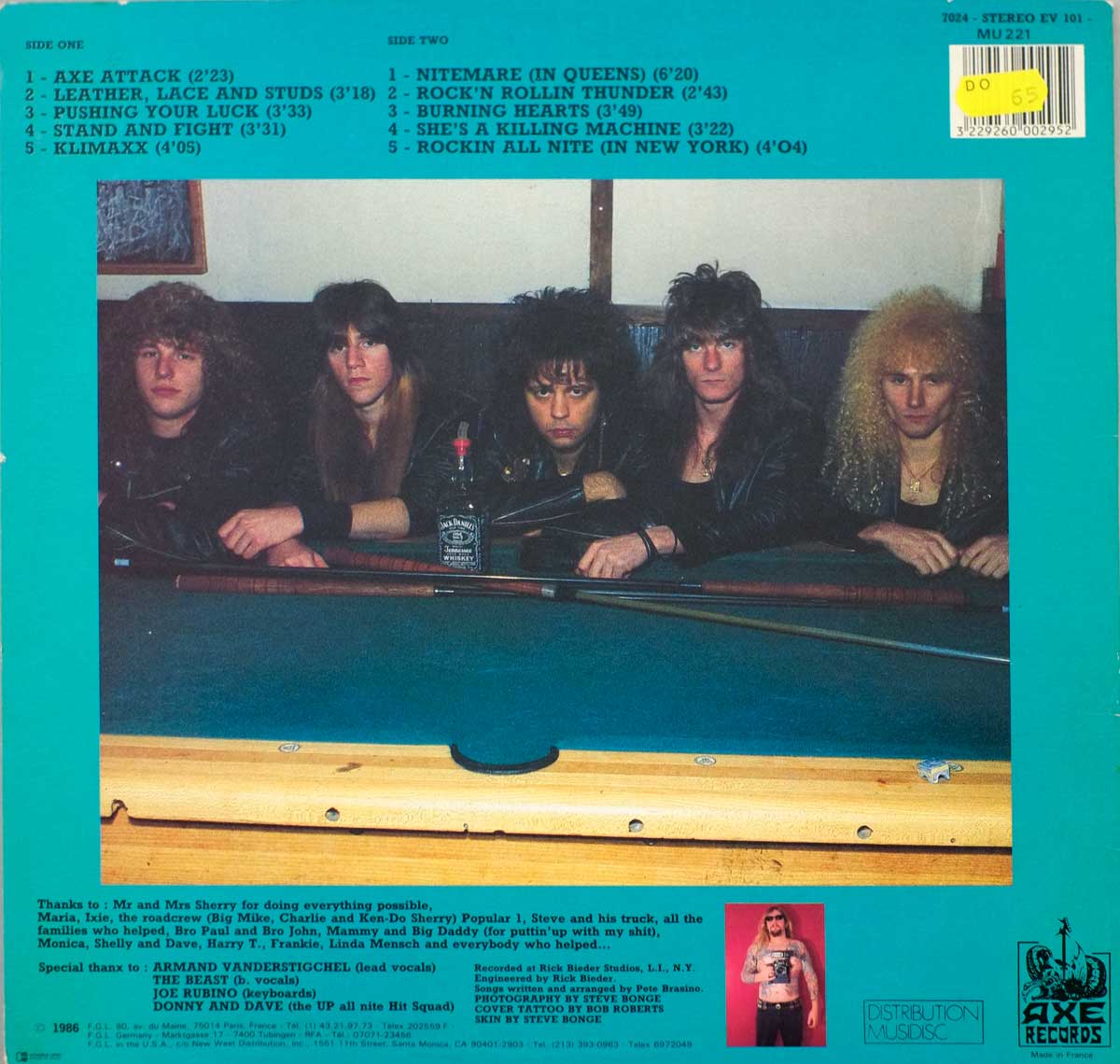
Back cover built around a turquoise background with a centered horizontal band photo. Five members sit behind a pool table, each leaning forward with arms on the rail. A full bottle of Jack Daniel's sits at the center, doubling as a visual anchor. Lighting is low and bar-like, giving the scene a gritty New York rehearsal hangout feel. Hair styles, leather jackets, and posture all reinforce the period speed-metal attitude.
Tracklisting appears above the band photo in two columns: Side One on the left with five tracks and timings, Side Two on the right with another five. Typography is clean and functional, printed in black with enough contrast to stand out against the turquoise. A barcode area with a yellow sticker occupies the top-right corner, showing the catalog number EV 101 – MU 221 and price sticker remnants that help date retail handling.
Lower section contains production details in small black type: musician credits, special thanks, recording info, and artwork acknowledgments. An inset photo on the bottom right shows a man displaying the same dragon tattoo featured on the front cover, confirming the artwork source. Distribution logos for Distribution Musidisc and AXE Records appear beneath it. The bottom edge includes copyright, pressing year, and catalog line confirming this as the 1986 French Axe Killer edition.
These layout details matter for collectors because they distinguish original Axe Killer pressings from later reissues. Typography weight, alignment, spacing around credits, barcode placement, and even the exact shade of turquoise all help authenticate the sleeve. This scan shows a clean, correctly aligned print without fading, which is essential when verifying condition and originality.
BOTTOM-LINE TEXT:
Thanks to: Mr and Mrs Sherry for doing everything possible,
Maria, Zoe, the Roadcrew (Big Mike, Charlie and Ken-Do Sherry) Popular 1, Steve and his truck, all the families who helped, Ruv Paul and Big Daddy (for putting up with my shit),
Monica, Shelly and Dave, Harry T., Frankie, Linda Mensch and everybody who helped...
Special thanx to: ARMAND VANDERSTIGCHEL (lead vocals)
THE BEAST (b. vocals)
JOE RUBINO (keyboards)
DONNY AND DAVE (the UP all nite Hit Squad)
Recorded at Rick Binder Studio, L.I., N.Y.
Engineered by Rick Binder
Songs written and arranged by Pete Brasino.
Photography by Steve Bonge
Cover Tattoo by Bob Roberts
Skin by Steve Bonge
1986 GLL Co., all rights reserved.
7024 - STEREO EV 101 - MU 221
Distribution MUSIDISC
AXE RECORDS
Made in France
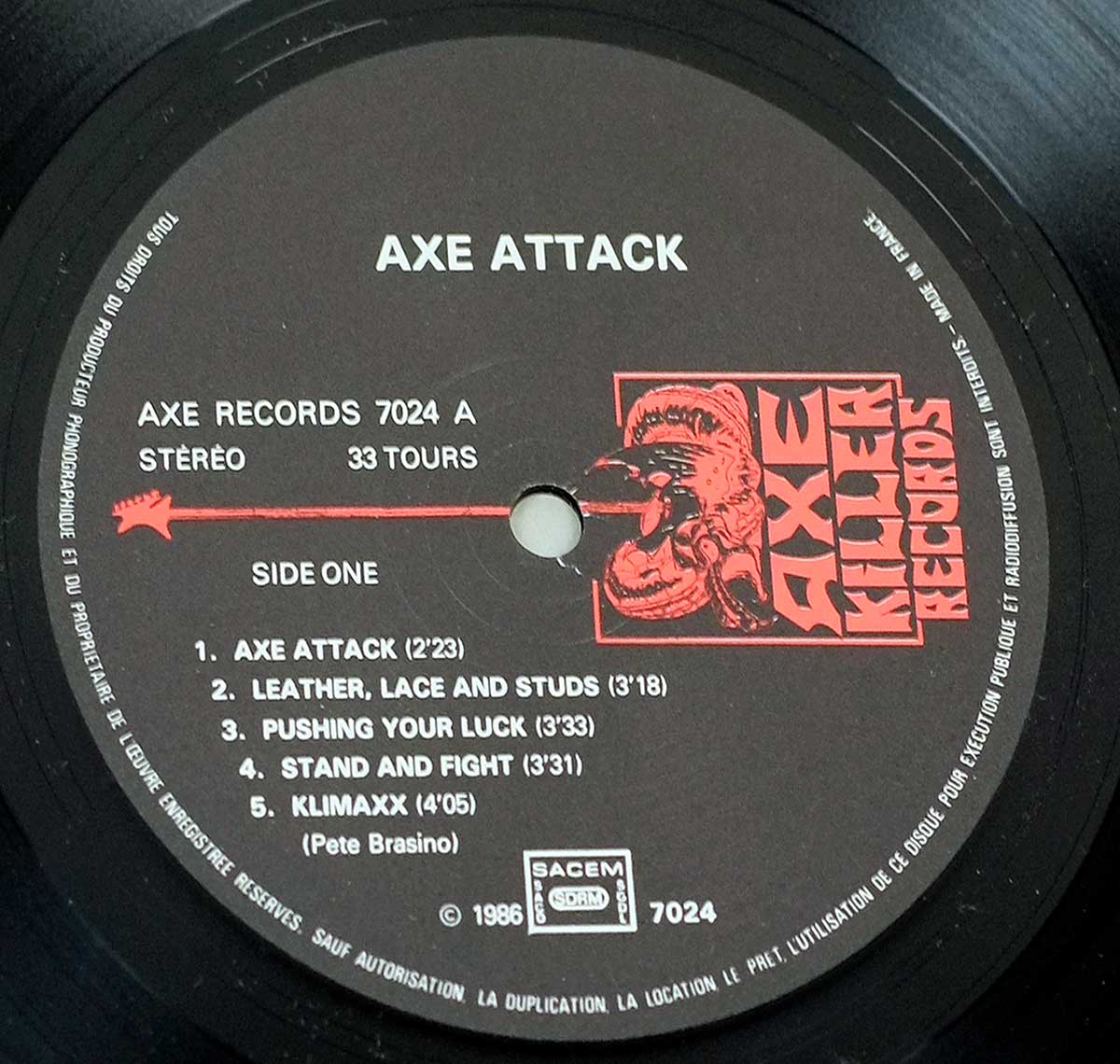
Side One label of the French Axe Killer pressing, printed on a dark brown matte surface with tight, crisp typography. The band name AXE ATTACK sits at the top in clean white sans-serif type. Just below, the line reads AXE RECORDS 7024 A with STEREO and 33 TOURS positioned underneath, reinforcing that this is a continental European issue. All printing is sharp, without bleeding or ink spread, which is important when verifying authenticity.
The right side features the Axe Killer Records logo in vivid red: a stylized skull with protruding tongue surrounded by bold block lettering. The contrast between the red artwork and the brown label stock is strong and unmistakable. A thin red pointer graphic runs horizontally from the logo toward the spindle hole, adding a visual anchor that collectors quickly recognize from mid-80s Axe Killer designs.
Tracklisting is aligned flush-left, numbered 1 through 5, each with timing: Axe Attack (2'23), Leather, Lace and Studs (3'18), Pushing Your Luck (3'33), Stand and Fight (3'31), and Klimaxx (4'05). Pete Brasino’s name appears beneath Klimaxx, identifying authorship. Text clarity, spacing, and font consistency help distinguish original pressings from cheap later reproductions.
Bottom edge includes SACEM rights logos, a (P) 1986 line, and catalog number 7024. Surrounding perimeter text in French notes reproduction restrictions, another common marker of genuine Axe Killer pressings. The spindle hole alignment is clean and centered, with no off-register misprint. Entire layout is typical of mid-80s French heavy-metal labels and provides key identifiers for grading and authentication.
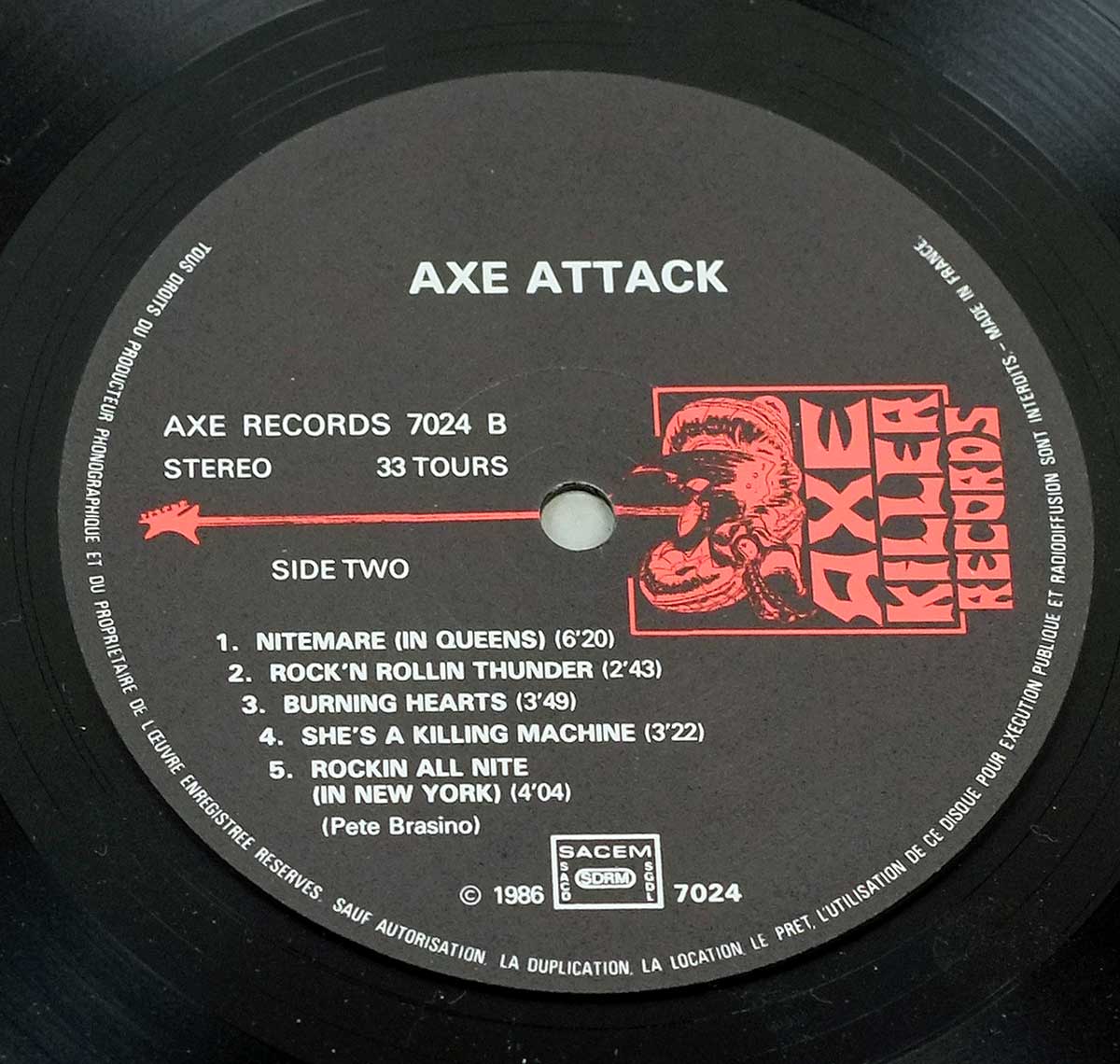
Side Two label of the Axe Killer Records French pressing, printed on the same matte dark brown stock used for Side One. AXE ATTACK appears at the top in white sans-serif type with no decorative elements. Just below, AXE RECORDS 7024 B is printed clearly, along with STEREO and 33 TOURS, confirming the European specification. All text is crisp and clean, with the spindle hole centered accurately against the printed layout.
The right-hand side features the red Axe Killer Records logo: a stylized skull lunging forward with an extended tongue, enclosed in heavy rectangular block lettering. The red arrow graphic extends from the logo toward the spindle hole, matching Side One’s design and serving as a visual identifier for this pressing. Color saturation and sharpness help confirm authenticity for collectors verifying label variations.
Tracklisting for Side Two is printed left-aligned in white: Nitemare (In Queens) (6'20), Rock'n Rollin Thunder (2'43), Burning Hearts (3'49), She's a Killing Machine (3'22), and Rockin All Nite (In New York) (4'04). Pete Brasino’s authorship credit appears beneath the final track. Font weight and spacing match Side One exactly, which is a detail often missed in counterfeit or poorly reproduced reissues.
Lower label area includes SACEM rights symbols, (P) 1986 copyright, and catalog number 7024. Perimeter text in French circles the outer edge, stating legal restrictions on reproduction and public performance. The clean, even print quality and unwarped label surface indicate a well-preserved copy, important when assessing condition for archival or collector grading.
All images on this site are photographed directly from the original vinyl LP covers and record labels in my collection. Earlier blank sleeves were not archived due to past storage limits, and Side Two labels are often omitted when they contain no collector-relevant details. Photo quality varies because the images were taken over several decades with different cameras. You may use these images for personal or non-commercial purposes if you include a link to this site; commercial use requires my permission. Text on covers and labels has been transcribed using a free online OCR service.