"Phantasmagoria" (1987) Album Description:
Geisha's "Phantasmagoria" landed in 1987 as the only full-length statement from a Danish heavy metal band that burned brightly, briefly, and then scattered its players into more famous shadows. It is not a stadium monster, not a million-selling beast, and thank heavens for that. This is Danish Heavy Metal with hard rock muscle and glam-metal mascara: bright guitars, sharp choruses, street-corner swagger, and just enough theatrical poison to make the sleeve feel like a warning rather than decoration.
The real pull is not just the music, though the riffs bite cleanly enough. It is the strange little crossroads inside the record: Geisha before the King Diamond connection, Heavy Metal Worldwide before the collector microscope, and a sleeve that looks as if someone locked fantasy art, photo-session vanity, and late-night Copenhagen ambition in the same room. Open the hidden part and the thing starts behaving less like a forgotten LP and more like a paper trail with distortion pedals.
Denmark in 1987 was no sleepy metal backwater, whatever lazy import-bin wisdom might suggest. King Diamond had "Abigail" out that same year, Mercyful Fate still cast a long black shadow over Copenhagen, Pretty Maids were pushing a cleaner hard rock and power-metal shine with "Future World", and Artillery were dragging Danish aggression into thrash with "Terror Squad". Geisha sat somewhere messier: not as occult as King Diamond, not as polished as Pretty Maids, not as savage as Artillery. A useful place to be, if you ask me.
"You Got What It Takes" opens the record with that cocky late-80s push, the sort of track that walks in wearing too much confidence and somehow gets away with it. "Shock Rock School" is exactly the kind of title that makes sensible people roll their eyes, which is usually a good sign, and "Gangland Sector 21" stretches the band's theatrical side further into comic-book menace and metal-club smoke. The album does not hide its appetite. It wants hooks, drama, guitars with teeth, and vocals that lean over the balcony.
The sound has a bright attack rather than a deep thud. Pete Blakk's guitars slash and sparkle, very much in that period where lead work had to arrive with elbows out, while the bass keeps enough weight underneath to stop the whole thing floating away in hairspray fumes. Yenz Cheyenne brings a theatrical vocal edge without turning the record into pure pantomime, and Tony Niemistö's drumming gives the songs forward shove instead of polite timekeeping. Polite timekeeping has ruined enough records already.
Produced by Geisha and Peter Mark, the album has the useful feel of a band still close to its rehearsal-room instincts. Hookfarm Studio in Copenhagen did not sand the roughness out of it; the guitars keep their bite, the drums breathe a bit, and the vocals sit right where this kind of record needs them: up front, half-sneer, half-performance. The production is not luxurious. It is better than luxurious. It sounds like the budget had limits and the band tried to outrun them.
The personnel story is where collectors start leaning closer. Geisha were active from the early-to-mid 1980s into 1988, and a planned second album, "Conform or Transform", reportedly collapsed as Pete Blakk and Hal Patino left for King Diamond. That move matters because it gives "Phantasmagoria" a before-the-bigger-stage tension. The record becomes a snapshot of players just before the map changed. No grand prophecy needed; the evidence is right there in the grooves.
There does not seem to have been a major controversy around the release, and pretending otherwise would be cheap theatre. The common mistake is more boring but more useful: treating the LP as a King Diamond footnote and nothing else. That sells the band short. The later connections help, naturally, but "Phantasmagoria" works best when heard as its own Danish Heavy Metal oddball, with glam glare, hard rock drive, and enough wrong turns to keep it from becoming tidy.
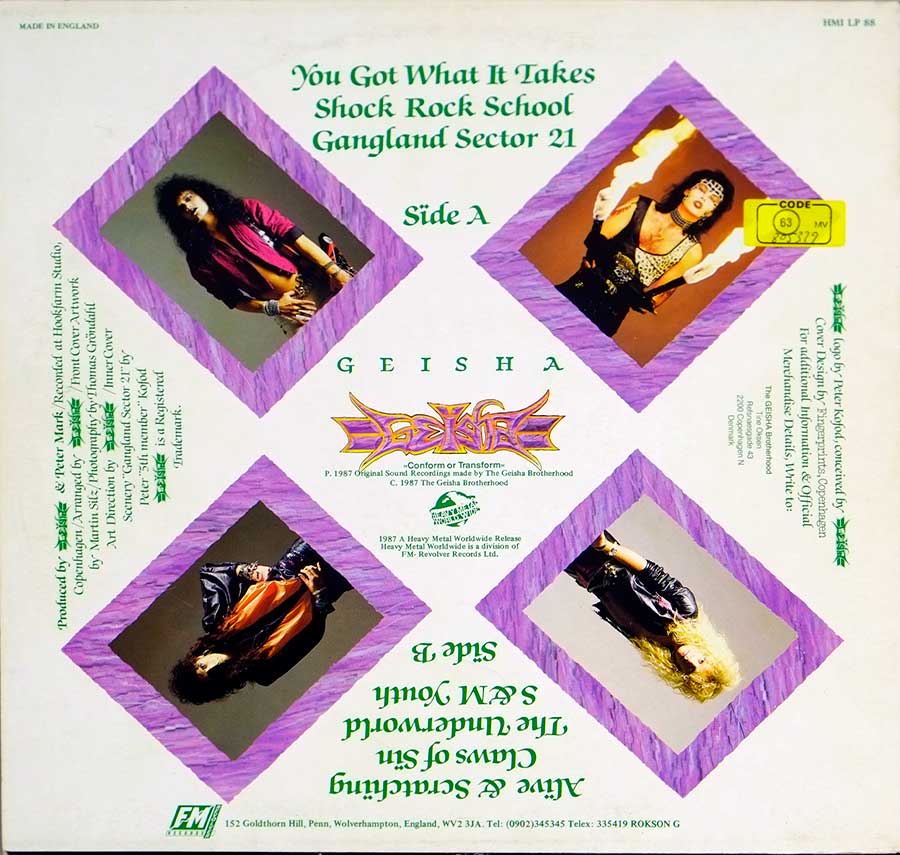
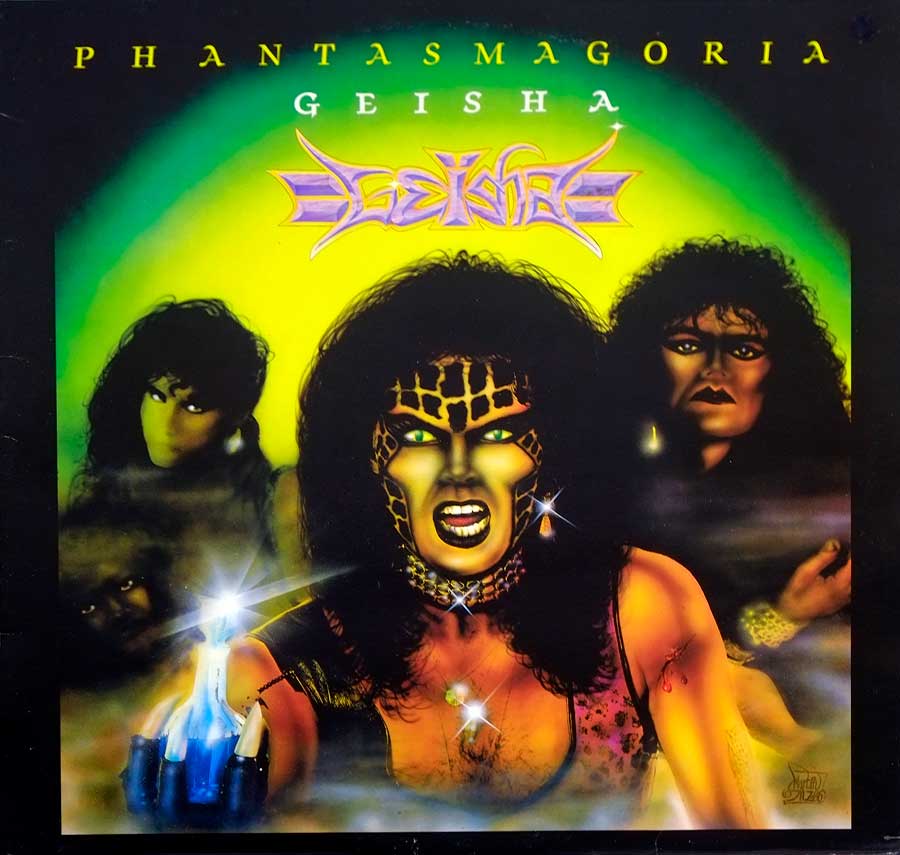
The sleeve backs up the music's refusal to behave. Martin Silz's front cover artwork goes full neon fever dream, while Peter Kofod's logo and the Fingerprints Copenhagen design work give the package that busy, slightly awkward period look collectors either love or pretend not to love. The back cover is even better for evidence: green type, purple diamond photo frames, "Made in England", HMI LP 88, and credits running down the sides like someone had too much layout and not enough restraint. Lovely nuisance.
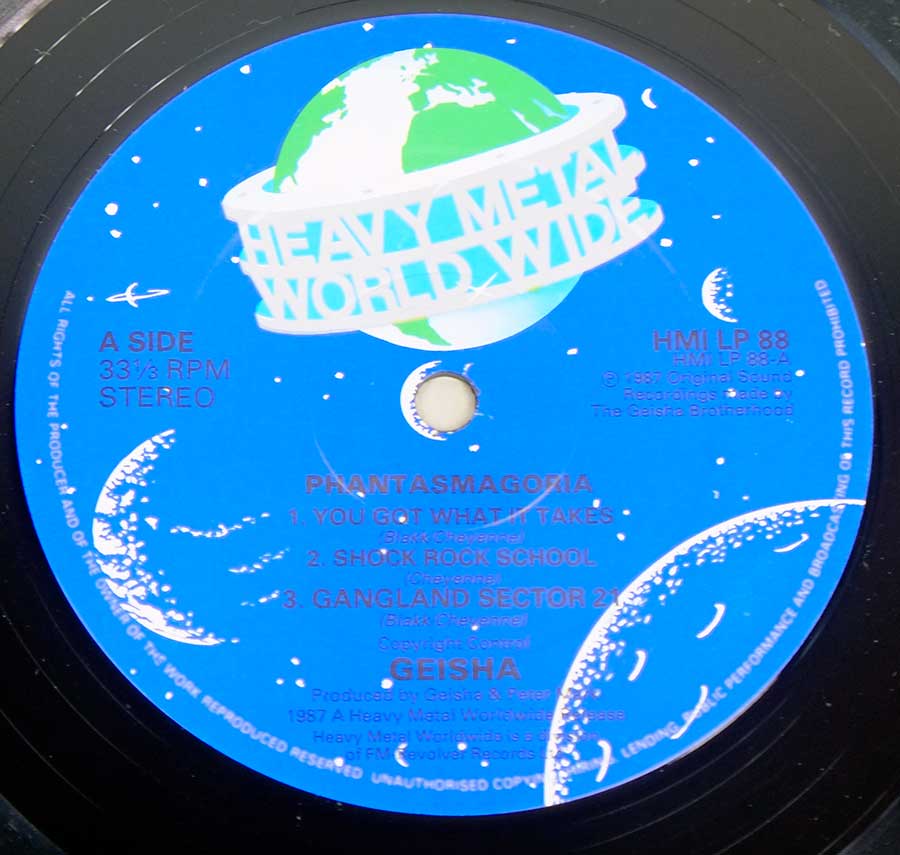
On a late night, this is the sort of LP that rewards being pulled from the shelf when the obvious classics feel too rehearsed. The Side A label, blue and loud with the Heavy Metal Worldwide globe, looks almost daft under a lamp, but it tells the collector what matters: format, side, speed, catalogue identity, and that small physical proof that this thing had a life before becoming a web page.
So no, "Phantasmagoria" is not the great lost Danish metal bible. That would be too neat, and this record is not neat. It is a short-lived band caught mid-stride, a 1987 sleeve full of ambition and questionable taste, a hard rock / glam-edged heavy metal record with links that grew more interesting after the fact. Sometimes that is exactly the kind of album worth keeping. The famous ones already have enough people shouting on their behalf.
References
- Vinyl Records Gallery - GEISHA "Phantasmagoria" high-resolution album cover photos and page context
- Encyclopaedia Metallum - Geisha band profile and history
- Encyclopaedia Metallum - Geisha "Phantasmagoria" album details, lineup, track list, and credits
- Discogs - Geisha "Phantasmagoria" release versions and collector context
- King Diamond "Abigail" - 1987 Danish heavy metal context
- Pretty Maids "Future World" - 1987 Danish hard rock and heavy metal context
- Artillery "Terror Squad" - 1987 Danish thrash metal context