Pekatralatak - Mort Au Punk & Urban Blight - Revolte 12" Vinyl LP Split Album

- This page shows the full set of photos of everything included with this split album.

The "Révolte" 12" LP unites the primal forces of Pekatralatak and Urban Blight in a punk symphony. The split album delivers unapologetic rebellion, with Pekatralatak's fierce energy on one side and Urban Blight's gritty urban commentary on the other. Accompanied by a booklet containing provocative lyrics and images, the vinyl encapsulates the raw, unfiltered essence of punk, inviting listeners to confront societal norms through an audial and visual journey of defiance.

  This album includes the booklet with offensive lyrics and photos


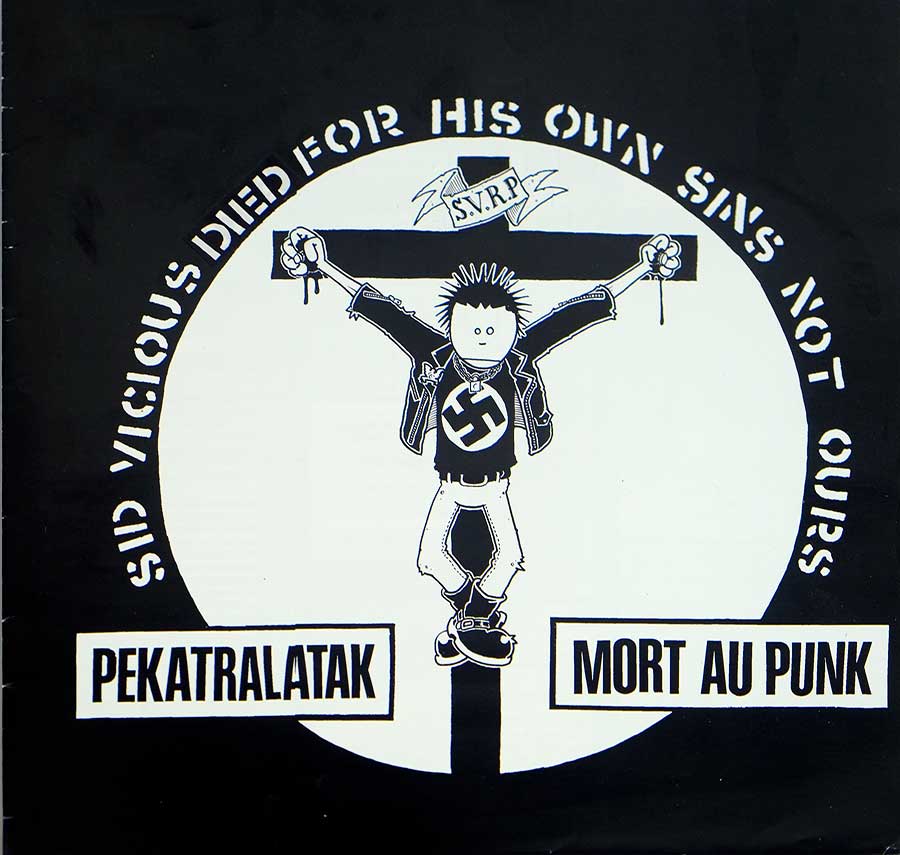
PEKATRALATAK - Mort Au PunK & URBAN BLIGHT - Revolte 12" LP Vinyl Album front cover https://vinyl-records.nl

Album Key Details: Genre, Label, Format & Release Info

Music Genre:

French Punk

Media Format:

Record Format: 12" LP Vinyl Stereo Gramophone Record
Total Weight: 400g

Complete Track-listing:

Tracklisting Side One:
  1. Urban Blight – Solidarité
  2. Urban Blight – Telly Lies
  3. Urban Blight – Révolté
  4. Urban Blight – Sunday Ballots
  5. Urban Blight – Carwash
  6. Urban Blight – Two Days In The Week
  7. Urban Blight – Ca Se Saurait
  8. Urban Blight – Solidarité
Tracklisting Side Two:
  1. Pekatralatak – L' Instinct De Mort
  2. Pekatralatak – A Tous Les Etages
  3. Pekatralatak – Cours Vite ...
  4. Pekatralatak – La Belle Vie
  5. Pekatralatak – N.g.s.
  6. Pekatralatak – Le Dernier Calmé
  7. Pekatralatak – Voleur De Terres
  8. Pekatralatak – Double Peine

Disclaimer: Track durations shown are approximate and may vary slightly between different country editions or reissues. Variations can result from alternate masterings, pressing plant differences, or regional production adjustments.

Album Front Cover Photo
PEKATRALATAK – Mort Au Punk 12-inch LP front cover showing stark black-and-white sleeve with circular white field on black background, cartoon punk figure crucified on cross, armband with swastika symbol as provocative graphic element, S.V.R.P. banner above, French slogan text around rim and boxed band and album titles at bottom; heavy ink saturation and flat matte finish typical of small-run punk pressing.

Sleeve sits heavy and matte in the hands, no lamination to hide behind, just flat black stock drinking in the light. The design is brutally simple: a white circle stamped onto a deep black field, like someone screen-printed it in a garage that smelled of beer and solvent. The ink sits thick; you can see slight pooling at the edges of the white where the coverage is denser. That circle frames the central cartoon—spiky-haired punk nailed to a cross, arms stretched, boots dangling, a deliberately offensive armband drawn in thick lines to make sure no one misses the provocation. It’s not subtle. Subtlety was never invited.

The typography behaves like it was cut with a ruler and impatience. “PEKATRALATAK” and “MORT AU PUNK” are boxed at the bottom in block capitals that feel more functional than aesthetic. The spacing between letters isn’t perfectly even; there’s a faint wobble that tells me this wasn’t typeset by a corporate art department. Around the top rim runs the slogan in French—“Nous died for his own sins not ours”—and yes, the grammar grates slightly. That irritation feels intentional, or at least unapologetic. Punk sleeves often shout; this one stares back and dares you to argue.

Edges show the usual shelf wear: slight whitening along the bottom seam where it’s been slid in and out of tight racks too many times. A faint pressure line cuts horizontally near the center, likely from years of the vinyl resting inside without an inner sleeve thick enough to cushion it. The black surface is unforgiving—every thumbprint leaves a ghostly sheen under strong light. That’s the trade-off with matte black stock; it looks menacing, ages like a suspect.

The central cross motif isn’t finely drawn. Lines are thick, almost clumsy, which makes it feel closer to fanzine graphics than calculated shock marketing. The S.V.R.P. banner above the cross is squeezed in, slightly cramped, as if added late in the layout process. That small awkwardness convinces me this wasn’t polished by committee. It’s confrontational in the blunt, early-80s continental punk way—more agitprop than art-school.

No glossy tricks, no embossing, no die-cuts. Just ink, paper, and an attitude that hasn’t mellowed with age. The longer this sleeve lives on a shelf, the more the black picks up hairline scuffs, the more the white circle risks slight yellowing at the edges. That fragility is part of the charm. This isn’t a sleeve that flatters a collector’s ego. It survives because someone cared enough not to throw it out, not because it begged to be framed.

Outer rim text: Sid Vicious died for his own sins not ours

Album Back Cover Photo
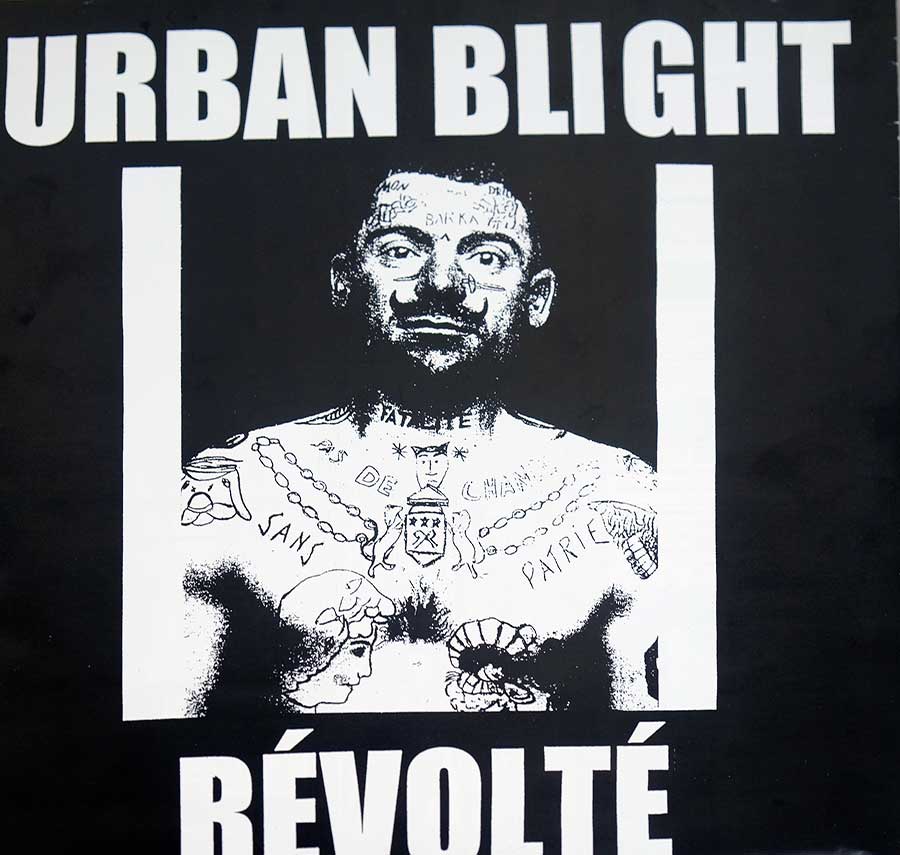
URBAN BLIGHT – Révolté 12-inch LP back cover featuring stark black-and-white layout with large block lettering top and bottom, central high-contrast portrait of tattooed male torso framed by two vertical white bars on black background; matte cardboard stock with visible edge wear and ink rub typical of small-run punk pressing.

Flip the sleeve over and the mood changes from cartoon provocation to something colder. The cardboard feels the same—matte, slightly rough, no lamination to soften the blow—but the design is heavier here. “URBAN BLIGHT” shouts across the top in thick, white block letters that nearly kiss the edge of the board. The ink coverage is dense, almost chalky against the black, and under angled light you can see tiny inconsistencies where the white didn’t fully saturate the grain of the stock.

The central image is a stark, high-contrast portrait of a bare-chested man, framed between two vertical white bars that echo prison imagery without spelling it out. The halftone is coarse. Dots are visible. Shadows break into grain. This wasn’t cleaned up for glossy reproduction; it looks lifted from a zine or a photocopy run one generation too far. Across the chest are crude tattoos—“PATRIOTE,” “DE CHAINES,” fragments of slogans—drawn or overlaid in a way that feels deliberately abrasive. Not elegant. Effective.

Down at the bottom, “RÉVOLTÉ” sits in the same blunt typeface, slightly tighter spaced than the title above. The accent over the E is sharp but a touch misaligned, which suggests manual paste-up rather than digital precision. That imperfection works for me. When punk sleeves start looking too perfect, they lose their teeth.

Handling tells its own story. The top edge shows faint whitening where it’s been thumbed while pulling the record from a tight shelf. There’s a shallow ring impression beginning to form, visible only when the light hits from the side, proof that the vinyl has rested inside for decades without thick inner protection. Along the right seam, a subtle stress line hints at someone gripping it too firmly during a late-night spin.

The black field is unforgiving. Hairline scuffs snake across it, invisible until you tilt the sleeve. That’s the curse of solid black: it looks menacing new, then slowly reveals every touch. No barcodes clutter the design, no marketing blurbs, no label logos screaming for attention. Just image and accusation. Whether one agrees with the imagery or not, it refuses to flatter the buyer. It confronts. That’s more honest than most sleeves pretending to be dangerous while playing it safe.

Photo of Poster Included with the Album
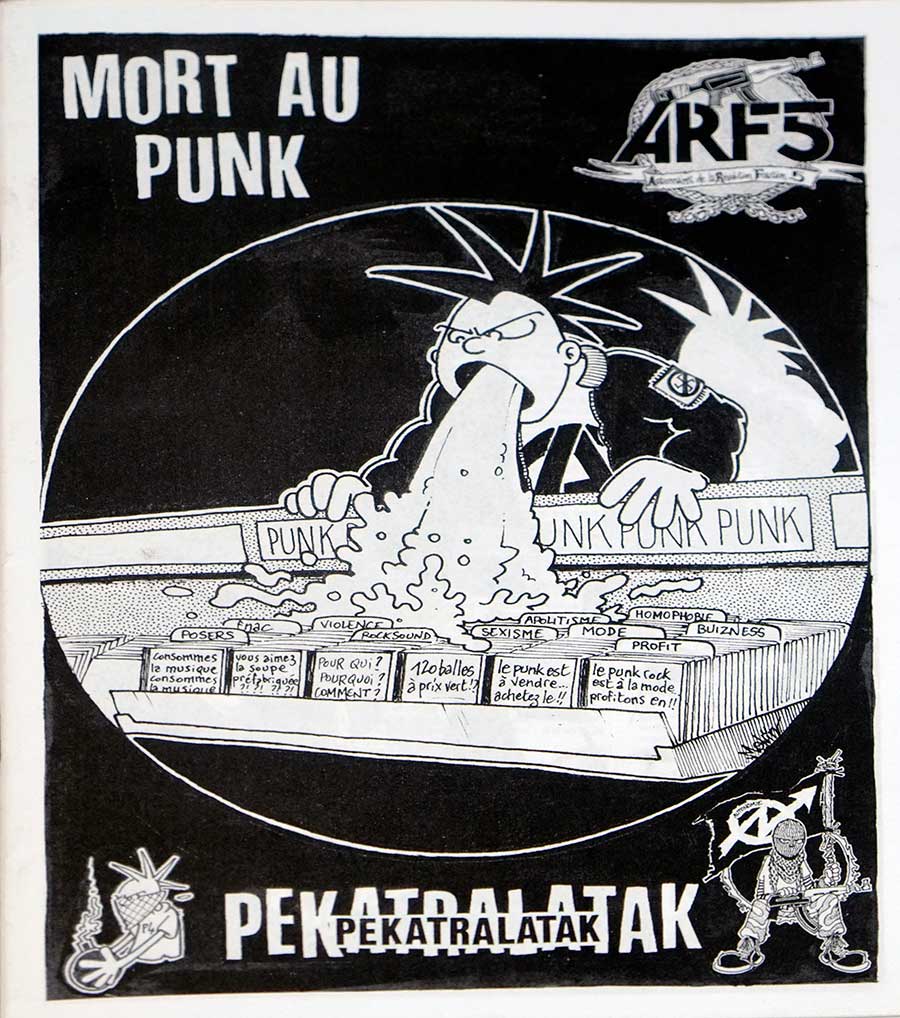
Fold-out poster included with PEKATRALATAK – Mort Au Punk 12-inch LP, black-and-white insert featuring large circular graphic of spiky-haired punk vomiting into record bins labeled with commercial and ideological terms, Mort Au Punk and PEKATRALATAK titles, ARTS logo top right; thin matte paper with visible fold creases typical of original insert.

Unfold the poster and the paper immediately gives it away. Thin stock, slightly greyed from age, no coating, the kind that remembers every fold it has ever suffered. The horizontal and vertical crease lines cut straight through the central circle, and you can feel the faint ridge where it was pressed flat inside the sleeve for decades. Corners are soft, not dramatically bent, just tired in the way inserts get when they’ve been pulled out a few times too often and then shoved back without ceremony.

The design doesn’t whisper. “MORT AU PUNK” sits bluntly in the upper left in block capitals, and opposite it the ARTS logo with rifle motif plants itself in the corner like a stamp of allegiance. Inside the large circular frame, a cartoon punk leans over a rack and vomits a torrent onto neatly arranged record sleeves. It’s crude, deliberately so. The stream splashes over boxes labeled with words like “posers,” “violence,” “mode,” “profit,” and “bizness.” No subtle satire here. It’s an accusation drawn with thick black outlines and a slightly uneven hand that feels closer to fanzine rage than professional illustration.

Look closer and the line work shows its origins. The halftone shading is patchy in places, especially around the character’s hair spikes where the black fills in heavier than intended. That slight over-inking along the edges tells me this was printed economically, probably in a modest run, not obsessively proofed. There’s a faint offset shadow near the lower title “PEKATRALATAK,” suggesting the sheet shifted a millimeter during printing. That sort of imperfection irritates a designer, but here it adds credibility. Punk rarely benefits from perfect registration.

The bottom margin carries two smaller cartoon figures flanking the oversized band name, and the spacing between letters feels just a touch compressed toward the center, as if someone nudged the layout at the last minute to avoid trimming too close to the edge. The white border framing the black field isn’t perfectly even; on the left side it runs marginally wider. Manufacturing reality, not aesthetic flourish.

Handling marks tell their own story. There’s a light ripple across the middle where moisture must have brushed it once, barely visible unless angled toward a lamp. Tiny nicks along the outer edge show where the paper caught on the sleeve opening. This is not a decorative art print. It’s a manifesto on cheap paper, folded, stored, unfolded again. And that roughness suits the message. A glossy poster would have betrayed it.

Photo of Booklet Included with the Album
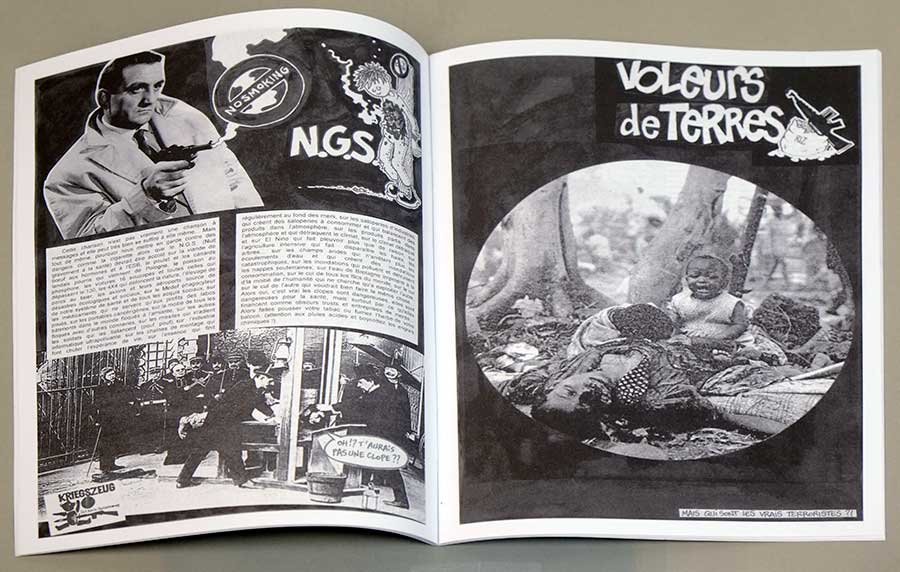
Open stapled booklet included with PEKATRALATAK – Mort Au Punk 12-inch LP, black-and-white two-page spread featuring collage of political imagery, N.G.S. heading with pipe-smoking figure, protest graphics, and opposite page titled Volgurs de Terres with circular photograph and caption; thin matte paper with visible center fold and staple stress.

Spread the booklet open and it lies flatter than you expect, though the center crease still rises slightly like a spine that remembers being folded tight inside the sleeve. The paper is thin, almost newsprint weight, with a faint translucency where the black ink pushes hard against it. Staples at the fold show the first signs of oxidation, tiny dull specks where metal meets paper. Run a finger along the middle and you feel the shallow indentation from years of pressure under the record.

The left page is a collage assault. A pipe-smoking man in a lab coat points a gun beneath a “NO SMOKING” sign, the irony spelled out in thick, uneven lettering: N.G.S. The surrounding text block is cramped, justified without mercy, letters pressing awkwardly against the margins. Beneath it, a grainy still of uniformed men and a speech bubble—“Oh!? T’aurais pas une clope?”—leans into dark humor. The halftone dots are coarse, and in places the blacks bleed slightly into the paper fibers. This wasn’t a luxury print job. It was meant to be read fast and argued over.

Turn the eye to the right page and the mood shifts but not toward comfort. “Volgurs de Terres” crowns the page in hand-drawn white lettering against a heavy black field. Inside a circular frame sits a stark photograph, reproduced with brutal contrast, details breaking into shadow at the edges. The bottom caption—“Mais qui sont les vrais terroristes?”—is small, almost an afterthought, which makes it land harder. There’s no decorative spacing, no breathing room. The design crowds you on purpose.

Handling has left its quiet marks. The outer edges show light feathering where the booklet rubbed against the inner sleeve. A faint thumbprint shadow appears near the lower margin of the right page, only visible when angled toward light. The top corner has the slightest dog-ear beginning to form, evidence that someone actually read this instead of sealing it in plastic and pretending it was art.

Layout-wise, it feels like a zine expanded just enough to fit inside a 12-inch package. Alignment drifts a millimeter here and there. Black backgrounds aren’t perfectly solid; you can spot subtle streaking from the press. That imperfection makes it credible. A slick booklet would have undercut the anger. This one looks like it was assembled with urgency, not approval from a marketing department. And that, frankly, is the whole point.

Close up of Side One record's label
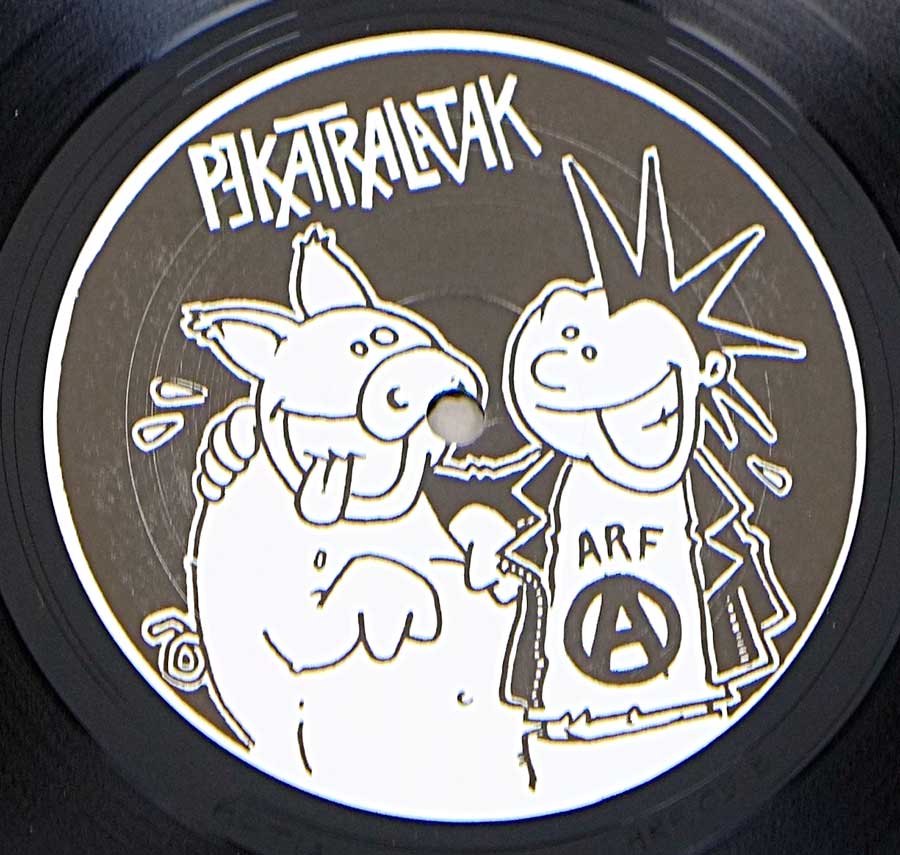
Close-up of Side One record label for PEKATRALATAK – Mort Au Punk 12-inch LP, black vinyl with black-and-white cartoon label showing spiky-haired punk figure wearing ARF shirt with anarchist symbol next to a dog, band name curved at top; visible spindle wear and light surface scuffs around center hole.

Hold the record at an angle and the first thing that jumps out is the contrast between the dead black vinyl and the stark white cartoon on the label. The paper label is matte, not glossy, and slightly textured under the fingertip. Around the spindle hole there’s the faint halo of use—tiny crescent marks where the record has been lowered onto a turntable more than once. Not abused, but definitely played. That matters.

The artwork keeps the same irreverent tone as the sleeve. A grinning spiky-haired punk in a sleeveless shirt marked “ARF” with an anarchist symbol stands arm-in-arm with a cartoon dog. The line work is thick and confident, though not perfectly smooth; you can see where the black outline thickens unevenly around the character’s hair spikes. The band name “PEKATRALATAK” curves across the top in jagged lettering that almost refuses to sit evenly along the arc. It’s slightly off-center if you really stare at it, which would irritate a perfectionist. Here it feels deliberate, or at least defiantly unbothered.

Look closely at the ink coverage and there’s minor feathering at the edges of the white shapes where the print meets the paper fibers. This wasn’t a luxury label run. The white ring framing the artwork is clean but not razor-sharp; under magnification you can spot the faintest misregistration where black meets white. Honest printing, not boutique reissue precision.

The vinyl surface itself shows light hairline scuffs radiating outward, the kind that come from sliding in and out of a tight inner sleeve. No deep gouges, no cloudy patches. The grooves still reflect light cleanly. A subtle ring impression is beginning to form in the label area from decades of storage pressure. That slow imprint is something you only notice when you’ve handled enough records to recognize the pattern.

There’s no clutter here—no track listing, no dense legal text crowding the image. Just artwork and attitude. For a punk release, that restraint works. It keeps the focus on the drawing, on the camaraderie between caricatured rebel and dog, half-joke and half-statement. A glossy corporate label would have killed that mood. This one feels appropriately rough around the edges, and I’d rather have that than something too clean to trust.

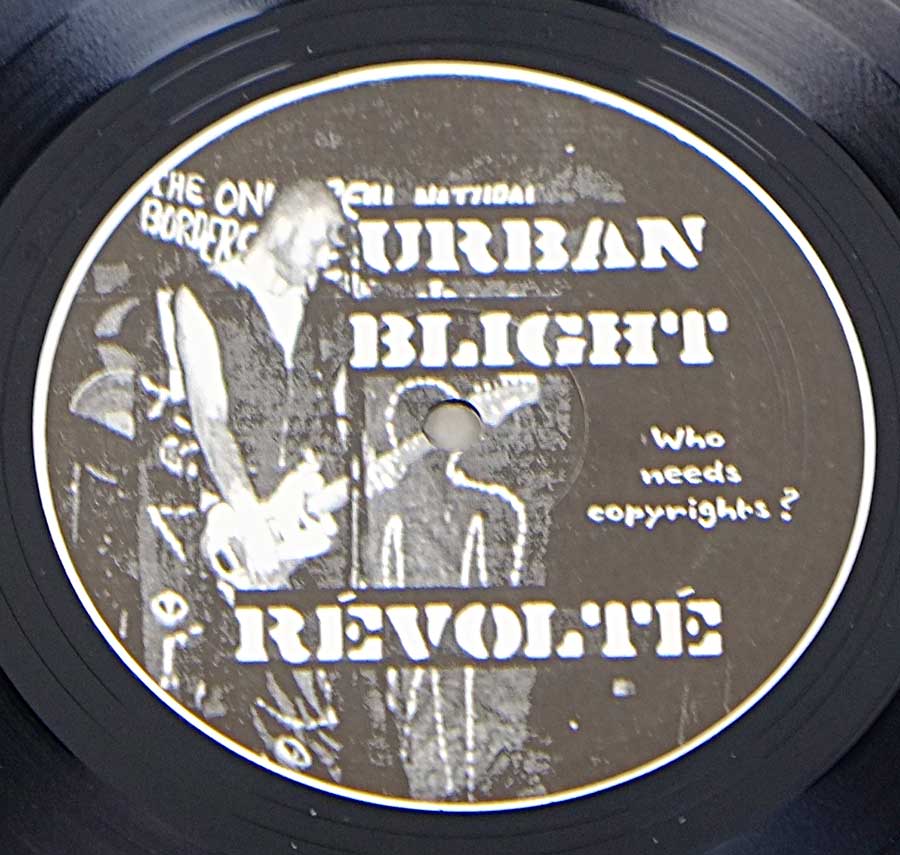
Side Two Close up of record's label
Close-up of Side Two record label for URBAN BLIGHT – Révolté 12-inch LP, black vinyl with black-and-white photographic label showing figure holding a knife, bold URBAN BLIGHT and REVOLTE lettering, slogan 'Who needs copyrights?' on right; visible spindle marks and light surface scuffs around center hole.

Turn the record over and the tone hardens immediately. The label on this side is darker, heavier, almost claustrophobic compared to the cartoon looseness of the other side. Matte paper again, slightly fibrous to the touch, with a faint ring impression forming around the center where decades of storage have pressed vinyl against label. Around the spindle hole, small crescent scratches reveal actual use, not decorative ownership.

The image is a grainy black-and-white photograph, pushed hard in contrast. A figure holds a knife, caught mid-gesture, details breaking into harsh shadow. “URBAN BLIGHT” stretches across the upper half in thick serif lettering that feels borrowed from somewhere older, maybe intentionally so. Below, “REVOLTE” anchors the bottom in matching weight. The type isn’t perfectly centered if you measure it. It leans just enough to notice. That slight imbalance gives it tension rather than polish.

On the right side, in smaller hand-drawn style text, sits the line: “Who needs copyrights?” It’s printed without flourish, almost tossed in. That line could have been smug; here it feels like a shrug paired with a challenge. The ink coverage shows minor inconsistencies, especially near the upper edge where the black field lightens microscopically. Budget printing, not luxury pressing.

The vinyl surface shows faint radial hairlines, the sort that come from sliding against paper sleeves over time. No deep scarring, but enough micro-lines to tell you this wasn’t sealed and forgotten. The white border framing the label is clean yet not razor precise; under close inspection, the edge wavers slightly where white meets black. Registration wasn’t obsessive, and frankly that suits the record better than sterile perfection would have.

This side feels more confrontational than playful. No cartoons, no grinning mascots. Just stark imagery and a sly anti-copyright jab. A corporate label would have cluttered this with catalog numbers and legal fine print. Instead, there’s space and attitude. The imperfections aren’t flaws here. They’re fingerprints of how and why this thing was made.

All images on this site are photographed directly from the original vinyl LP covers and record labels in my collection. Earlier blank sleeves were not archived due to past storage limits, and Side Two labels are often omitted when they contain no collector-relevant details. Photo quality varies because the images were taken over several decades with different cameras. You may use these images for personal or non-commercial purposes if you include a link to this site; commercial use requires my permission. Text on covers and labels has been transcribed using a free online OCR service.