BLADE RUNNER – Hunted 12" Vinyl LP Album

- debut NWOBHM studio album, released in 1984 on Ebony Records

Album Front Cover Photo of BLADE RUNNER – Hunted Visit: https://vinyl-records.nl/

"Hunted" is the first/debut full-length studio album by the British Heavy Metal (NWOBHM) band BLADE RUNNER, released in 1984 on Ebony Records. Formed in London in 1983, Blade Runner arrived late in the NWOBHM cycle but played with the urgency of a band aware the window was closing. The album captures a raw, hungry sound built on tight riffs, restless tempos, and street-level attitude, documenting a brief but intense moment before the band faded from view.

Table of Contents

"Hunted" (1984) Album Description:

Introduction

"Hunted" landed in 1984 like a sweat-soaked club gig pressed onto vinyl, capturing BLADE RUNNER at the exact moment ambition briefly outran circumstance. It’s a debut that doesn’t pretend to be revolutionary, but it absolutely refuses to be polite. This is NWOBHM played by people who meant it, even if the world was already starting to move on.

Historical and Cultural Context

By 1984, the New Wave of British Heavy Metal was no longer the new kid kicking down doors. Iron Maiden and Saxon were established names, thrash was sharpening its knives, and glossy hard rock was flirting with MTV. Bands like Blade Runner existed in that narrow, dangerous gap where underground credibility still mattered, but survival demanded a record deal and a fast turnaround.

How the Band Came to Record This Album

Blade Runner formed in London in 1983, late enough to miss the first NWOBHM gold rush but early enough to catch its echo. Signing with Ebony Records meant access to studio time and vinyl, but also pressure to deliver quickly. "Hunted" feels like a band running on adrenaline, rehearsed hard, recorded fast, and hoping the grooves would do the rest.

The Sound, Songs, and Musical Direction

The album lives on tight riffs, restless tempos, and vocals that sound permanently one step ahead of the beat. Songs like "Too Far Too Late" and "Run From The Night" don’t overstay their welcome; they punch, hook, and move on. There’s melody here, but it’s wired directly into urgency rather than polish.

Comparison to Other Albums of the Era

Released the same year as genre benchmarks like Iron Maiden’s "Powerslave" or Saxon’s "Crusader", "Hunted" sits a level below in budget but not in intent. Where the bigger bands sounded expansive and confident, Blade Runner sounded hungry. That hunger is the album’s real calling card.

Band Dynamics and Creative Tensions

You can hear a band still negotiating its identity, balancing classic metal roots with the speed and aggression audiences were starting to expect. The dual guitar presence adds muscle, while the vocals steer everything toward street-level drama rather than fantasy epics. It’s less about grand statements and more about getting through the next song alive.

Critical Reception and Legacy

At the time, "Hunted" didn’t rewrite the rulebook or storm the charts, and that probably sealed its cult status. Over the years, it’s become one of those records collectors talk about with a knowing nod: solid, sincere, and overlooked. Its French pressing on Ebony only adds to that quiet, collector-grade mystique.

Reflective Closing

Decades later, this record still feels honest in a way many slicker releases don’t. Drop the needle and you can almost smell the rehearsal room and cheap beer clinging to the riffs. "Hunted" remains a snapshot of a band catching its moment, even as the clock was already ticking.
Album Key Details: Genre, Label, Format & Release Info

Label & Catalognr:

Ebony – Cat#: EBON-21

Media Format:

Record Format: 12" LP Vinyl Stereo Gramophone Record
Total Weight: 230g

Year & Country:

1984 – France

Production & Recording Information:

Producers:
  • Darryl Johnston – Music Producer, Record Company Founder Darryl Johnston, a key figure in the New Wave of British Heavy Metal (NWOBHM), founded Ebony Records in 1982, providing a platform for emerging metal bands. His work with artists like Grim Reaper and Chateaux helped shape the genre. Though he left the industry in 1987, his impact endures. Learn more about
Recording Location:

Ebony Studios – Hull, England

Album Cover Design & Artwork:
  • Garry Sharpe-Young – Graphic Designer Garry Sharpe-Young was a British metal historian, writer and graphic designer whose work mapped countless rock and NWOBHM bands from the late 1970s through the 2000s. He documented scenes, interviewed artists, and designed several 80s metal releases. Garry Sharpe-Young Biography

Band Members / Musicians:

Band Line-up:
  • Steve MacKay – Lead Vocals Steve MacKay is the voice that defines "Hunted", and to my ears he sounds like a singer fully aware the clock is ticking. His vocals sit right on the edge between melody and urgency, never drifting into fantasy theatrics. On this album he delivers street-level narratives with grit and restraint, pushing the choruses just hard enough to stick without smoothing off the rough edges. He gives the record its human pulse.
  • Gary Jones – Guitar, Vocals Gary Jones carries a double load on "Hunted", locking in the core guitar attack while adding backing vocals where needed. His playing favors sharp, economical riffs over showy excess, which keeps the album moving at a relentless pace. The guitar tone is lean and aggressive, perfectly matched to the songs’ urgency, and his vocal support thickens the choruses without distracting from the album’s raw drive.
  • Mark Wilde – Guitars Mark Wilde adds the second guitar layer that gives "Hunted" its weight and bite. Where one guitar pushes forward, the other reinforces and sharpens the edges, creating that classic NWOBHM twin-guitar tension. His contributions aren’t about spotlight moments but about density and pressure, filling out the sound so the riffs hit harder and the faster songs feel properly armed rather than thin.
 
  • Mick Cooper – Bass Mick Cooper’s bass work on "Hunted" does exactly what good NWOBHM bass should do: hold the center while quietly adding muscle. He follows the guitars closely but never disappears, giving the faster tracks a solid spine and the mid-tempo moments extra weight. It’s not flashy playing, but it’s essential, anchoring the album so the riffs and vocals can cut loose without collapsing.
  • Greg Ellis – Drums Greg Ellis drives "Hunted" with tight, no-nonsense drumming that keeps everything urgent and forward-moving. His playing favors momentum over ornament, locking into fast, disciplined patterns that push the songs ahead without clutter. The drums give the album its sense of chase and pressure, reinforcing the feeling that this band was playing like every track might be their last chance to be heard.

Complete Track-listing:

Tracklisting Side One:
  1. Too Far Too Late
  2. Run From The Night
  3. Back Street Lady
  4. The Stealer
  5. Hunted
Tracklisting Side Two:
  1. I've Got To Rock
  2. Dogs Of War
  3. Back On The Street
  4. Looking From The Outside

Disclaimer: Track durations are not listed for this release. Actual playback times may vary slightly between pressings or country editions due to mastering or manufacturing differences.

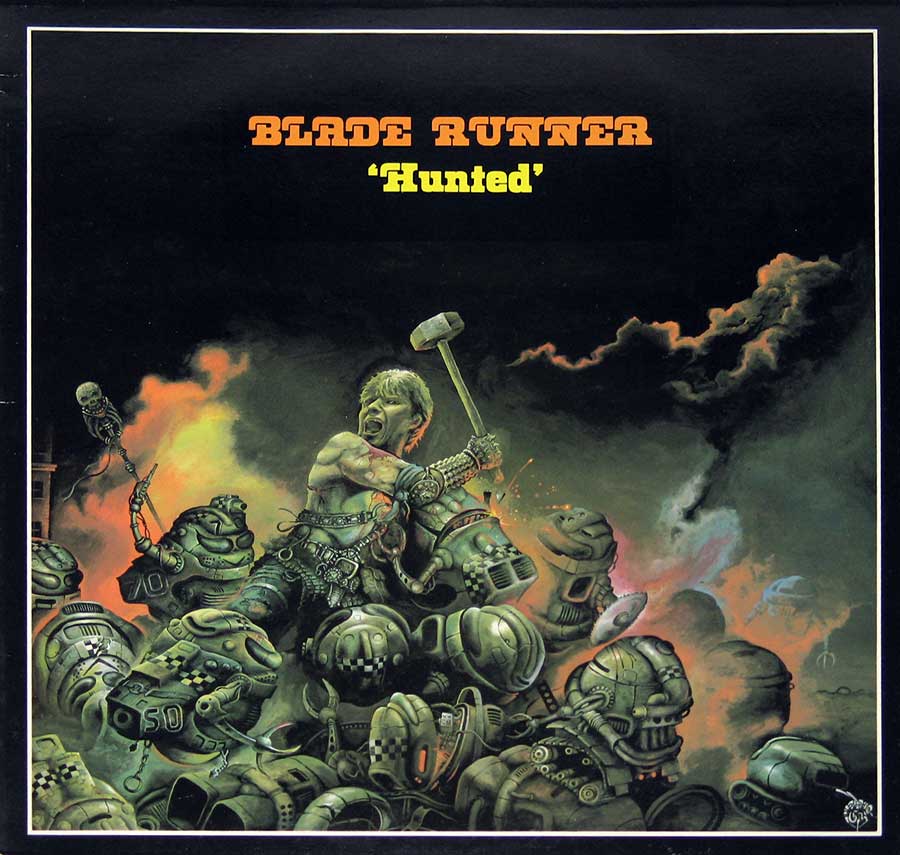
Album Front Cover Photo
Front cover of BLADE RUNNER – Hunted showing a muscular human person with a raised hammer standing over shattered robotic bodies, framed by dark smoke, fire-toned clouds, and bold orange-yellow band and album typography, a classic mid-80s NWOBHM illustrated sleeve with strong contrast and heavy mechanical detail

This is the original front cover artwork for BLADE RUNNER – “Hunted”, and it is a full-on, no-apologies early-80s heavy metal sleeve. The background is almost entirely black, boxed in by a thin white rectangular border that immediately frames the artwork like a poster. Centered at the top, the band name BLADE RUNNER appears in thick, blocky orange lettering, with the album title “Hunted” printed just below it in yellow, smaller but still bold and highly legible. The typography is clean, symmetrical, and designed to punch through dim record shop lighting.

The main illustration dominates the lower two-thirds of the sleeve. A muscular human person stands at the center, bare-chested, shouting with mouth wide open, frozen in a moment of violent motion. One arm is raised high, gripping a heavy hammer mid-swing. The body is exaggerated and heroic in scale, very much in line with classic metal fantasy illustration. Surrounding and beneath this person is a pile of crushed and broken robotic heads and mechanical bodies, rendered in greenish-grey tones with heavy shading, bolts, vents, and checkerboard industrial markings.

The robots are clearly defeated, stacked chaotically, some with hollow eye sockets, others with exposed wiring or dented metal plating. The contrast between human flesh and cold machinery is intentional and central to the image’s message. Behind the scene, thick smoke and cloud formations roll across the background, lit with muted orange and yellow highlights that suggest fire, explosions, or a battlefield aftermath. The lighting pulls the eye back toward the central figure, reinforcing the sense of dominance and survival.

From a collector’s perspective, this sleeve matters because it is pure period artwork: hand-painted, highly detailed, and unapologetically dramatic. The color palette, the mechanical detail, and the aggressive composition place it firmly in the mid-80s NWOBHM visual language. No barcodes, hype stickers, or distractions clutter the front. Everything here is about impact, attitude, and shelf presence, exactly what you want when flipping through vinyl racks.

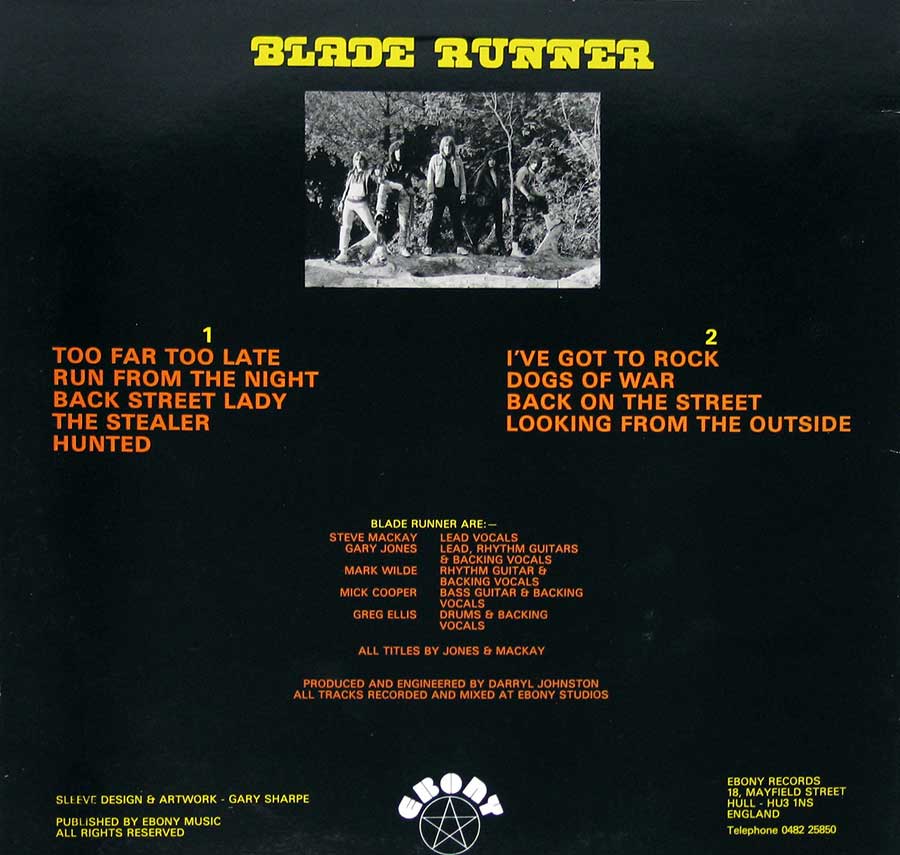
Album Back Cover Photo
Back cover of BLADE RUNNER – Hunted showing black sleeve with yellow band logo, orange track listings for both sides, central black-and-white band photo, full musician credits, production details, Ebony Records logo, and label address printed at the bottom

This is the original back cover of BLADE RUNNER – “Hunted”, and it is laid out with a very functional, no-nonsense NWOBHM design approach. The entire background is deep black, which immediately pushes all text and images forward. At the very top, the band name BLADE RUNNER appears again in bold yellow block lettering, consistent with the front cover typography and clearly intended for instant recognition when the sleeve is flipped in a rack.

Centered below the logo is a small rectangular black-and-white band photograph. The image shows the band members standing outdoors, dressed casually, and presented without dramatic staging. This kind of photo was common for early-80s metal releases and gives the sleeve a grounded, almost documentary feel rather than a fantasy-driven one. The photo is framed cleanly and sits above the text-heavy lower section.

The track listings are split cleanly into two columns, clearly labeled with the numbers 1 and 2 for Side One and Side Two. All song titles are printed in strong orange capital letters, highly legible against the black background. Side One lists “Too Far Too Late,” “Run From The Night,” “Back Street Lady,” “The Stealer,” and “Hunted.” Side Two lists “I’ve Got To Rock,” “Dogs Of War,” “Back On The Street,” and “Looking From The Outside.” There is no timing information, keeping the layout uncluttered and direct.

Below the track listing, the full band line-up is printed in compact orange text, pairing each name with their exact role. Credits include lead vocals, guitars, bass, drums, and backing vocals, all clearly defined. Beneath that, songwriting credits state that all titles are by Jones and MacKay. Production details follow, noting that the album was produced and engineered by Darryl Johnston, with all tracks recorded and mixed at Ebony Studios.

Along the bottom edge, additional credits and label information are printed. Sleeve design and artwork are credited to Gary Sharpe. The Ebony Records logo is placed centrally near the bottom, with the label’s Hull address and telephone number printed to the right. From a collector’s standpoint, this back cover is valuable because it is complete, clearly printed, and rich in original credits, exactly the kind of detail that confirms an authentic early-80s Ebony Records pressing.

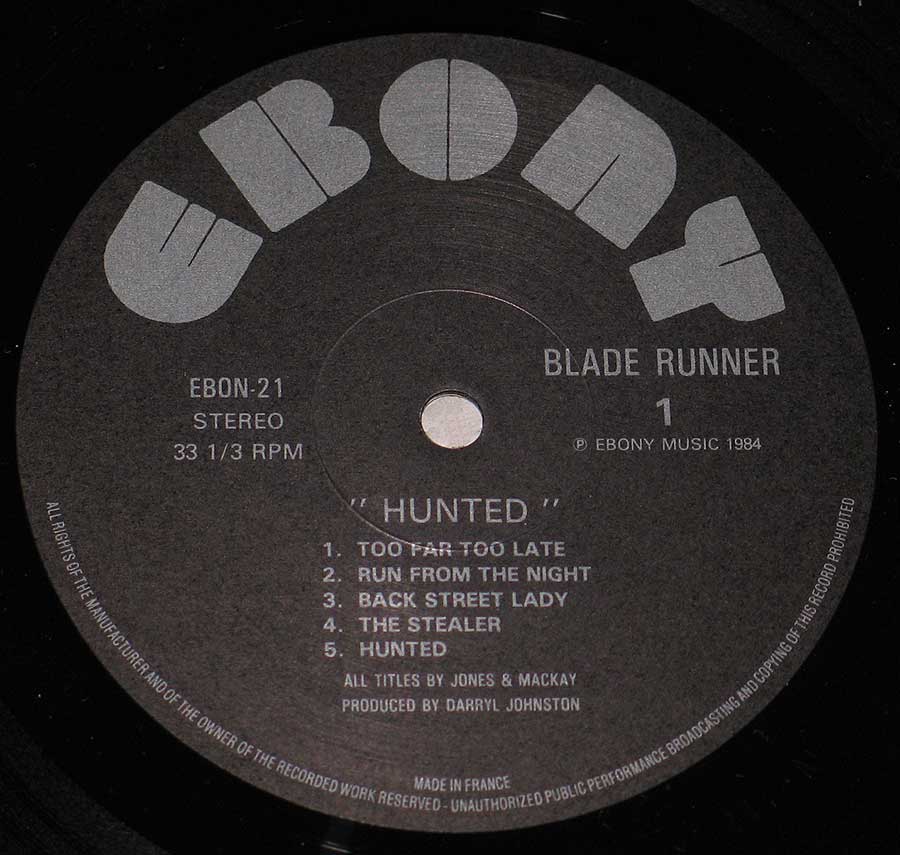
Close up of Side One record’s label
Close-up of Side One vinyl label for BLADE RUNNER – Hunted on Ebony Records, showing EBON-21 catalog number, stereo 33 1/3 RPM format, Side One track list, production credit, and Made in France manufacturing text on a dark grey label

This image shows a tight close-up of the Side One center label from the original vinyl pressing of BLADE RUNNER – “Hunted”. The label uses a dark grey background with subtle paper texture, typical of early-80s Ebony Records pressings, and contrasts it with light grey and white text that remains clean and readable even under low light. Dominating the upper arc is the stylized EBONY logo, stretched wide and split by vertical breaks in each letter, a distinctive design element that immediately identifies the label.

On the left side of the label, the catalog number EBON-21 is printed above the format information, clearly stating Stereo and 33 1/3 RPM. On the right side, the band name BLADE RUNNER is printed in block capitals, with the numeral 1 beneath it to indicate Side One. Just below, the copyright line reads © Ebony Music 1984, confirming the original release year.

Centered beneath the spindle hole, the album title “Hunted” is printed in quotation marks, followed by the full Side One track listing numbered one through five. The songs listed are “Too Far Too Late,” “Run From The Night,” “Back Street Lady,” “The Stealer,” and “Hunted.” Below the track list, songwriting credits state that all titles are by Jones and MacKay, followed by the production credit naming Darryl Johnston.

Running around the bottom edge of the label is the legal rim text, including the standard rights reservation warning and the manufacturing credit Made in France. From a collector’s perspective, this label is important because it confirms the French pressing, the correct catalog number, and the original Ebony layout, all key identifiers when verifying authenticity and distinguishing it from later reissues or unofficial copies.

All images on this site are photographed directly from the original vinyl LP covers and record labels in my collection. Earlier blank sleeves were not archived due to past storage limits, and Side Two labels are often omitted when they contain no collector-relevant details. Photo quality varies because the images were taken over several decades with different cameras. You may use these images for personal or non-commercial purposes if you include a link to this site; commercial use requires my permission. Text on covers and labels has been transcribed using a free online OCR service.