Street Fever - Album Description:
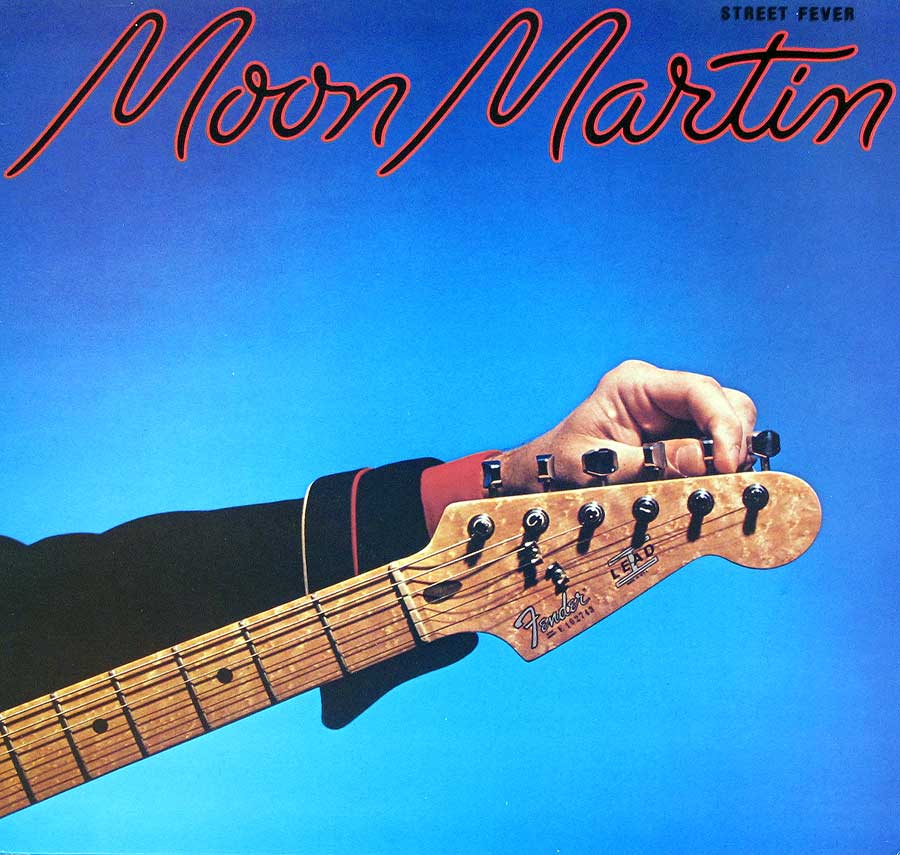
"Street Fever" (1980) is Moon Martin’s third studio album, and it doesn’t stroll in politely.
It kicks the door, checks the room, and starts throwing hooks like they’re cheap — which, of course, is exactly why they work.
This is the record I grab when I’m bored of “tasteful” rock production and want something leaner, sharper, a little more impatient.
The credits tell the story if you actually read them like a human.
Moon co-produced it with Warren Dewey, and you can hear that push-pull: tight control, but the songs keep trying to wriggle loose.
Tracked at Studio 55 in Los Angeles, then cleaned up and shaped at Sunset Sound — the kind of places where a chorus either survives, or gets politely murdered.
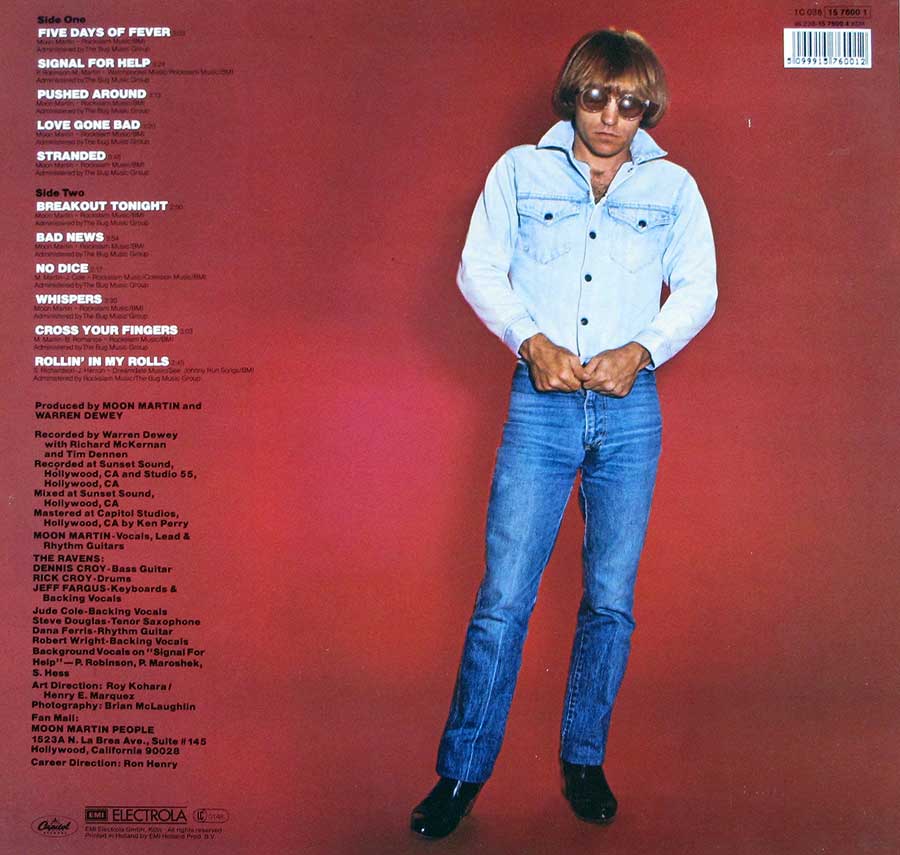
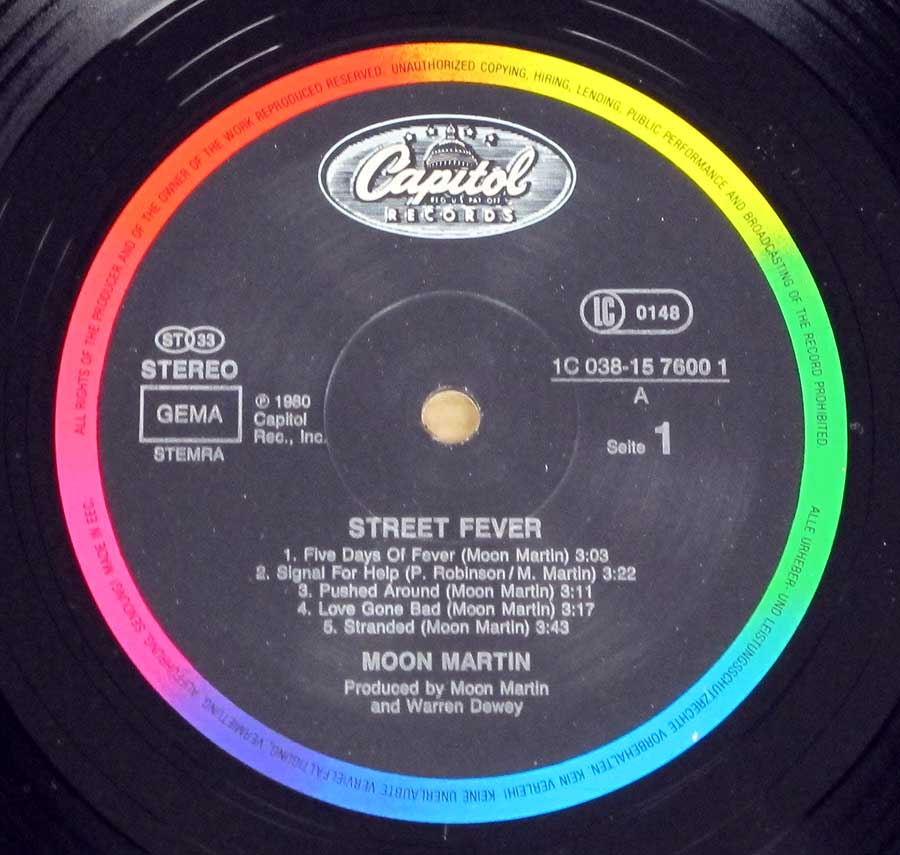
Side A runs like a streetlight chain at midnight: "Five Days Of Fever", "Signal For Help", "Pushed Around", "Love Gone Bad", "Stranded".
No long speeches. No dramatic introductions.
Just song after song choosing momentum over manners.
Flip it over and it gets scrappier.
"Breakout Tonight" is all elbows, "Bad News" moves like a warning you ignore anyway, and "No Dice" hits fast and vanishes.
"Whispers" slows the pulse without turning soft, and "Cross Your Fingers" does that Moon thing where pop instincts and a rough-edged voice argue in the same sentence.
The sleeve photo is by Brian McLaughlin, and it fits: not glamorous, not desperate, just that slightly wired look that says the music inside won’t behave.
"Rollin' In My Rolls" shuts the lights off with a grin — and the album doesn’t beg you to call it a classic.
It just sits there, daring you not to play it again.
References
Moon Martin Biography:
Moon Martin was really John David Martin — born 31 October 1945 in Altus, Oklahoma — and he always sounded like a guy who’d slept in his boots and still showed up with a melody.
Not polished. Not polite. Useful.
He didn’t “arrive” in Los Angeles in some tidy career chapter either. He was already out there by the late ’60s, rolling in with his band, shedding skins, chasing the next usable sound.
Rockabilly first, then the band becomes Southwind and leans into country-rock. That’s the kind of origin story that doesn’t come with fireworks.
It comes with van mileage.
I first noticed him the same way a lot of people did: backwards.
Not from his name on the sleeve — from somebody else making his song famous.
“Bad Case of Loving You (Doctor, Doctor)” is his, recorded in 1978, then Robert Palmer turns it into a 1979 single and suddenly everyone thinks it fell out of the sky fully formed.
That’s show business: the spotlight has terrible aim.
The thing is, Moon’s own records are where the personality lives.
His real debut is "Shots from a Cold Nightmare" (1978) — and it plays like a stack of late-night radio hooks with a cigarette burn in the corner.
He follows it with "Escape from Domination" (1979) and "Street Fever" (1980), and the titles alone tell you he wasn’t aiming for soft-focus adult comfort.
I’ve always liked that about him: the songs grin, but they don’t relax.
If you want the other side of his brain, listen to where his writing ended up.
“Cadillac Walk” shows up with Mink DeVille in 1977 — streetwise, strutting, built to move.
That’s Moon in a nutshell: he could write something that walks into a room before you do.
He had his flashes of visibility — “Rolene” being the obvious one — and later he even pops up on MTV with “X-Ray Vision,” which is funny in its own way because he never felt like an “MTV guy.”
He felt like the guy MTV found while looking for someone else.
Moon Martin died on 11 May 2020 in Encino, California, aged 74.
I still don’t think he ever got “his proper due,” but that phrase is too clean for him anyway.
Better to say it like this: he wrote the kind of songs that keep turning up in other people’s lives, like a familiar face you can’t quite place — and that’s almost more annoying, and more flattering, than fame.
References